Skip to Content Facebook Feature Image

EU ministers meet to align climate goals ahead of UN climate talks

News

EU ministers meet to align climate goals ahead of UN climate talks
News

News

EU ministers meet to align climate goals ahead of UN climate talks

2025-11-04 23:11 Last Updated At:11-09 16:49

BRUSSELS (AP) — The European Union is attempting to forge new climate goals on Tuesday before the U.N. climate talks in Brazil.

Ministers from across the 27-nation bloc met in Brussels to try to get at least 15 to align their nationally determined emissions targets to have a stronger negotiating position during the Conference of Parties — known less formally as COP30 in Belem.

“We need to show to the world that we are leaders in climate change. We need to deliver adequate signals for investors. Today’s the day," Spanish climate minister Sara Aagesen said before the meeting.

A draft proposal for an agreement on climate commitments seen by The Associated Press calls for loosening core climate regulations by giving priority to economic and energy security.

Climate ministers will discuss the proposal, which would allow nations to swap emissions between domestic economic sectors like manufacturing and agriculture. It also calls for larger allowances for EU nations to buy carbon credits outside the bloc.

The EU's long-held leadership of action on climate is under threat by domestic and international pressure.

Wildfires, heat waves and floods have disrupted life across Europe, spurring calls for more climate action. But crises like Russia's war in Ukraine, and a newly volatile relationship with the United States, have increased political and economic pressure to curtail flagship environmental policies.

A recent weakening of a deforestation law by the European Commission, the EU's executive arm, upset environmentalists. They worried that it signaled a deeper disenchantment with green priorities by European Commission President Ursula von der Leyen. In February, she had announced an economic policy that some said eroded her Green Deal, a plan aimed at making Europe the world’s first carbon-neutral continent.

But von der Leyen said in September that “the world can count on Europe’s climate leadership” and pledged that the EU is “on our way to climate neutrality” and would slash carbon emissions by 90% by 2040.

She has linked climate investment to sovereignty and defense, arguing that a self-reliant Europe can better face threats like disruptive tariffs or export controls, armed conflict and environmental disasters.

Many EU governments have shifted to the right since the Paris Agreement in 2015. Some see climate regulations as shackling the economy, while others say Europe will either make and sell renewables or be forced to buy energy or green products from countries like China.

Wopke Hoekstra, the EU's climate commissioner, said that the bloc needed to “bridge climate action with competitiveness and industrial savviness, if you will, and independence that is going to be the name of the game in the years that we have ahead of us.”

“We’ll do our utmost to be successful, but it takes 27 to tango,” he said of the negotiations on Tuesday.

The U.S. decision to withdraw from the Paris Agreement and set back its climate goals has rattled Europe, whose climate vision was in part forged in partnership with the Democratic administrations of former U.S. Presidents Barack Obama and Joe Biden.

The Paris Agreement aims to keep average global temperature from rising beyond 2 degrees Celsius (3.6 degrees Fahrenheit), and ideally limit it to 1.5 degrees Celsius (2.7 degrees Fahrenheit), compared to the 1850s. To do that, the agreement says nations must slash planet-warming pollution that results when coal, oil and gas are burned.

The EU's commitments in Paris have driven investment in renewable energies and electric vehicles, often in cooperation and at odds with Chinese companies.

Heat-trapping carbon dioxide levels in the atmosphere jumped by the highest amount on record last year, soaring to a height not seen in human civilization and “turbocharging” the Earth’s climate and causing more extreme weather, according to the U.N. weather agency.

Europe is the world’s fastest-warming continent and has been heating up twice as fast as other regions since the 1980s. The heat has been linked to more intense rains and floods, and the report predicts rainfall decline and more severe droughts in southern Europe.

“Today is about the level of ambition, and it’s about standing ground and not only sticking to talking the talk when it is easy, but also walking the walk when it becomes difficult,” Swedish climate minister Romina Pourmokhtari said in Brussels.
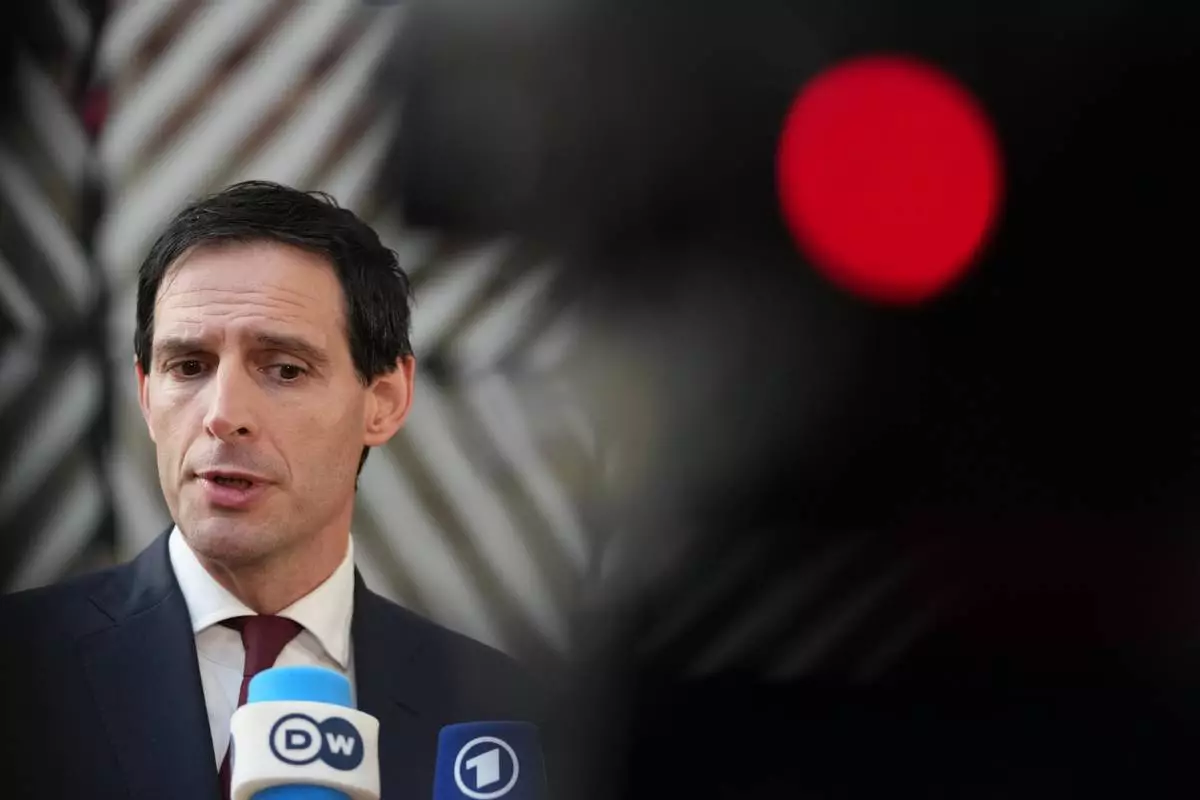
European Commissioner for Climate, Net-Zero and Clean Growth Wopke Hoekstra speaks with the media as he arrives for a meeting of EU Environment ministers at the European Council building in Brussels, Belgium, Tuesday, Nov. 4, 2025. (AP Photo/Virginia Mayo)
European Commissioner for Climate, Net-Zero and Clean Growth Wopke Hoekstra speaks with the media as he arrives for a meeting of EU Environment ministers at the European Council building in Brussels, Belgium, Tuesday, Nov. 4, 2025. (AP Photo/Virginia Mayo)
CARACAS, Venezuela (AP) — President Donald Trump is set to meet Thursday at the White House with Venezuelan opposition leader María Corina Machado, whose political party is widely considered to have won 2024 elections rejected by then-President Nicolás Maduro before the United States captured him in an audacious military raid this month.

Less than two weeks after U.S. forces seized Maduro and his wife at a heavily guarded compound in Caracas and brought them to New York to stand trial on drug trafficking charges, Trump will host the Nobel Peace Prize laureate Machado, having already dismissed her credibility to run Venezuela and raised doubts about his stated commitment to backing democratic rule in the country.

“She’s a very nice woman,” Trump told Reuters in an interview about Machado. “I’ve seen her on television. I think we’re just going to talk basics.”

The meeting comes as Trump and his top advisers have signaled their willingness to work with acting President Delcy Rodríguez, who was Maduro’s vice president and along with others in the deposed leader's inner circle remain in charge of day-to-day governmental operations.

Rodríguez herself has adopted a less strident position toward Trump and his “America First” policies toward the Western Hemisphere, saying she plans to continue releasing prisoners detained under Maduro — a move reportedly made at the behest of the Trump administration. Venezuela released several Americans this week.

Trump, a Republican, said Wednesday that he had a “great conversation” with Rodríguez, their first since Maduro was ousted.

“We had a call, a long call. We discussed a lot of things,” Trump told reporters. “And I think we’re getting along very well with Venezuela.”

In endorsing Rodríguez, Trump has sidelined Machado, who has long been a face of resistance in Venezuela. She had sought to cultivate relationships with Trump and key advisers like Secretary of State Marco Rubio among the American right wing in a political gamble to ally herself with the U.S. government. She also intends to have a meeting in the Senate on Thursday afternoon.

Despite her alliance with Republicans, Trump was quick to snub her following Maduro’s capture. Just hours afterward, Trump said of Machado that “it would be very tough for her to be the leader. She doesn’t have the support within or the respect within the country. She’s a very nice woman, but she doesn’t have the respect.”

Machado has steered a careful course to avoid offending Trump, notably after winning last year’s Nobel Peace Prize, which Trump coveted. She has since thanked Trump and offered to share the prize with him, a move that has been rejected by the Nobel Institute.

Machado’s whereabouts have been largely unknown since she went into hiding early last year after being briefly detained in Caracas. She briefly reappeared in Oslo, Norway, in December after her daughter received the Nobel Peace Prize on her behalf.

The industrial engineer and daughter of a steel magnate began challenging the ruling party in 2004, when the nongovernmental organization she co-founded, Súmate, promoted a referendum to recall then-President Hugo Chávez. The initiative failed, and Machado and other Súmate executives were charged with conspiracy.

A year later, she drew the anger of Chávez and his allies again for traveling to Washington to meet President George W. Bush. A photo showing her shaking hands with Bush in the Oval Office lives in the collective memory. Chávez considered Bush an adversary.

Almost two decades later, she marshaled millions of Venezuelans to reject Chávez’s successor, Maduro, for another term in the 2024 election. But ruling party-loyal electoral authorities declared him the winner despite ample credible evidence to the contrary. Ensuing anti-government protests ended in a brutal crackdown by state security forces.

Janetsky reported from Mexico City. AP Diplomatic Writer Matthew Lee in Washington contributed to this report.

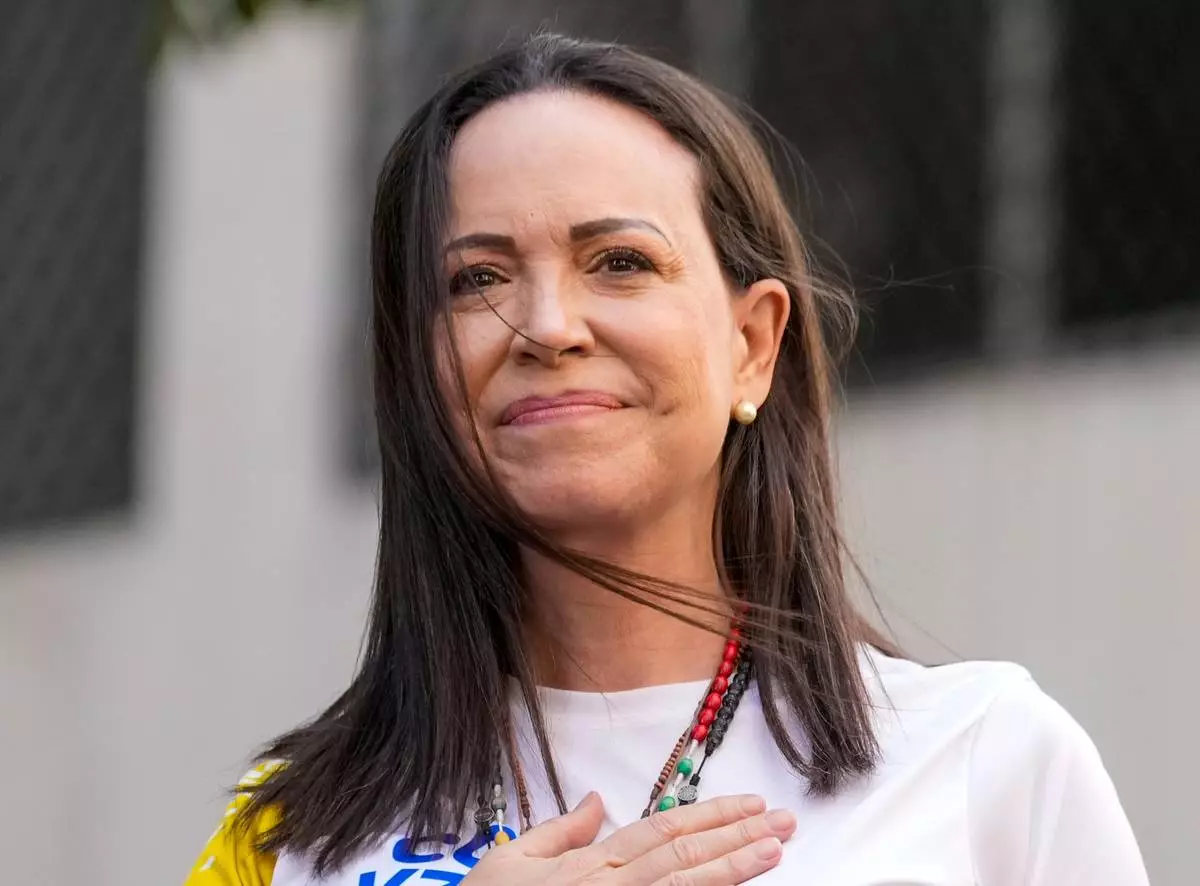
FILE - Opposition leader Maria Corina Machado gestures to supporters during a protest against President Nicolas Maduro the day before his inauguration for a third term, in Caracas, Venezuela, Thursday, Jan. 9, 2025. (AP Photo/Ariana Cubillos, file)

FILE - Opposition leader Maria Corina Machado gestures to supporters during a protest against President Nicolas Maduro the day before his inauguration for a third term, in Caracas, Venezuela, Thursday, Jan. 9, 2025. (AP Photo/Ariana Cubillos, file)

Recommended Articles