WASHINGTON (AP) — The Federal Aviation Administration said Wednesday that it was taking the extraordinary step of reducing air traffic by 10% across 40 “high-volume” markets beginning Friday morning to maintain travel safety as air traffic controllers exhibit signs of strain during the ongoing government shutdown.
The cutback stands to impact thousands of flights nationwide because the FAA directs more than 44,000 flights daily, including commercial passenger flights, cargo planes and private aircraft. The agency didn't immediately identify which airports or cities will be affected but said the restrictions would remain in place as long as necessary.
“I’m not aware in my 35-year history in the aviation market where we’ve had a situation where we’re taking these kinds of measures,” FAA Administrator Bryan Bedford said at a news conference.
Air traffic controllers have been working unpaid since the shutdown began Oct. 1, and most have been on duty six days a week while putting in mandatory overtime. With some calling out of work due to frustration, taking second jobs or not having money for child care or gas, staffing shortages during some shifts have led to flight delays at a number of U.S. airports.
Bedford, citing increased staffing pressures and voluntary safety reports from pilots indicating growing fatigue among air traffic controllers, said he and U.S. Transportation Secretary Sean Duffy did not want to wait until the situation reached a crisis point.
“We’re not going to wait for a safety problem to truly manifest itself when the early indicators are telling us we can take action today to prevent things from deteriorating,” Bedford said. “The system is extremely safe today and will be extremely safe tomorrow. If the pressures continue to build even after we take these measures, we’ll come back and take additional measures.”
He and Duffy said they would meet with airline executives later Wednesday to determine how to implement the reduction in flights before a list of the affected airports would be released sometime Thursday.
United, Southwest and American all said they will try to minimize the impact on consumers as they cut their schedules to comply with the order.
Calls to the customer service hotlines at United and American were answered within a few minutes Wednesday afternoon, suggesting anxious passengers were not swamping the airlines with questions about the status of their upcoming flights.
In a letter to employees, United CEO Scott Kirby promised to focus the cuts on regional routes and flights that don't travel between hubs. He said the airline will try to reschedule customers when possible and will also offer refunds to anyone who doesn't want to fly during this time, even if their flight isn't canceled.
“United’s long-haul international flying and our hub-to-hub flying will not be impacted by this schedule reduction direction from the FAA,” Kirby said. “That’s important to maintain the integrity of our network, give impacted customers as many options as possible to resume their trip, and sustain our crew pairing systems.”
Airline industry analyst Henry Harteveldt, who is president of Atmosphere Research Group, said he thinks the government may have bungled this announcement by not meeting with airlines first and giving them more time to adjust schedules made months in advance.
“To tell airlines you’ve got 48 hours to rebuild your schedules at 90% of what you’ve got isn’t much time, and it’s going to result in a lot of chaos,” said Harteveldt, who was waiting to hear if his own flight from San Francisco to Dallas on Saturday would be canceled. He added that the Trump administration may be using aviation safety “to force the two sides in Washington back to the negotiating table to resolve the shutdown.”
AAA spokesperson Aixa Diaz advised travelers to watch for flight updates on the airline's app and airport social media accounts. She also recommended allowing plenty of time at the airport before a scheduled flight.
“It’s frustrating for travelers, because there’s not much you can do. At the end of the day, you either fly or you don’t,” she said.
The cuts could represent as many as 1,800 flights and upward of 268,000 seats combined, according to an estimate by aviation analytics firm Cirium. For example, O’Hare International Airport in Chicago could see 121 of its 1,212 flights currently scheduled for Friday cut if the FAA distributes the reductions equally among impacted airports, Cirium said.
The FAA regularly slows down or stops flights from taking off toward an airport for a number of reasons, including weather conditions, equipment failures and technical problems. Staffing shortages also may lead to slowed or halted departures if there aren't enough controllers and another facility can't absorb some of the work load.
Last weekend saw some of the worst staffing shortages of the shutdown, which became the longest on record early Wednesday.
From Friday to Sunday evening, at least 39 different air traffic control facilities announced there was some potential for limited staffing, according to an Associated Press analysis of operations plans sent through the Air Traffic Control System Command Center system. The figure, which is likely an undercount, is well above the average for weekends before the shutdown
During weekend periods from Jan. 1 to Sept. 30, the average number of airport towers, regional centers overseeing multiple airports and facilities monitoring traffic at higher altitudes that announced the potential for staffing issues was 8.3, according to the AP analysis. But during the five weekend periods since the shutdown began on Oct. 1, the average more than tripled to 26.2 facilities.
Major airlines, aviation unions and the wider travel industry have urged Congress to end the shutdown.
Wednesday's announcement came on the heels of Duffy warning a day earlier that there could be chaos in the skies next week if the shutdown drags on long enough for air traffic controllers to miss their second full paychecks next Tuesday.
Duffy said the FAA wanted to take a proactive approach instead of reacting after a disaster. He pointed to all the questions that arose after the deadly midair collision in January between a commercial jet and a military helicopter near Ronald Reagan Washington National Airport about why FAA didn't recognize the risks and act sooner.
“We learned from that. And so now we look at data, and before it would become an issue, we try to assess the pressure and try to make moves before there could be adverse consequences,” Duffy said. “And that’s what’s happening here today.”
Yamat reported from Las Vegas, and Funk from Omaha, Nebraska. Associated Press journalist Christopher L. Keller in Albuquerque, New Mexico, contributed.
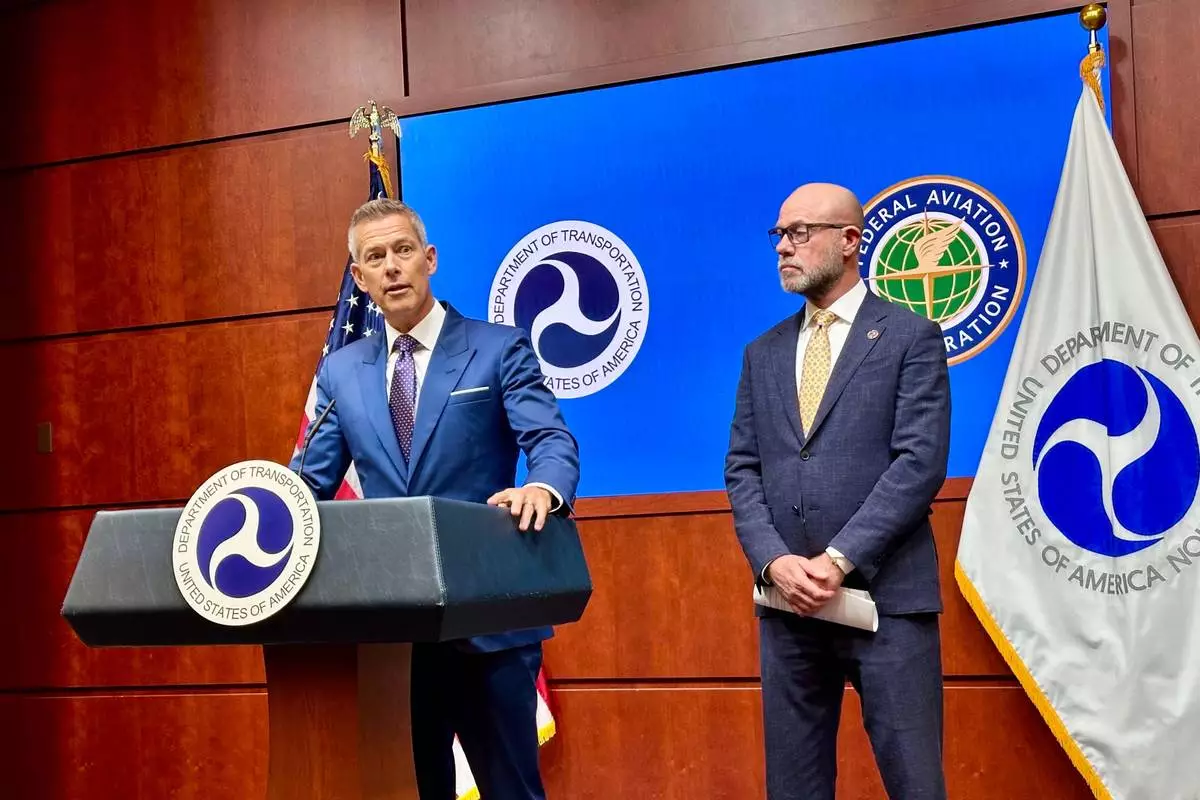
Transportation Secretary Sean Duffy, left, speaks at a news conference with FAA administrator Bryan Bedford to announce flight cancellations across the country because of the government shutdown Wednesday, Nov. 5, 2025 at the U.S. Department of Transportation headquarters in Washington. (AP Photo/Matthew Daly)

Transportation Secretary Sean Duffy speaks alongside Vice President JD Vance about the impact of the government shutdown on the aviation industry, outside of the West Wing of the White House, Thursday, Oct. 30, 2025, in Washington. (AP Photo/Jacquelyn Martin)

An United Airlines flight arrives at O'Hare International Airport in Chicago, Monday, Nov. 3, 2025. (AP Photo/Nam Y. Huh)
LONDON--(BUSINESS WIRE)--Jan 6, 2026--
Accenture (NYSE: ACN) has agreed to acquire Faculty, a leading UK-based AI native services and products business built on highly technical applied AI skills and a unique decision intelligence product that features advanced simulation and optimization capabilities. The acquisition will expand Accenture’s capabilities to help its clients reinvent core and critical business processes with safe and secure AI solutions that result in tangible outcomes.
This press release features multimedia. View the full release here: https://www.businesswire.com/news/home/20260105193357/en/
Founded in 2014, Faculty has a strong track record working with public and private sector clients to deploy AI solutions in the U.K. and other key markets. Its services—which include AI strategy, AI safety and the design, build and implementation of high performance AI systems—support the scaled and safe adoption of AI by client organizations.
With a longstanding commitment to AI safety, Faculty works with clients to build AI systems that are safe and ethical by design—addressing risks such as bias, privacy and unexplainable outcomes by ensuring that AI safety is embedded within every stage of the development lifecycle from development, validation and predictions to monitoring. Faculty works with some of the world’s leading AI labs, including OpenAI and Anthropic, to ensure that AI models are safe, as well as with the UK AI Security Institute and other organizations to make baseline safety assessments of general-purpose models.
Upon closing of the transaction, Faculty’s team of more than 400 AI native professionals, including highly qualified data scientists and AI engineers, will integrate with Accenture’s teams to scale world‑class AI capabilities for clients. And, in addition to his role as CEO of Faculty, Marc Warner will become chief technology officer of Accenture and join the company’s Global Management Committee. Before founding Faculty, Warner was a Research Fellow in Quantum Physics at Harvard and served on the court of Imperial College London and as a member of the U.K.’s AI Council, an independent expert committee that provides advice to government and high-level leadership of the Artificial Intelligence (AI) ecosystem.
“With Faculty, we will further accelerate our strategy to bring trusted, advanced AI to the heart of our clients’ businesses,” said Julie Sweet, chair and CEO, Accenture. “I’m pleased to welcome the Faculty team to Accenture and look forward to Marc's contribution shaping our technology vision and strategy as Chief Technology Officer."
As part of the acquisition integration, Faculty Frontier TM, Faculty’s enterprise decision intelligence product, will join Accenture’s suite of products that help organizations make better, faster decisions by connecting data, AI models and business processes into a unified decision system. For example, Accenture and Faculty are already working together to support leading life sciences companies, such as Novartis, to use Frontier TM to transform the economics of clinical trial planning and execution.
Marc Warner, CEO of Faculty, said, “Our vision has always been a world in which safe AI delivers widespread benefits to humanity. We have spent the last ten years supporting our clients to bring this world about, step by step. As AI advances rapidly, the ambition of our clients is now, rightly, no less than the reinvention of their business. I am delighted that by teaming up with Accenture, we have everything in place to support AI transformation from start to finish.”
Faculty is known for its ability to apply AI in mission-critical settings. For example, during the COVID-19 pandemic, Faculty built the UK National Health Service’s (NHS) Early Warning System. This was used daily by NHS Gold Command to accurately predict patient demand across the country, and to optimally allocate critical care resources to where they were needed most.
Manish Sharma, chief strategy and services officer at Accenture, added, “Accenture bridges the best of technology and human ingenuity to maximize returns on AI investments. Together with Faculty we will assemble a powerhouse of talent helping clients make AI work in the real world—linking data, processes, and people so value shows up faster, orchestrated through multiple combinations of bespoke client specific solutions, partner solutions and Faculty Frontier TM. This will help our clients stay competitive, pursue sovereign solutions, and reinvent their operations with transparency and resilience at a critical time.”
Accenture will leverage Faculty’s Fellowship Program, a highly structured early career training and placement program that helps promising STEM PhD and master’s graduates as well as post-doctoral researchers transition from academia to industry. Building on the success of this program in the U.K., Accenture plans to extend the program globally to its people as well as to clients.
Accenture and Faculty have collaborated since December 2023 when Accenture was confirmed as a preferred implementation partner for Faculty Frontier TM.
Completion of the acquisition is subject to customary closing conditions, including required regulatory approval. Terms of the transaction were not disclosed.
Forward-Looking Statements
Except for the historical information and discussions contained herein, statements in this news release may constitute forward-looking statements within the meaning of the Private Securities Litigation Reform Act of 1995. Words such as “may,” “will,” “should,” “likely,” “anticipates,” “aspires,” “expects,” “intends,” “plans,” “projects,” “believes,” “estimates,” “positioned,” “outlook,” “goal,” “target” and similar expressions are used to identify these forward-looking statements. These statements are not guarantees of future performance nor promises that goals or targets will be met, and involve a number of risks, uncertainties and other factors that are difficult to predict and could cause actual results to differ materially from those expressed or implied. These risks include, without limitation, risks that: Accenture and Faculty will not be able to close the transaction in the time period anticipated, or at all, which is dependent on the parties’ ability to satisfy certain closing conditions; the transaction might not achieve the anticipated benefits for Accenture; Accenture’s results of operations have been, and may in the future be, adversely affected by volatile, negative or uncertain economic and geopolitical conditions and the effects of these conditions on the company’s clients’ businesses and levels of business activity; Accenture’s business depends on generating and maintaining client demand for the company’s services and solutions including through the adaptation and expansion of its services and solutions in response to ongoing changes in technology and offerings, and a significant reduction in such demand or an inability to respond to the evolving technological environment could materially affect the company’s results of operations; risks and uncertainties related to the development and use of AI could harm the company’s business, damage its reputation or give rise to legal or regulatory action; if Accenture is unable to match people and their skills with client demand around the world and attract and retain professionals with strong leadership skills, the company’s business, the utilization rate of the company’s professionals and the company’s results of operations may be materially adversely affected; Accenture faces legal, reputational and financial risks from any failure to protect client and/or company data from security incidents or cyberattacks; the markets in which Accenture operates are highly competitive, and Accenture might not be able to compete effectively; Accenture’s ability to attract and retain business and employees may depend on its reputation in the marketplace; if Accenture does not successfully manage and develop its relationships with key ecosystem partners or fails to anticipate and establish new alliances in new technologies, the company’s results of operations could be adversely affected; Accenture’s profitability could materially suffer due to pricing pressure, if the company is unable to remain competitive, if its cost-management strategies are unsuccessful or if it experiences delivery inefficiencies or fail to satisfy certain agreed-upon targets or specific service levels; changes in Accenture’s level of taxes, as well as audits, investigations and tax proceedings, or changes in tax laws or in their interpretation or enforcement, could have a material adverse effect on the company’s effective tax rate, results of operations, cash flows and financial condition; Accenture’s results of operations could be materially adversely affected by fluctuations in foreign currency exchange rates; Accenture’s debt obligations could adversely affect its business and financial condition; changes to accounting standards or in the estimates and assumptions Accenture makes in connection with the preparation of its consolidated financial statements could adversely affect its financial results; as a result of Accenture’s geographically diverse operations and strategy to continue to grow in key markets around the world, the company is more susceptible to certain risks; if Accenture is unable to manage the organizational challenges associated with its size, the company might be unable to achieve its business objectives; Accenture might not be successful at acquiring, investing in or integrating businesses, entering into joint ventures or divesting businesses; Accenture’s business could be materially adversely affected if the company incurs legal liability; Accenture’s work with government clients exposes the company to additional risks inherent in the government contracting environment; Accenture’s global operations expose the company to numerous and sometimes conflicting legal and regulatory requirements; if Accenture is unable to protect or enforce its intellectual property rights or if Accenture’s services or solutions infringe upon the intellectual property rights of others or the company loses its ability to utilize the intellectual property of others, its business could be adversely affected; Accenture may be subject to criticism and negative publicity related to its incorporation in Ireland; as well as the risks, uncertainties and other factors discussed under the “Risk Factors” heading in Accenture plc’s most recent Annual Report on Form 10-K, as updated in Item 1A, “Risk Factors” in its Quarterly Report on Form 10-Q for the second quarter of fiscal 2025, and other documents filed with or furnished to the Securities and Exchange Commission. Statements in this news release speak only as of the date they were made, and Accenture undertakes no duty to update any forward-looking statements made in this news release or to conform such statements to actual results or changes in Accenture’s expectations.
About Accenture
Accenture is a leading solutions and services company that helps the world’s leading enterprises reinvent by building their digital core and unleashing the power of AI to create value at speed across the enterprise, bringing together the talent of our approximately 784,000 people, our proprietary assets and platforms, and deep ecosystem relationships. Our strategy is to be the reinvention partner of choice for our clients and to be the most client-focused, AI-enabled, great place to work in the world. Through our Reinvention Services we bring together our capabilities across strategy, consulting, technology, operations, Song and Industry X with our deep industry expertise to create and deliver solutions and services for our clients. Our purpose is to deliver on the promise of technology and human ingenuity, and we measure our success by the 360° value we create for all our stakeholders. Visit us at accenture.com.

Accenture has agreed to acquire Faculty, a leading UK-based AI native services and products business built on highly technical applied AI skills and a unique decision intelligence product that features advanced simulation and optimization capabilities.