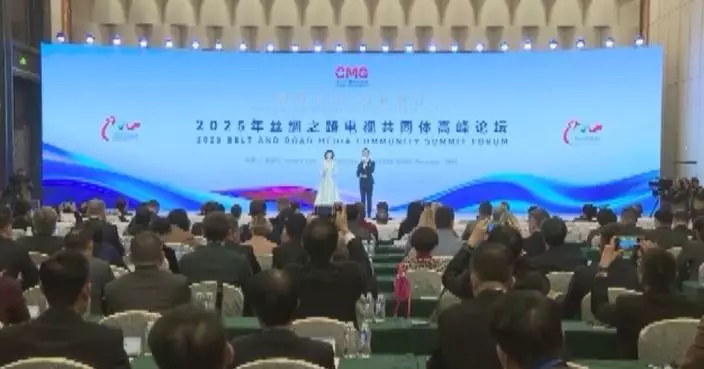
Several media leaders from around the world have highlighted the role China's Global Governance Initiative can play in narrowing the North-South gap and creating a more balanced international information order during a panel discussion at a media forum in Xi'an of northwest China's Shaanxi Province on Thursday.
The panel discussion took place on the sidelines of the Global South Media Partners Mechanism Inauguration Meeting and the 13th Global Video Media Forum (VMF), which opened in Xi'an on the same day.
Themed "Building Consensus for Shared Benefits: Media's Role in Global Governance," the two-day event has gathered hundreds of government officials, leaders of international organizations, and representatives of major media outlets across the Global South to exchange views on enhancing the voice of developing countries, promoting fairness and equity in international communication, and sharing compelling stories of peace and development.
As guests discussed the key role and responsibility of the media in improving global governance, many pointed to the importance of China's Global Governance Initiative (GGI) in addressing present issues amid the current turbulent international landscape.
Proposed by Chinese President Xi Jinping, the GGI calls for upholding five principles -- sovereign equality, international rule of law, multilateralism, people-centered development and action orientation -- to promote the building of a more just and equitable global governance system.
Adrian Wells, managing director of the Luxembourg-based European News Exchange (ENEX), hailed the GGI's potential to deliver more concrete action to address global challenges.
"It's great that we have this new initiative, because things are not good. We have the institutions which were all built after World War II, the United Nations, various other treaties, which of course are meant to protect all of our freedoms and security and territorial integrity. And yet whilst we have those institutions, we don't really have a lot of fantastic performance from those institutions I think at the moment," he said.
Taking current global conflicts in the Gaza Strip, South Sudan, and Myanmar as an example, Wells added that although there have been strong press releases from existing international institutions, they have failed to spark much needed action to bring about peace.
Ahmed Al Alawi, editor-in-chief of the United Arab Emirates' Al-Ain News, said the GGI is crucial for reshaping the international system, calling it an initiative full of hope that will help connect people from different countries.
Meanwhile, Irfan Junaidi, editor-in-chief of the Indonesian news agency Antara, said the GGI can help media outlets across the Global South to contribute to a more equal and balanced form of global governance.
"Today, we can say there is imbalanced narrative information in the world. It really happens. So, I think this initiative is very important for us to make the stories and information in the world to become more balanced between the Global South and Global North," Junaidi said.
Leonardo Attuch, founder and CEO of Brasil 247, a Brazilian news and political analysis website, said the GGI is arriving in the right time as the old global order is collapsing.
Najib Gouiaa, CEO of MediaCity Mauritius, agreed that the world's information order has been imbalanced for decades, expressing hope that the GGI will help narrow the gap between the Global South and Global North and create a more balanced communications environment.
"Generally, in most cases, it's the North covering the South. So, our goal is to provide information in different ways and find a perspective from the South to report news in other places of the world," Gouiaa said.
The VMF is an annual professional journalism forum launched by the CCTV Video News Agency (CCTV+) of the China Media Group back in 2011, focusing on the latest video content communication and innovation trends, and providing a highly specialized and interactive platform for domestic and foreign media peers.
This year's gathering also saw the inauguration of the Global South Media Partners Mechanism, which aims to deepen collaboration among media outlets of the Global South, encourage practical cooperation, content sharing, professional training and joint productions, as well as foster dialogue and research among participating media partners.

Global media leaders hail China's Global Governance Initiative, call for more balanced narratives