PARIS (AP) — Damian Penaud overtook Serge Blanco as France's all-time leading try scorer in test rugby with his 39th try early into a 32-17 home defeat against world champion South Africa on Saturday.
Penaud latched onto a smart chip kick from fullback Thomas Ramos and ran over in the right corner untouched.
The 29-year-old Penaud took 57 tests to pass Blanco, who retired in 1991 as one of the greatest fullbacks of all time and had 38 tries in 93 tests.
Penaud added a second try in the first half to reach 40, with Ramos setting him up again following a quick line move which swept from left to right.
The sides met for the first time since 2023 when South Africa knocked out the World Cup host 29-28 in an epic quarterfinal. Eleven Springboks from that matchday 23 returned to the Stade de France.
South Africa trailed 14-13 and had a player less for the entire second half following Lood De Jager's red card but still rallied to win.
AP rugby: https://apnews.com/hub/rugby

South Africa's Sacha Feinberg-Mngomezulu, left, is tackled by France's Damian Penaud during the rugby union Nations Series match between France and South Africa in Saint-Denis, outside Paris, Saturday, Nov. 8, 2025 . (AP Photo/Michel Euler)

France's Damian Penaud is tackled during the rugby union Nations Series match between France and South Africa in Saint-Denis, outside Paris, Saturday, Nov. 8, 2025 . (AP Photo/Michel Euler)

France's Damian Penaud is tackled during the rugby union Nations Series match between France and South Africa in Saint-Denis, outside Paris, Saturday, Nov. 8, 2025 . (AP Photo/Michel Euler)
BRUSSELS (AP) — The stunning victory of the Alternative for Germany in a state election has renewed fears of an ascendant far right in Europe, as voters repeatedly vent discontent and mainstream leaders grapple with myriad crises, from affordability to Russian aggression and scraps with China and the United States over trade.
But while anti-immigrant, pro-Russian parties have made inroads across the continent in recent years, there have also been notable reversals, and some have softened their views to build coalitions with moderates.
The AfD fell short of an absolute majority in Sunday’s vote in Saxony-Anhalt that would have allowed it to form the first far-right state government since the Nazi era — though it may still manage to do so.
Far-right leaders from Portugal to Austria celebrated the win as they ready for elections across Europe in the coming months. These will show whether the vote was a watershed moment in the demise of an anti-fascist consensus dating back to World War II, or the latest in a series of elections worldwide in which frustrated voters simply cast out incumbents.
The far right's biggest success in recent years was the rise of Giorgia Meloni, who became prime minister of Italy, one of Europe's most influential countries, at the helm of a party with neo-fascist roots.
But Meloni, who campaigned as an EU-skeptic, took a moderate turn in office that has won praise from across the continent and led to her presiding over the most stable government in decades. She now faces a challenge from the right, in the form of an upstart party led by a retired general.
Far-right parties have meanwhile joined governments and gained key portfolios in Finland, Croatia and Slovakia.
Populist anti-immigrant parties also made major gains in the 2024 elections for the European Union parliament, reflecting their growing support across the 27-nation bloc.
Since then, the center-right European People's Party has increasingly coordinated with the far right, as it did earlier this year in embarking on a historic migration overhaul that incensed traditional allies on the center left and human rights groups.
“It’s a bit of a paradox: you partner up with them to prevent them from getting more powerful,” said Sophia Russack, a fellow at the Brussels-based Centre for European Policy Studies.
For 16 years, Hungary's Viktor Orbán was the standard-bearer of the far right in Europe and an inspiration for populists worldwide. But he lost in a landslide in April to a former ally who had campaigned against corruption.
In the Netherlands, Geert Wilders, another far-right celebrity, broke up a coalition he had helped form when his allies refused to go along with his far-reaching crackdown on immigration.
The far-right, anti-immigration Reform UK party has grown in influence in the United Kingdom in recent years and was the big winner in local elections in May, a result that helped spur a panicky Labour Party to replace then-leader Keir Starmer with new Prime Minister Andy Burnham.
Though it holds just eight of the 650 seats in the House of Commons, Reform has often led opinion polls and dominated political debates on immigration. Led by the veteran nationalist politician Nigel Farage, the party has been particularly successful in areas that supported Brexit in 2016.
But Reform has recently suffered reverses, losing several special elections and facing questions about funding.
Electoral setbacks, however, send “a double-edged message,” said Jeremy Cliffe, editorial director of the European Council on Foreign Relations.
“These parties are mortal, they can be defeated, but when they’re in power, they’re not all chaotic and hopeless.”
Next year's elections in France and Spain present major opportunities for the far right to resume its march across the continent — or stumble, said Lisa Musiol, head of EU Affairs for the International Crisis Group.
Spanish Prime Minister Pedro Sanchez, revered by the global left for his stance on migration and the wars in Gaza and Iran, has faced mass protests over the Ceuta border crisis.
The far-right, anti-immigrant Vox party, which holds just 32 seats in the country's 350-member parliament, is poised to gain. It has already entered into governing agreements with the center-right Popular Party, parliament's second biggest faction, in four regional elections.
Sánchez said Monday that the AfD win should be “a warning that the far-right threat is gaining ground in Europe and the world,” and that “a progressive coalition government is more necessary than ever.”
In France, the far-right leader Marine Le Pen is the front-runner to replace the increasingly unpopular President Emmanuel Macron, who is constitutionally barred from seeking a third term. She has long been hostile toward the EU and immigration.
French Foreign Minister Jean-Noël Barrot, whose center-right party is among a crowded field running against Le Pen's National Rally, decried the Germany vote as a victory for “the neo-Nazi, anti-European and pro-Putin far right.”
“We urgently need to open our eyes to the despair that is propelling such ideas and such parties to power,” he said in a post online. “It can be done, but this is our last chance.”
This version corrects that Saxony-Anhalt was not the first win for AfD, but its largest to date.
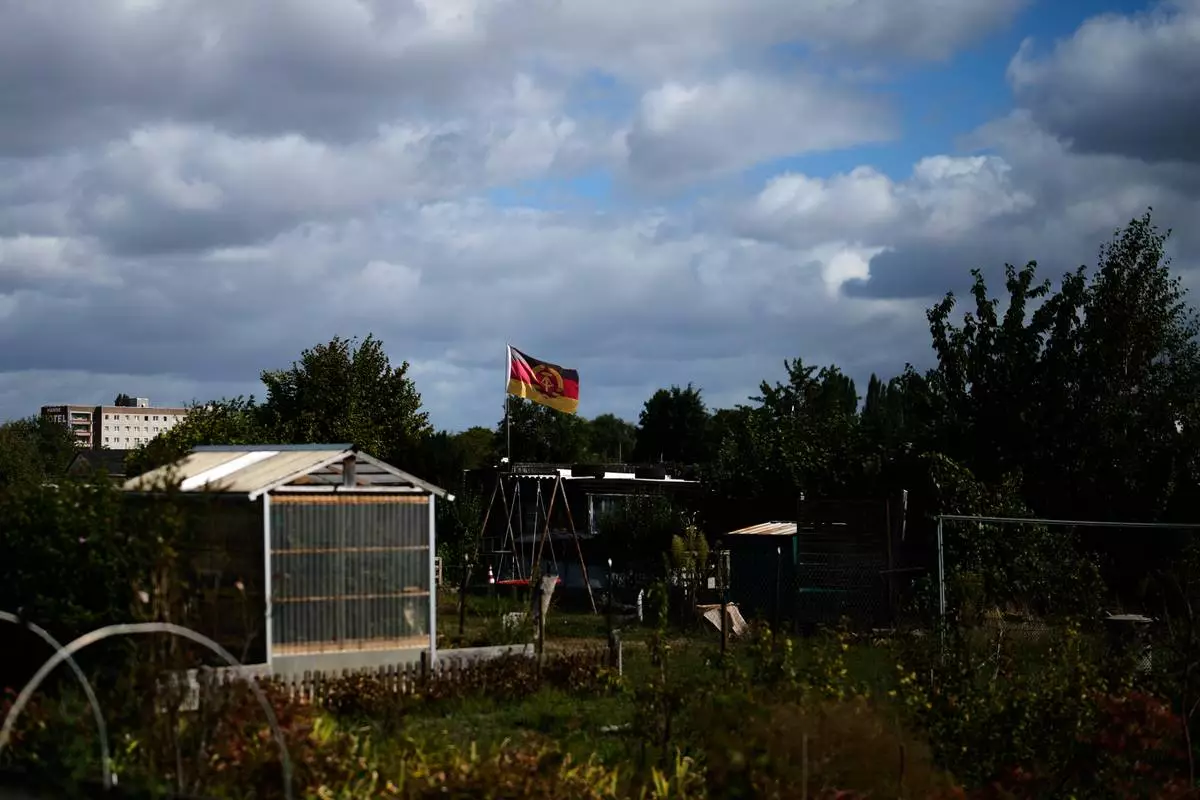
The flag of the former German Democratic Republic (GDR) waves on the weekend of the state elections in Saxony-Anhalt in an allotment garden in Stendal, Germany, Sunday, Sept. 6, 2026. (AP Photo/Matthias Schrader)
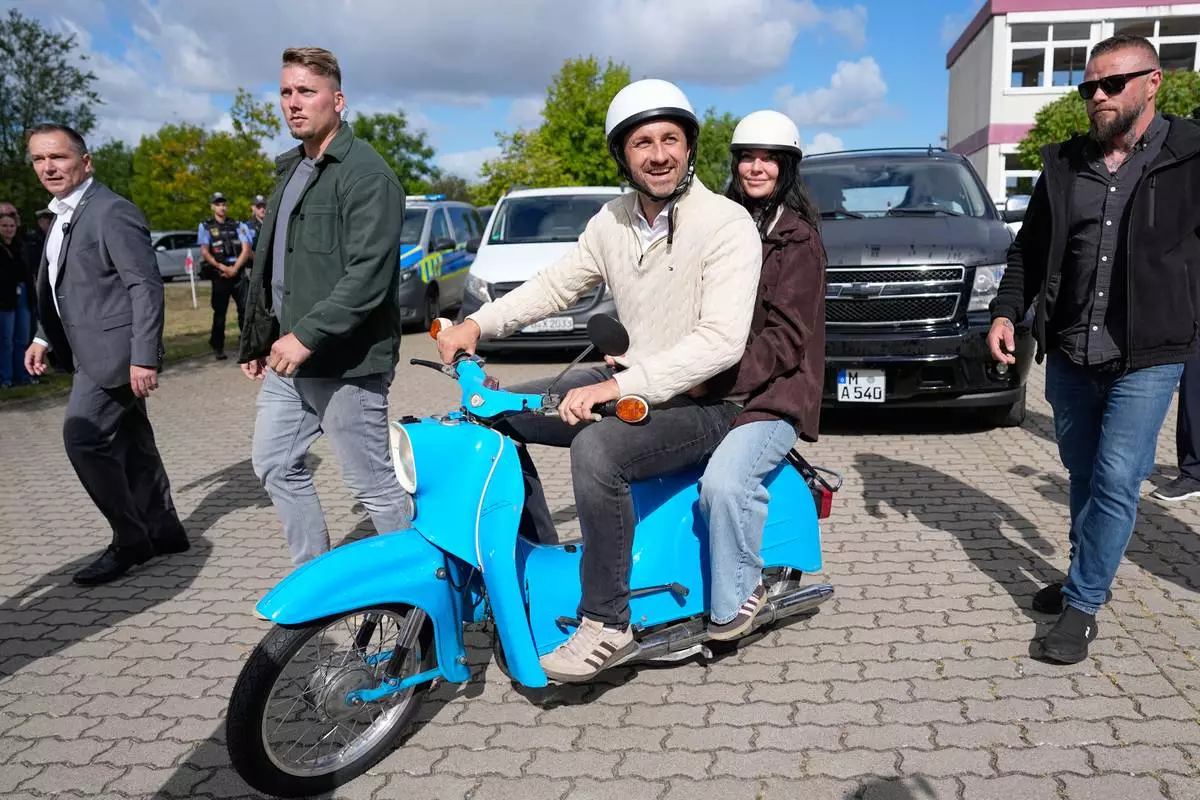
Ulrich Siegmund, top candidate for the "Alternative for Germany" (AfD) party and his wife Julia leaving a polling station on a small Schwalbe motorcycle after voting during the Saxony-Anhalt state elections in Tangermuende, eastern Germany, Sunday, Sept. 6, 2026. (AP Photo/Matthias Schrader)
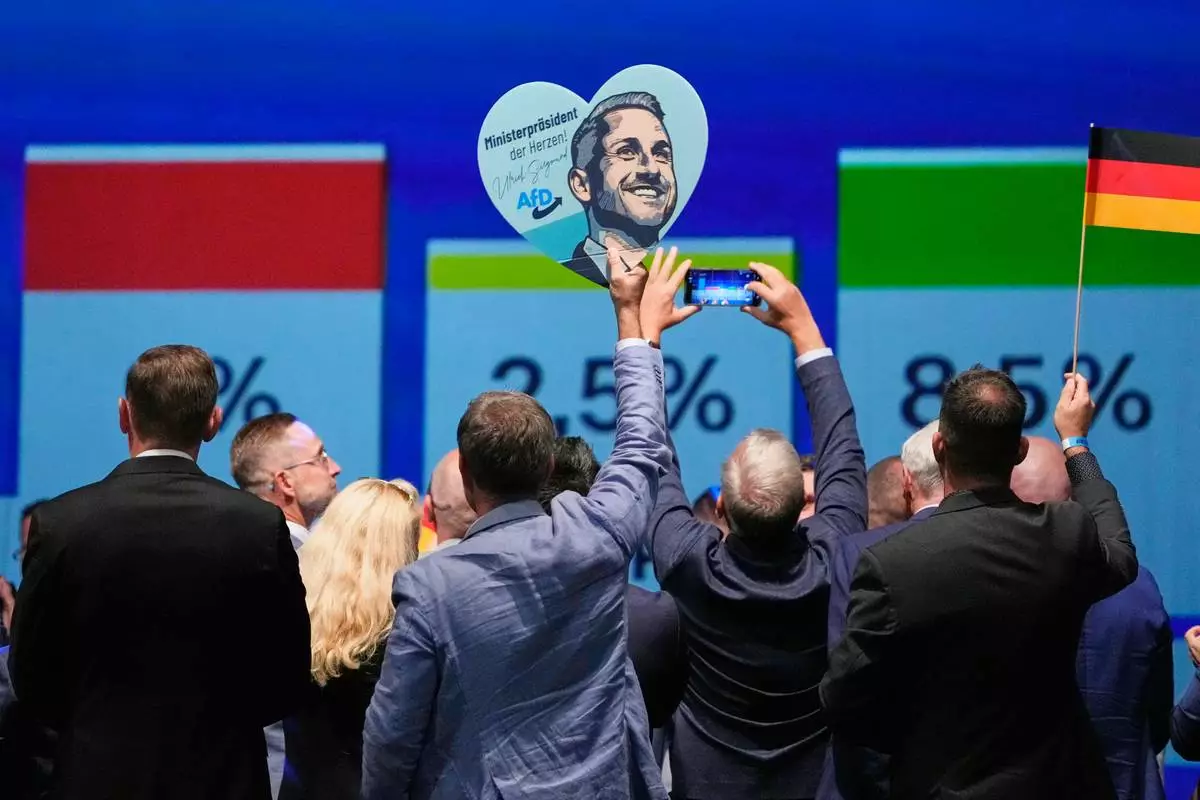
Party members celebrate with a sign of AfD top candidate Ulrich Siegmund after the first results at an election party of the "Alternative for Germany" (AfD) after the Saxony-Anhalt state elections in Magdeburg, eastern Germany, Sunday, Sept. 6, 2026. (AP Photo/Matthias Schrader)

Top candidate Ulrich Siegmund speaks at an election party of the "Alternative for Germany" (AfD) after the Saxony-Anhalt state elections in Magdeburg, eastern Germany, Sunday, Sept. 6, 2026. (AP Photo/Matthias Schrader)
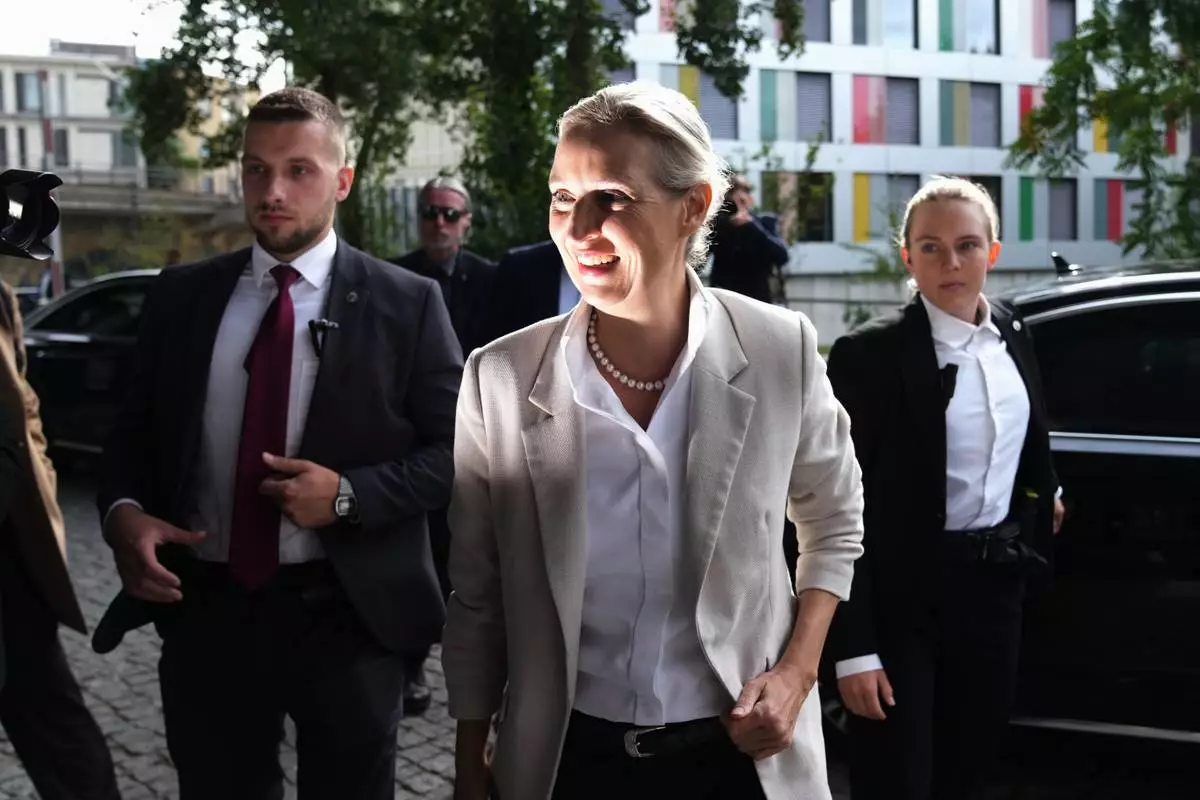
Co-leader of Alternative for Germany party, or AfD, Alice Weidel, arrives for a press conference in Berlin, Germany, Monday, Sept. 7, 2026. (AP Photo/Ebrahim Noroozi)