SAO PAULO (AP) — After a gap of eight years since Brazilian Formula 1 fans last watched a homegrown driver on the grid, some had been moved to come up with mascots, songs, anything to cheer for 21-year-old rookie Gabriel Bortoleto at Sunday’s Sao Paulo Grand Prix.
Former driver Felipe Massa was previously the last Brazilian to race in front of home fans in 2017.
But the pressure of racing in front of fans might have made Bortoleto's life tougher at Interlagos, where he started from 18th and last on the grid Sunday despite his team initially saying he would be in the pit lane. A crash during Saturday's sprint race following an attempt to overtake prevented him from qualifying.
And it got worse Sunday when the young driver crashed out on the first lap at Interlagos in what looked to be a more promising outing after he overtook three rivals in quick succession.
The season has been a steep learning curve for Bortoleto, who has 19 points and is 19th in the drivers' championship. Although his Sauber does not provide him with a great shot at competing for podiums, his performances have boosted expectations that he has a bright future.
Sauber will be taken over by Audi in 2026, with Bortoleto under contract through next season. He has already enjoyed a rapid rise through the junior formula categories before making his F1 debut this season. Bortoleto won back-to-back titles in F3 and F2 before moving to F1, often beating his current Racing Bulls rival Isack Hadjar, another rookie that has drawn attention this season.
“The talent and the potential to be a very successful F1 driver, he surely has,” Massa told The Associated Press on the sidelines of the Brazilian GP on Saturday.
“He might win races, titles. But we need to be patient, there's a lot of decisions that don't depend on him. For example, what his team will be and whether it is the right one for each moment.”
Bortoleto started competing in go-karts when he was seven years old and won several titles in Brazil between 2011 and 2019. He moved to Italy in 2020 to race in the F4 Championship, where he finished with one win and five podiums. Alpine took him to Formula Regional in 2021, where he finished 6th overall, with two victories.
And then two-time F1 champion Fernando Alonso became his mentor.
Bortoleto dominated the F3 season in 2023 and did the same in F2 the following year after he joined the McLaren Driver Development programme.
“He has everything that drivers who win titles have. He has the confident personality, he is a calm competitor. The other teams noticed that even before he was scoring points,” said Reginaldo Leme, a veteran F1 pundit in Brazil who has covered the sport for more than 50 years. “But for that to happen, fans will need to be patient and avoid putting too much pressure.”
Crashes on Saturday and Sunday raised questions about whether Bortoleto can manage to avoid feeling the pressure of expectations.
On Saturday, as he tried to overtake the Williams of Alexander Albon, his car was off the racing line close to turn 1, and the Brazilian lost control and crashed into a wall in front of his home fans, before spinning and sliding in front of Albon's car and hitting another barrier.
“I was genuinely scared when I saw it,” said Claudio Herz, a 74-year-old Brazilian supporter who came to Interlagos with a national flag with Bortoleto's face on it. He also carried a small doll of “BorBoleto,” a butterfly mascot that was created for the Sauber driver.
“I am sure he wouldn't try the same if it was another race, you want to give 100% plus if your people come to the track to see you race. But give him time, he is going to be big,” Herz said.
On Sunday, Bortoleto came into contact with the car of Aston Martin's Lance Stroll and hit a barrier, quickly ending his chances of scoring points at home.
Bortoleto denied feeling any pressure at Interlagos, where he has raced a few times. He told journalists on Wednesday that he was approaching the Brazilian Grand Prix “as another race of the season.”
“We've had so many,” he said. “But I am definitely looking forward to it. I want to drive, feel what Interlagos is like and everything else. But I don't see it as pressure.”
Bortoleto's team spent the night trying to rebuild his car after the crash. He did not take part in qualifying, which initially raised doubts about whether he could even be able to compete on Sunday.
After Saturday's accident, Bortoleto acknowledged his mistake, but kept his confident tone.
“I need to learn and test a few things. The day I have a car to fight for titles, I cannot make mistakes like this,” he said on Saturday. “Situations like this make better drivers. Look at Max Verstappen at the beginning of his career.”
Sunday's crash had an emotional impact of its own on Bortoleto as he met family members and threw Sauber caps to fans in the stands. Asked about the next race at Interlagos, he tried to keep some optimism.
“I will be stronger than ever. A weekend like this one, it can't be worse. And I will only get stronger in front of my country,” Bortoleto said. “I am sad, but today is today, tomorrow is tomorrow.”
Massa, who until Sunday was the last Brazilian driver on the grid at Interlagos, says that Bortoleto will depend on more than results to boost his chances in F1. The relationship with team mechanics also counts, and it will be tested after Saturday's setback.
“Gabriel is creating good relationships and getting credibility in his team, people trust him there,” Massa said. “This is a good season performance-wise, learning-wise. He might be one of those who race in F1 for a very long time.”
AP auto racing: https://apnews.com/hub/auto-racing
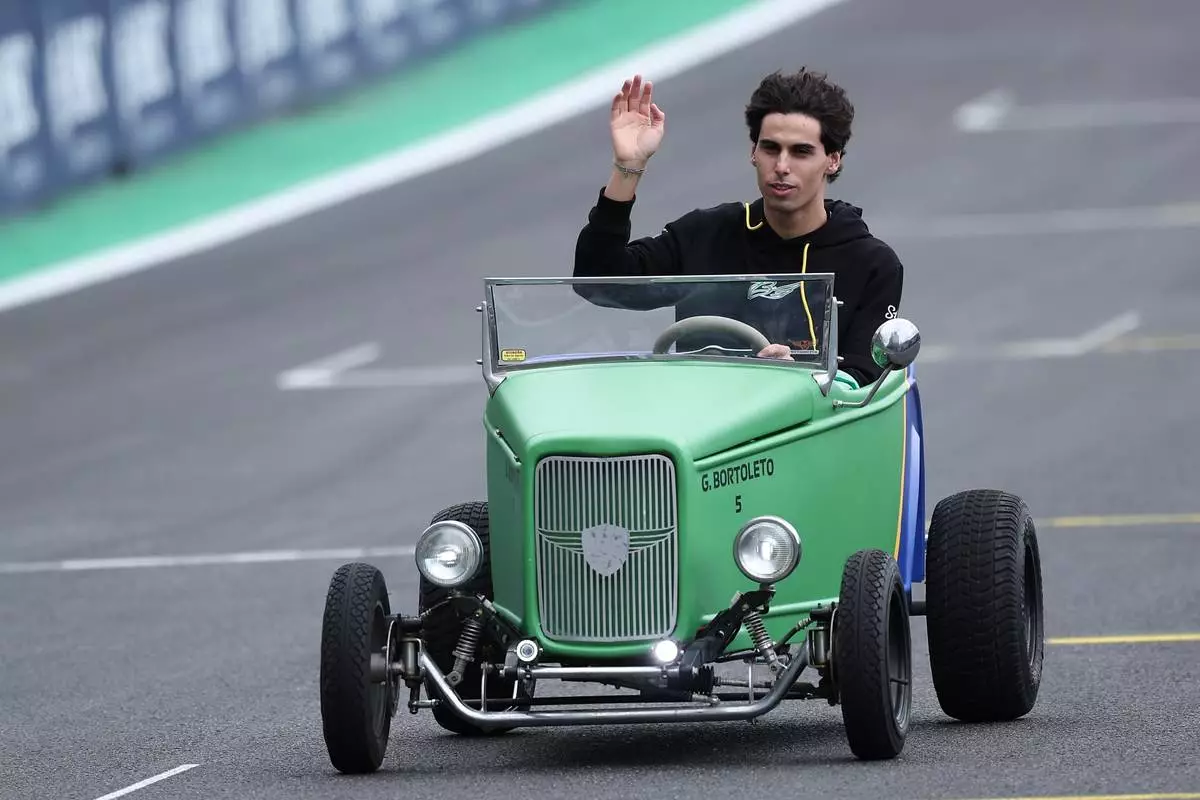
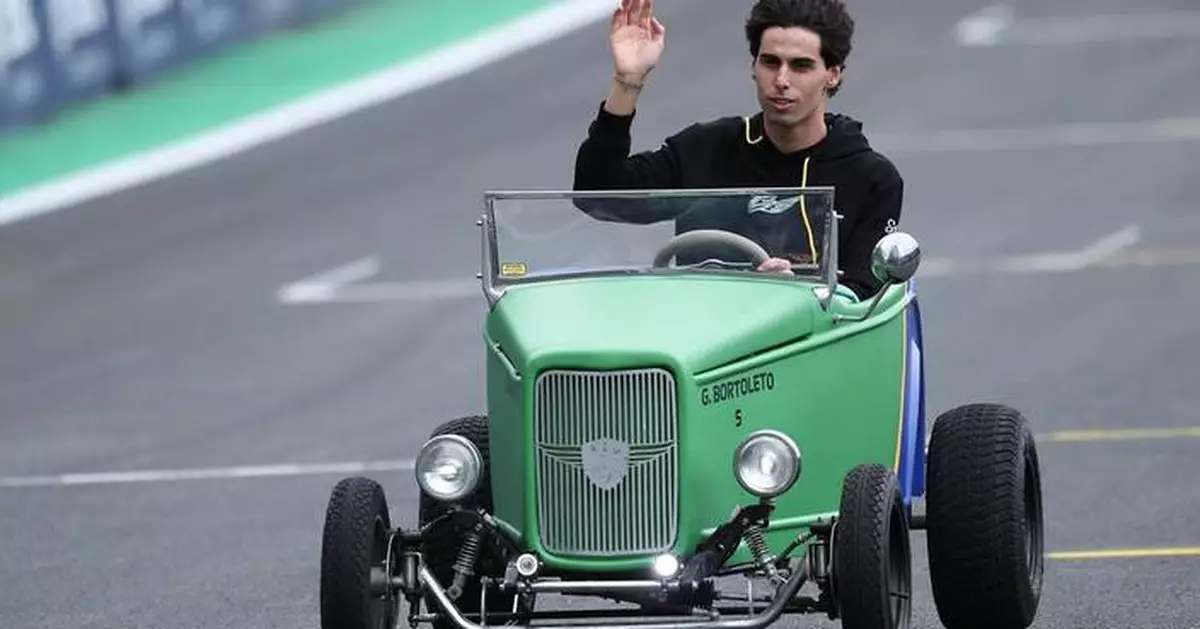
Kick Sauber driver Gabriel Bortoleto of Brazil waves fans during the drivers parade ahead of the Brazilian Formula One Grand Prix at the Interlagos race track, in Sao Paulo, Sunday, Nov. 9, 2025. (AP Photo/Ettore Chiereguini)