VIENNA (AP) — The International Atomic Energy Agency has not been able to verify the status of Iran’s near weapons-grade uranium stockpile since Israel and the United States struck the country’s nuclear sites during the 12-day war in June, according to a confidential report by the U.N. nuclear watchdog circulated to member states and seen Wednesday by The Associated Press.
The agency warned that it "lost continuity of knowledge in relation to the previously declared inventories of nuclear material in Iran” at facilities affected by the war and stressed that this issue must be “urgently addressed.”
The report stressed that the IAEA's “lack of access to this nuclear material in Iran for five months means that its verification — according to standard safeguards practice — is long overdue.”
According to the IAEA’s last report in September, Iran maintains a stockpile of 440.9 kilograms (972 pounds) of uranium enriched up to 60% purity — a short, technical step away from weapons-grade levels of 90%.
That stockpile could allow Iran to build as many as 10 nuclear bombs, should it decide to weaponize its program, IAEA director general Rafael Grossi warned in a recent interview with the AP. He added that it doesn’t mean that Iran has such a weapon.
Iran long has insisted its program is peaceful, but the IAEA and Western nations say Tehran had an organized nuclear weapons program up until 2003.
According to the safeguards agreement that Iran has with the U.N. nuclear watchdog, Iran is obliged to produce a “special report” detailing the location and status of its nuclear material, including its highly enriched uranium stockpile, following events such as attacks or earthquakes. The special report must also address the status of the facilities affected by the June war.
The IAEA said Wednesday that “the provision of such a report is indispensable for the Agency to provide assurances that nuclear material subject to safeguards in Iran remains in peaceful nuclear activities and that the facilities subject to safeguards are not being misused.”
The report said that Iran explained in a letter to the IAEA on Nov. 11 that “any cooperation with the Agency is conditional on the decision of the Supreme National Security Council (SNSC) of Iran.”
The IAEA report on Wednesday also said that Iran has not granted IAEA inspectors access to sites affected by the war.
Tehran did, however, allow the IAEA to inspect undamaged facilities after Grossi reached an agreement with Iranian Foreign Minister Abbas Araghchi in Cairo at the beginning of September.
Those facilities include the Bushehr Nuclear Power Plant, the Tehran Research Reactor and three other nuclear facilities in Tehran.
The report also said that IAEA inspectors are traveling to Iran on Wednesday to conduct inspections at the Isfahan Nuclear Technology Center site.
The facility, some 350 kilometers (215 miles) southeast of Tehran, employs thousands of nuclear scientists. It is also home to three Chinese research reactors and laboratories associated with Iran's atomic program.
During the war, Israel struck buildings at the Isfahan site, among them a uranium conversion facility. The U.S. also struck Isfahan with missiles.
Iran suspended all cooperation with the IAEA after the war with Israel.
IAEA chief Grossi then reached an agreement with Iranian Foreign Minister Abbas Araghchi in Cairo at the beginning of September to resume inspections.
But later that same month, the U.N. reimposed crushing sanctions on Iran, drawing an angry response from Tehran and leading the country to halt implementation of the Cairo agreement.
Iran is legally obliged to cooperate with the IAEA under the Treaty on the Non-Proliferation of Nuclear Weapons.
European powers decided to reimpose the U.N. sanctions via the so-called snapback mechanism after Iran failed to enter into direct talks with the U.S., resume full cooperation with the IAEA and clarify the status of its near weapons-grade uranium stockpile.
The sanctions freeze Iranian assets abroad, halt arms deals with Tehran, and penalize any development of Iran’s ballistic missile program, among other measures, further squeezing the country’s reeling economy and isolating Tehran after its atomic sites were repeatedly bombed during a 12-day war with Israel.
———
The Associated Press receives support for nuclear security coverage from the Carnegie Corporation of New York and Outrider Foundation. The AP is solely responsible for all content.
Additional AP coverage of the nuclear landscape: https://apnews.com/projects/the-new-nuclear-landscape/
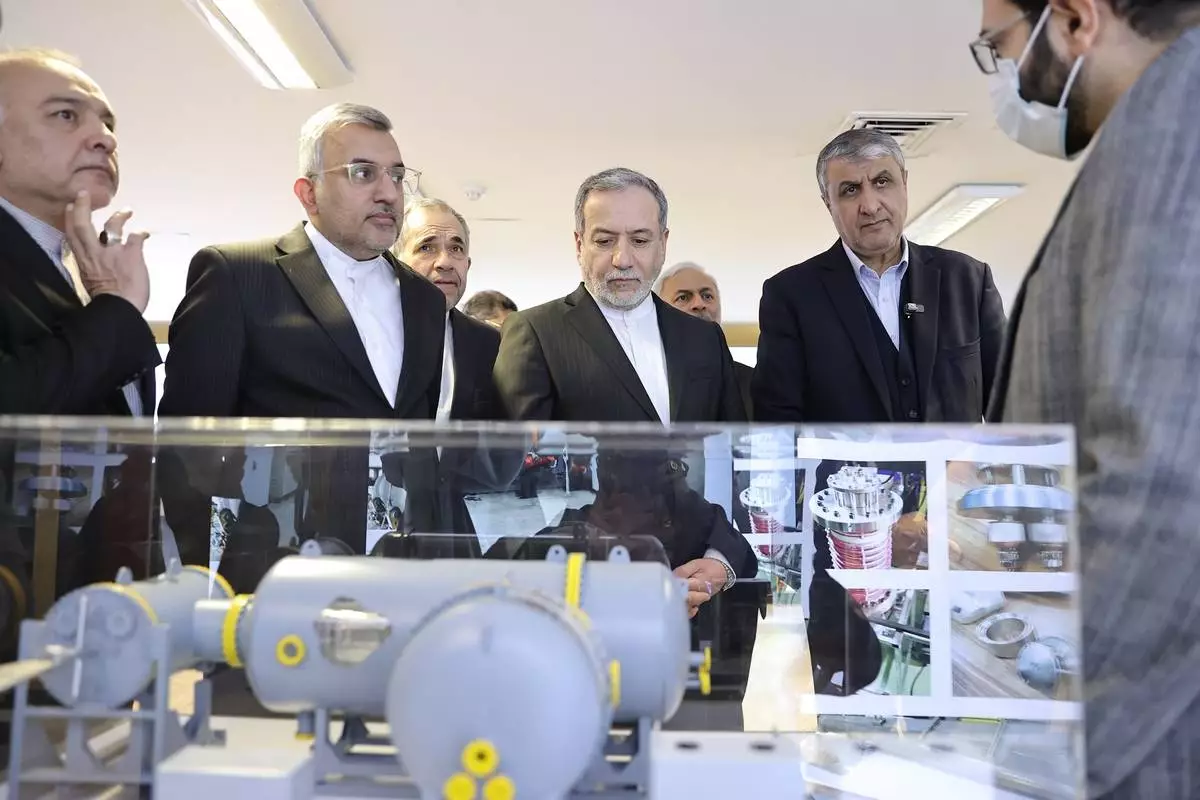
In this photo, released on Monday, Nov. 10, 2025 by the Atomic Energy Organization of Iran, Foreign Minister Abbas Araghchi, center, listens to explanations as he visits an exhibition of the country's nuclear achievements during his tour to the Atomic Energy Organization, while he is accompanied by the head of the Atomic Energy Organization of Iran, Mohammad Eslami, second right, in Tehran, Iran. (Atomic Energy Organization of Iran via AP)
FILE - The International Atomic Energy Agency (IAEA) in Vienna, Austria, Monday, June 23, 2025. (AP Photo/Michael Gruber, file)
ADEN, Yemen (AP) — The United Arab Emirates said early Saturday it had withdrawn all its troops from Yemen.
The move comes after days of airlifts by UAE military aircraft following an order to withdraw from anti-Houthi forces in Yemen following Saudi Arabia pushing back against the advance of Emirati-backed separatists there.
“The UAE forces follows the implementation of a previously announced decision to conclude the remaining missions of counter-terrorism units,” a Defense Ministry statement said. “The process has been conducted in a manner that ensured the safety of all personnel and carried out in coordination with all relevant partners.”
THIS IS A BREAKING NEWS UPDATE. AP’s earlier story follows below.
ADEN, Yemen (AP) —
Yemen 's separatist movement on Friday announced a constitution for an independent nation in the south and demanded other factions in the war-torn country accept the move in an escalation of a confrontation that has pitted Gulf powerhouses Saudi Arabia and the United Arab Emirates against each other.
The UAE-backed Southern Transitional Council depicted the announcement as a declaration of independence for the south. But it was not immediately clear if the move could be implemented or was largely symbolic. Last month, STC-linked fighters seized control of two southern provinces from Saudi-backed forces and took over the Presidential Palace in the south's main city, Aden. Members of the internationally recognized government — which had been based in Aden — fled to the Saudi-capital Riyadh.
On Friday, Saudi warplanes bombed camps and military positions held by the STC in Hadramout province as Saudi-backed fighters tried to seize the facilities, a separatist official said. It was the latest direct intervention by Saudi Arabia, which in recent weeks has bombed STC forces and struck what is said was a shipment of Emirati weapons destined for the separatists.
Ostensibly, Saudi Arabia and the UAE and their allies on the ground in Yemen have all been part of a Saudi-led coalition fighting Iranian-backed Houthi rebels who control the north in the country's decade-long civil war. The coalition's professed goal has long been to restore the internationally recognized government, which was driven out of the north by the Houthis. But tensions between the factions and the two Gulf nations appear to be unraveling the coalition, threatening to throw them into outright conflict and further tear apart the Arab world's poorest country.
The head of the STC, Aidarous al-Zubaid, issued a video statement Friday saying that the constitution his group issued would be in effect for two years, after which a a referendum would be held on “exercising the right to self-determination for the people of the South.” During those two years, he said, the “relevant parties” in north and south Yemen should hold a dialogue on “a path and mechanisms that guarantee the right of the people of the South.”
He said that if the other factions don't agree to his call or if they take military action, “all options remain open.”
The 30-article “constitution” proclaimed the creation of “the State of South Arabia," covering the same territory of the former People’s Democratic Republic of Yemen, the independent southern state that existed from 1967-1990.
It seemed to be the most overt move yet by the STC toward its long-proclaimed goal of independence. In the confusion that has reigned in the south in recent weeks, it was not clear what practical impact it would have. But the declaration could set back efforts to avert an outright conflict between the separatists and the rest of the Saudi-led coalition.
The UAE’s Foreign Ministry said in a statement Friday that the country was dealing with the situation “with restraint, coordination, and a deliberate commitment to de-escalation, guided by a foreign policy that consistently prioritizes regional stability over impulsive action.”
The Saudi-led coalition in Yemen demands the withdrawal of the STC-linked Southern Shield forces from the two governorates they seized, Hadramout and Mahra, as part of de-escalation efforts. The STC has so far refused to hand over its weapons and camps.
Saudi-backed fighters, known as the National Shield Forces, advanced on two STC-camps in Hadramout, said a senior STC official, Ahmed bin Breik, a former governor of the province. The separatist forces refused to withdraw and in response, Saudi planes struck the camps, he said.
Mohamed al-Nakib, spokesperson for the STC-backed forces, said the strikes caused fatalities, without providing details. The Associated Press couldn’t independently verify that claim.
He told the AP later Friday that “intense clashes” erupted between his forces and the National Shield forces across several areas of Hadramout.
It was not clear if the Saudi-backed forces succeeded in retaking the camps.
Salem al-Khanbashi, the governor of Hadramout who was chosen Friday by Yemen's internationally recognized government to command the Saudi-led forces in the governorate, said the move to reclaim the camps was “not a declaration of war and is not seeking an escalation.” He said it was a “pre-emptive measure to remove weapons.”
In a post on X, the Saudi ambassador to Yemen, Mohammed al-Jaber, said the kingdom had tried “all efforts with STC” for weeks "to stop the escalation" and to urge the separatists to leave Hadramout and Mahra, only to be faced with “continued intransigence and rejection from Aidarous al-Zubaidi."
Al-Jaber said the STC had not permitted a Saudi delegation's jet to land in Aden, despite having agreed on its arrival with some STC leaders to find a solution that serves “everyone and the public interest.”
Yemen’s Transportation Ministry, aligned with STC, said Saudi Arabia on Thursday imposed requirements mandating that flights to and from Aden International Airport undergo inspection in Jeddah. The ministry denounced the decision. There was no confirmation from Saudi authorities.
ِA spokesperson with the transport ministry told the AP late Thursday that all flights from and to the UAE were suspended until Saudi Arabia reverses these reported measures.
Khaled reported from Cairo. Associated Press writer Bassem Mroue in Beirut contributed to this report.
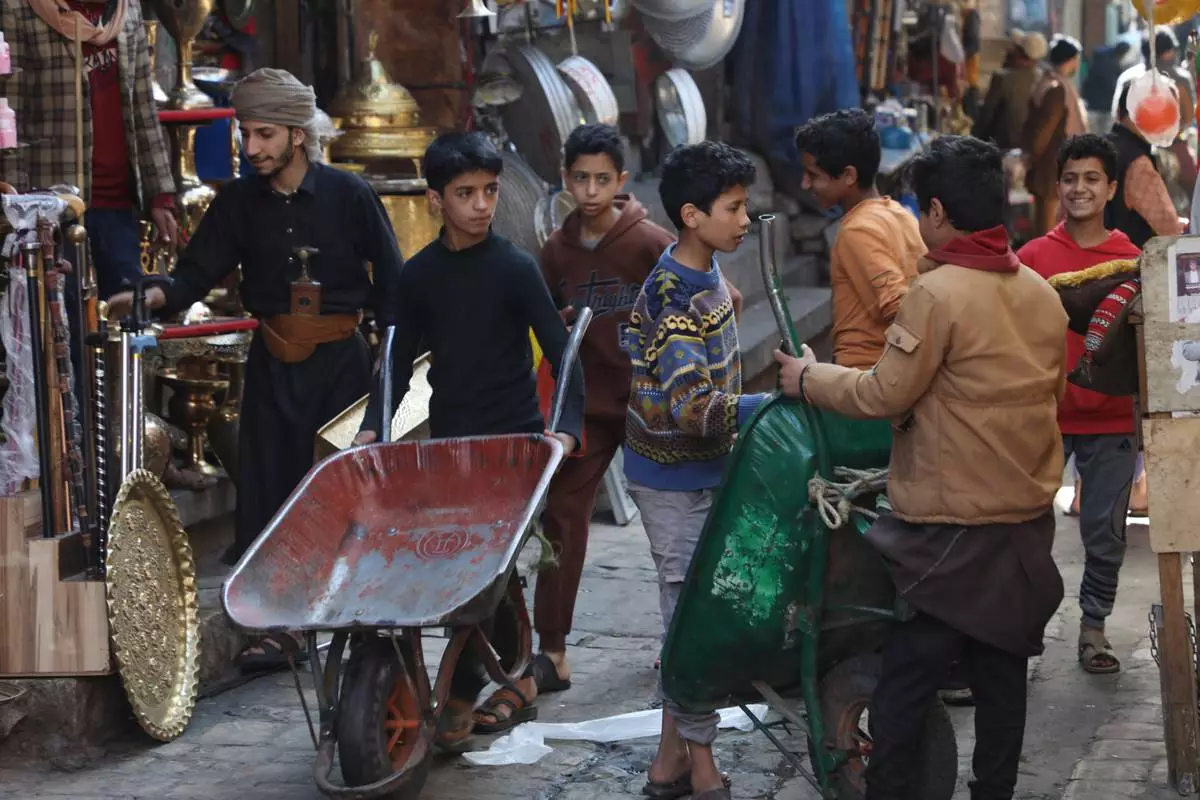
Yemeni workers chat at a popular market in Sanaa, Yemen, Thursday, Jan. 1, 2026. (AP Photo/Osamah Abdulrahman)
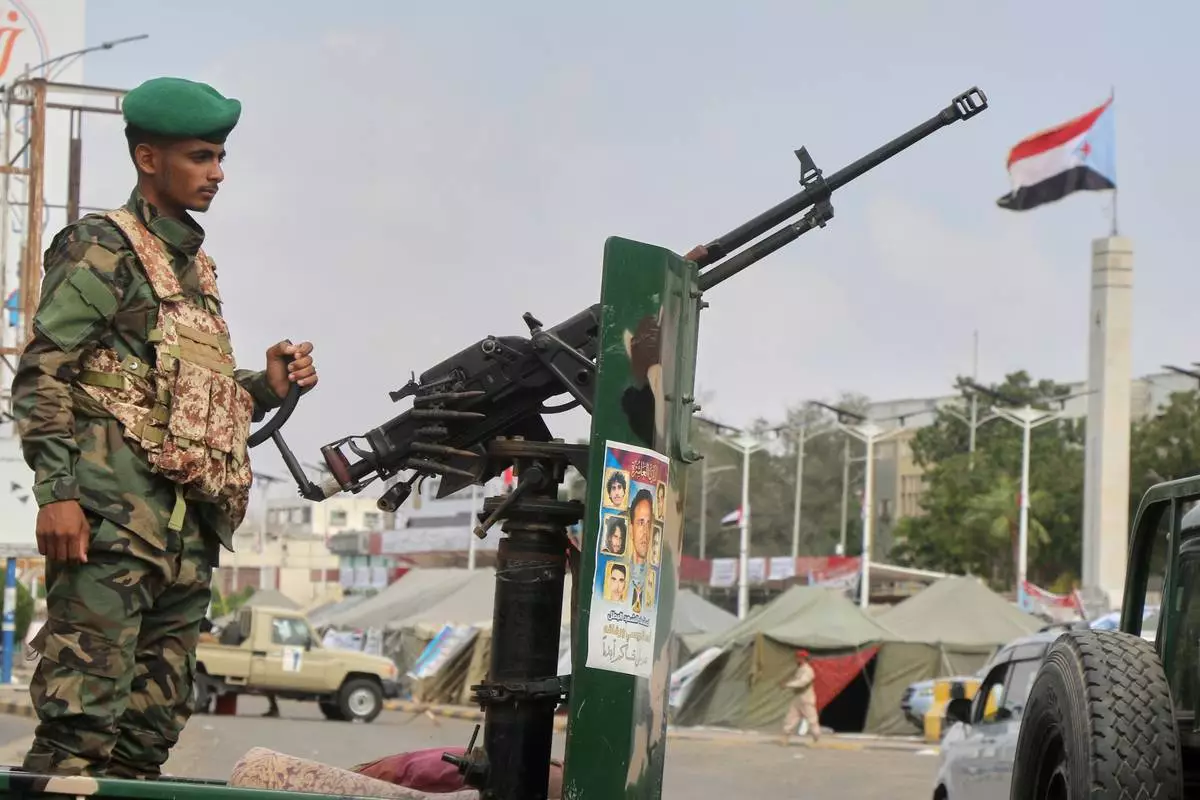
A Southern Yemen soldier of Southern Transitional Council (STC) stands at a check point, in Aden, Yemen, Wednesday, Dec. 31, 2025. (AP Photo)
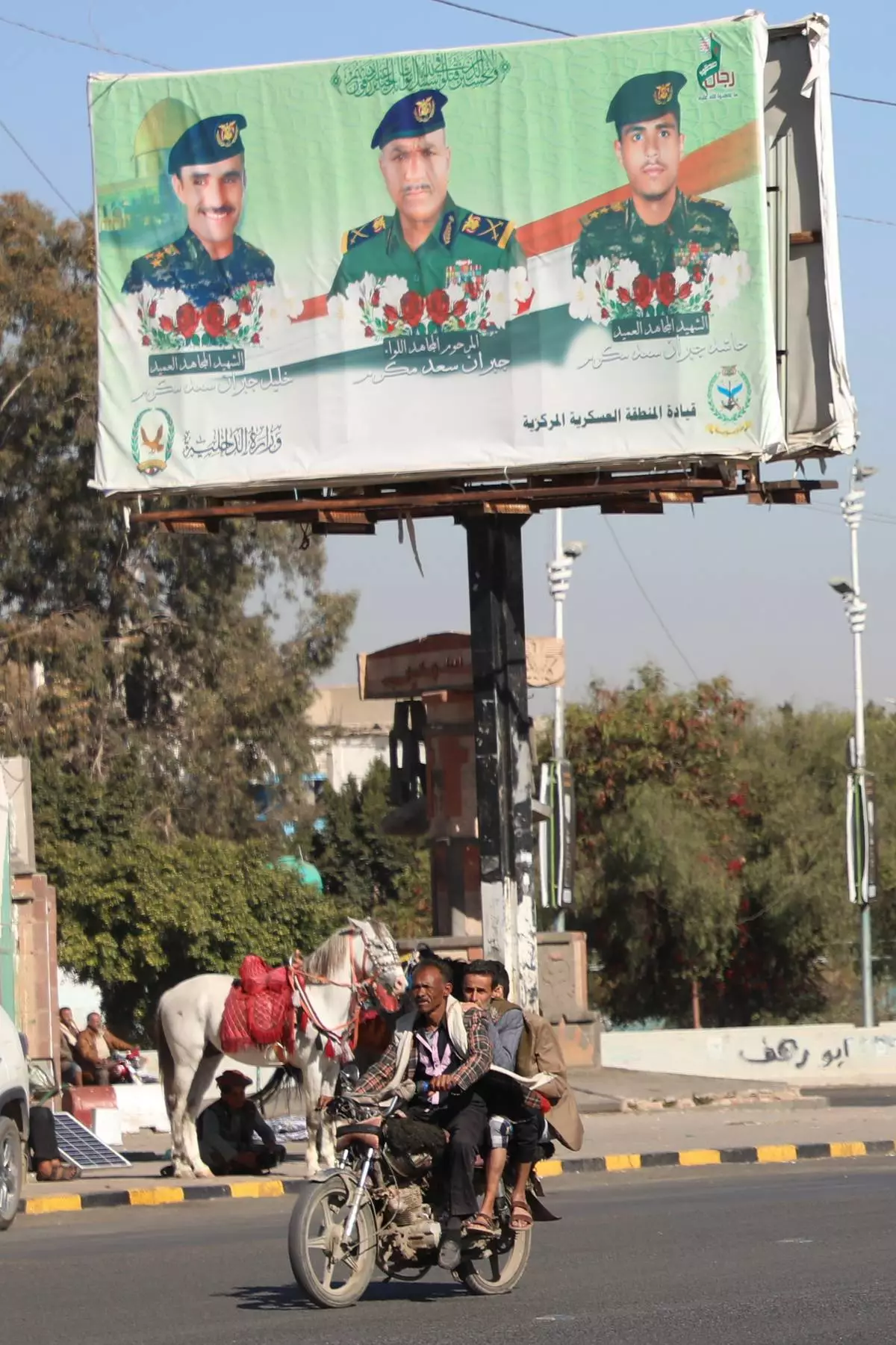
A Yemeni rides his motorbike under a banner honoring Houthi leaders who were killed during Israeli airstrikes, in Sanaa, Yemen, Thursday, Jan. 1, 2026. (AP Photo/Osamah Abdulrahman)
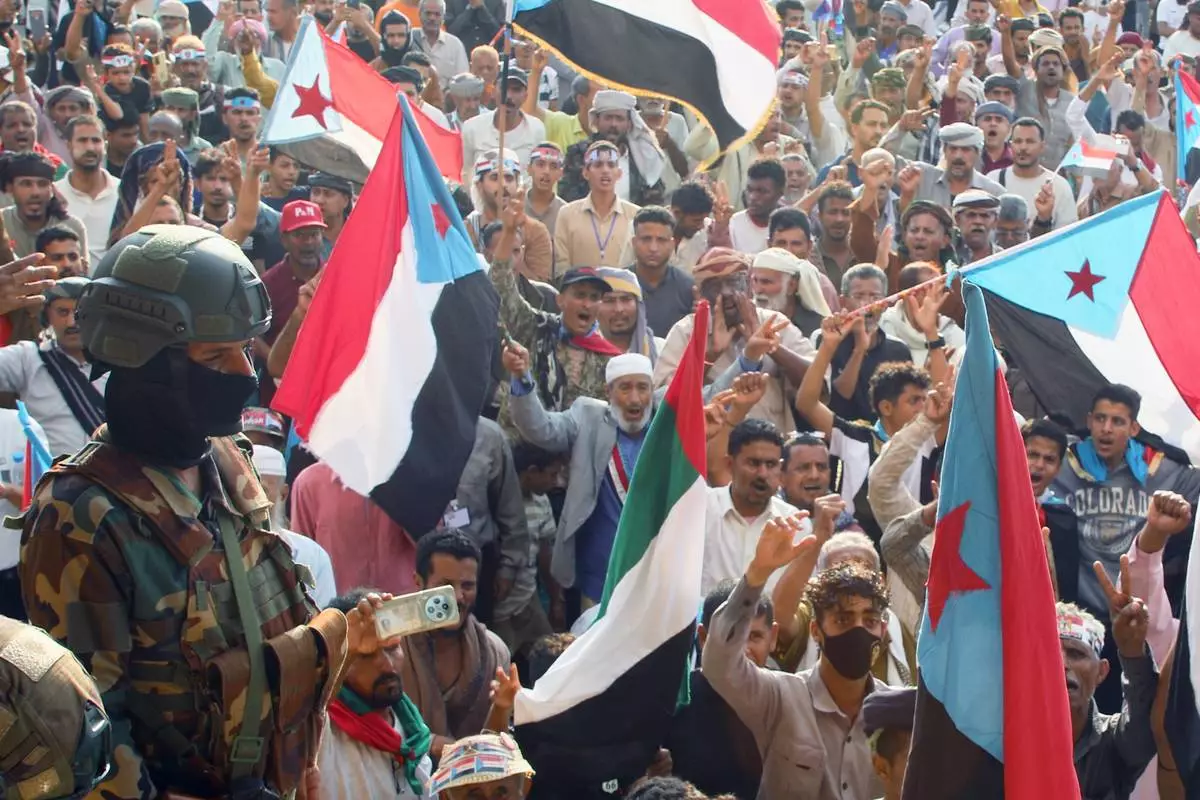
Supporters of the Southern Transitional Council (STC), a coalition of separatist groups seeking to restore the state of South Yemen, hold South Yemen flags during a rally, in Aden, Yemen, Friday, Jan. 2, 2026. (AP Photo)
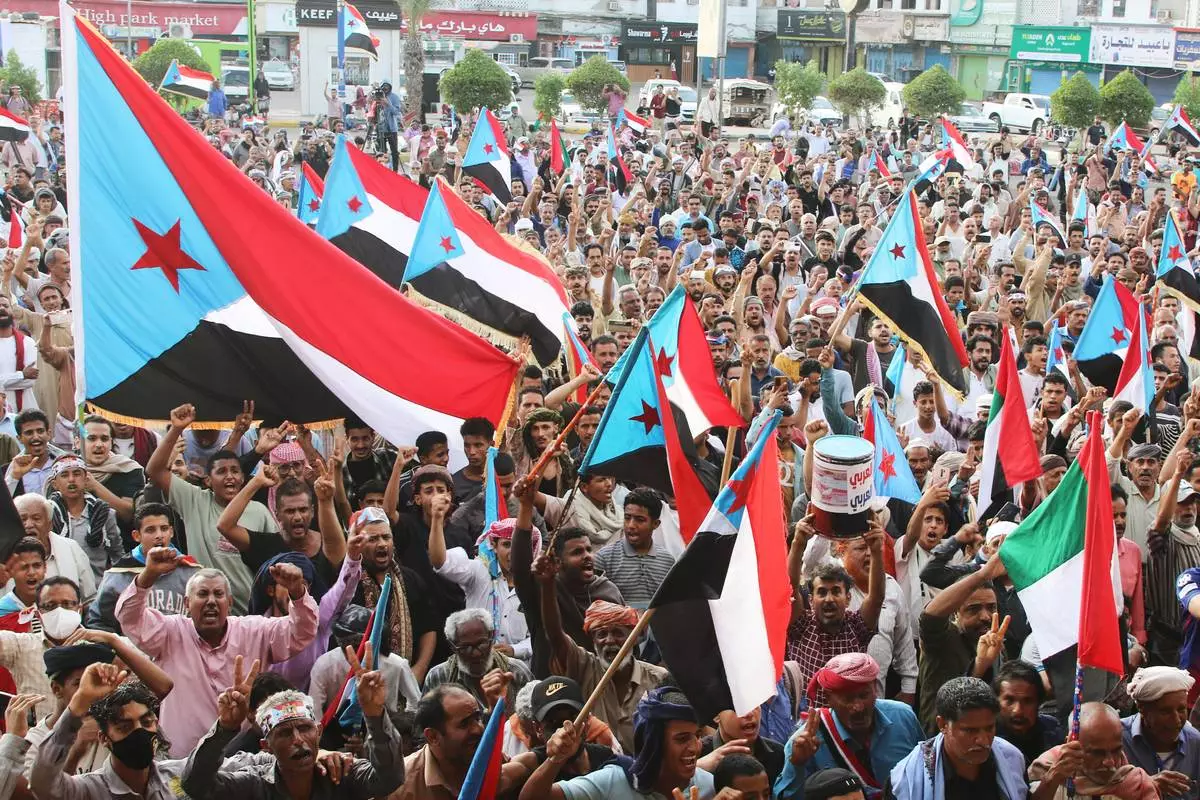
Supporters of the Southern Transitional Council (STC), a coalition of separatist groups seeking to restore the state of South Yemen, hold South Yemen flags during a rally, in Aden, Yemen, Friday, Jan. 2, 2026. (AP Photo)
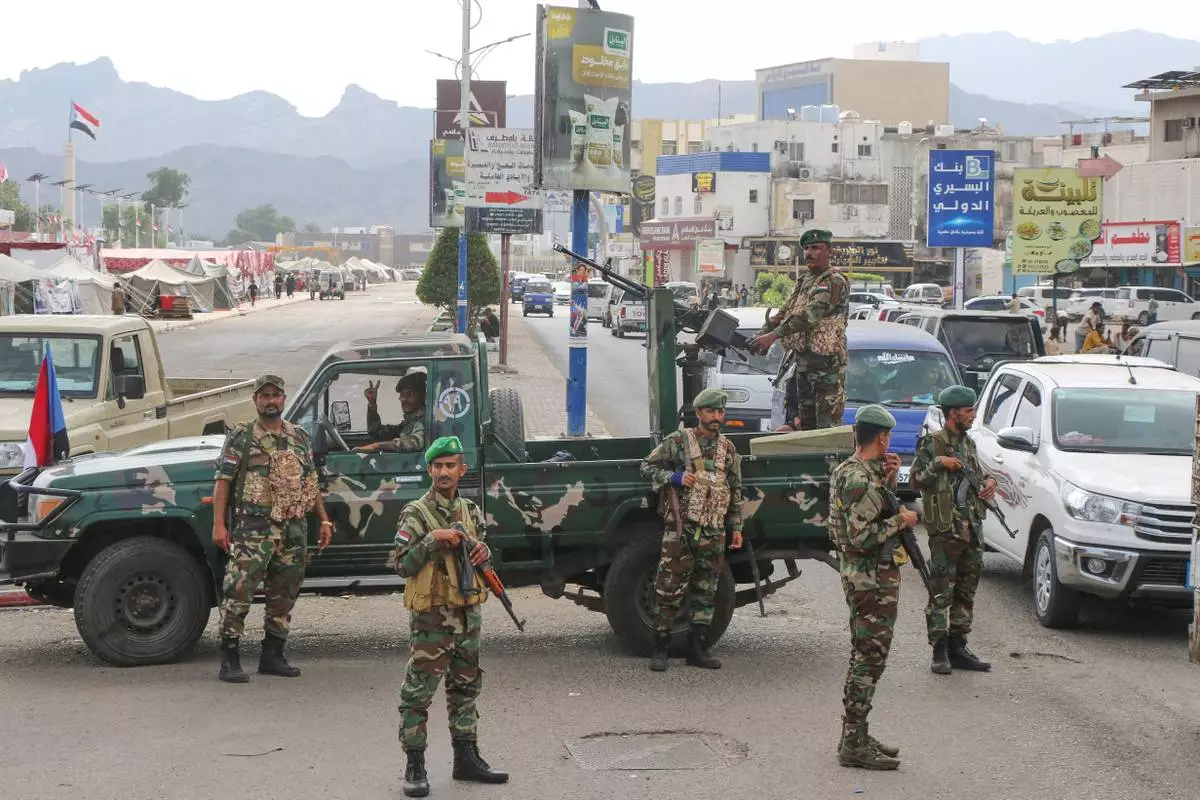
Southern Yemen soldiers of Southern Transitional Council (STC) at a check point, in Aden, Yemen, Wednesday, Dec. 31, 2025. (AP Photo)