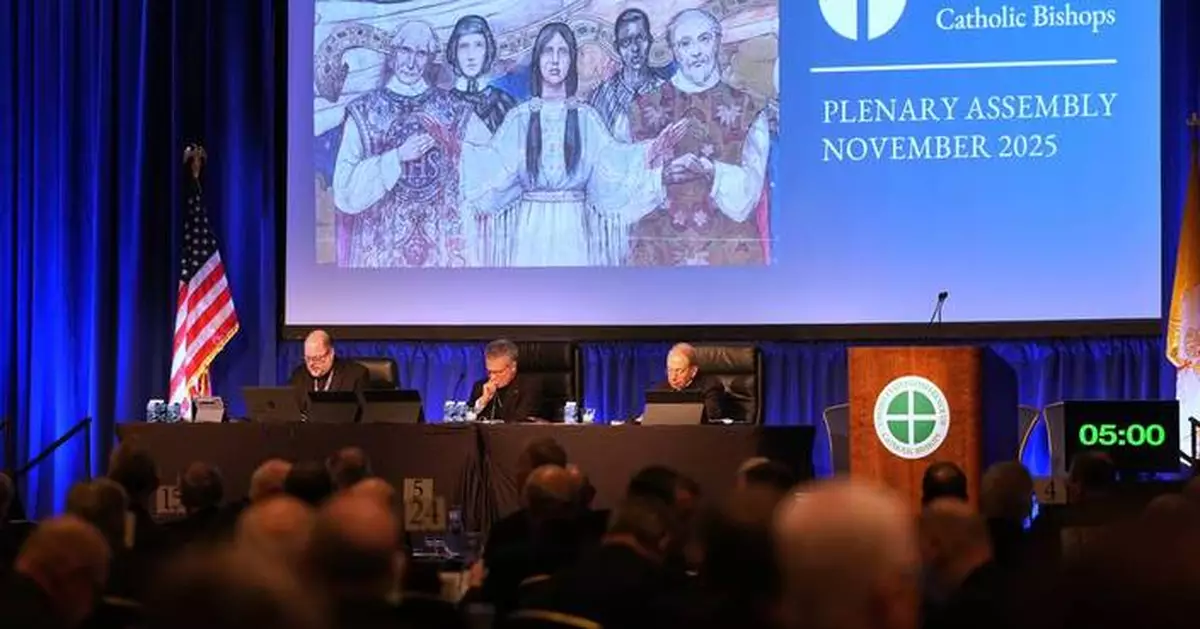
U.S. Catholic bishops voted Wednesday to make official a ban on gender-affirming care for transgender patients at Catholic hospitals. The step formalizes a yearslong process for the U.S. church to address transgender health care.
From a Baltimore hotel ballroom, the bishops overwhelmingly approved revisions to their ethical and religious directives that guide the nation’s thousands of Catholic health care institutions and providers.
More than one in seven patients in the U.S. are treated each day at Catholic hospitals, according to the Catholic Health Association. Catholic hospitals are the only medical center in some communities.
Major medical groups and health organizations support gender-affirming care for transgender patients.
Most Catholic health care institutions have taken a conservative approach and not offered gender-affirming care, which may involve hormonal, psychological and surgical treatments. The new directives will formalize that mandate. Bishops will have autonomy in making the directives into law for their dioceses.
“With regard to the gender ideology, I think it’s very important the church makes a strong statement here,” said Bishop Robert Barron of Minnesota’s Winona-Rochester diocese during the public discussion of the revised directives.
The Catholic Health Association thanked the bishops for incorporating much of the organization’s feedback into the directives. It said in a statement, “Catholic providers will continue to welcome those who seek medical care from us and identify as transgender. We will continue to treat these individuals with dignity and respect, which is consistent with Catholic social teaching and our moral obligation to serve everyone, particularly those who are marginalized.”
The new guidelines incorporate earlier documents on gender identity from the Vatican in 2024 and the U.S. bishops in 2023.
In the 2023 doctrinal note, titled “Moral Limits to the Technological Manipulation of the Human Body,” the bishops specified: “Catholic health care services must not perform interventions, whether surgical or chemical, that aim to transform the sexual characteristics of a human body into those of the opposite sex, or take part in the development of such procedures.”
The Catholic Church is not monolithic when it comes to transgender rights. Some parishes and priests welcome trans Catholics into the fold, while others are not as accepting.
“Catholic teaching upholds the invaluable dignity of every human life, and for many trans people, gender-affirming care is what makes life livable,” said Michael Sennett, a trans man who is active in his Massachusetts parish.
Sennett serves on the board of New Ways Ministry, which advocates for LGBTQ+ inclusion in the Catholic Church. In 2024, the group arranged a meeting with Pope Francis to discuss the need for gender-affirming care.
New Ways Ministry’s executive director, Francis DeBernardo, said that for many transgender Catholics he knows, "the transition process was not just a biological necessity, but a spiritual imperative. That if they were going to be living as authentic people in the way that they believe God made them, then transition becomes a necessary thing.”
On the same day that U.S. Catholic bishops were discussing gender identity, the heads of several major progressive religious denominations issued a statement in support of transgender, intersex and nonbinary people, at a time when many state legislatures and the Trump administration are curtailing their rights.
The 10 signers included the heads of the Unitarian Universalist Association, the Episcopal Church, the Union for Reform Judaism and the Presbyterian Church (U.S.A.).
“During a time when our country is placing their lives under increasingly serious threat, there is a disgraceful misconception that all people of faith do not affirm the full spectrum of gender – a great many of us do. Let it be known instead that our beloveds are created in the image of God – Holy and whole,” the religious leaders said in a statement.
The Catholic bishops, wrapping up their conference in Baltimore, overwhelmingly approved a “special message” on immigration Wednesday. Such pastoral statements are rare; the last was in 2013 in response to the Obama administration’s mandate for insurers to provide contraception coverage.
Catholic leaders individually have criticized the Trump administration’s immigration crackdown. Fear of immigration enforcement has suppressed Mass attendance at some parishes. Local clerics are fighting to administer sacraments to detained immigrants.
“We are disturbed when we see among our people a climate of fear and anxiety around questions of profiling and immigration enforcement,” the bishops’ statement reads. “We are saddened by the state of contemporary debate and the vilification of immigrants. We are concerned about the conditions in detention centers and the lack of access to pastoral care.”
In a show of unity, multiple bishops stood up to speak in favor of the statement during the final afternoon discussion, including Oklahoma City Archbishop Paul Coakley, the newly elected president of the conference.
“I’m strongly in support of it for the good of our immigrant brothers and sisters, but also to find a nice balance,” Coakley said, noting that they call “upon our lawmakers and our administration to offer us a meaningful path of reform of our immigration system.”
Chicago Cardinal Blase Cupich walked to the microphone to recommend stronger language around mass deportation. “That seems to be the central issue we are facing with our people at this time,” he said.
His brother bishops agreed. The updated text now states that U.S. Catholic bishops “oppose the indiscriminate mass deportation of people.”
Associated Press religion coverage receives support through the AP’s collaboration with The Conversation US, with funding from Lilly Endowment Inc. The AP is solely responsible for this content.
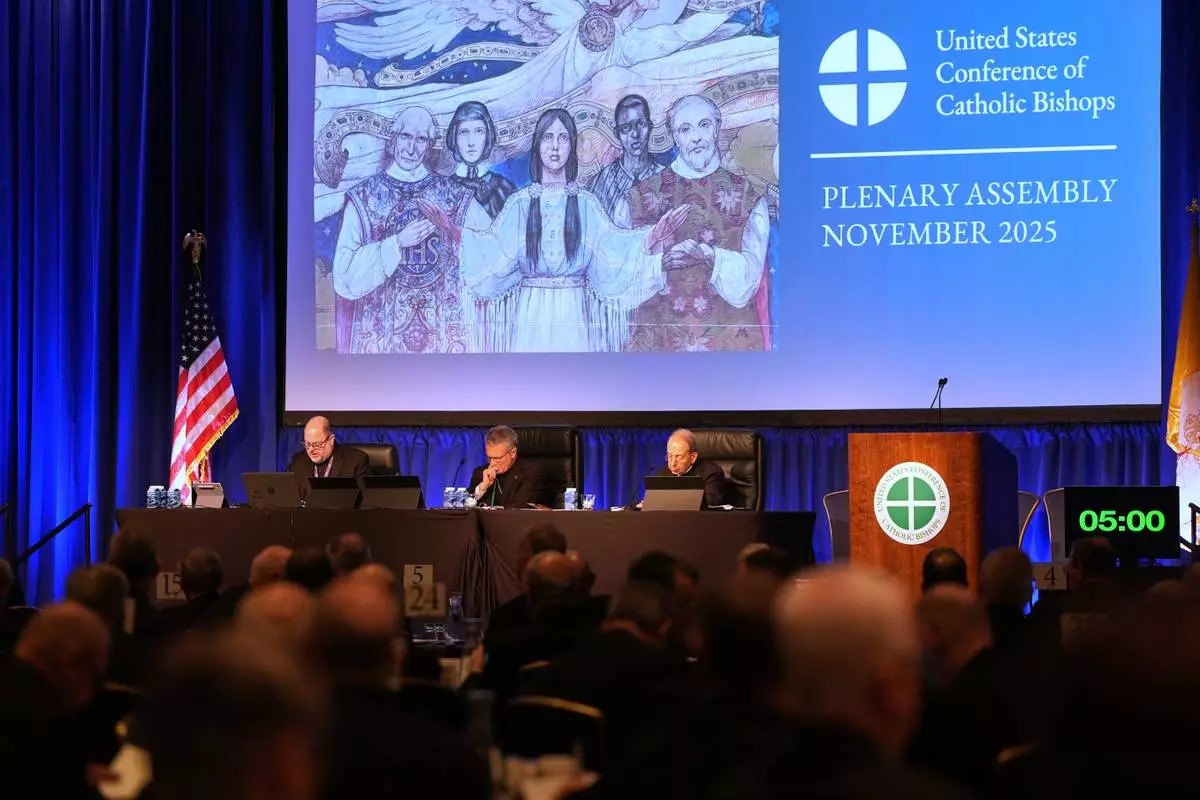
From left; Rev. Michael J.K. Fuller, Archbishop Timothy Broglio and Archbishop William Lori of Baltimore conduct the United States Conference of Catholic Bishops plenary assembly in Baltimore, Tuesday, Nov. 11, 2025. (AP Photo/Stephanie Scarbrough)
LOS LLANITOS, México (AP) — On a dirt field on Mexico’s Pacific coast, five cousins between the ages of 8 and 13 strip down and kick off their shoes. Nearby, adults help them fasten the pre-Hispanic-style “fajado,” securing loincloths and leather belts that wrap around their hips.
The Osuna children grab the rubber ball, all 3.2 kilograms of it — around 7 pounds or seven times heavier than a soccer ball — and begin playing. Only the hips may touch it, forcing players to leap through the air or dive low when it skims the ground.
As Mexico prepares to co-host the 2026 FIFA World Cup, the nation is looking back 3,400 years to one of the oldest team sports: the ancient ballgame known as ulama, a ritual practice nearly erased during the Spanish conquest that survived only in the remote pockets of northwestern Mexico before its late 20th-century rebirth. Today, authorities and its modern players are leveraging the momentum of international soccer to shine a spotlight on the ancient sport once again.
While players acknowledge that tourism fueled the sport’s revival, many worry that projecting an “exotic” image undermines a tradition central to their identity.
“We must rid the game of the notion that it is a living fossil,” said Emilie Carreón, a researcher at the National Autonomous University of Mexico, UNAM, and director of a project aimed at studying and practicing the sport.
That's exactly what the Osuna family is trying to do. After ulama player Aurelio Osuna died, his widow, María Herrera, 53, continued his legacy, teaching the ballgame to their grandchildren in their small village in Sinaloa, 1,000 kilometers (620 miles) northwest of Mexico City.
“This seed will bear fruit someday,” she said.
According to the Popol Vuh, the sacred Mayan book, the world was created from a ballgame, where light and darkness clashed to balance life and death and set the universe in motion.
Long before the Maya, the Olmecs — the earliest known Mesoamerican civilization — practiced the sport; the recreation of this clash of opposing forces was common in various pre-Hispanic cultures. The evidence is in millennial rubber balls unearthed in Mexico and in nearly 2,000 ball courts found from Nicaragua to Arizona.
The game, depicted in codices, stone carvings and sculptures, had many variations and meanings, from fertility or war ceremonies, to political acts and even sacrifices.
While some players were beheaded — possibly the losers — Guatemalan archaeologist and anthropologist Carlos Navarrete explained this occurred only during specific periods and in certain regions. The physically demanding game was primarily a big social event, drawing crowds for fun and betting.
Spanish conquistador Hernán Cortés was impressed by the spectacle presented by the Aztec emperor Moctezuma but the Spanish ultimately banned ulama and ordered the destruction of its courts, likely viewing the tradition as a form of resistance to Christianity. For the Catholic Church “the ball was the living devil,” Carreón said.
The game — played by hitting the ball with the hip, the forearm or a mallet — survived only on the Mexican northern Pacific coast, where the colonial process led by Jesuit priests was less aggressive and ulama was accepted in Catholic festivities, said Manuel Aguilar Moreno, a professor of art history at California State University.
On the opening day of the 1968 Mexico City Olympics, spectators watched as burly men contorted their bodies in unexpected ways to keep the rubber ball moving for as long as possible. The exhibition sparked studies about the ballgame and how to preserve it in the following decades.
Luis Aurelio Osuna, 30, Herrera’s eldest son, began playing hip ulama after school, just as his father did decades ago in Los Llanitos, a ranch next to the port city of Mazatlán. Now his three children also play.
Osuna and his mother teach the children how to hit the ball and guide them through the complicated rules, which include a scoring system with points that are won and lost.
They do it out of passion, but also out of pragmatism in a state where organized crime is pervasive.
“We need to find a way to keep them entertained with good things,” said Osuna.
Hip ulama teams have up to six players and the Osuna family sometimes participates in tournaments or exhibitions.
Decades ago, matches were big events tied to religious feasts, sometimes stretching on for an entire week. But those days are gone, as interest waned and rubber balls became hard to get.
In the 1980s, filmmaker Roberto Rochín documented the work of perhaps the last rubber ball-maker in the mountains of Sinaloa. The artisan made them similar to the Olmecs, who discovered that mixing hot rubber sap with a plant created a strong, elastic and durable material. This civilization made some of the oldest balls of the world.
During the 1990s, staff from a resort in the Mexican Caribbean traveled across the country in search of Sinaloan families who could represent the ballgame as a tourist attraction in the Riviera Maya, where no one played it anymore.
“It’s pure spectacle: they paint their faces and put on feathered costumes,” Herrera said. Yet, she acknowledges the value. “That’s where the revival began.”
The ballgame began to spread and to be known outside Mexico. Osuna, with the family team his father had formed, ended up playing hip ulama in a Roman amphitheater in Italy. It attracted so much attention that they were hired for a deodorant commercial, he said.
As the World Cup approaches, authorities and corporations are launching exhibitions in Mexico City and Guadalajara, and featuring ulama players in ad campaigns highlighting Mexican heritage — a move that has sparked mixed feelings.
“We’re not circus monkeys,” says Ángel Ortega, a 21-year-old ulama player from Mexico City who recently participated in a TV commercial alongside football players.
Ilse Sil, a player and member of the UNAM project led by Carreón, believes that institutional support will help to preserve ulama but officials need to promote the game in communities and schools to recruit more young players, as it remains a marginal sport with approximately 1,000 players mainly in México and Guatemala.
In Los Llanitos, Herrera’s grandchildren love playing. They don't care where — in the dirt field, in a court or even in the house corridor — but always with the precious inheritance: a handmade decades-old rubber ball from the mountains of Sinaloa. They say it cushions the blows better.
Eight-year-old Kiki is the most enthusiastic. He says he is determined to keep practicing until he fulfills the dream of leading a team of his own.
Follow AP’s coverage of Latin America and the Caribbean at https://apnews.com/hub/latin-america
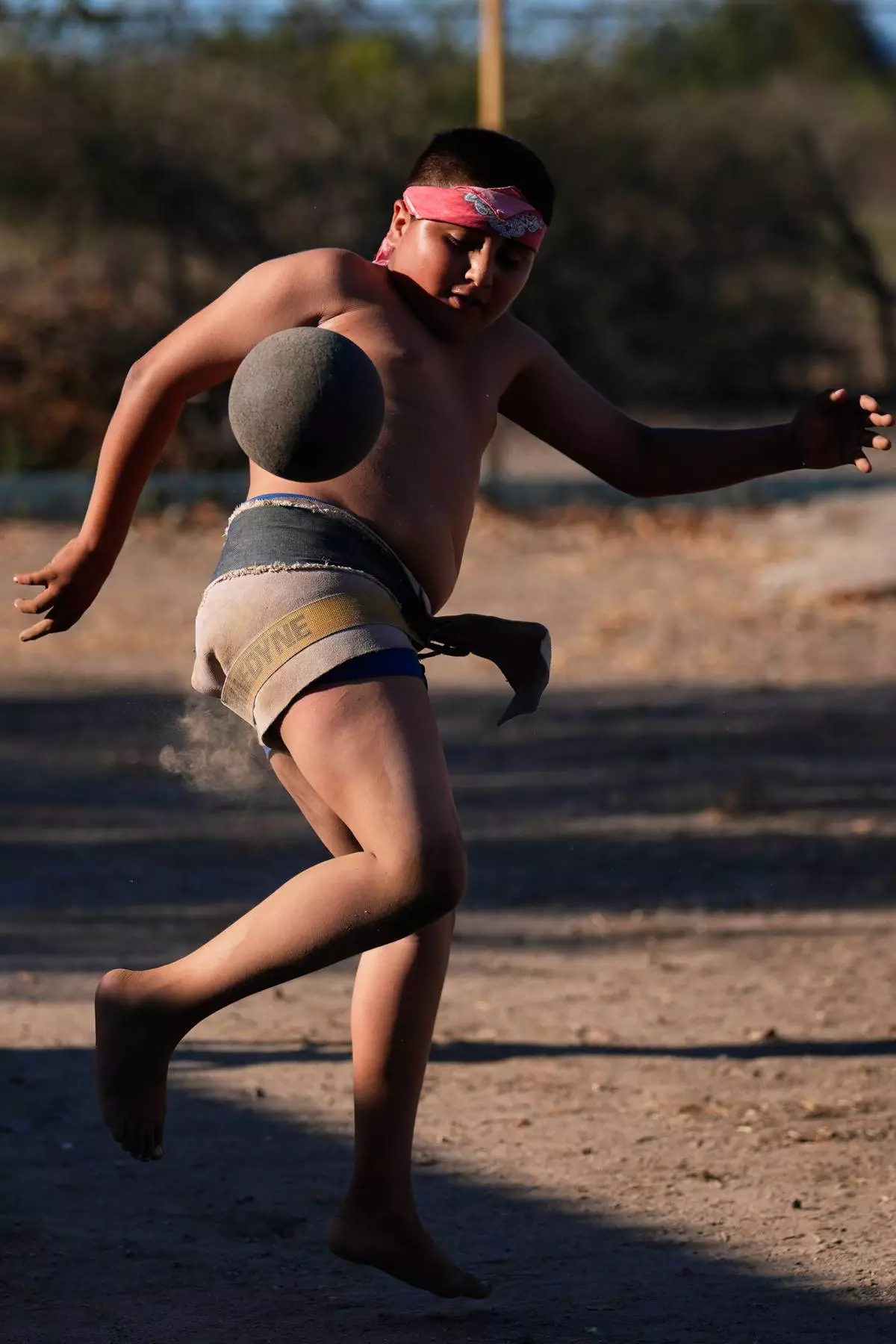
Juan Osuna plays ulama, a traditional Mesoamerican ballgame dating to pre-Hispanic times, in Los Llanitos on the outskirts of Mazatlan, Mexico, Saturday, April 25, 2026. (AP Photo/Marco Ugarte)
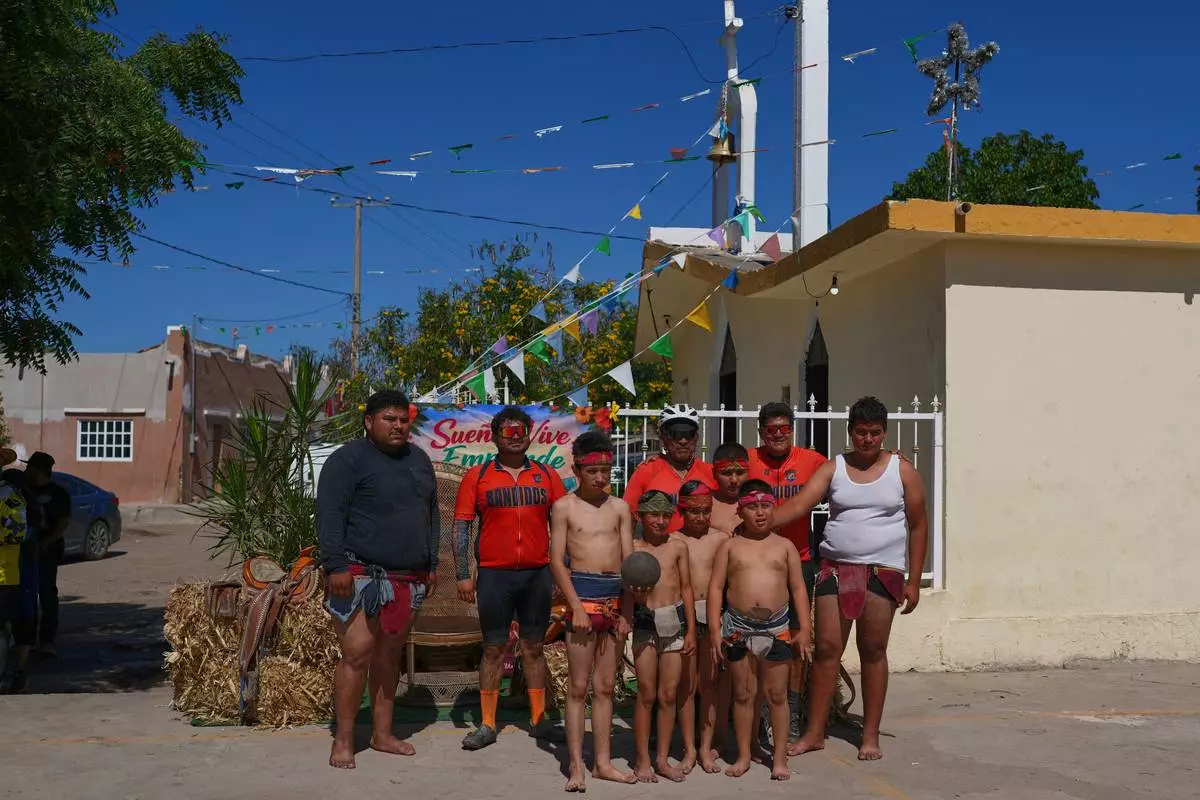
The Osuna family poses for a photo before a match of ulama, a traditional Mesoamerican ballgame dating to pre-Hispanic times, that they organized in Los Llanitos on the outskirts of Mazatlan, Mexico, Saturday, April 25, 2026. (AP Photo/Marco Ugarte)
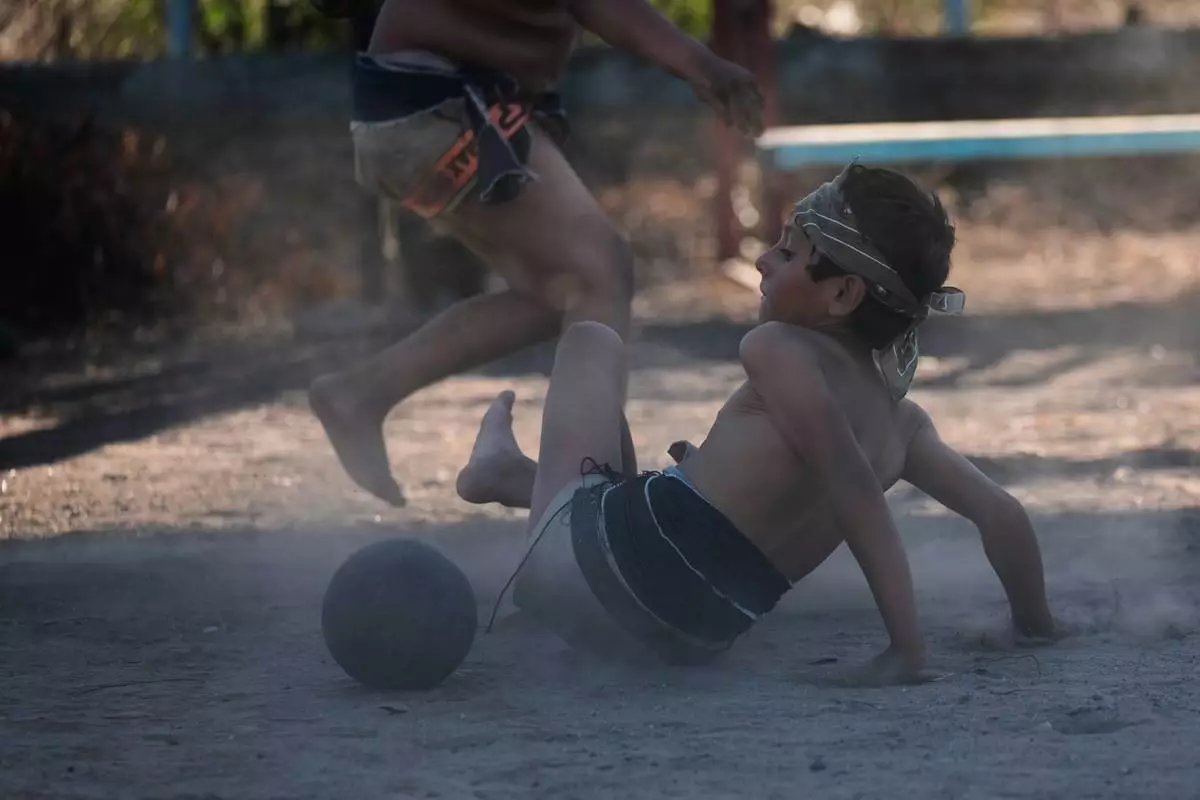
Iker Salgueido plays ulama, a traditional Mesoamerican ballgame dating to pre-Hispanic times, in Los Llanitos on the outskirts of Mazatlan, Mexico, Saturday, April 25, 2026. (AP Photo/Marco Ugarte)
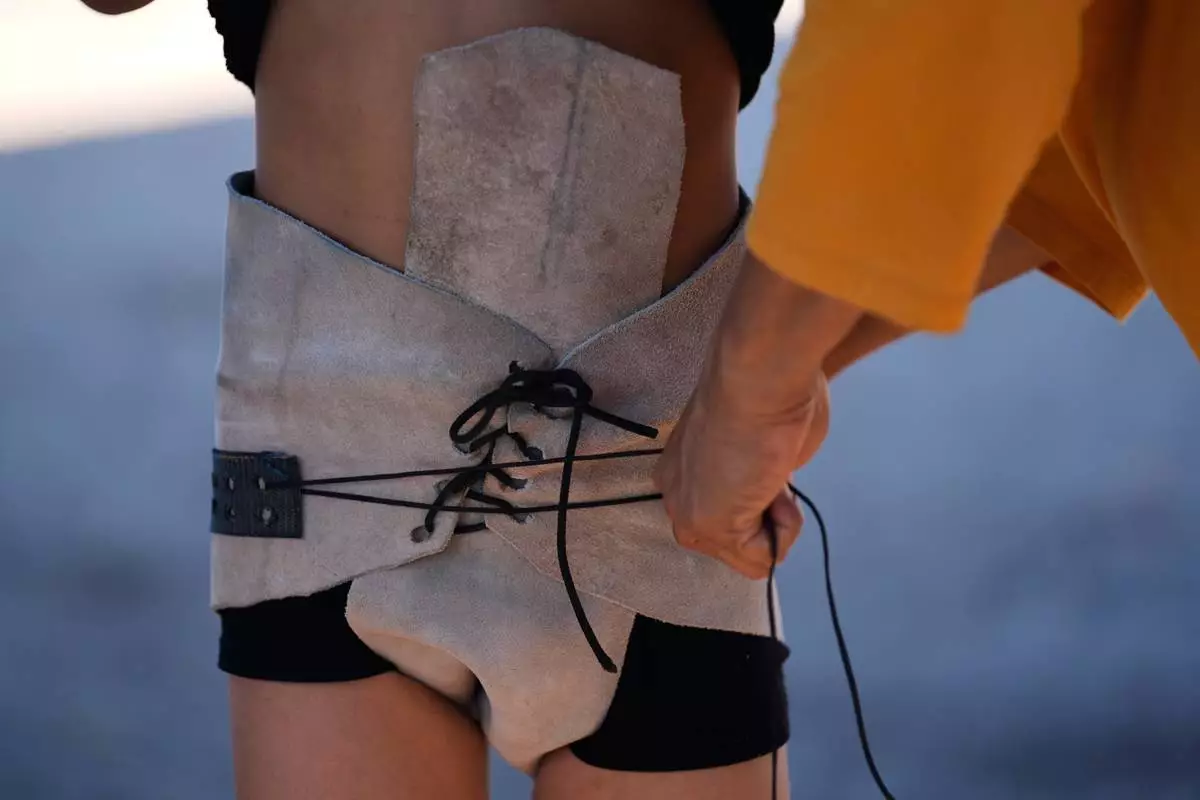
Iker Salgueiro stands still as an adult fastens a pre-Hispanic-style “fajado,” or leather belt, in preparation for ulama, a traditional Mesoamerican ballgame dating to pre-Hispanic times, in Los Llanitos on the outskirts of Mazatlan, Mexico, Saturday, April 25, 2026. (AP Photo/Marco Ugarte)
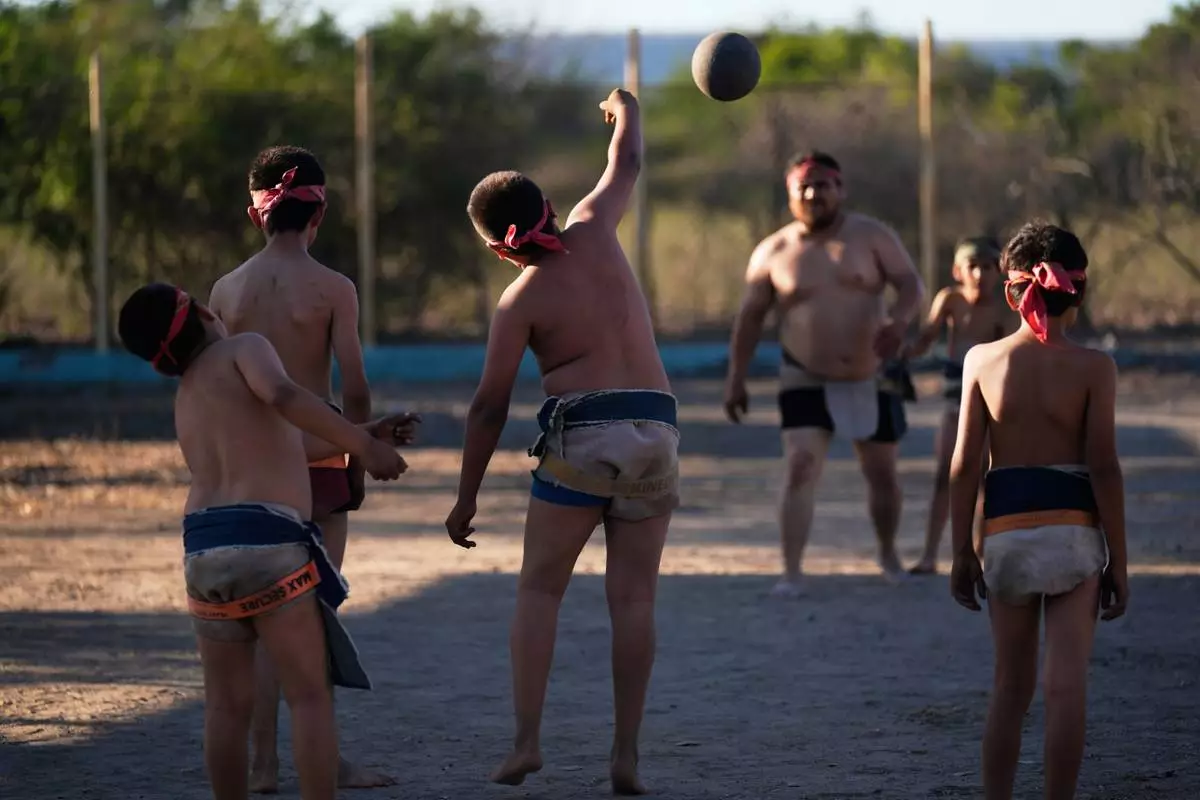
Youth play ulama, a traditional Mesoamerican ballgame dating to pre-Hispanic times, in Los Llanitos on the outskirts of Mazatlan, Mexico, Saturday, April 25, 2026. (AP Photo/Marco Ugarte)