Residents in some northern Chinese cities were treated to a rare and spectacular natural phenomenon on Wednesday evening as vibrant auroras lit up the night sky, as an intense geomagnetic storm punctuated a period of peak solar activity.
In Beijing, the celestial display appeared around 19:00, with ethereal shades of pale pink and emerald green dancing across the heavens for approximately 20 minutes.
The phenomenon was documented by residents in Beijing's northern suburbs, including Huairou and Yanqing. "It is rare to see auroras in Beijing. This occurrence was primarily due to extremely intense solar activity. Under such conditions, sightings become possible in Beijing's more northern areas, particularly in locations with minimal light pollution. Auroras are generally uncommon in our country because China is not situated at high latitudes in the Northern Hemisphere. However, 2024 and 2025 represent the peak years of the current solar cycle, making it possible to observe auroras in some northern regions of China during this period," said Li Xin, director of science education at the Beijing Planetarium.
In Hulunbuir City in north China's Inner Mongolia Autonomous Region, the auroral display was even more spectacular, lasting nearly 10 hours from 19:00 Wednesday through early Thursday morning.
Residents in cities including Genhe and Erguna, located at latitudes around 50 degrees north, witnessed ribbons of red and green illumination swirling across the night sky.
Hulunbuir's location in northern China makes it particularly suitable for seeing the auroras. This week's remarkable display was driven by a powerful geomagnetic storm during the solar maximum, where charged particles collide with atmospheric atoms to produce the unusual red-green auroras at these latitudes.
This marks the second consecutive year of aurora sightings in Genhe, while Erguna has experienced an "aurora-active year" with recorded appearances in January, March, April, and now November.
Further northwest, in Altay Prefecture of northwest China's Xinjiang Uygur Autonomous Region, another stunning auroral performance unfolded late Wednesday.
Situated at a latitude of 46 degrees north with minimal light pollution, the county of Qinghe in the prefecture provided ideal conditions for observing the multicolored bands that shimmered above distant snow-capped mountains, completing a remarkable night of celestial observations across northern China.
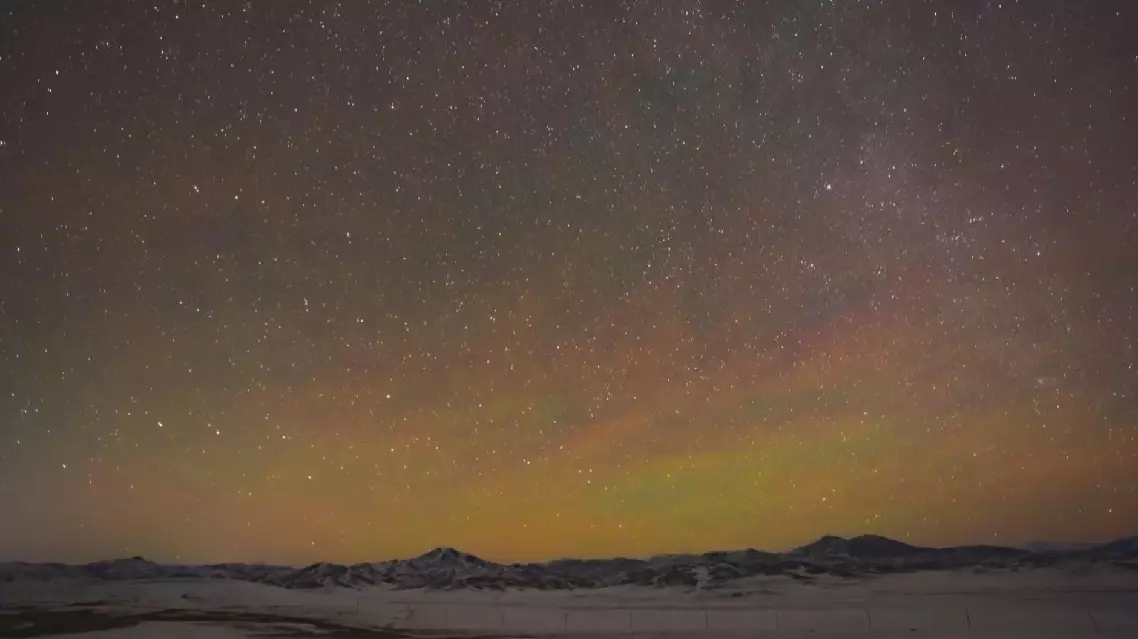
Auroras illuminate skies over northern Chinese cities in rare celestial display