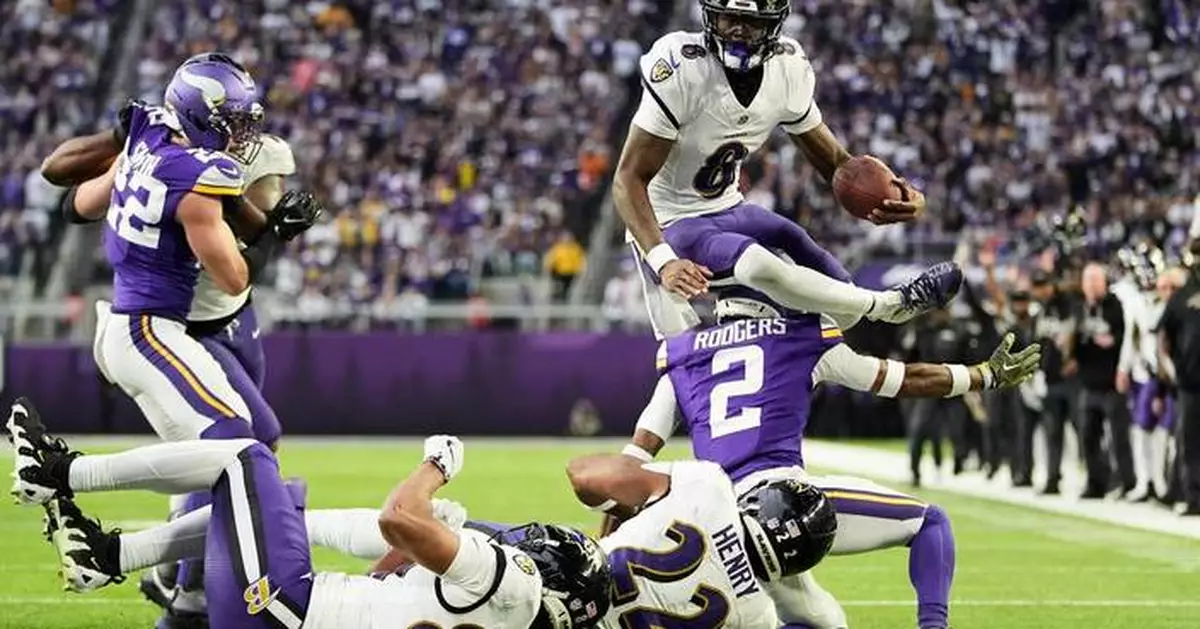
Another injury to Lamar Jackson briefly threatened to disrupt Baltimore's preparation for Sunday's AFC North matchup at Cleveland.
Luckily for the Ravens, Jackson sitting out Wednesday’s practice with a sore knee was only a slight hindrance.
Jackson, a two-time MVP, returned to practice Thursday and is expected to start as Baltimore seeks its fourth straight win and contends for a third consecutive division title.
Jackson, who wasn't sure exactly when he suffered the injury during last weekend’s 27-19 win at Minnesota, almost sounded as if he welcomed the challenge if the Browns decided to blitz him more often because of the knee problem.
“That’s cool with me. I’m cool with it. We’re going to see,” Jackson said.
Baltimore (4-5) lost five of its first six but is unbeaten since its bye week. The Ravens routed the Browns 41-17 in Week 2.
Jackson, who missed three games with a hamstring injury, has completed 35 of 51 passes for 380 yards and five touchdowns in two games since his return.
“Yeah, looks like himself. The offense is a huge challenge with him in there — just his ability as a passer, and the running element he adds to their offense. They have playmakers throughout the roster,” Browns coach Kevin Stefanski said.
While the Ravens have scored at least 27 points in each of their last three games, their greatest improvement has been on defense.
Baltimore gave up at least 37 points in four of its first five games, but has held its last four opponents under 20.
“I think we’ve built some confidence over the past few weeks. Stemming from after the bye,” safety Kyle Hamilton said. “I think a lot of guys felt it was a good time for that bye to come and just like a hard reset for everybody. We’re rolling now as a defense and as a team, so we just have to keep it going. We can’t take for granted what we’ve created over the past few weeks. We have to keep it moving.”
The Ravens aim to sweep the Browns for the first time since 2020. Cleveland (2-7) has lost two straight and continues to struggle offensively. Dillon Gabriel, 1-4 as a starter, first played against Baltimore in mop-up duty, throwing an 8-yard TD pass to Dylan Sampson.
The Browns had two turnovers and a punt blocked in the first meeting, which led to 21 Ravens points.
Gabriel becomes the sixth Browns quarterback to face the Ravens in six meetings. Joe Flacco made his return to Baltimore earlier this season but lost a fumble and threw a pair of interceptions. Flacco was eventually traded to Cincinnati.
Gabriel, a third-round draft pick has completed only 58.6% of his passes. He has thrown for seven touchdowns and only two interceptions.
The Ravens beat another rookie quarterback, Minnesota's J.J. McCarthy, last week.
“It’s very challenging. You have to face the people that you play, and you have a guy (in Dillon Gabriel) who is athletic. He’s young. We haven’t seen much of him,” Ravens coach John Harbaugh said.
Cleveland’s defense, ranked second overall, allows 264.9 yards per game. However, two penalties on the final drive last weekend gave the New York Jets first downs and let them run out the clock.
All-Pro pass rusher Myles Garrett leads the league with 17 tackles for loss and shares the sack lead with 11. He has sacked Jackson seven times.
The Ravens are closing in on a few milestones. Mark Andrews is 3 yards receiving behind Derrick Mason for the franchise’s career lead, and he’s six receptions behind Mason for the team record in that category. Mason caught 471 passes for 5,777 yards for Baltimore.
Additionally, veteran DeAndre Hopkins is four receptions shy of 1,000.
Baltimore had a minus-7 turnover margin while starting the season 1-5. Then the Ravens won three in a row with a plus-7 margin across those games.
“It’s something that we practice and something that has to be intentional throughout the game — intentionally punching at the ball, ripping at the ball, whatever it may be,” Hamilton said. “Guys see other guys doing it, and it motivates other people and brings that intentionality out.”
AP Sports Writer Noah Trister contributed to this report.
AP NFL: https://apnews.com/hub/nfl
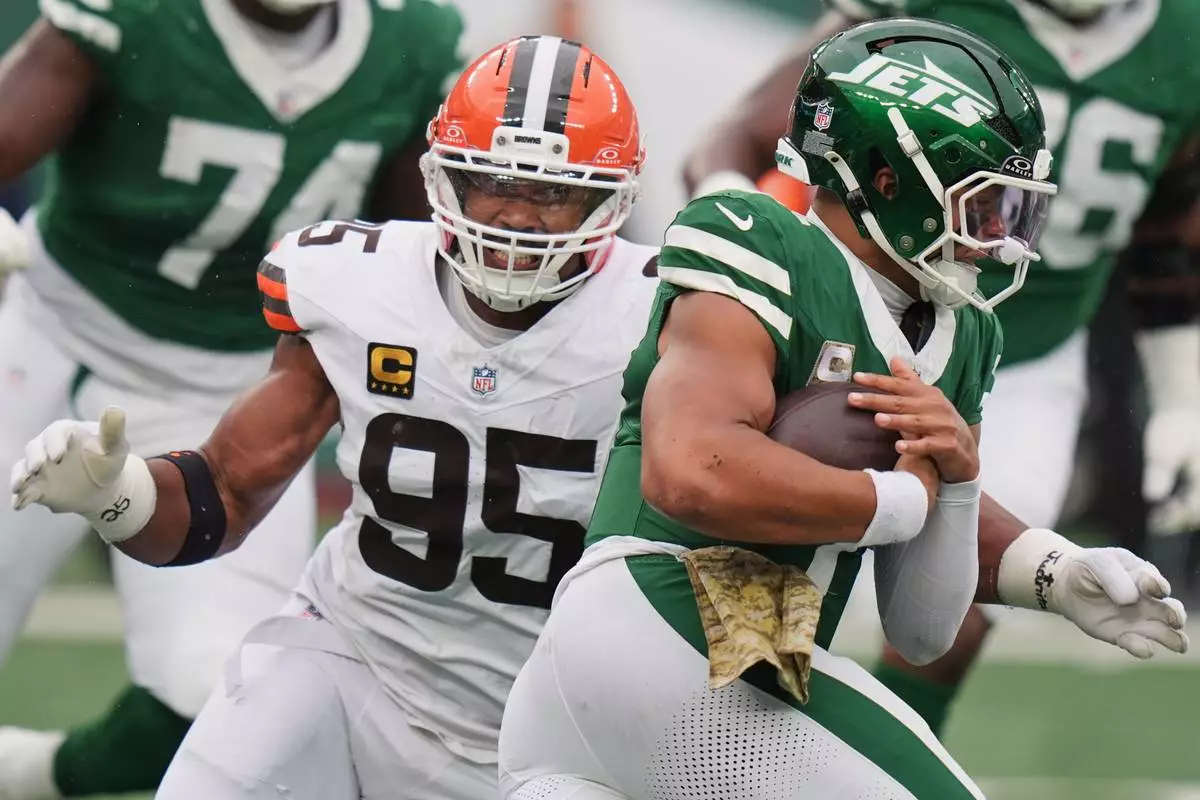
Cleveland Browns defensive end Myles Garrett (95) sacks New York Jets quarterback Justin Fields, right, in the first half of an NFL football game Sunday, Nov. 9, 2025, in East Rutherford, N.J. (AP Photo/Seth Wenig)

Cleveland Browns quarterback Dillon Gabriel (8) gestures in the first half of an NFL football game against the New York Jets, Sunday, Nov. 9, 2025, in East Rutherford, N.J. (AP Photo/Seth Wenig)
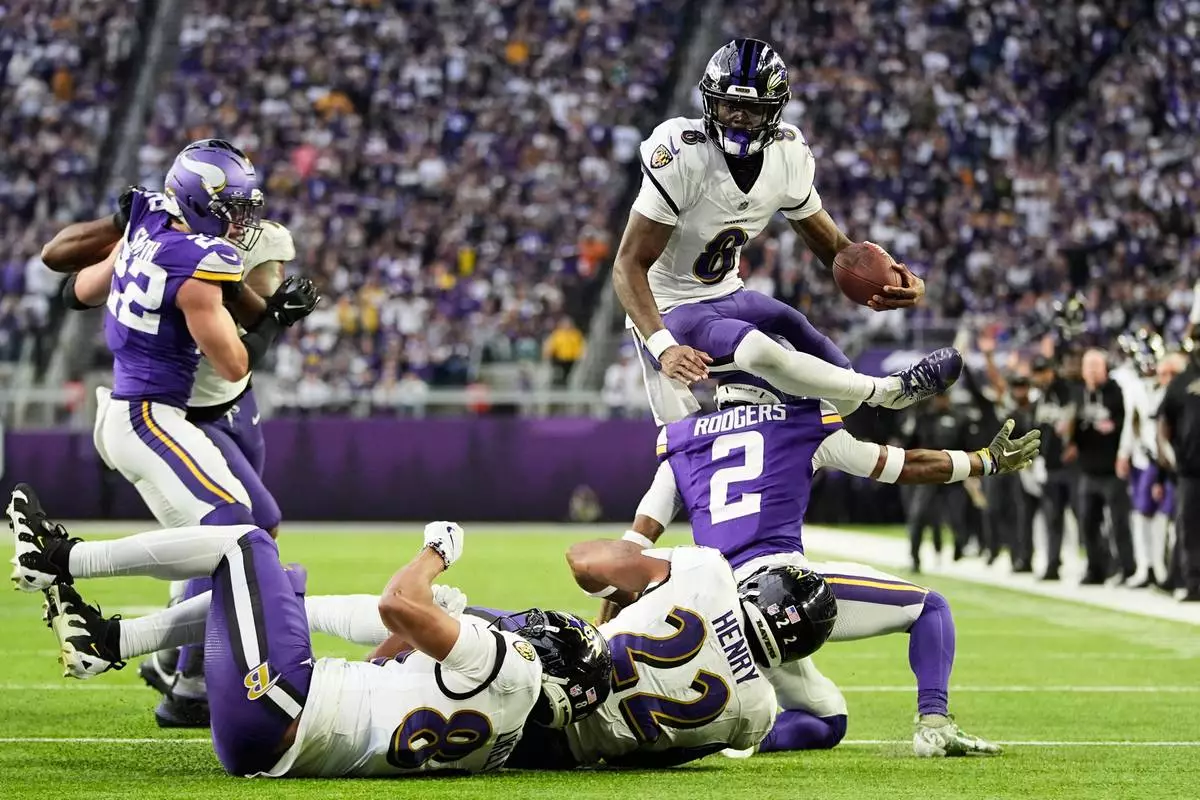
Baltimore Ravens quarterback Lamar Jackson (8) hurdles over Minnesota Vikings cornerback Isaiah Rodgers (2) near the goal line in the second half of an NFL football game, Sunday, Nov. 9, 2025, in Minneapolis. (AP Photo/Abbie Parr)
DUBAI, United Arab Emirates (AP) — Iran hit an oil tanker off the coast of Qatar and Kuwait’s airport on Wednesday while airstrikes battered Tehran — an unrelenting tempo hours after U.S. President Donald Trump said he was nearly ready to wind down the war.
Trump, who is scheduled to address the nation later in the day, said he could walk away from the war in two to three weeks once he felt confident Iran would not be able to build a nuclear weapon — even if Tehran does not agree to a ceasefire.
That raised the possibility that the U.S. could withdraw without any guarantee from Iran that it would stop bombing its Gulf Arab neighbors or release its grip on the crucial Strait of Hormuz. A fifth of the world’s traded oil passes through the strait in peacetime and Tehran’s stranglehold, along with its strikes on energy infrastructure in the region, has caused oil prices to skyrocket, with far-reaching consequences for the global economy. Even if the strait were to reopen quickly, some effects like higher food prices could persist for months or longer.
It’s also not clear what Israel, which began bombing Iran alongside the U.S. on Feb. 28, would do if the U.S. pulls out without a deal. It also leaves open the question of what Iran might do with the highly enriched uranium still in its stockpiles.
Trump’s comments offered another mixed signal from the American leader who has offered shifting objectives for the war and repeatedly said it could be over soon while also threatening to widen the conflict. Thousands of additional U.S. troops are currently heading to the Middle East, and speculation abounds about the purpose of their deployment.
Just days ago, Trump warned that the U.S. would attack Iran’s power plants if Tehran did not reopen the strait by April 6. He has also threatened to attack Iran’s Kharg Island oil export hub and possibly desalination plants.
But on Tuesday, Trump said the U.S. “will not have anything to do with” ensuring the security of ships passing through Hormuz.
Speaking to Al Jazeera, Iranian Foreign Minister Abbas Araghchi signaled Tehran’s willingness to keep fighting.
“You cannot speak to the people of Iran in the language of threats and deadlines,” he said. “We do not set any deadline for defending ourselves.”
Trump has been under growing pressure to end the war as oil prices have skyrocketed, pushing up the cost of gasoline, food and other goods. The spot price of Brent crude, the international standard, was up more than 40% since the start of the war, trading at more than $103 a barrel on Wednesday.
The U.S. has presented Iran with a 15-point plan aimed at bringing about a ceasefire, including a demand for the strait to be reopened and for is nuclear program to be rolled back.
Iran insists its nuclear program is peaceful. Its own five-point response includes retaining sovereignty over the strait.
In the interview with Al Jazeera, Araghchi acknowledged receiving direct messages from U.S. Mideast envoy Steve Witkoff. He insisted, however, that there were no direct negotiations and said Iran has no faith that talks with the U.S. could yield any results, saying “the trust level is at zero.”
He warned against any U.S. attempt to launch a ground offensive, saying “we are waiting for them.”
A cruise missile slammed into an oil tanker off Qatar’s coast Wednesday, the Defense Ministry said. The 21-member crew of the tanker, contracted by state-owned QatarEnergy, was evacuated and no casualties were reported.
A fully-loaded Kuwaiti oil tanker came under attack off Dubai the day before, one of more than 20 ships attacked by Iran during the war.
In the United Arab Emirates, a person was killed when he was hit by debris from an intercepted drone in Fujairah, one of the country’s seven emirates.
Bahrain sounded two alerts for incoming missiles, while Kuwait’s state-run KUNA news agency said a drone hit a fuel tank at Kuwait International Airport, sparking a large fire.
Two drones were also intercepted in Saudi Arabia, and air raid sirens sounded in Israel though there were no immediate reports of damage or casualties.
An airstrike on Tehran, meanwhile, appeared to have hit the former U.S. Embassy compound, which has been controlled by Iran’s Revolutionary Guard since American diplomats were held hostage there in 1979.
Witnesses said buildings outside the massive compound had their windows blown out and that it appears the strike happened inside the walled facility.
Israel also said it hit a plant in Iran producing fentanyl, a synthetic opioid. Israel and the United States have alleged in recent years that Iran was experimenting with using fentanyl in chemical weapons.
Iran acknowledged a strike Tuesday on Tofigh Daru factory, but insisted it only supplied “hospital drugs.” Hospitals use fentanyl to treat severe pain but it can also be fatal.
In Lebanon, at least five people were killed in an Israeli strike on a Beirut neighborhood.
Israel invaded southern Lebanon after the Iran-linked Hezbollah militant group began launching missiles into northern Israel days after the outbreak of the war. Many Lebanese fear another prolonged military occupation.
More than 1,200 people have been killed in Lebanon and more than 1 million displaced, according to authorities. Ten Israeli soldiers have also died there.
In Iran, authorities say more than 1,900 people have been killed, while 19 have been reported dead in Israel. More than two dozen people have died in Gulf states and the occupied West Bank, while 13 U.S. service members have been killed.
Rising reported from Bangkok. Associated Press writers Giovanna Dell’Orto in Miami and Samy Magdy in Cairo contributed to this report.

A young girl is comforted by her father and Israeli soldiers as they take cover in a bomb shelter during air raid sirens warning of incoming Iranian missile strikes in Bnei Brak, Israel, Wednesday, April 1, 2026. (AP Photo/Oded Balilty)
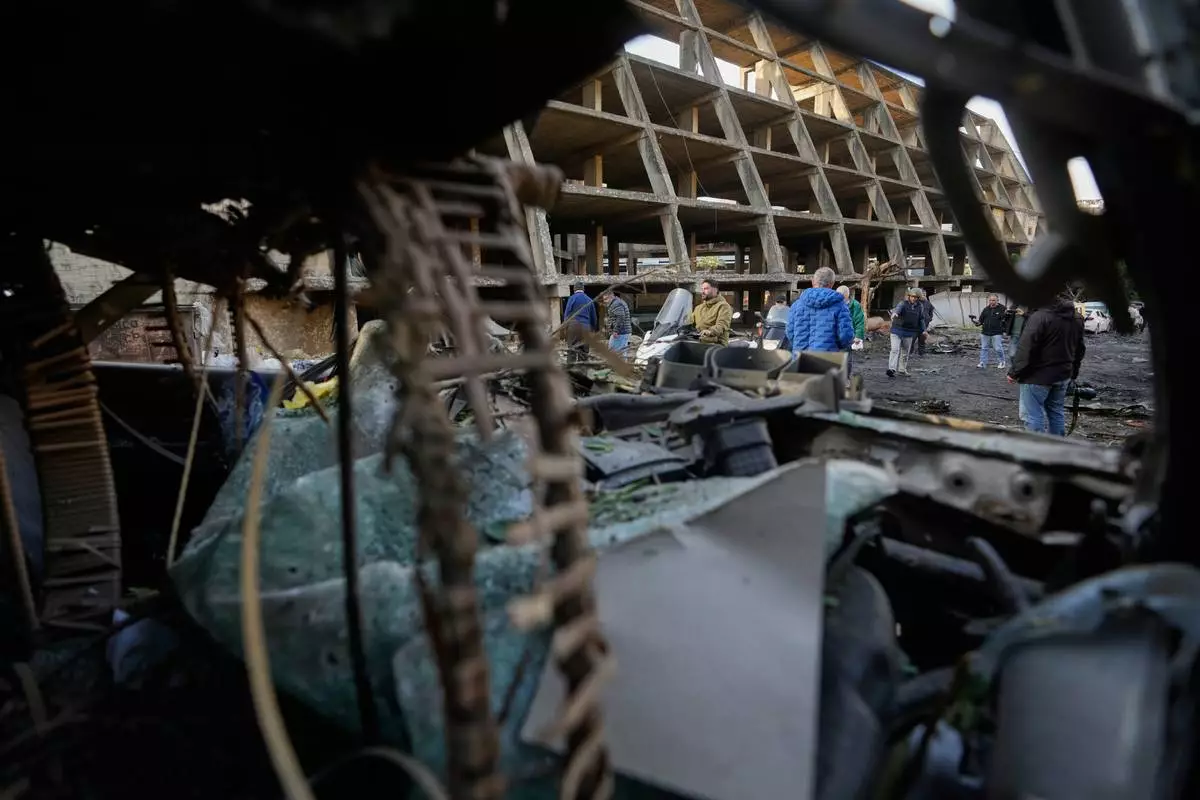
People inspect the site of an Israeli strike amid debris and damaged vehicles in Beirut, Lebanon, Wednesday, April 1, 2026. (AP Photo/Hassan Ammar)

A man feeds stray cats in Tehran, Iran, Tuesday, March 31, 2026. (AP Photo/Vahid Salemi)
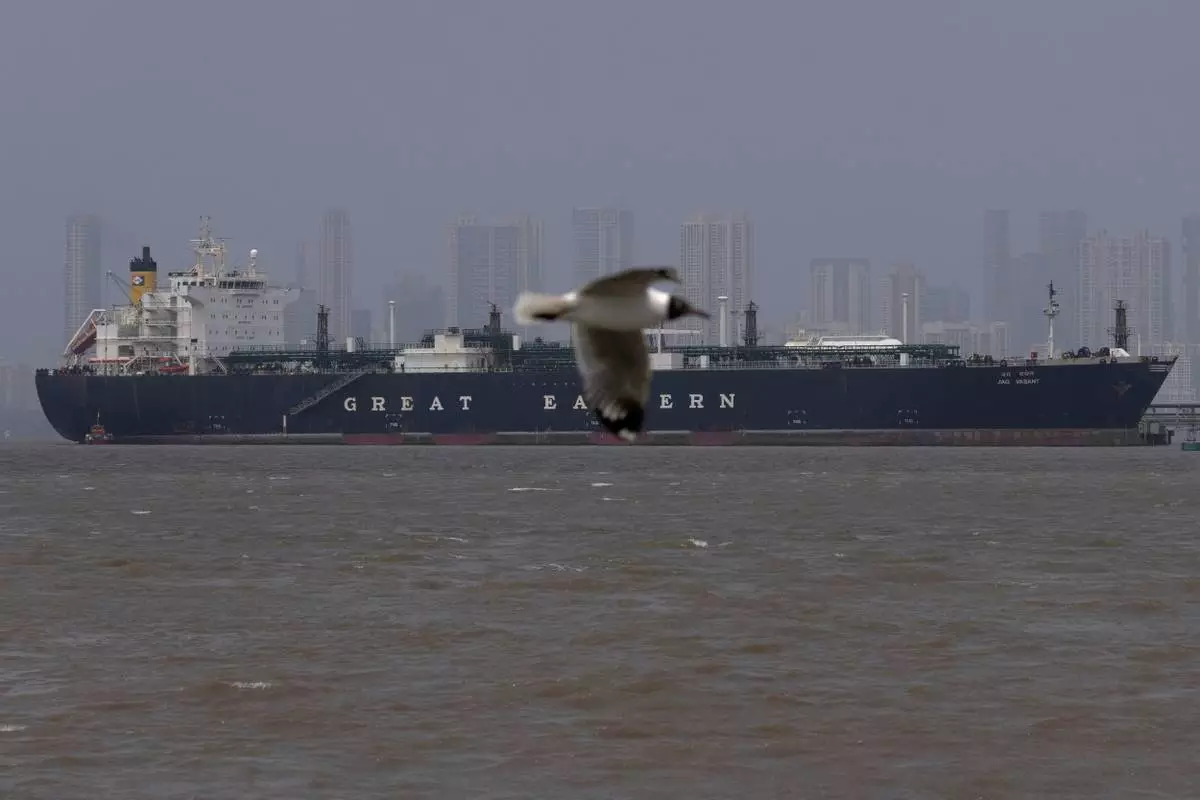
The Indian flagged LPG carrier Jag Vasant transporting liquefied petroleum gas, is seen at the Mumbai Port in Mumbai, India, after it arrived clearing the Strait of Hormuz, Wednesday, April 1, 2026. (AP Photo/Rafiq Maqbool)
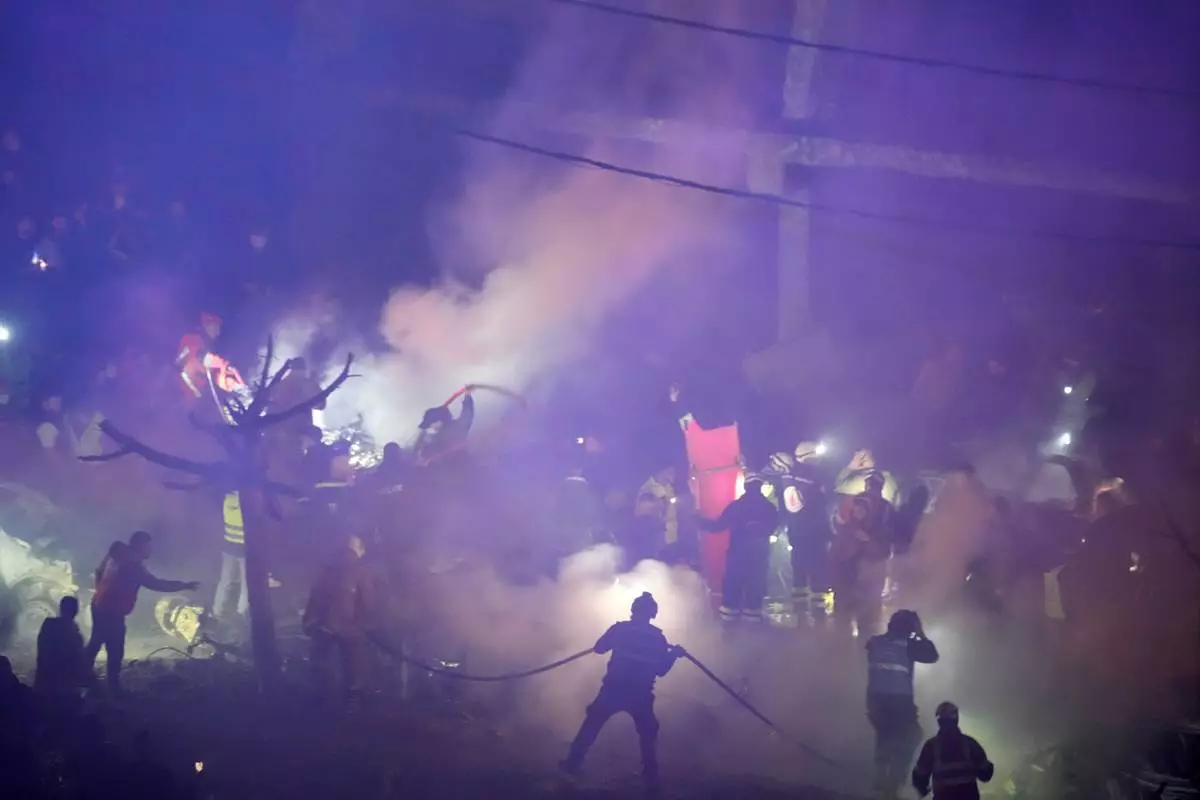
Firefighters and rescue workers work at the site of Israeli airstrikes, in Beirut, Lebanon, Wednesday, April 1, 2026. (AP Photo/Hussein Malla)
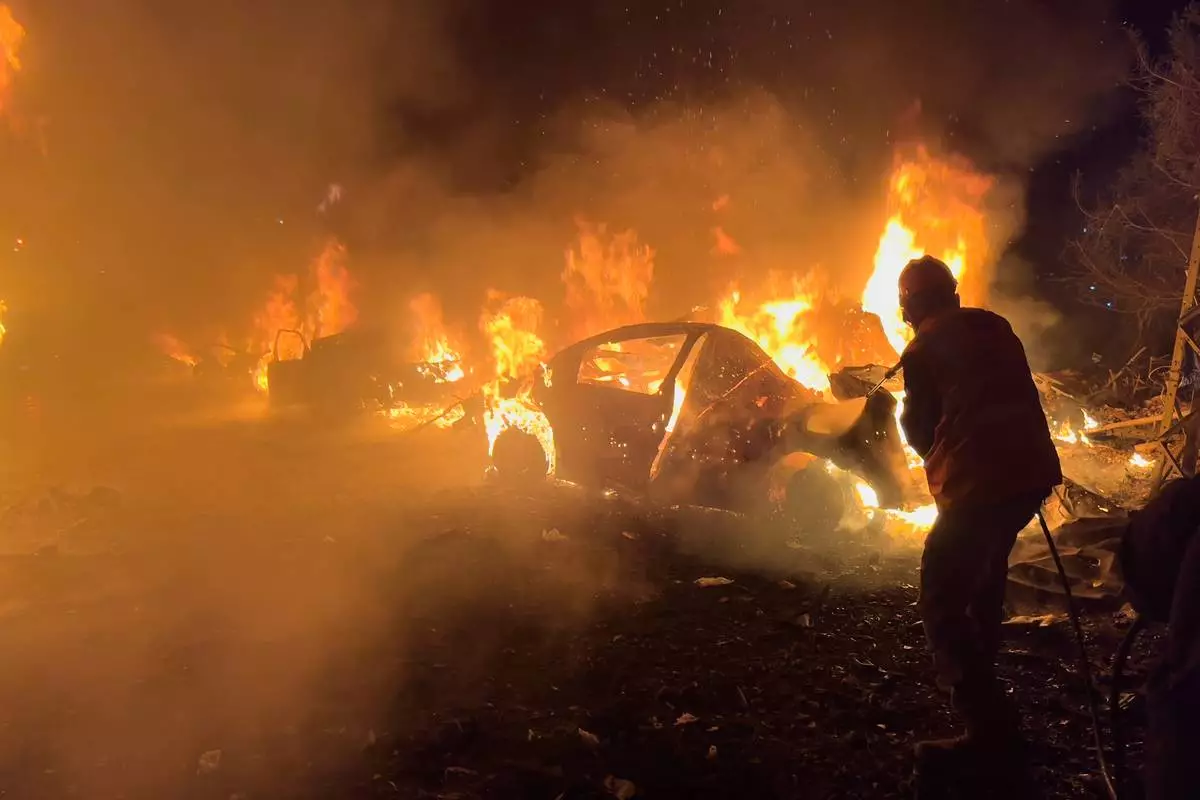
A firefighter extinguishes a car at the site of Israeli airstrikes, in Beirut, Lebanon, Wednesday, April 1, 2026. (AP Photo/Hussein Malla)
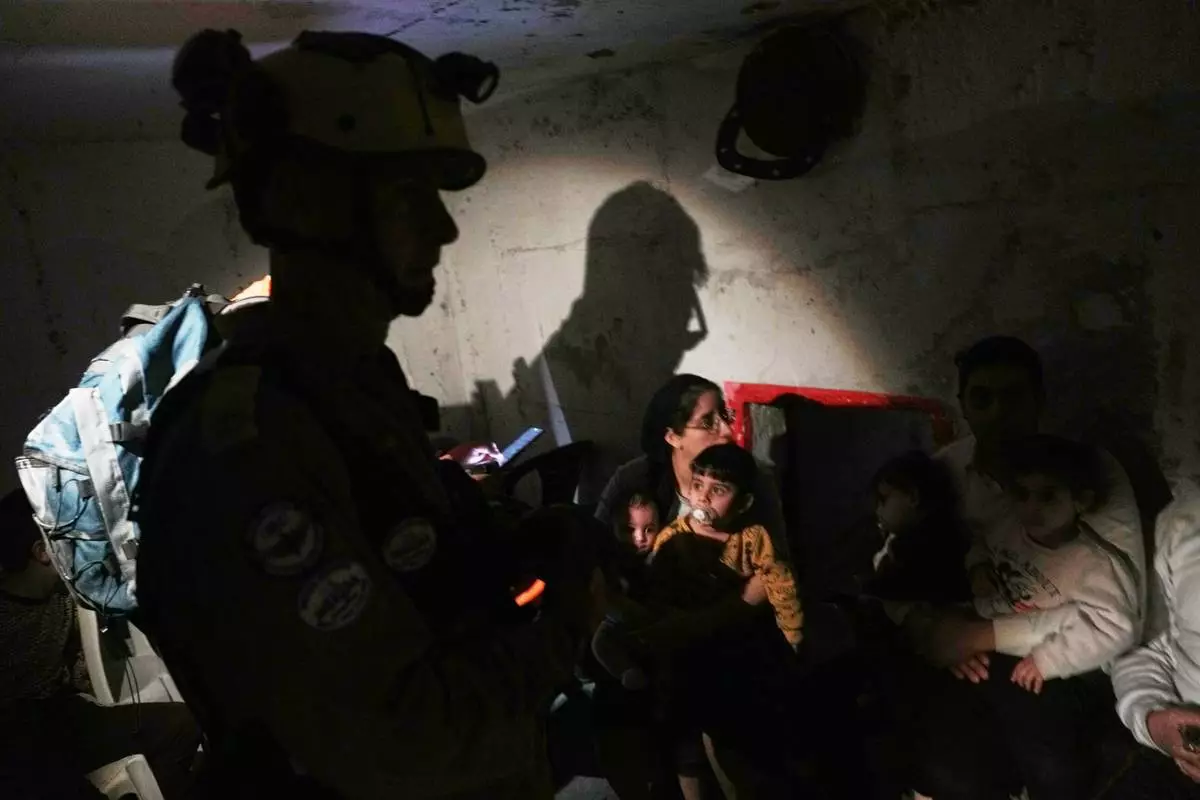
Israel's rescue teams and residents take shelter as sirens sounds next to a site struck by an Iranian missile in Bnei Brak, Wednesday, April 1, 2026. (AP Photo/Oded Balilty)

A police vehicle is seen through a shattered windshield at the site of an Israeli strike in Beirut, Lebanon, Wednesday, April 1, 2026. (AP Photo/Hassan Ammar)
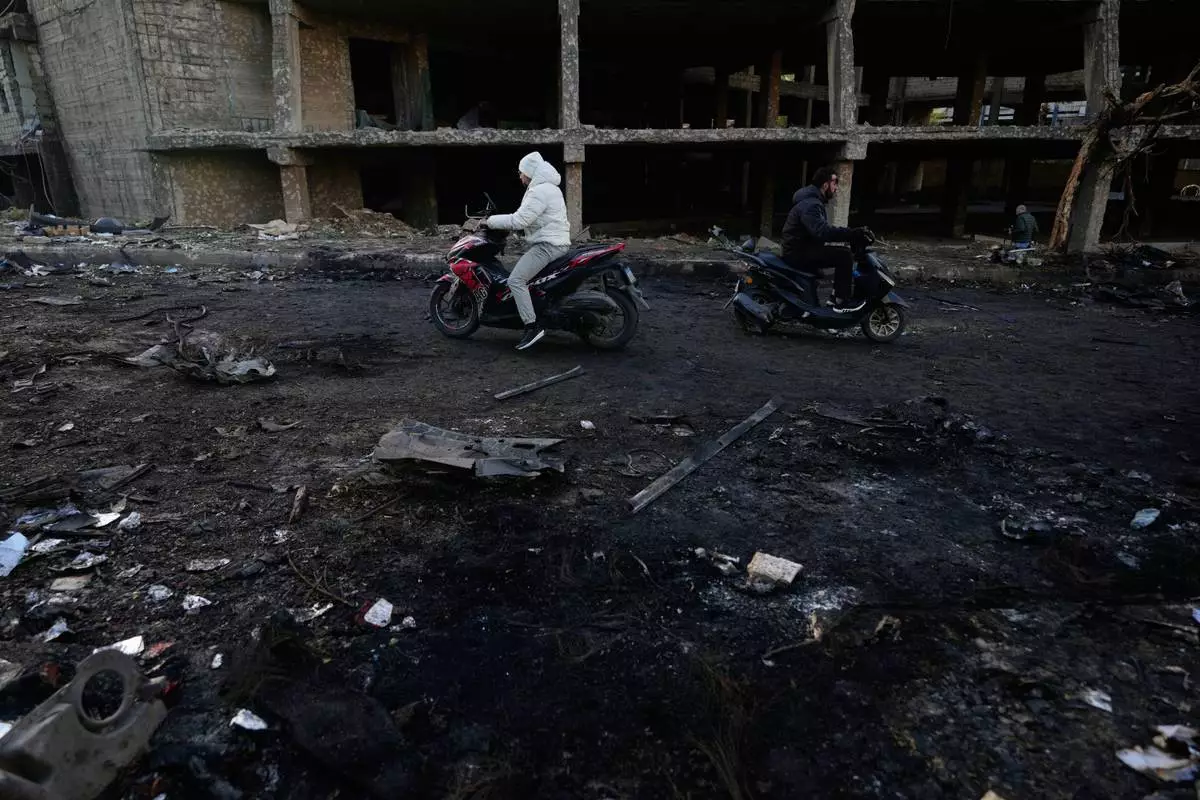
Two men ride scooters past charred debris at the site of an Israeli strike in Beirut, Lebanon, Wednesday, April 1, 2026. (AP Photo/Hassan Ammar)