BERLIN--(BUSINESS WIRE)--Nov 14, 2025--
ESMO AI & Digital Health 2025 - Massive Bio today introduced Reticulum Nexus, the company’s most significant technological leap to date: a patient-centric, multi-agent platform engineered to coordinate the full oncology journey, from first contact to last-mile enrollment, across networks operating at global scale.
This press release features multimedia. View the full release here: https://www.businesswire.com/news/home/20251112162820/en/
In an environment where clinical trial access has long been constrained by fragmented data pipelines, site-centric processes, and human-heavy workflows, Reticulum Nexus establishes a unified operating fabric. This next-generation system integrates clinical and operational intelligence to match, enroll, and collect outcomes to build more powerful advanced analytics.
The company’s most recent announcements include:
“Most systems optimize a single node,” said Selin Kurnaz, PhD, Cofounder & CEO. “Reticulum Nexus will help bring in the world’s first scalable patient journey, and paired with the enablement of AI agents.”
“ Moravec’s Paradox shows us the boundary between repetitive and contextual work,” said Arturo Loaiza-Bonilla, MD, Cofounder & Chief Medical AI Officer. “With Reticulum Nexus, multi-agent, contextual AI handles the operational load so clinicians can focus on human care. Dr. Arturo AI already supports thousands of patients; we can now safely scale to millions.”
“Radiant Core is the control plane that makes agentic AI dependable at production scale,” added Çağatay Çulcuoğlu, Cofounder, CTO & COO. “SYNERGYAI OS is the routing fabric connecting every workflow. Together, they deliver interoperability, auditability, and real-world performance from day one.”
Inside Reticulum Nexus
Radiant Core - the control plane focused on data quality, compliance, and agent behavior.
SYNERGYAI OS - the multi-agent operating system
Interoperable Architecture - native FHIR/mCODE integration, governance designed for regulated environments (GDPR, HIPAA).
Modules Available at Launch
About Massive Bio
Massive Bio, co-founded by Selin Kurnaz, Arturo Loaiza-Bonilla, and Çağatay Çulcuoğlu, transforms the pharmaceutical value chain with AI-driven solutions. As an AI-enabled real-world data company, Massive Bio streamlines patient journeys, improves access to cutting-edge treatments, and optimizes clinical trial operations across 17 countries. A founding member of the CancerX public-private partnership and participant in the White House Cancer Moonshot initiative, the company continues to lead the way in ethical AI and data-driven innovation.
For more information, visit www.massivebio.com.

Reticulum Nexus: Massive Bio’s new AI-driven multi-agent platform supporting every step of the patient journey.
NAGOYA, Japan (AP) — Led by 13-year-old Yu Zidi, China dominated the first day of swimming at the Asian Games with Yu and defending Olympic champion Pan Zhanle taking gold.
Yu easily won the 200-meter butterfly on Sunday at the Olympic pool in Tokyo, and Pan took the 100 free, where he holds the world record (46.40 seconds) set two years ago in Paris.
Yu swam a personal-best time of 2:05.08 and fellow Chinese Chang Mohan took silver (2:08.44) with bronze for Misa Okuzono (2:09.97) of Japan.
“This is to step onto the podium of the Olympic Games,” Yu said. “The top podium. I train hard day after day.
“Success never arrives overnight. I am very excited and proud."
Teammate Li Bingjie a former Olympic and world champion who won the 1,500 freestyle, is from the same area in China — the city of Baoding in Hebei province. She suggested that made the victory even more special.
“I am very happy for her,” Li said. “I was very excited to see her win the gold while I was waiting for my race.”
Yu is a swimmer the world is watching heading to next year's world championships in Budapest, Hungary, and the Los Angeles Olympics in 2028. She turns 14 in October.
Yu defeated American Regan Smith earlier this year in the 200 fly in a meet in China. She swam a personal best in that race (2:05.71), which she eclipsed on Sunday.
Smith took silver in the 2024 Paris Olympics behind the dominant swimmer in the event — Summer McIntosh of Canada.
McIntosh holds the world record in the 200 fly (2:01.65) and also holds the marks in Yu's two other dominant races — the 200 individual medley (2:05.70) and the 400 IM (4:23.65). Yu will swim all three events in Japan.
Pan was more than a second off his world-record time and finished in 47.61, barely beating Kim Youngbeom of South Korea (47.65). Another South Korean, Hwang Sunwoo, took bronze (47.79).
Leon Marchand, who won four Olympic gold medals two years ago, was on the pool deck in Tokyo handing out medals.
The Asian games opened officially on Saturday with the first full-day of competition on Sunday. They end Oct. 4.
See full AP coverage of Asian sports here
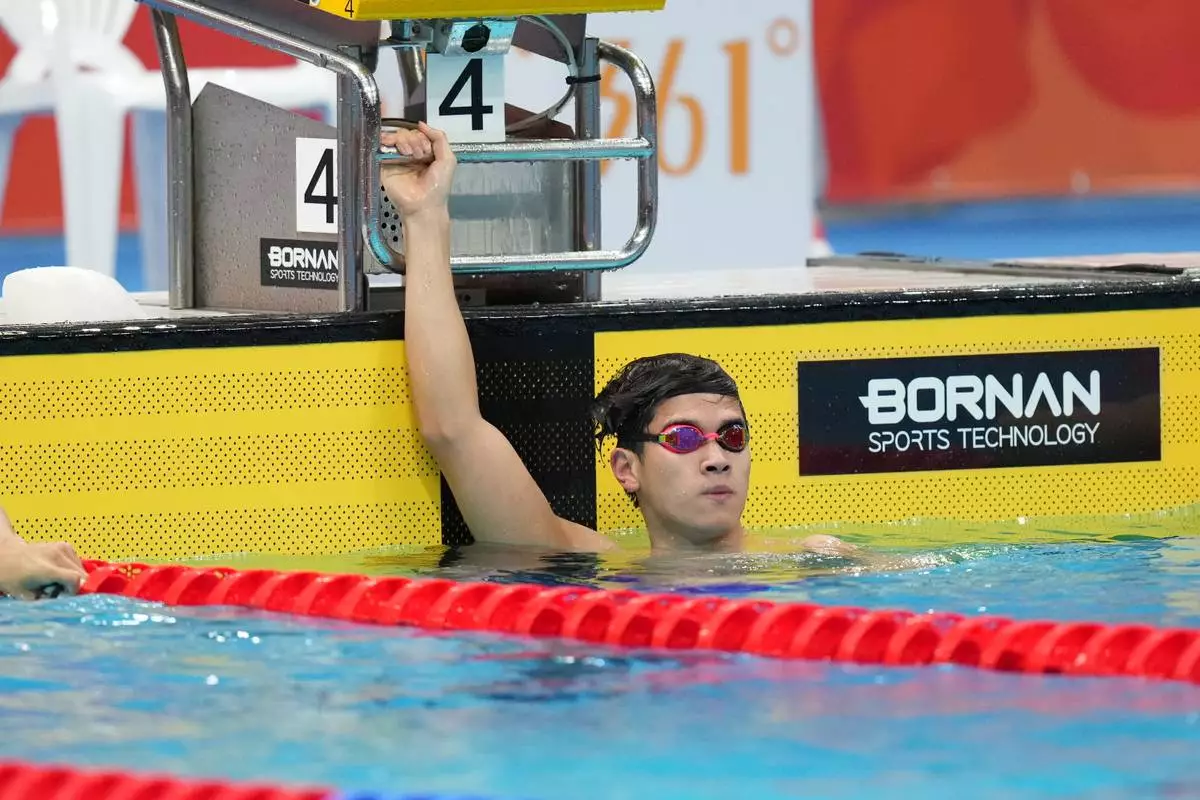
Pan Zhanle of China watches the scoreboard after competing in the men's 100-meter freestyle final in swimming at the Asian Games in Tokyo, Japan, Sunday, Sept. 20, 2026. (AP Photo/Hiro Komae)
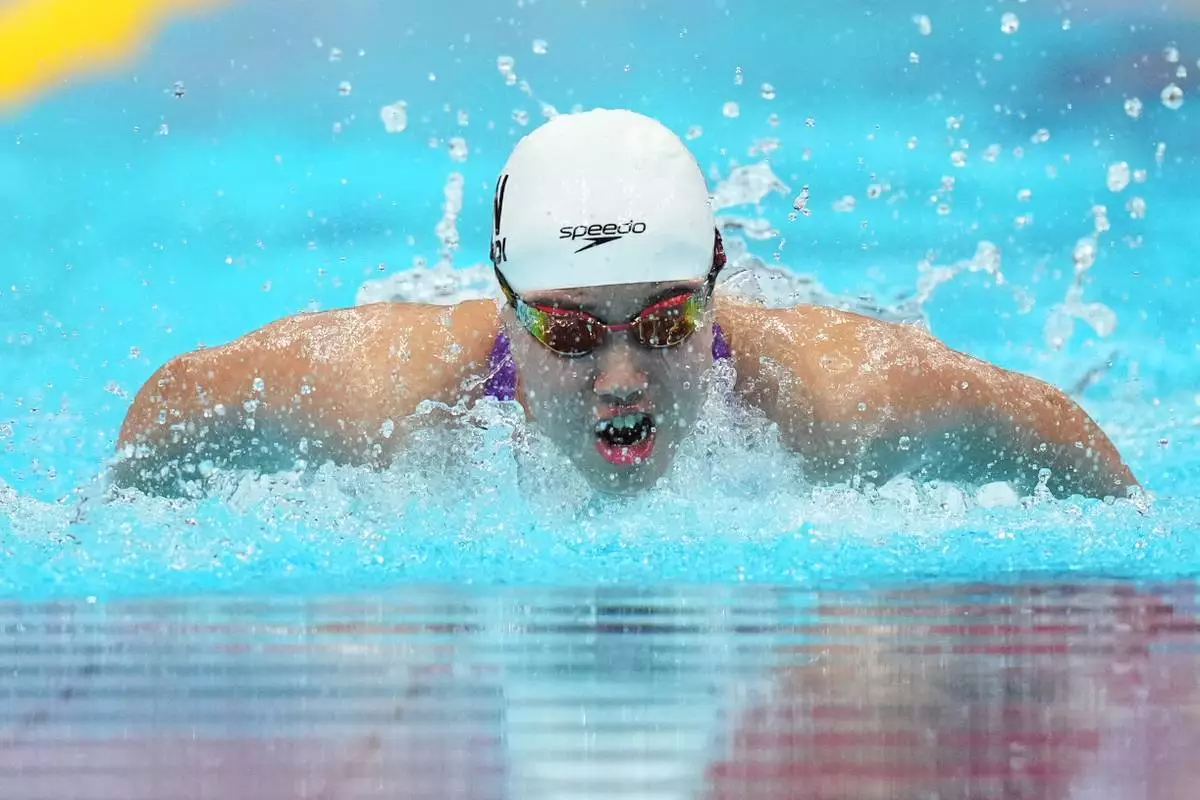
Yu Zidi of China competes in the women's 200-meter butterfly final in swimming at the Asian Games in Tokyo, Japan, Sunday, Sept. 20, 2026. (AP Photo/Hiro Komae)
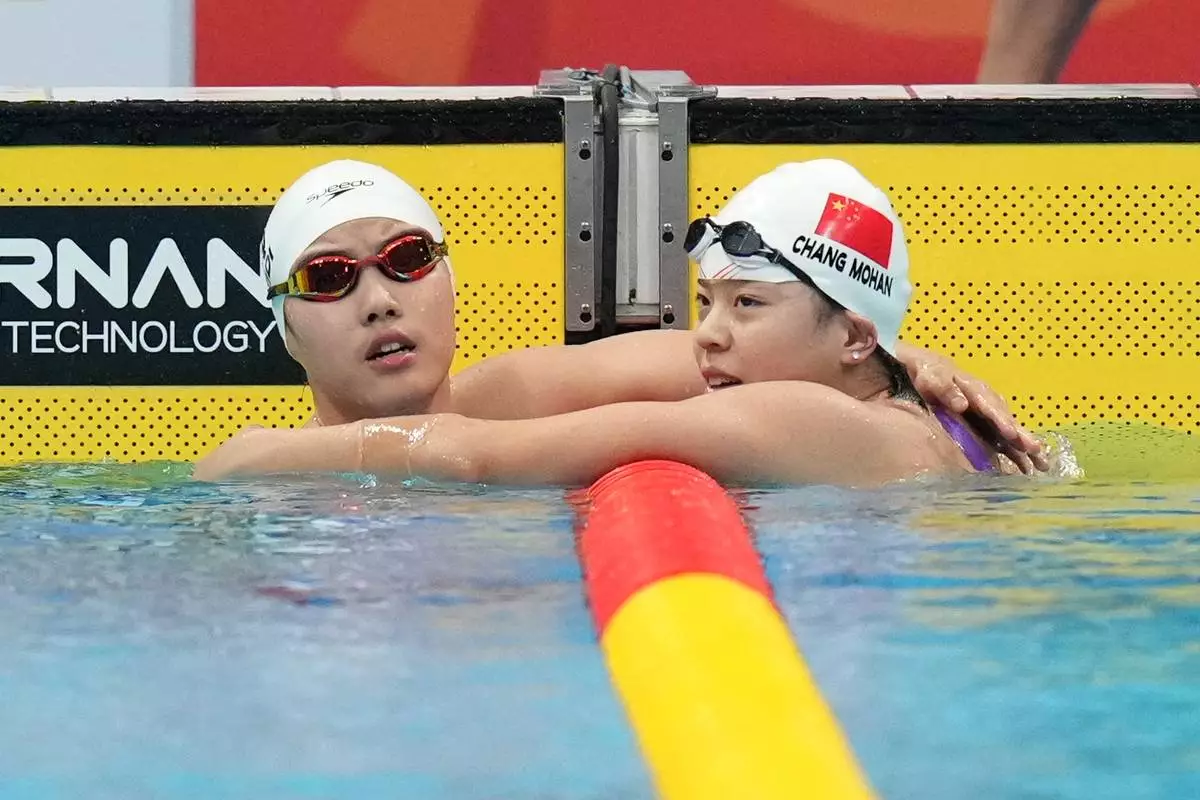
Yu Zidi of China, left, and Chang Mohan of China reach towards each other after competing in swimming at the Asian Games in Tokyo, Japan, Sunday, Sept. 20, 2026. (AP Photo/Hiro Komae)
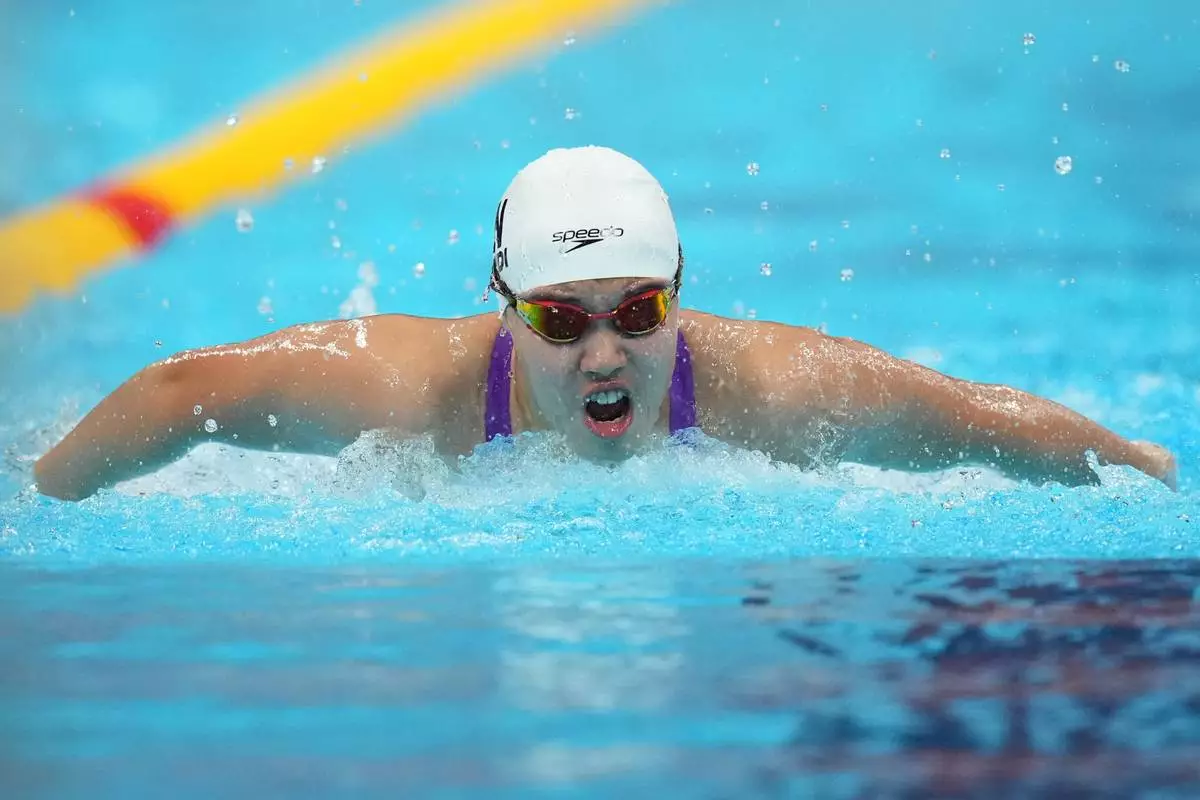
Yu Zidi of China competes in the women's 200-meter butterfly final in swimming at the Asian Games in Tokyo, Japan, Sunday, Sept. 20, 2026. (AP Photo/Hiro Komae)

Gold medalist Yu Zidi of China, center, flanked by silver medalist Chang Mohan of China, left, and bronze medalist Misa Okuzono of Japan pose on the podium after the women's 200-meter butterfly final in swimming at the Asian Games in Tokyo, Japan, Sunday, Sept. 20, 2026. (AP Photo/Hiro Komae)