WASHINGTON (AP) — The U.S. Chamber of Commerce asked the Supreme Court on Friday to pause new California laws expected to require thousands of companies to report emissions and climate-risk information.
The laws are the most sweeping of their kind in the nation, and a collection of business groups argued in an emergency appeal that they violate free-speech rights.
The measures were signed by Democratic Gov. Gavin Newsom in 2023, and reporting requirements are expected to start early next year.
Lower courts have so far refused to block the laws, which the state says will increase transparency and encourage companies to assess how they can cut their emissions.
The Chamber of Commerce asked the justices to put the laws on hold while lawsuits continue to play out.
One requires businesses that make more than $1 billion a year and operate in California to annually report their direct and indirect carbon emissions, beginning in 2026 and 2027, respectively.
That includes planet-warming pollution from burning fossil fuels directly, as well as releases from activities such as delivering products from warehouses to stores and employee business travel. The Chamber of Commerce estimates it will affect about 5,000 companies, though state air regulators say it will apply to roughly 2,600.
The other law requires companies that make more than $500,000 a year to biennially disclose how climate change could hurt them financially. The state Air Resources Board estimates more than 4,100 companies will have to comply.
“Without this Court’s immediate intervention, California’s unconstitutional efforts to slant public debate through compelled speech will take effect and inflict irreparable harm on thousands of companies across the country,” the companies argued.
Companies that fail to publish could be subject to civil penalties. ExxonMobil also challenged the laws in a lawsuit filed last month.
The state has argued that the laws don’t violate the First Amendment because commercial speech isn’t protected the same way under the Constitution.
In 2023, Newsom called the emissions-disclosure law an important policy and of the state's “bold responses to the climate crisis, turning information transparency into climate action.” The environmental group Ceres has said the information will help people decide whether to support the businesses.
The U.S. Securities and Exchange Commission approved a rule last year requiring some public companies to report their greenhouse gas emissions and climate risks, but the agency paused the regulation amid litigation.
The conservative-majority Supreme Court has cast a skeptical eye on some environmental regulations in recent years, including a landmark decision that limited the Environmental Protection Agency's authority to regulate carbon dioxide emissions from power plants in 2022, and another that halted the agency’s air-pollution-fighting “good neighbor” rule.
Austin reported from Sacramento.
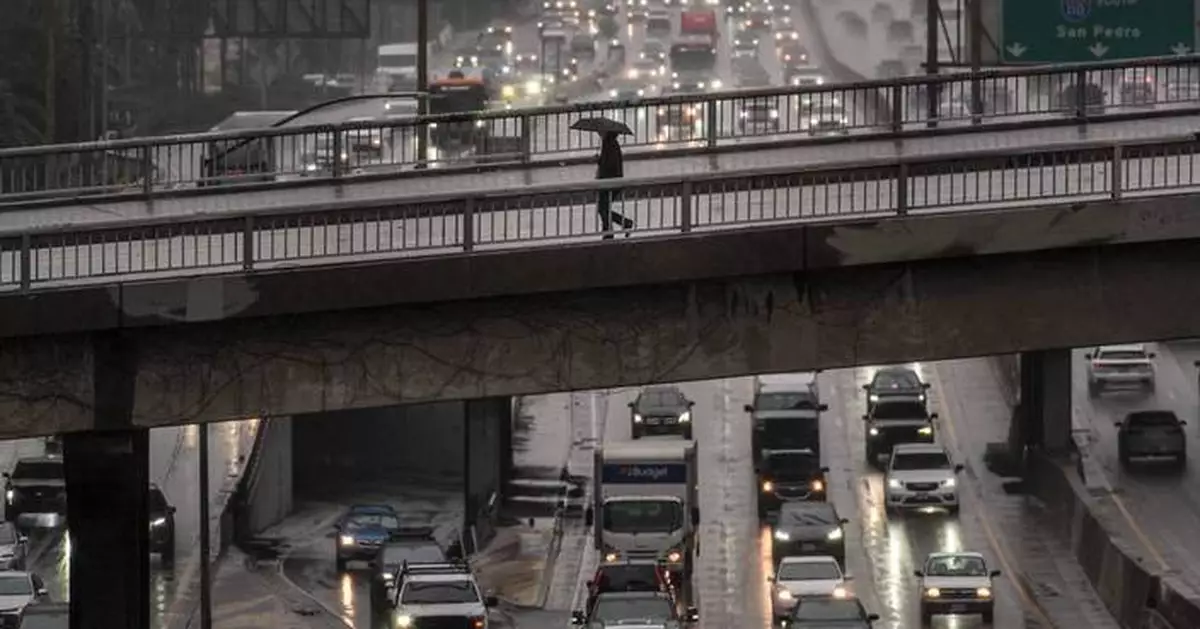
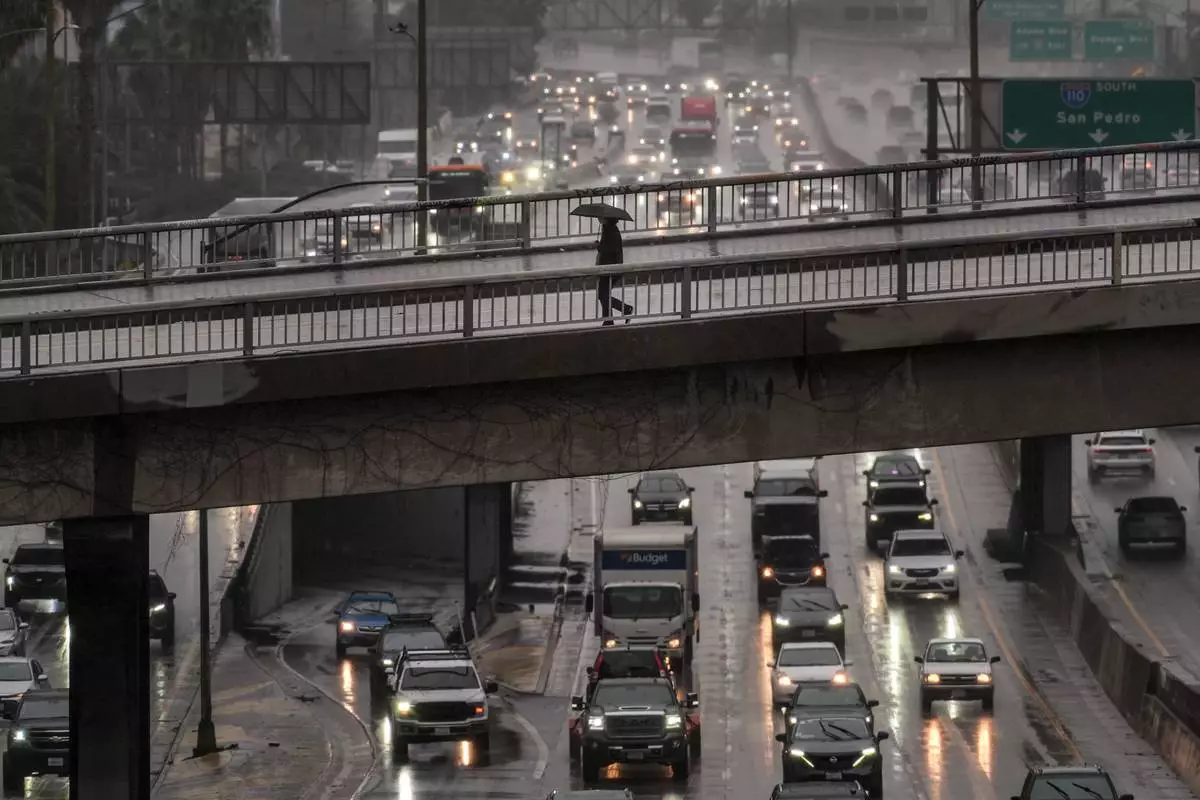
A pedestrian with an umbrella walks on a bridge over the rain-soaked 110 Freeway in Los Angeles Friday, Nov. 14, 2025. (AP Photo/Jae C. Hong)
These used to be among the fundamental facts about going to college in America: College lasts four years. And though that timeline had been flexible when it comes to sports, there was never much debate over the notion that once a player moved on to the pros, their days as a college athlete were over.
A recent rule passed by the NCAA has resulted in confusion, lawsuits and the once unthinkable notion of players leaving college, signing with professional teams and now leaving those teams to head back to college.
Among this week's headline grabbers are Dae’Quan Wright, an undrafted tight end out of Mississippi who had tryouts with the Eagles and Browns over the summer, but now has a deal in place to play this season at Ole Miss' rival in the Southeastern Conference, No. 11 LSU.
Wright is among a number of college athletes who have sued for the right to return to college to play as the start of both the college football and NFL seasons approach. A quick look at how we got here:
This part happened in June, and by the NCAA's plodding standards, it happened quite fast.
The rule now allows athletes to play five seasons over the span of five years. Most college athletes now see the “clock” start on their eligibility either when they enroll full-time in college or at the start of the regular school year immediately following their 19th birthday, whichever comes first.
The rule itself isn't all that outlandish. A lot of players were taking redshirt years (and getting extensions due to the pandemic) to prolong their eligibility to five, six, seven years and more, so putting some guardrails around it made some sense.
But the NCAA's decision to start applying this new rule to athletes who graduated high school in 2023 is what caused the chaos. By not including those from the Class of '22, many of whom saw their fourth and final year of eligibility end after last school year, they opened themselves up to trouble.
The members of the Class of ‘22 are arguing they’re being deprived of education and potential NIL financial benefits by being excluded from the rule.
Meanwhile, college athletes are suddenly looking at unexpected competition for roster spots and playing time coming from a class of players they thought would be gone this season. And teams, most of which have locked in their football rosters, are seeing a potential influx of talent they didn't expect.
A basketball player named Brock Wisne filed a federal class-action lawsuit, saying the NCAA violated antitrust law by excluding that Class of 2022 from the new rule. A judge in Denver ruled in favor of Wisne, opening the door for everyone in the class to come back to college, but only to their former college. The judge left NCAA transfer portal rules intact, meaning the players couldn't come back, enter the (currently closed) portal and find a new school.
An appeals court last Friday temporarily halted that judge's order, though that was hardly the end of the confusion.
Despite the federal court ruling, players across the country have filed lawsuits in state courts and many judges granted orders allowing them to come back to school. This “find a local judge” approach has generally been successful for the athlete over the past couple of years.
In some cases — including the case involving Wright in Louisiana — a judge not only said the players could come back, but also ordered a weeklong reopening of the transfer portal, which gave the players a chance to shop around.
Side note about Wright's potential move from Ole Miss to LSU: The SEC forbids moves within the conference such as that one, unless they come when the transfer portal is open, which in football is January. There is no clarity on how the ruling impacts the SEC rule.
The issue prompted conference leaders to meet Monday and draft a statement saying that allowing players to move back and forth between the pros and college “will blur the line between college and professional sports, create significant equity concerns and reduce opportunities for high school and current college athletes.”
Sam Ehrlich, a former lawyer who follows college sports litigation at Boise State, said the state lawsuits were filed “just in case” the federal order got overturned. It did, and that federal case had no bearing on the various state lawsuits.
According to Ehrlich's College Sports Litigation Tracker, at least 26 eligibility cases have been filed in state and county courts across the U.S. In at least 10 of those, judges have granted a restraining order or injunction favoring the players. In only one — involving basketball player Filip Borovicanin — has an appeals court overturned the initial decision, leading to a favorable outcome for the NCAA.
Court cases move slowly, and in the Wisne case, odds are nothing will be final until long after football (and maybe basketball and baseball) season is over and there's no relief left to give to the impacted players.
While football teams are madly scrambling, trying to make sense of it all, basketball teams are also feeling some pressure. Teams are allowed to start practice on Sept. 25. A notable instance of where confusion might set in is Gonzaga, which recruited two players from that Class of '22 who (presumably) had their eligibility restored.
One, however, is Javon Bennett, who was part of the Borovicanin lawsuit that an Ohio court overturned. The other is Chauncey Wiggins, who comes from Florida State and was part of a case in Georgia, where the ruling favorable to the players remains in force.
Sign up for Top 25 poll alerts here. Visit the Top 25 here and see AP’s full college football coverage here.
The NFL logo is shown the field before the start of a preseason NFL football game between the Green Bay Packers and the Pittsburgh Steelers in Pittsburgh, Thursday, Aug. 13, 2026. (AP Photo/Gene J. Puskar)