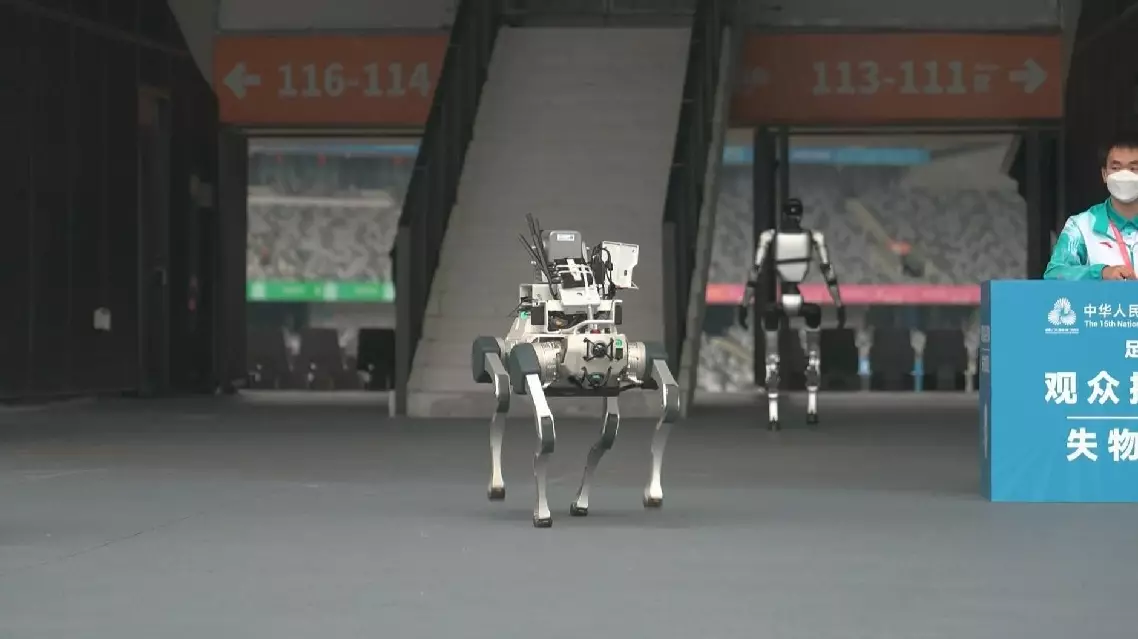
Robots are assisting in patrol duties around the competition venue at the 15th National Games in Shenzhen City of south China's Guangdong Province, helping with security maintenance and various other tasks.
At the Shenzhen Universiade Sports Center, a patrol robot and two robot dogs have been working in harmony to monitor the surroundings of the venue.
Equipped with advanced obstacle avoidance radar, these robots are connected to the Game's command center in real time, allowing citizens to make emergency calls quickly by pressing a button on the robot.
"The robots utilize technologies such as 5G, artificial intelligence, the Internet of Things, cloud computing and big data, and their cameras provide police officers with visual feedback during patrols," said Peng Wei, a security staff member.
Meanwhile, robot dogs from Shenzhen's power supply bureau are effectively performing tasks related to electrical supply, such as equipment temperature monitoring, electric meter identification and abnormal noises detection. All data is transmitted to the bureau in real time.
With the help of the AI diagnostic system, power supply bureau staff can quickly and accurately identify potential hazards, enabling early detection and prompt resolution of power supply issues.
The 15th National Games, taking place across Guangdong Province, Hong Kong, and Macao from Nov 9 to 21, mark the first time that the three Chinese regions are co-hosting the country's highest-level and largest national multi-sport event.
Robots assist in venue patrolling at ongoing National Games
Voting for the election of the eighth-term Legislative Council (LegCo) of China's Hong Kong Special Administrative Region (HKSAR) concluded on Sunday night.
Voting for the election began at 07:30 a.m. local time on Sunday. More than 600 polling stations were opened across Hong Kong, serving approximately 4.13 million registered voters.
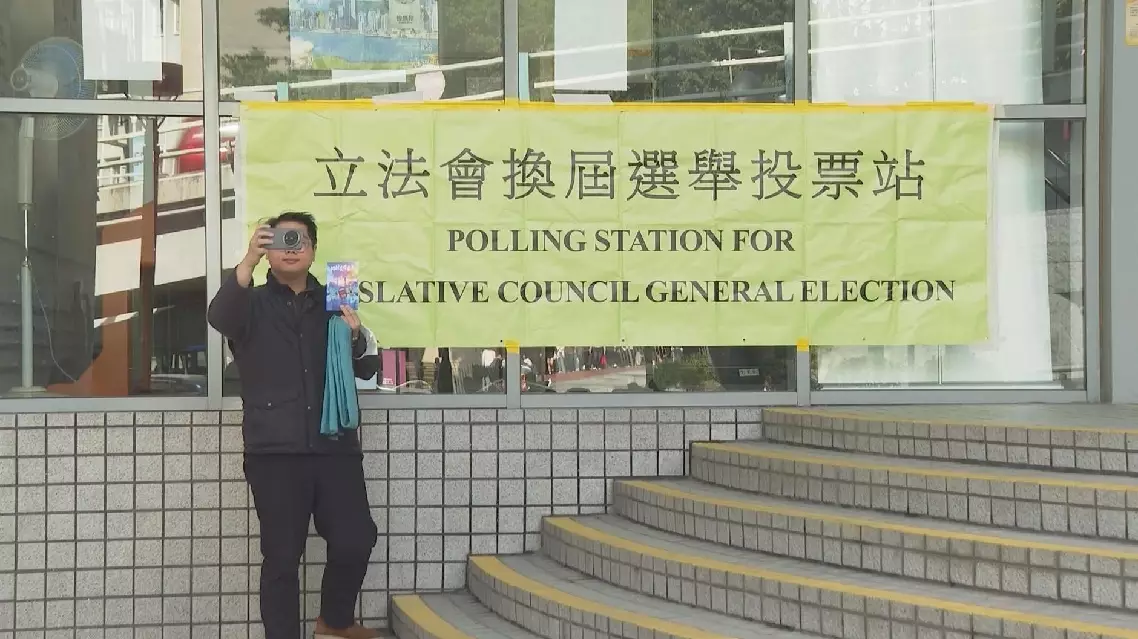
Long queues had already formed outside multiple polling stations across Hong Kong before the polls opened. At polling station entrances, staff and volunteers attentively assisted voters with the procedures. Some voters posed for a photo holding a thank-you card given by staff after casting their ballot.
"As a Hong Kong citizen, I think it's my responsibility to vote, and I don't want to give up my rights. That's why I come here to support," a voter said.
"We actually flew in from Thailand. Learning today is a special day to vote, we actually canceled all our appointments and canceled everything, and we flew in with the whole family just to be part of Hong Kong and to vote, and to cast our vote and be part of the community," said another voter.
HKSAR Chief Executive John Lee cast his ballot at around 08:30 a.m. at Raimondi College on Robinson Road. He said that the LegCo election is of great importance to Hong Kong's overall development and future reforms, and it also represents the expectations of Hong Kong society.
A number of voters said they look forward to the new term of the Legislative Council taking greater responsibility in advancing Hong Kong's economy, society, and public welfare.
"I think an area of focus I'd like to see is, one is the economy, and secondly is youth mobility and youth policies. I think youth are the future, and it's very important to get unity within the youth and also give us hope, right? The youth in general -- what can we do to, for us as youth, to partake in civil society and to show our responsibility, but also from the government, like, what kind of policy that can help us do that as well," said a young voter.
"I hope that there will be more fair education in the sense that even people from the poor family, they can actually receive good education in good schools," another voter said.
The new term of LegCo will be composed of 90 members, including 40 elected by the Election Committee, 30 elected by functional constituencies, and 20 elected by geographical constituencies through direct elections.
The eighth-term LegCo of the HKSAR will commence its four-year term on Jan 1, 2026.
Voting for 8th-term HKSAR LegCo election concludes