Chinese scientists have announced a breakthrough discovery from the Large High Altitude Air Shower Observatory (LHAASO) which identifies black holes as a key source of cosmic rays, shedding light on a 70-year-old astrophysical mystery.
The latest findings by the Institute of High Energy Physics (IHEP) at the Chinese Academy of Sciences were published on Sunday in peer-reviewed academic journals National Science Review and Science Bulletin.
Cosmic rays, which are high-energy particles traveling through the universe at nearly the speed of light, have intrigued scientists since their discovery. Decades of space- and ground-based experiments have mapped the energy spectrum of these particles, revealing a unique bend known as the "knee," named for its resemblance to a human knee. Though first identified nearly 70 years ago, the physical origin of this feature has remained a mystery.
Until now, a research team led by Academician Cao Zhen at IHEP has used the ultra-sensitive detectors at LHAASO to make a significant discovery.
They identified five powerful celestial objects known as micro-quasars within the Milky Way that exhibit extreme particle acceleration capability. A micro-quasar consist of a black hole and a companion star being consumed by the black hole's immense gravitational pull. As the black hole devours its neighboring star, it simultaneously emits jets of high-energy particles into space, releasing energy each second equivalent to the explosive force of 400 trillion most powerful hydrogen bombs on Earth.
"We often think of black holes as cosmic 'devourers,' swallowing everything around them. But surprisingly, they are also generators of extremely high-energy particles. This discovery pinpoints [the most likely] origin of the cosmic rays," Cao Zhen said.
According to scientists, within LHAASO's field of view, the Milky Way hosts more than a dozen such black hole-star systems, and the five identified so far have already demonstrated black holes' remarkable ability to produce high-energy particles. Their research offers the most compelling explanation to date for the physical mechanism behind the cosmic ray "knee" structure, positioning black holes as a main source of these energetic cosmic rays.
The findings mark a major step forward in understanding the extreme physical processes of black hole systems and the origins of cosmic rays, and are expected to propel China's astroparticle physics research to new heights.
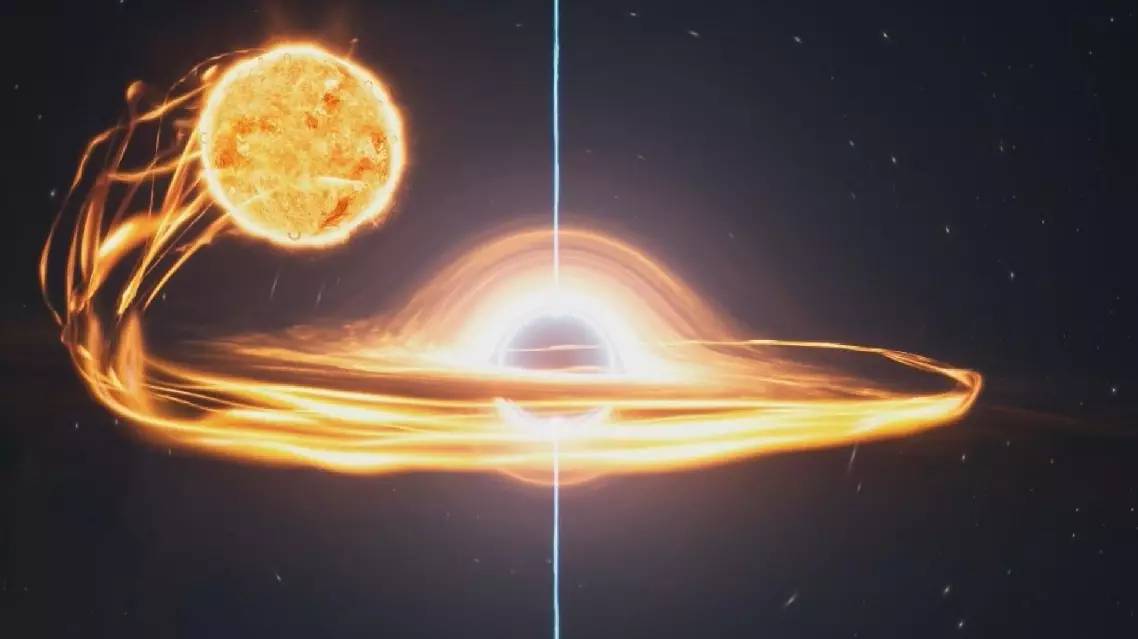
China's observatory LHAASO identifies black holes as key cosmic ray source