Speech by FS at Hong Kong Global Maritime Trade Summit
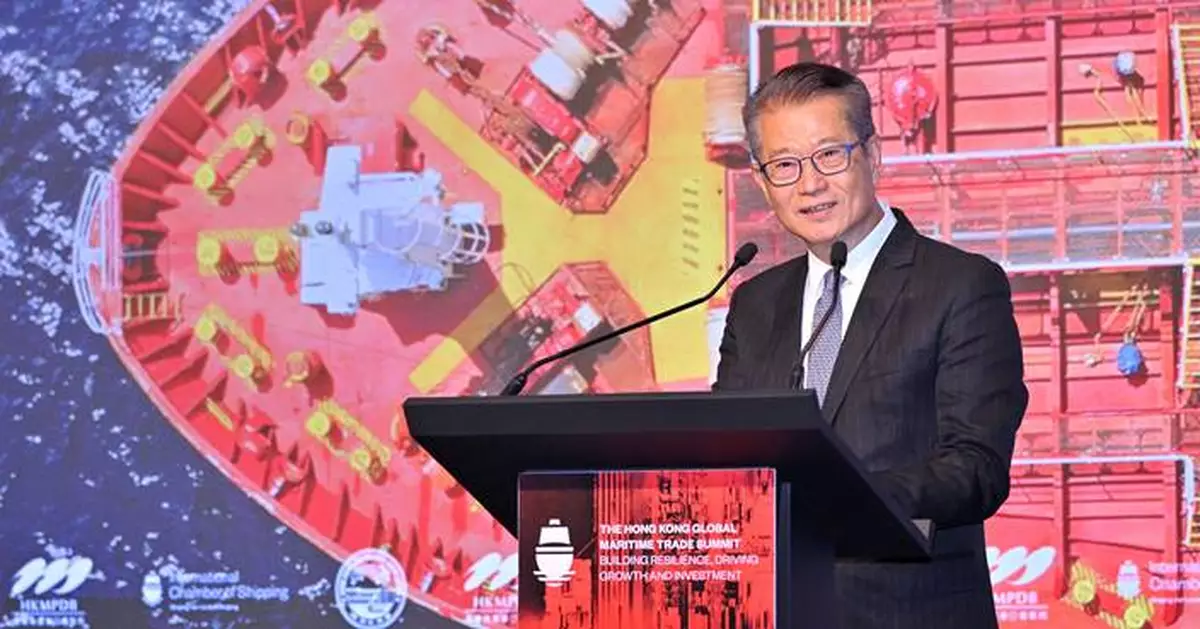
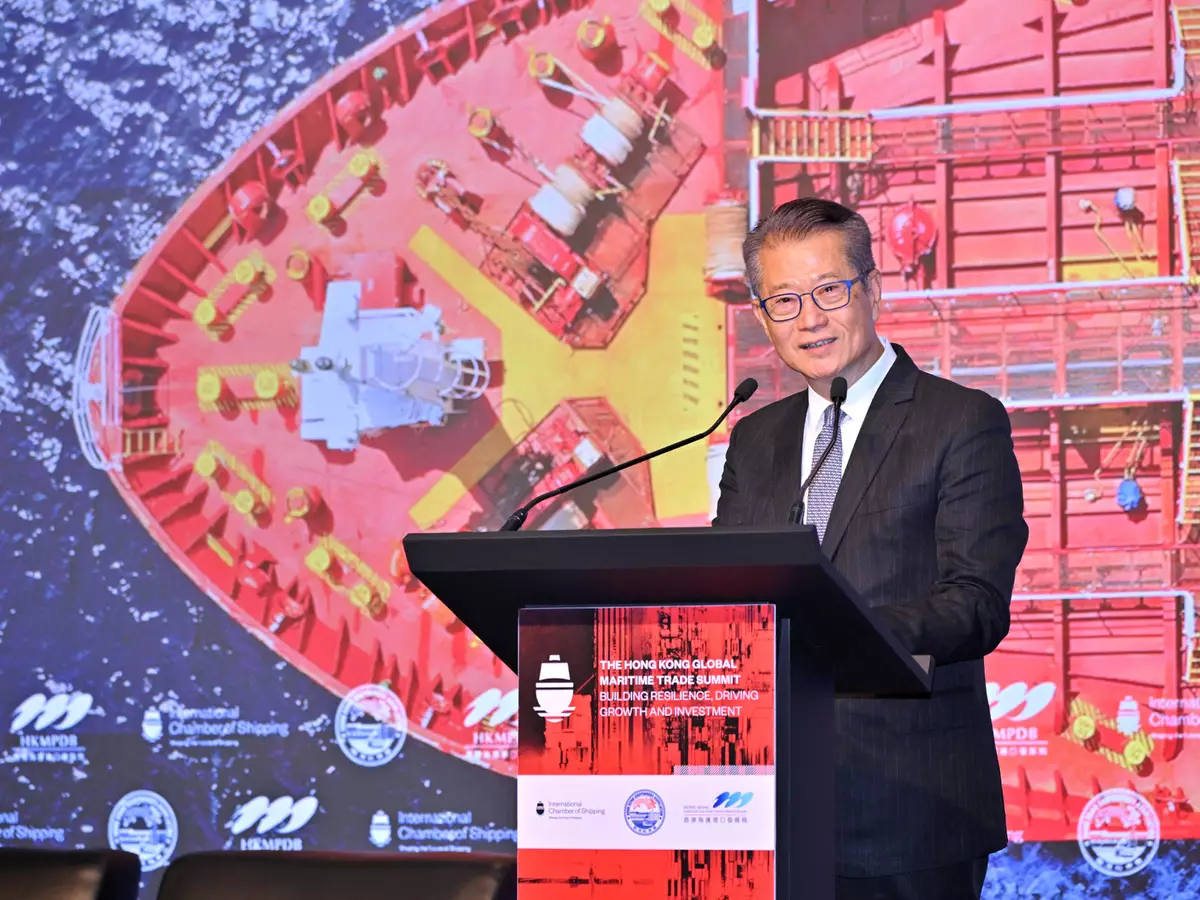
Following is the speech by the Financial Secretary, Mr Paul Chan, at the Hong Kong Global Maritime Trade Summit today (November 17):
Dr Emanuele Grimaldi (Chair of the International Chamber of Shipping), Your Excellencies, Ministers, distinguished guests, ladies and gentlemen,
Good morning. It is a pleasure to welcome you all to the second Hong Kong Global Maritime Trade Summit, co-hosted by the International Chamber of Shipping (ICS), the Hong Kong Shipowners Association, and the newly formed Hong Kong Maritime and Port Development Board.
This important event brings together more than 300 global maritime leaders from some 30 economies for vital dialogue and collaboration. Your presence speaks to the global significance of the discussions here.
I would like to thank the ICS for once again choosing Hong Kong to host this pivotal summit, casting a strong vote of confidence in us as an international maritime centre. Representing over 80 per cent of the world's merchant fleet, your leadership in shaping the global maritime agenda is unparalleled.
Building Resilience in an Age of Transformation
The theme of this Summit - "Building Resilience, Driving Growth and Investment" - speaks directly to our moment. Global maritime trade is no doubt facing headwinds: geopolitical tensions, tariff escalations, and new trade barriers are reshaping shipping routes and disrupting established patterns. The UNCTAD (United Nations Conference on Trade and Development) Review of Maritime Transport 2025 forecasts seaborne trade growth of merely 0.5 per cent this year, down from 2.2 per cent in 2024 - the slowest pace in years. Vessel rerouting has pushed ton-miles to record levels, forcing ships to travel longer distances at higher cost.
Yet this is not necessarily a story of decline, but of transformation. Allow me to offer three observations.
Shifting maritime trade patterns
First, in my view, geopolitics will reshape rather than weaken maritime trade flows. Consider China. It has stood as the world's largest manufacturing economy for 15 consecutive years, commanding close to 30 per cent of global manufacturing output. It has an industrial ecosystem spanning the entire classification of industrial categories recognised by the United Nations. Despite talk of supply chain diversification, no country possesses China's completeness, scale, efficiency or integrated capacity. Indeed, supply chain reconfiguration arising from trade tensions is creating a complementary, not substitutional, relationship across the region.
While Southeast Asian nations are attracting more investments and manufacturing activities, in this process, they are reinforcing the two-way trade flow with China, in raw materials, components, semi-finished goods and finished products. As a matter of fact, China-ASEAN (Association of Southeast Asian Nations)trade reached a record of some US$690 billion in the first eight months of 2025. Hong Kong, as a key re-export hub, has witnessed substantial growth in this business.
As a manufacturer, China will continue to demand vast quantities of raw materials and components from Southeast Asia, Africa and the Pacific, like Australia. Meanwhile, as a consumer market of 1.4 billion people with a rapidly expanding middle income group, China will drive continued growth in the import of food, fashion, electronics, and more.
At the same time, Southeast Asia, with approximately 700 million people with a median age of 32, is experiencing a significant demographic dividend. More importantly, their incomes are rising substantially. By 2030, ASEAN will contribute 140 million new consumers, representing 16 per cent of the world's new consumer class.
Beyond Asia, the broader Global South, currently accounting for 18 per cent of global GDP, is projected to grow at 4.2 per cent annually through 2029. By 2033, South-South trade is expected to approach US$14 trillion.
I believe this economic dynamism will be reshaping maritime trade. Intra-regional trade is emerging as a powerful engine of growth. Intra-Asia container volumes are projected to reach more than 42 million TEUs (Twenty Equipment Unit) by 2028, representing 3.8 per cent growth per year, outpacing the global average.
The maritime sector itself is evolving, too. Intra-regional trade is driving demand for smaller, fuel-efficient vessels optimised for short-sea shipping. Scheduling patterns are also shifting to accommodate new supply chains and regional trade growth. Bulk commodities remain dominant in seaborne trade, and containerised cargo - including consumer electronics, automotive components, and renewable energy products - is experiencing robust growth, particularly in intra-Asia routes.
Decarbonisation as both imperative and opportunity
My second observation is that decarbonisation of maritime operations is both an imperative and opportunity. The IMO (International Maritime Organization) has set a target of achieving net-zero carbon emissions from international shipping by 2050. This is not environmental aspiration alone. It is regulatory reality.
To this end, the liner shipping industry is making substantial progress, with 79 per cent of the deadweight tonnage of container and vehicle carriers capable of operating on renewable fuels. Yet scaling green fuel production and creating financial mechanisms to support adoption remain challenging. It requires strong political commitment and cross-sectoral collaboration.
The opportunity is substantial. Maritime decarbonisation represents a multi-trillion-dollar investment opportunity through 2050. The transition to zero-emission marine fuels could create up to 4 million jobs globally across the energy supply chain. Here in Hong Kong, we are embracing this. For example, we have published an Action Plan on Green Maritime Fuel Bunkering, positioning ourselves as a regional hub for sustainable fuel supply. Our goal is to provide bunkering services for green fuels to ocean-going vessels more than 60 times per year by 2030, involving over 200 000 tonnes of green maritime fuels.
Harnessing digital transformation
My third observation is on technology's transformative power. Ports and global container lines are commonly deploying artificial intelligence, blockchain and advanced data analytics to improve operational efficiency, optimise routes, and reduce downtime and carbon emissions. This is where Hong Kong also comes in, with our vibrant technology and startup community. Many of them are pioneering innovations in smart logistics. They can play a role not only in supporting our own transformation but also in serving the broader region.
Technology is also reshaping what is shipped and how. As consumer preferences shift and companies adopt new production methods, the mode of maritime trade also evolves. Consumers are now preferring sustainable, traceable products, driving demand for supply chain solutions that can verify environmental and social credentials in real time. Besides, the speed of technology adoption in operation and management will determine competitive success in this decade. Those who are able to digitalise their operations will reduce costs, capture market share, and be better able to meet the expectations of increasingly sophisticated customers and regulators.
Concluding remarks
Ladies and gentlemen, the maritime industry stands at a pivotal moment. Geopolitical fragmentation, shifting patterns of global commerce, climate imperatives and technological advancement are formidable forces. Yet they create opportunity precisely because they demand agility, innovation and vision.
Yes, the currents are shifting, and the waters may be uncharted. But like the explorers in the Age of Discovery, there lies tremendous opportunity for those with the vision to navigate with strategy, courage and conviction. I am convinced that the voyage ahead is one of extraordinary growth for those who are willing and ready.
On this note, I wish you all a most rewarding Summit, and the best of health and business in the time ahead.
And for those of you coming from afar, I would like to appeal to you: don’t just work, but enjoy the city. We have wonderful hiking trails, beaches, about 200 Michelin-recommended restaurants, great museums, and above all, we don’t impose duty on wine! And remember to shop till you drop! Thank you.
Speech by FS at Hong Kong Global Maritime Trade Summit Source: HKSAR Government Press Releases