BUDAPEST, Hungary (AP) — With Hungary's parliamentary elections still five months away, the country is already immersed in an intense political campaign between Prime Minister Viktor Orbán and his challenger, Péter Magyar, that promises to be the biggest challenge of the nationalist leader's career.
Elected for a first term in 1998 and then for four more terms beginning in 2010, Orbán has stood at Hungary's helm for 20 years. Beloved by his supporters but accused by his critics of corruption and authoritarian tactics, he has overseen a political system in which his far-right Fidesz party has exercised nearly unchecked power.
But now, support for Europe's longest-serving leader is declining amid poor economic performance and chronic inflation, and a challenger who has shifted the political tides by promising to dismantle Orbán's system and put Hungary on a more prosperous, democratic track.
“Viktor Orbán’s despicable, corrupt government will do everything to preserve their stolen loot and their power, we have no doubt,” Magyar, a 44-year-old former Fidesz insider, told The Associated Press. “This power cannot be reformed, it is not able to regain contact with the people. This power has become inhumane.”
Most polls show Magyar and his Tisza party with a solid lead over Orbán's Fidesz — a feat nearly unprecedented for any opposition force in the past two decades.
Many observers in Hungary have puzzled over how Magyar, unlike generations of Orbán’s previous political opponents, has in fewer than two years managed to emerge from relative obscurity to build a party with such substantial support.
András Bíró-Nagy, director of the Budapest-based Policy Solutions think tank, says Magyar’s near-constant “grassroots campaigning” in rural Hungary — and his focus on bread-and-butter issues like the cost of living and poor public services — have contributed to his success in small towns that traditionally gravitated toward Orbán’s nationalist message.
On Thursday, Magyar visited Tab, a community of fewer than 4,000 people in southwestern Hungary. The stop was one of dozens he plans across the country on a tour he calls “Road to Victory.”
Hundreds filled the town’s socialist-era community center and listened to Magyar speak for nearly two hours. As Erika Bognár, a 76-year-old widowed retiree, walked into the event, she declared angrily that her monthly pension was too low to survive on, and that she wanted “a system change, because this system sucks.”
“Everywhere in the shops people are grumbling they can’t make ends meet,” she said. “We live in misery, we have been pushed completely into misery.”
Bognár’s experience reflects that of many Hungarians who are dissatisfied with the country's economy. The European Union has frozen some 14 billion euros ($16.2 billion) in funding to Hungary over rule-of-law and corruption concerns, a deficit that has exacerbated chronically stagnant economic performance.
Orbán’s government has sought to mitigate the economic pain by introducing price caps on many products, and to woo voters with pre-election government spending like low-interest loans for first-time home buyers and abolishing income tax for mothers with at least two children.
Still, Bognár, who says she’s rarely voted in elections until now, blames Orbán’s government for rising costs of living, and believes that if Magyar is elected, “it won’t get any worse.”
Orbán has sought to portray his opponent as an existential danger that — through his inexperience and alleged foreign allegiances — would bankrupt the country and drag it into the war in neighboring Ukraine, allegations Magyar has denied.
Unlike nearly every other EU leader, Orbán has refused to supply Ukraine with economic aid or weapons to assist in its defense against Russia's full-scale invasion, and has cast as warmongers those countries that do support Kyiv.
He has also cast the EU as an oppressive force, and compared the bloc to the Soviet Union, which dominated and occupied Hungary for decades in the 20th century.
The Tisza party, Orbán has alleged, is nothing more than an EU project contrived in Brussels to topple his government and install a puppet regime that will drain Hungary's finances into Ukraine — and even involve it directly in the war.
“Whoever thinks that they support a change in government is in reality supporting the war, whether they know it or not," Orbán said in a speech to tens of thousands of supporters in October.
“There are many Hungarians who believe that they are supporting a good cause when they support Brussels and its puppet government candidates. We must tell them: Brussels today is not a source of help, but a source of danger.”
Orbán's message is amplified by a sprawling pro-government media empire that has dominated Hungary's political discourse for more than a decade, as well as taxpayer-funded campaigns that malign Magyar and promote Orbán's policies.
Balázs Orbán, who is not related to the prime minister but is his political director and Fidesz's campaign manager, did not respond to requests for comment.
Bíró-Nagy noted that the past several Hungarian elections were deemed “free but not fair” by the Organization for Security and Cooperation in Europe, which found a “pervasive overlap" between the messaging of Fidesz and the government, as well as biased news coverage that “limited voters’ opportunity to make an informed choice.”
The situation for the 2026 elections "has not changed in any sense,” Bíró-Nagy said. “What we see is that there is no level playing field.”
Sándor Rofrics, a member of a local Tisza activist group in Tab, said outside Magyar’s event that he believes “money is no object for Fidesz, even state money. They will spend a lot of public money on this campaign.”
Magyar himself acknowledges that his party has fewer resources with which to campaign, portraying the contest as a “David and Goliath” struggle where “we’re essentially facing a machine with a full arsenal — propaganda, secret services, unlimited government money.”
In addition to traditionally opposition liberal and centrist voters, Tisza has also reached out to disaffected Fidesz supporters and voters with more conservative views. Magyar says his party does not define itself “along ideological fault lines," but campaigns on "the image of a functioning and humane Hungary, bringing EU money home, introducing anti-corruption measures and welcoming everyone in our community.”
With five months until the ballot and Tisza still leading, Magyar said he senses a desire for change in the towns and villages he visits on his campaign tour. But despite his party's lead, “I think you should never look down on or underestimate your opponent, especially not Viktor Orbán."
“He is an experienced player and has a lot to lose in this election, perhaps more than just the prime minister’s seat," he said.
Béla Szandelszky contributed reporting.

Leader of the Hungarian opposition Tisza Party Peter Magyar delivers his speech during the party's nationwide roadshow in Gyor, Hungary, Saturday, Nov. 15, 2025. (Csaba Krizsan/MTI via AP)

Hungary's Prime Minister Viktor Orban speaks during a meeting with President Donald Trump in the Cabinet Room of the White House, Friday, Nov. 7, 2025, in Washington. (AP Photo/Evan Vucci)
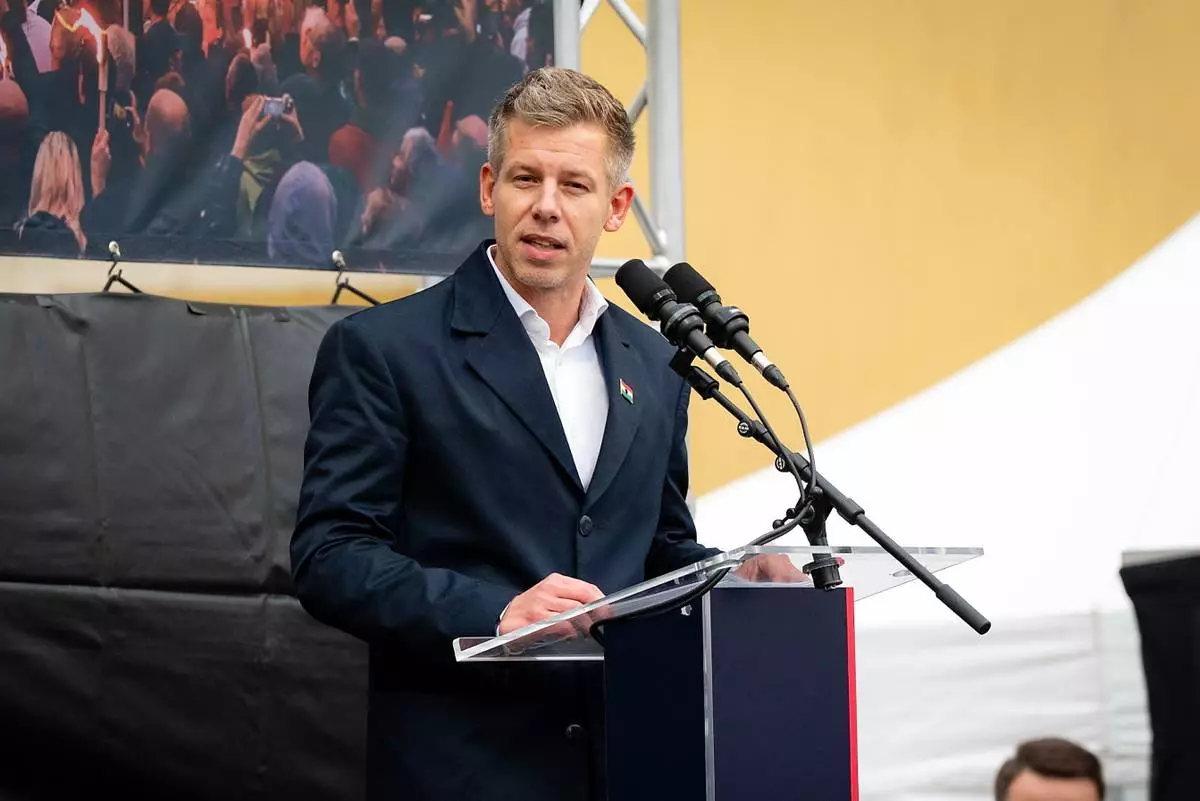
Leader of the Hungarian opposition Tisza Party Peter Magyar delivers his speech during the party's nationwide roadshow in Gyor, Hungary, Saturday, Nov. 15, 2025. (Csaba Krizsan/MTI via AP)