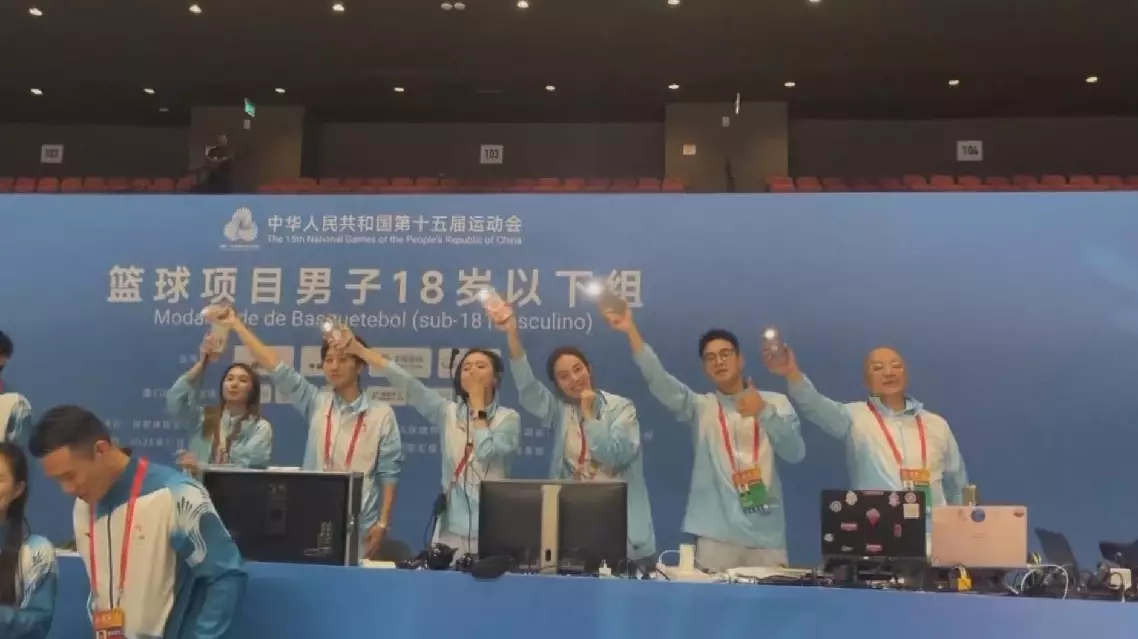
A dedicated youth entertainment team is helping drum up the excitement and deliver a thrilling spectator experience during the basketball matches at China's ongoing 15th National Games in Macao, with spectacular light shows, energetic music, and vivid dance presentations generating a lively atmosphere. For the first time, south China's Guangdong Province, and the Hong Kong and Macao special administrative regions have joined hands to host China's premier multi-sport event, which opened on Nov 9 and will run through Nov 21.
In homage to this joint hosting, a special youth team comprised of members from the Chinese mainland, Hong Kong, and Macao has been assembled to turn up the volume and keep the crowds engaged during breaks in play.
Led by Liu Changmei, the team is responsible for all of the associated sports presentations at Macao's two basketball arenas.
"The music you hear, the cheerleading routines you see, and the mascot performances, in other words, everything you witness beyond the competitions themselves, are all planned and organized by us behind the scenes," said Liu Changmei, director of the sports presentation team in Macao.
Knowing exactly how to match the rhythm of play with their song choices, how to boost morale and celebrate big scores, or how to swiftly bring a sense of calm and hit the right tone when a player is injured on court, all demands split-second judgment from this well-prepared behind-the-scenes team.
"Our sports presentations aim to add more excitement into the scores, allowing both spectators and athletes to share a special connection," said Liu, a native of the northeastern Heilongjiang Province who has lived and worked in Macao for more than a decade after pursuing advanced studies there.
The team began preparing for the Games six months before the opening, scripting over 100 lighting cues, dozens of music tracks, and countless key moments for announcements. Bringing together directors from Beijing and Hangzhou, hosts from the Yunnan and Sichuan provinces, and lighting and sound engineers from Hong Kong, the diverse team has made the Games in Macao more vibrant.
"We serve the competitions, striving to make them more appealing and showcase the beauty of sports," said another team member called Chan Wai Hin from Macao.
"Now that we are hosting the event across Guangdong, Hong Kong, and Macao, we can incorporate more Macao elements into the Macao competition zone, making the National Games more diverse and vibrant," said team member Ho Chi Sun, another Macao local.
"People have come from all over the country to support the event in Macao. Macao's integration into the country's overall strategic development and the integrated development of the Guangdong-Hong Kong-Macao Greater Bay Area have given us young people opportunities and a much broader stage. It fills us with hope for the future," said Liu.
Dedicated entertainment team drums up atmosphere at National Games in Macao
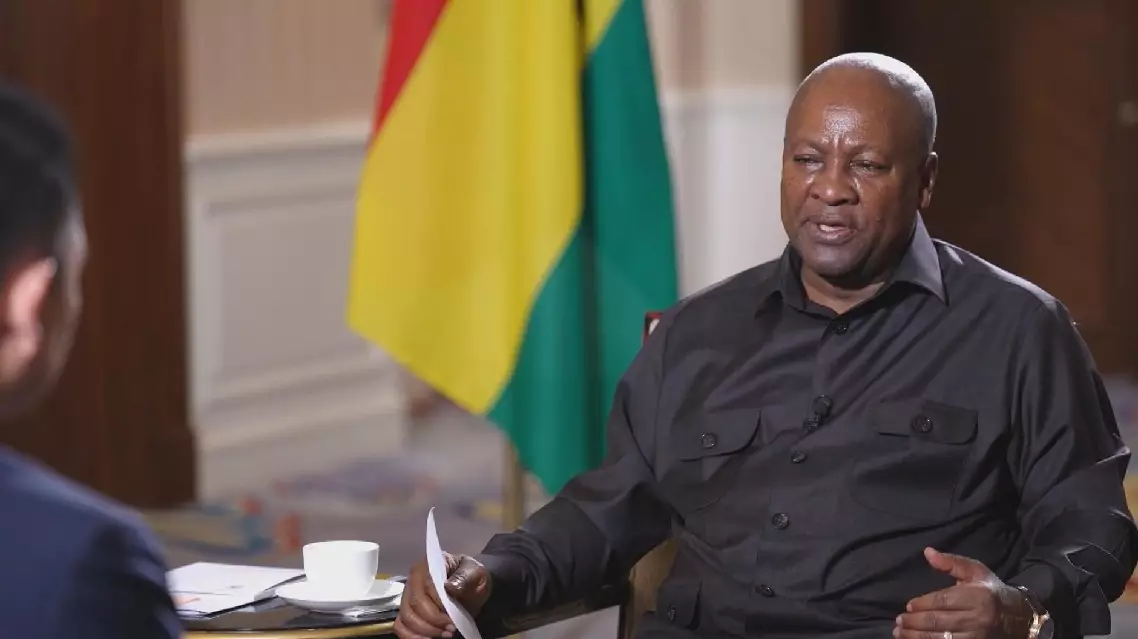
Ghanaian President John Dramani Mahama has underscored the need for the international community to properly recognize the historical injustices committed against Africa and support efforts to advance reparations for Africans and people of African descent.
Mahama made the remarks in an interview with the China Media Group (CMG) which was aired Friday and recorded during the Ghanaian President's trip to Beijing in October.
Earlier this year, Mahama had issued a call for collective action in securing justice for Africans and individuals of African descent through reparations at the 38th Ordinary Session of the African Union.
Located in West Africa along the northern shore of the Gulf of Guinea and bordered by the Atlantic Ocean to the south, Ghana boasts a more than 500-km coastline and abundant agricultural, fishery, forestry and mineral resources. Yet its history, like much of the African continent, has been deeply scarred by centuries of foreign aggression.
From the 15th century onward, Western colonial powers invaded coastal areas of what is now Ghana, plundering resources and conducting the slave trade, casting a long colonial shadow over the African continent which hung for centuries.
In 1955, the successful convening of the Bandung Conference -- which gathered representatives of Asian and African states in Indonesia -- ignited a new wave of national liberation movements these continents, accelerating the collapse of the global colonial system.
Ghana's independence in 1957 lit the first torch of freedom in sub-Saharan Africa and was hailed as the dawn of Africa's awakening.
Africa's first tragedy, the transatlantic slave trade, constituted an extremely grave atrocity, Mahama said.
During that period, an estimated 12 to 15 million Africans were forcibly taken from the continent and sent to the Caribbean, the Americas and Europe. They contributed to the building of modern Western civilization, yet received no compensation for their labor, whether working on sugar plantations or constructing railways, roads and bridges, he noted.
Mahama outlined his wish that the United Nations takes action to recognize the slave trade as "the greatest crime against humanity" and takes steps to ensure reparations are paid back to the descendants of those who suffered.
"We believe that first and foremost, it should be recognized as the greatest crime against humanity. We must condemn the activity of slavery of the people who were shipped to what I call the 'New World', that's the Western world. It's estimated that as many as 2 million did not arrive at the destination because they were either too sick or they died on board, and they were just tossed over into the ocean. That was genocide. And so it's an issue that the first step is for us to accept. And so Ghana wants to move a motion in the UN next year asking the world to recognize the slave trade as the greatest crime against humanity. And so we'll continue to push on the African [Union] Champion on Reparations when I spoke even at the UN, I raised the issue of reparations and so I do think that that is to do with slavery," he said.
Mahama also stressed the impact of colonialism, which further entrenched injustice and led to global inequality as African nations were ruthlessly exploited.
"With regards to colonialism, the Berlin Conference (1884–1885) partitioned Africa and the European nations took colonies in Africa, ran those colonies, exploited their natural resources and transferred those natural resources, oil palm, gold, minerals, cocoa and other products, to develop their countries. And it's only from the late 1950s that countries like Ghana got independent. And so that was an injustice. Colonialism was an injustice against African countries," he said.
Ghanaian president urges reparative justice for Africa, citing slavery, colonial exploitation