The stage play "Searching for Doolittle" depicting the friendship between China and the United States during World War II premiered in Quzhou City, east China's Zhejiang Province on Saturday.
During World War II, China and the United States joined hands in Asia to fight fascism, with the heroic rescue of U.S. airmen after the Doolittle Raid on Japan providing an exemplary tale of cooperation between the two countries.
On April 18, 1942, a group of 16 U.S. bombers, led by Lieutenant Colonel James Doolittle, took off from the aircraft carrier USS Hornet to attack Japanese cities in retaliation for the attack on Pearl Harbor.
Ahead of the raid, bombers took off at a location farther from Japan than in the initial mission plan, as they had encountered Japanese patrol crafts.
After the raid, 15 bombers headed for an airport in Quzhou as previously planned, and the other one headed towards the Soviet Union. The airport in China was considered friendly territory for the Americans, and was geographically close to mainland Japan.
However, due to the increased flight range, the 15 planes had run out of fuel before reaching their destinations. Encountering bad weather and facing communication difficulties, the planes crashed or ditched in various parts of east China, mostly in Zhejiang.
Of the 75 airmen aboard the planes, 64 were rescued by local people, most of whom were villagers who had received no official notice. Facing Japanese invaders searching for the Americans on the coast, the locals refused to tell the whereabouts of the airmen.
Their assistance to the US airmen, however, came at a tremendous cost. Many villagers were suspected of sheltering the Americans, and some were even tortured or slaughtered by the Japanese. The three-month campaign resulted in massive civilian deaths.
Over the decades, the rescue of the American airmen has stood as a testament to the friendship between people from the two countries forged in the war against fascism.
Jointly produced by the Publicity Department of CPC Quzhou Municipal Committee and the China Coal Mine Art Troupe, "Searching for Doolittle" tells the story of this extraordinary rescue mission carried out by ordinary people such as local farmers, patriotic students and workers who built the airport.
"The play is very good. It's a really effective way to promote city culture and a wonderful record of that piece of history," said Jin Jing, an audience member after the premiere at the Quzhou Poly Grand Theatre.
"This play closely centers on the construction of an airport in Quzhou as the beginning of the story, which follows the historical facts. It showcases the great love shown by the people of Quzhou in rescuing the American pilots," said Lu Yi, an actor in the play.
"The rescue of Dolittle by the military and civilians in Quzhou is itself a truly remarkable story. This is a very authentic production that commemorates the 80th anniversary of the victory in the Chinese People's War of Resistance Against Japanese Aggression from different perspectives," said Zhong Hao, the director of the play.
Following Quzhou premiere, "Searching for Doolittle" is scheduled to tour Beijing and other cities in January 2026, offering wider audiences the chance to reflect on this shared history between China and the United States.
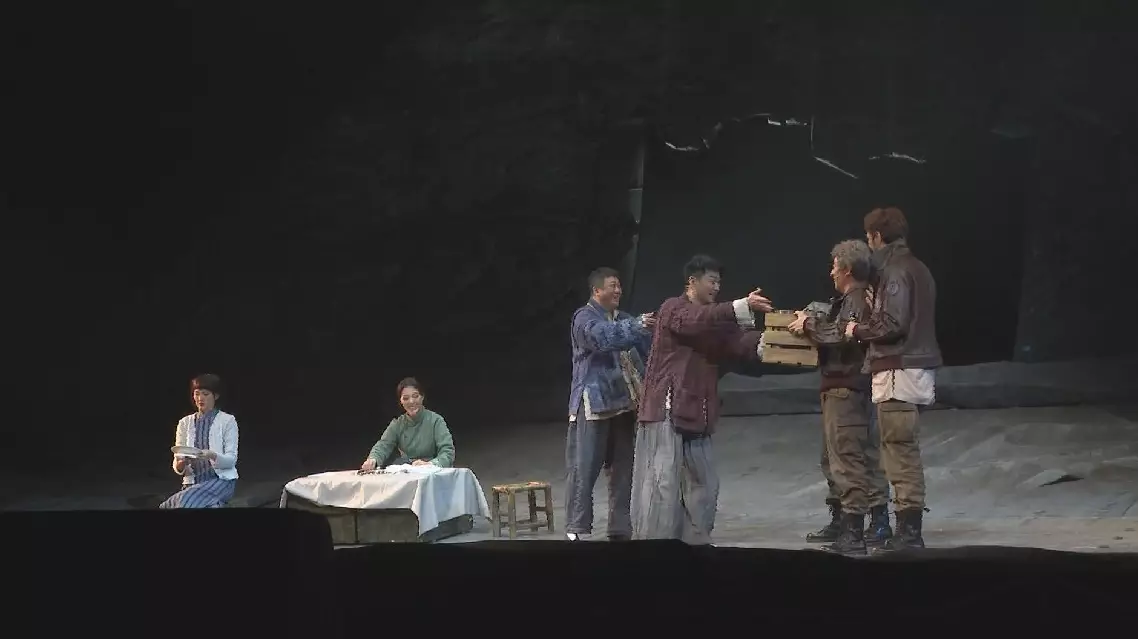
Stage play on rescue of American airmen during WWII premieres in China's Quzhou
Stage play on rescue of American airmen during WWII premieres in China's Quzhou
Stage play on rescue of American airmen during WWII premieres in China's Quzhou