A lawmaker skeptical of the Big Ten's proposed $2.4 billion deal with a private investor has requested a Congressional analysis of the tax consequences for the NCAA, its schools and conferences in the changing college sports industry.
“Legitimate questions have been raised about whether it is time to rethink the tax-exempt regime under which college sports currently operates,” Sen. Maria Cantwell, D-Wash., wrote in a letter Monday to the head of the Congressional Joint Committee on Taxation.
Last month, Cantwell sent a letter to Big Ten leaders warning that deals with private investors could have negative consequences, including impacting the schools’ tax-exempt status.
Her letter Monday asked for a more detailed look at how a number of changes impacting college sports could impact the longstanding tax-exempt standing held by those who oversee college athletics.
Among the questions from Cantwell, who is the ranking member on the Senate committee that oversees college sports, were:
— Whether Congress should consider rewriting tax rules for name, image and likeness collectives that work with schools to provide payments to players. She cited other analysis that has determined collectives don't qualify as tax-exempt organizations.
— If there were measures Congress should consider “with respect to addressing excessive compensation for coaches” and the size of their buyouts.
— The tax implications for athletes if they are classified as employees or independent contractors.
The timing comes at a key moment for the Big Ten, which is facing resistance from the universities of Michigan and Southern California over a proposed $2.4 billion deal that would break off the league's media rights and other properties and place them in a separate business that could negotiate deals through 2046.
Among the reservations Michigan and USC leaders have expressed about the deal are an uneven distribution of the funds from the deal and the overall impact of joining with a private investor.
“We greatly value our membership in the Big Ten Conference and understand and respect the larger landscape,” USC athletic director Jennifer Cohen wrote in letter to boosters last week. “But we also recognize the power of the USC brand is far-reaching, deeply engaging, and incredibly valuable, and we will always fight first for what’s best for USC.”
In her letter last month to the Big Ten leaders, Cantwell spelled out the stakes of selling part of the conference's media rights.
“Your university’s media revenues currently are not taxed because they are considered ‘substantially related to’ your tax-exempt purpose,” she wrote. “However, when a private, for-profit investor holds a stake in those revenues it raises questions whether the revenue loses its connection to your institution’s educational purpose.”
AP college sports: https://apnews.com/hub/college-sports

FILE - Senate Commerce, Science, and Transportation Committee Ranking Member Sen. Maria Cantwell, D-Wash., speaks Jan. 28, 2025, in Washington. (AP Photo/Jacquelyn Martin, File)

FILE - Big Ten Conference commissioner Tony Petitti speaks during a news conference after meetings with the Southeastern Conference, Oct. 10, 2024, in Nashville, Tenn. (AP Photo/George Walker IV, File)
The Nordic countries are no strangers to the long, dark winter.
Despite little to no daylight — plus months of frigid temperatures — people who live in northern Europe and above the Arctic Circle have learned how to cope mentally and physically with the annual onset of the winter blues, which can begin as early as October and last into April for some.
The winter solstice will occur Dec. 21, marking the shortest day and longest night of the year in the Northern Hemisphere. While sunlight increases daily after that, winter won't be over for a while yet.
The Associated Press spoke to experts in Norway, Sweden and Finland about the winter blues. Here's how they suggest looking for light, literally and figuratively, during the darkest months of the year:
Dr. Timo Partonen, a research professor at the Finnish Institute for Health and Welfare, said the dark winter affects our circadian rhythm.
With limited daylight, our internal body clocks cannot reset or synchronize properly and it throws off our sleep. We may sleep longer in the winter, he said, but we don't wake up refreshed and can remain tired the rest of the day.
Partonen recommended trying a dawn simulator, sometimes known as a sunrise alarm clock, to gradually light up your bedroom and ease you awake.
In addition to being more tired, we're more likely to withdraw from others socially in the wintertime. We're more irritable, Partonen said, and more prone to fights with friends.
It's important to maintain our relationships, he said, because symptoms rarely improve in isolation.
And since keeping up with exercise is also key to combating the winter blues, consider inviting a friend along for a workout.
It could also help keep off the wintertime weight gain — typically 2 to 5 kilograms (4 to 11 pounds) a year, Partonen said — that's fed by cravings for carbohydrates, especially in the evenings.
Millions of people worldwide are estimated to suffer from seasonal depression. Also known as seasonal affective disorder, or SAD, patients typically have episodes of depression that begin in the fall and ease in the spring or summer. A milder form, subsyndromal SAD, is recognized by medical experts, and there’s also a summer variety of seasonal depression, though less is known about it.
Scientists are learning how specialized cells in our eyes turn the blue wavelength part of the light spectrum into neural signals affecting mood and alertness. Sunlight is loaded with the blue light, so when the cells absorb it, our brains’ alertness centers are activated and we feel more awake and possibly even happier.
Researcher Kathryn Roecklein at the University of Pittsburgh tested people with and without SAD to see how their eyes reacted to blue light. As a group, people with SAD were less sensitive to blue light than others, especially during winter months. That suggests a cause for wintertime depression.
In severe cases, people need clinical support and antidepressant medications. Christian Benedict, a pharmacology professor at Uppsala University in Sweden, suggests light therapy for people with SAD as well as those who have a milder case of the winter blues.
“It’s not like it’s a fate, an annual or a seasonal fate, and you cannot do anything about it,” Benedict said. “There are possibilities to affect it.”
A routine of morning light therapy, using devices that emit light about 20 times brighter than regular indoor light, can be beneficial for both people with and without SAD.
The light therapy helps to kickstart your circadian rhythm and increases serotonin in your brain, Benedict said.
Research supports using a light that’s about 10,000 lux, a measure of brightness, for 30 minutes every morning. Special lights run from $70 to $400, though some products marketed for SAD are not bright enough to be useful. Your insurance company might cover at least part of the cost if you’ve been diagnosed with SAD.
Partonen recommended using both a dawn simulator and a light therapy device each day before noon.
Yale has tested products and offers a list of recommendations, and the nonprofit Center for Environmental Therapeutics has a consumer guide to selecting a light.
And don't forget to, well, look on the bright side. It's crucial to embrace winter instead of dreading it, according to Ida Solhaug, an associate professor in psychology at the University of Tromsø, also known as the Arctic University of Norway — the world's northernmost university.
Prioritize a positive outlook as a survival strategy and learn to appreciate the change in seasons. It's a typical Norwegian way of thinking, she said, that can make all the difference when there's very little daylight for months.
“It's part of the culture,” she said.
And don't forget to take advantage of both outdoor and indoor hobbies, she said. Inside, channel hygge — the Danish obsession with getting cozy — and snuggle up on the couch with blankets and a movie.
But don't hibernate all winter. After the film finishes, head outside with a thermos for fika, the traditional Swedish coffee break. Even during cloudy days, a quick walk in the fresh air will help, she said. And if you're brave enough, do a cold plunge like many people in the Nordics.
Solhaug tries to jump into the frigid waters off the coast of Tromsø, an island 350 kilometers (217 miles) north of the Arctic Circle, at least once a week, adding that it makes her feel revitalized during the long winter.
“Challenge yourself to look for light in the darkness,” she said.
After all, as many Nordic people say, there’s no such thing as bad weather — only bad clothing.
Finland's President Alexander Stubb, too, had some tips for how to tackle Nordic winters. When asked in an interview with The Associated Press last month how to survive the cold season, he had some very specific advice.
“Take an ice bath and then followed up by a sauna and do one more ice bath, one more sauna, then a shower and go out there. You’ll manage,” Stubb said.
__
Dazio reported from Berlin.

People pass a shop window in Helsinki, Finland, Friday, Nov. 14, 2025. (AP Photo/Sergei Grits)

People walking along the square are reflected in a puddle in Helsinki, Finland, Friday, Nov. 14, 2025. (AP Photo/Sergei Grits)

People enjoy in a public pool in Helsinki, Finland, Friday, Nov. 14, 2025. (AP Photo/Sergei Grits)

People enjoy the sunny weather with the Helsinki Cathedral of the background in Helsinki, Finland, Friday, Nov. 14, 2025. (AP Photo/Sergei Grits)
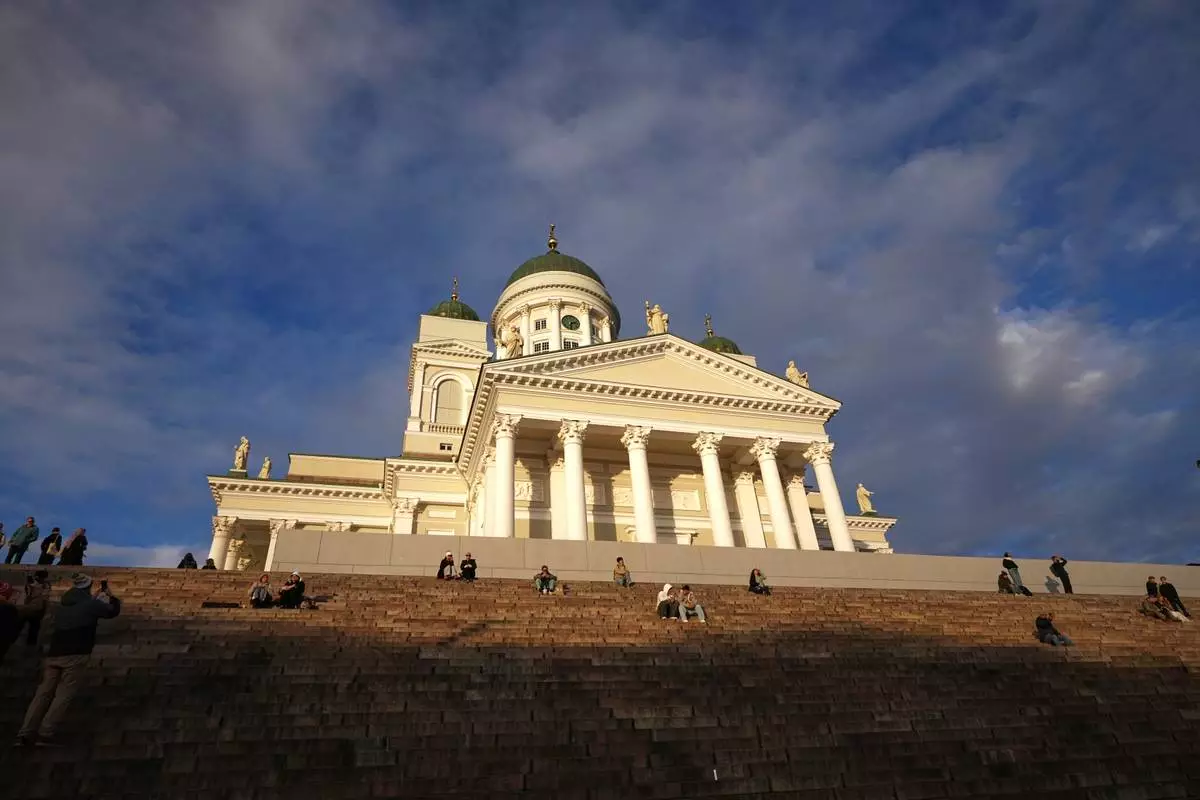
People enjoy the sunny weather with the Helsinki Cathedral of the background in Helsinki, Finland, Friday, Nov. 14, 2025. (AP Photo/Sergei Grits)