Members of the Sackler family who own OxyContin maker Purdue Pharma must pay billions of dollars to settle a flood of lawsuits over the harms of opioids, in a new deal formally approved by a federal bankruptcy judge on Tuesday.
The Sacklers must contribute up to $7 billion over 15 years. Most of the money will go to government entities to fight the opioid crisis, which has been linked to 900,000 deaths in the U.S. since 1999. Thousands of victims could be paid thousands of dollars each, with some distributions beginning next year for people who had OxyContin prescriptions and their survivors.
“This plan is not perfect,” U.S. Bankruptcy Judge Sean Lane said as he laid out his reasoning for approving the settlement, which he indicated he would do last week. “The court wishes it could do more to ease the suffering of the opioid crisis.” Still, he said the settlement is equitable, in the parties' best interests, and overwhelmingly supported by groups with claims against Purdue.
The agreement replaces one the U.S. Supreme Court rejected last year, saying the earlier proposal would have improperly shielded Sackler family members from future lawsuits. The new agreement allows entities that do not opt into the payments to still sue members of the family.
The deal is among the largest in a series of opioid settlements brought by state and local governments against drugmakers, wholesalers and pharmacies that totaled about $50 billion.
Lane said the plan offers more certainty and value than years of litigation would. Suing the Sackler family members would have no guarantee of success, he said, and it could be hard to collect because much of their wealth is held in off-shore trusts. The family has consistently said they would fight claims against them.
He also noted that states and individuals would get less if Purdue were liquidated, as only only $3.4 billion would have been available, including $2 billion owed to the federal government as part of the company's criminal plea deal. The federal penalties were to be largely waived if a broader settlement could be reached.
Sackler family members were collectively paid more than $10 billion by Purdue in the decade before they stopped involvement with the company in 2018. About half of that went to taxes. Under the deal, they will provide most of the settlement's $7 billion. As in other opioid settlements, money distributed to states, local governments and Native American tribes must be used primarily on the opioid crisis. About $850 million will be set aside for individual victims, including children born with opioid withdrawal.
People with addiction and survivors of those who died must have proof they were prescribed OxyContin to participate. However, it could be a challenge for some to find medical records or photos of prescription bottle labels dating back decades.
Those who can provide documentation could receive $8,000 or around $16,000, depending on how long they received the drug and how many other people qualify. The money for individual victims is to be distributed next year.
The Sackler family will also relinquish ownership of Purdue, although that won't be a major challenge since no family member has served on its board or received money from the company since 2018. Purdue will be replaced with a new company, Knoa Pharma, controlled by a board appointed by the states and designed to operate in the public interest.
The Sacklers are also agreeing not to seek naming rights at institutions in exchange for donations, a common practice by the family before many organizations cut ties with them.
The company will publicly release a trove of internal documents that could shed more light on how the company promoted and monitored opioids.
One part of an earlier settlement will not return: a requirement for Sackler family to hear directly from people harmed by OxyContin.
Purdue filed for bankruptcy in 2019 as it faced thousands of opioid-related lawsuits. A judge approved a settlement two years later, but the Supreme Court struck it down because it protected the Sacklers from lawsuits over opioids even though they were not personally declaring bankruptcy. The new plan avoids that issue by allowing those who don't opt into the deal to still sue the family.
Few parties objected to the settlement this time, although opioid victims who represented themselves raised concerns during last week's hearing. One of them told the judge on Tuesday she planned to appeal.
Kay Scarpone of New Hampshire, whose son died of an overdose, served for years on a committee of creditors in Purdue's bankruptcy. She's glad the deal was accepted but saddened to say goodbye to the far-flung friends she worked alongside.
She said she participated to help “take what you can get from the Sackler family and do the best thing you can do, which is get money into the hands of the victims.” Still, Scarpone expects many will be upset once they see the actual payout sizes.
For Susan Ousterman, a Pennsylvania mother whose son also died of an overdose, the ruling is only disheartening. It's another reminder, she said, of “how complicit the system is.”
“These people will walk free. They’re criminals,” she said Tuesday of the Sacklers. “They scare me far more than any drug dealer.”
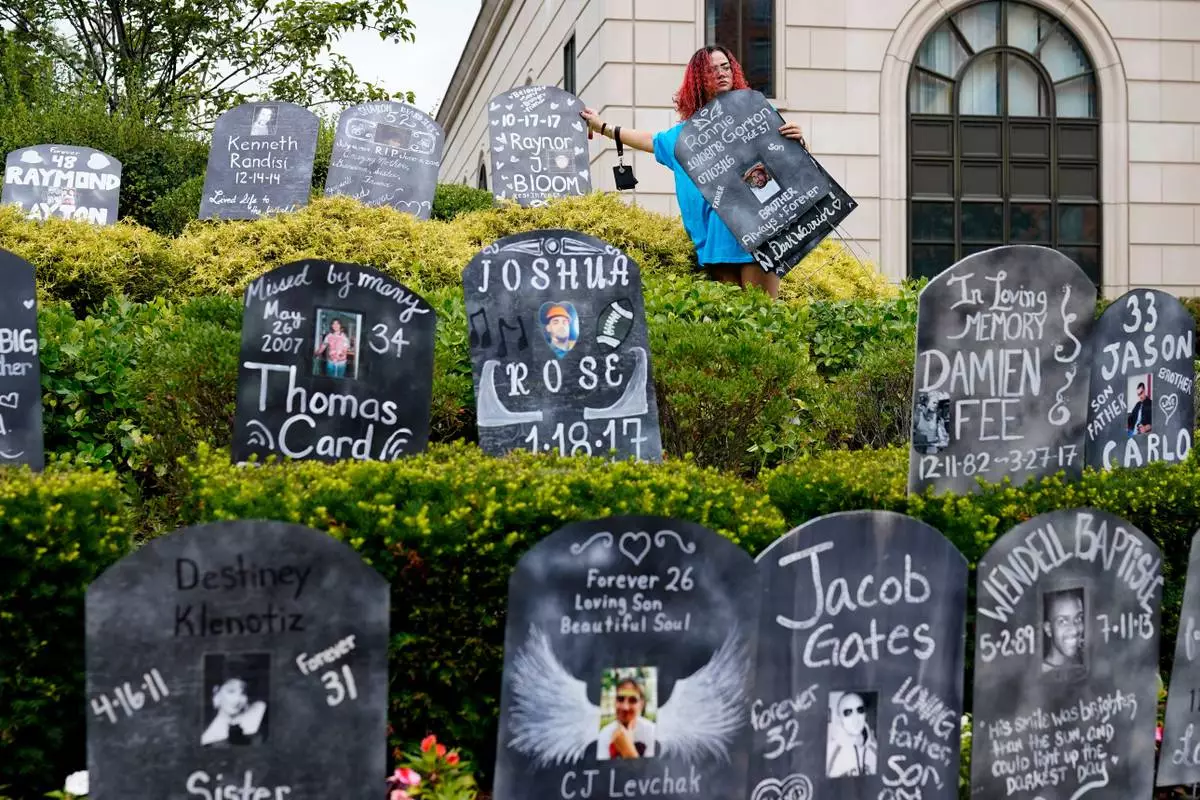
FILE - Jayde Newton helps to set up cardboard gravestones with the names of victims of opioid abuse outside the courthouse where the Purdue Pharma bankruptcy is taking place in White Plains, N.Y., on Aug. 9, 2021. (AP Photo/Seth Wenig, File)
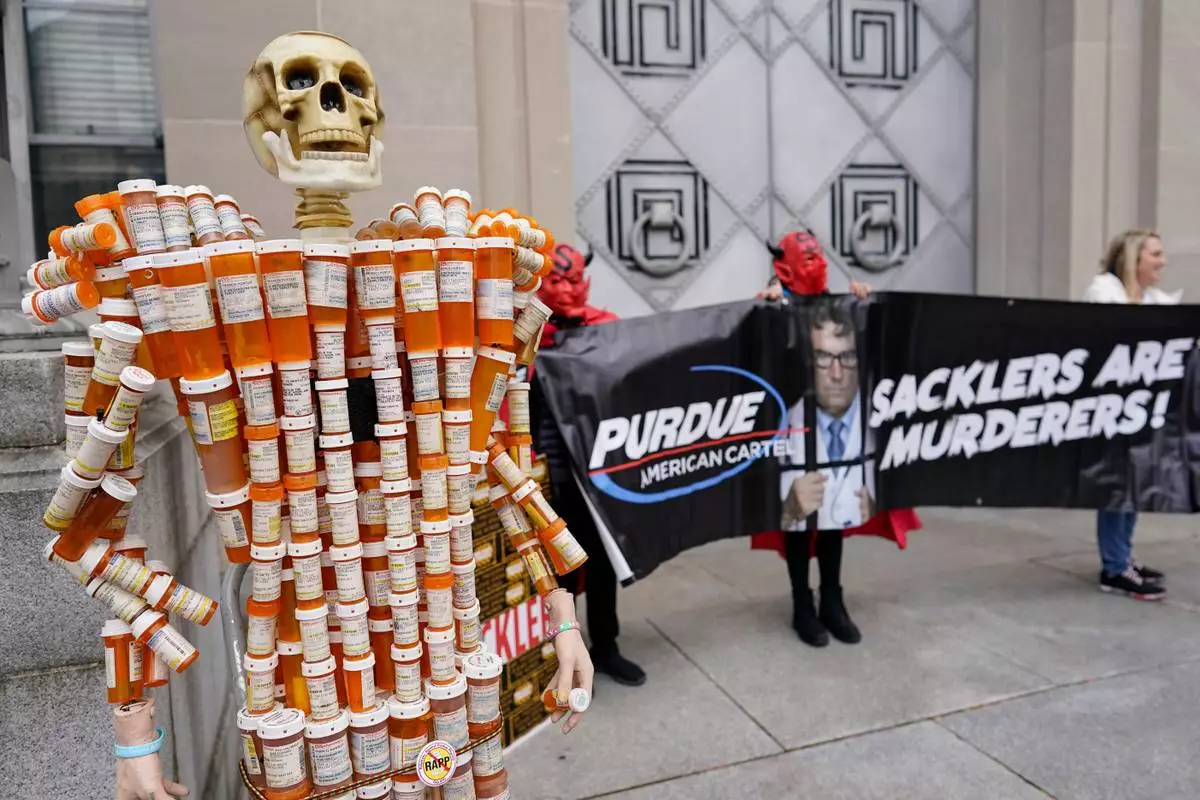
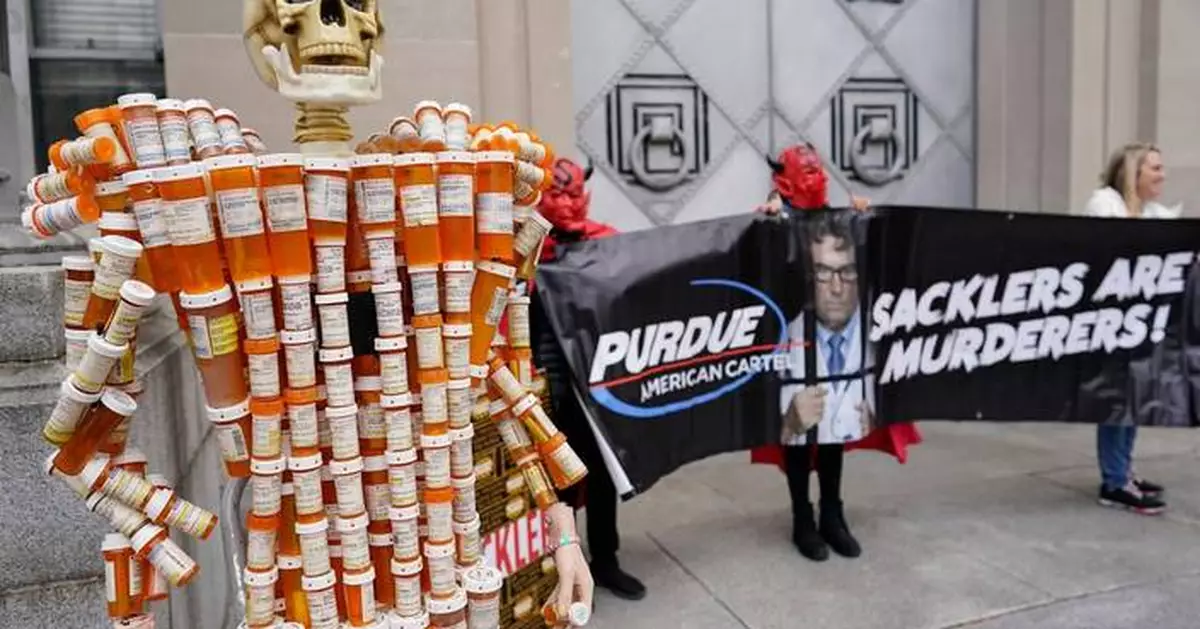
FILE - "Pill Man" made by Frank Huntley of Worcester, Mass., from his opioid prescription pill bottles, is displayed during a protest by advocates for opioid victims outside the Department of Justice, Dec. 3, 2021, in Washington. (AP Photo/Carolyn Kaster, File)
FORT LAUDERDALE, Fla. (AP) — Lionel Messi 's legacy was long secured when he came to Inter Miami and joined Major League Soccer. He'd won a World Cup, won dozens of trophies, was generally considered the greatest player in the sport's history.
He didn't need an MLS Cup.
But he wanted one — and got it.
Messi and Inter Miami have completed their ascent, beating the Vancouver Whitecaps 3-1 on Saturday in the MLS Cup final for the franchise's first championship. It came 2 1/2 years after the legend arrived in South Florida, a move that stunned plenty of onlookers at the time.
“They said soccer would never make it in America,” MLS Commissioner Don Garber said during the trophy ceremony. “Inter Miami fans, has soccer made it?”
It has in South Florida, thanks to Messi. He set up the title-clinching goal with a 72nd-minute assist to Rodrigo De Paul, a play where Messi stole the ball and threaded a pass through a tiny gap in a wall of Vancouver defenders. De Paul got it in stride, pushed it into the far corner of the net — and Messi went airborne to hop into his arms a few seconds later, all smiles.
And as the final minutes ticked away, Inter Miami's pink-clad fans — most wearing Messi's No. 10 on their backs — stood and stomped and cheered. South Florida has seen NFL and NBA and Major League Baseball and NHL titles in the past.
It's a soccer town now, too. Messi made that happen. Tadeo Allende scored in the sixth minute of stoppage time — off another Messi assist, of course — to make it 3-1. And when Messi lifted the trophy surrounded by his teammates, confetti rained down and fireworks boomed.
Inter Miami became the 16th franchise in the league's 30-year history to win an MLS title. And this extends a run of parity for MLS, which has seen five different franchises win championships in the last five years and eight franchises claim a title in the last nine seasons — only Columbus has won twice in that span.
It was also the culmination of a 12-year odyssey for David Beckham, part of Inter Miami’s ownership group.
He retired as a player in 2013 and his MLS contract said he could start a franchise at a discounted rate when his career ended. Beckham chose Miami and it took him years to finally make it happen; it wasn’t until January 2018 when the franchise was formally born, after he partnered with Miami businessmen Jorge Mas and Jose Mas, and even then the team didn’t have a stadium plan.
The team started play in 2020, and Messi arrived halfway through the 2023 season. Inter Miami was in last place in MLS at the time.
And then Messi arrived. The last-place team then now runs the league.
“It’s been an incredible journey,” Beckham said.
The trophy is Messi’s 47th for club and country, extending his global men’s soccer record, and some say it's actually 48 because MLS awards a trophy for winning conference titles as well. He’s now won at least 21 titles in one-match final situations, many of them with the core of this team — Sergio Busquets, Jordi Alba, Luis Suarez and Javier Mascherano, his longtime Barcelona teammates.
Busquets and Alba are retiring and got to go out as champions. Suarez’s future is uncertain. Mascherano is the coach now, one who changed Inter Miami’s lineup and tactics halfway through the season — his first one leading the club — with this moment in mind.
And the 38-year-old Messi, the 2024 MLS MVP who seems like a lock to win the award again this season, still is like none other in the biggest moments with a contract that could have him playing with Miami into his early 40s. When next season starts, the team will be playing in a new stadium near Miami International Airport with a back-to-back title in mind.
“He’s not just here to enjoy living in Miami,” Beckham said. “His wife and the kids love Miami, but he’s come here to win, and that’s really what Leo is all about. He wants to win. He’s got that dedication, the loyalty that he shows to his teammates, to the city, to the club. Leo is a winner. It’s simple as that.”
Inter Miami went up 1-0 on an own goal in the eighth minute, before Vancouver tied it in the 60th on a score by Ali Ahmed. Another Vancouver shot hit both posts about two minutes later but stayed out, and Inter Miami got the lead for good when Messi found De Paul.
And not long after the final whistle, Messi went over to the Inter Miami supporters section and threw both his hands in the air. It was a moment 2 1/2 years in the making.
AP soccer: https://apnews.com/hub/soccer
Inter Miami forward Tadeo Allende (21) celebrates his goal during the second half of the MLS Cup final soccer match against the Vancouver Whitecaps Saturday, Dec. 6, 2025, in Fort Lauderdale, Fla. (AP Photo/Rebecca Blackwell)
Inter Miami forward Tadeo Allende (21) kicks the ball for a goal during the second half of the MLS Cup final soccer match against the Vancouver Whitecaps Saturday, Dec. 6, 2025, in Fort Lauderdale, Fla. (AP Photo/Rebecca Blackwell)
Inter Miami midfielder Rodrigo de Paul (7) reacts at the end of the second half of the MLS Cup final soccer match against the Vancouver Whitecaps Saturday, Dec. 6, 2025, in Fort Lauderdale, Fla. (AP Photo/Rebecca Blackwell)
Inter Miami forward Lionel Messi (10) and his teammates celebrate after Inter Miami forward Tadeo Allende (21) scores a goal during the second half of the MLS Cup final soccer match against the Vancouver Whitecaps Saturday, Dec. 6, 2025, in Fort Lauderdale, Fla. (AP Photo/Rebecca Blackwell)
Vancouver Whitecaps' Ali Ahmed (right) celebrates his goal against Inter Miami with Andres Cubas during the second half of the MLS Cup final soccer match, in Fort Lauderdale, Fla., on Saturday, Dec. 6, 2025. (Darryl Dyck/The Canadian Press via AP)
Inter Miami forward Lionel Messi (10) kicks a corner kicks during the first half of the MLS Cup final soccer match against the Vancouver Whitecaps Saturday, Dec. 6, 2025, in Fort Lauderdale, Fla. (AP Photo/Lynne Sladky)
Inter Miami forwards Lionel Messi (10) and Tadeo Allende (21) celebrate after Vancouver Whitecaps defender Édier Ocampo scored an own goal during the first half of the MLS Cup final soccer match Saturday, Dec. 6, 2025, in Fort Lauderdale, Fla. (AP Photo/Rebecca Blackwell)
Inter Miami midfielder Rodrigo de Paul (7) celebrates a goal with forward Lionel Messi (10) and defender Jordi Alba (18) during the second half of the MLS Cup final soccer match against the Vancouver Whitecaps Saturday, Dec. 6, 2025, in Fort Lauderdale, Fla. (AP Photo/Lynne Sladky)