NAPLES, Fla. (AP) — What the LPGA Tour sees as a strength might be what keeps it from gaining more traction during this surge in women's sports.
Yes, there is a depth of talent — more power, greater precision, lower scoring.
That much was on display Monday night during the season-ending CME Group Tour Championship when 11 first-time LPGA winners graced the stage at a glitzy awards dinner. Two of them, Mao Saigo and Miyuu Yamashita, are major champions.
They are among 29 winners in 30 tournaments (including a team event in Michigan) in a most unusual year. It took until October — the 26th official tournament of the season — before the LPGA had a multiple winner in Jeeno Thitikul, the world's No. 1 player.
Equally amazing, Nelly Korda is not among the winners after seven titles in 2024.
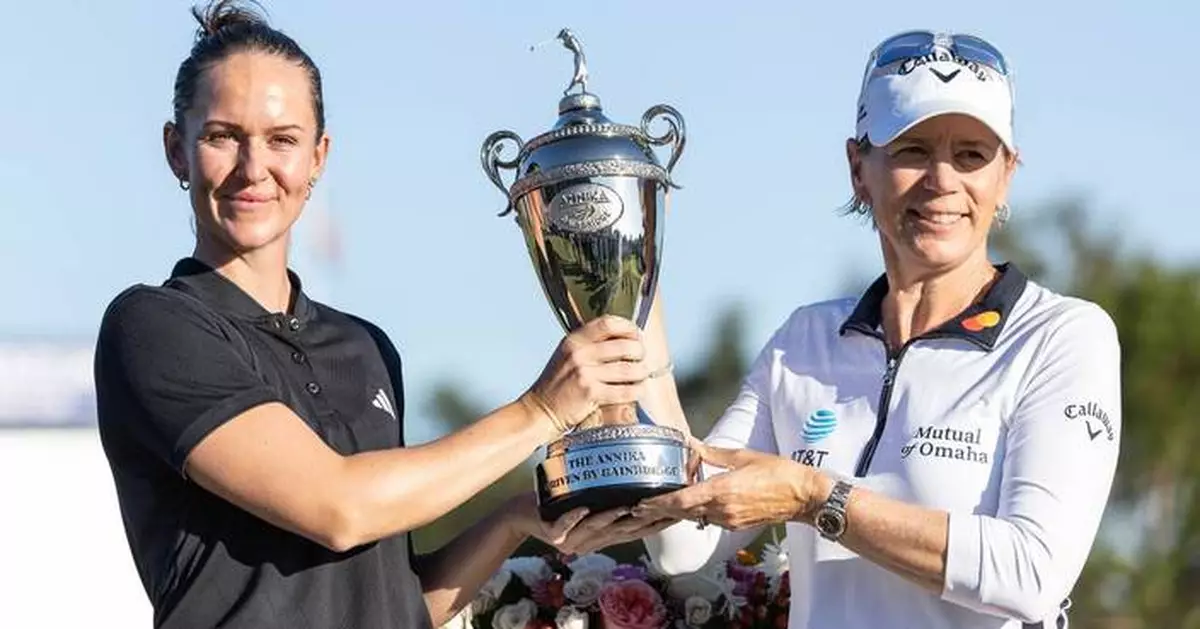
“It's been an interesting year on the LPGA,” Annika Sorenstam said after watching a fellow Swede, Linn Grant, win her tournament on Sunday to be unique winner No. 29.
“I think after ‘24, I don’t think people thought what we've seen this year would be what it is," Sorenstam said. "It shows the depth of the tour. I think we're in a little bit of a transition between some players and generations maybe."
This is the third time in four years the LPGA has produced at least 11 first-time winners in a season, so maybe Sorenstam is onto something.
But depth can be a convenient way of saying that winning is hard. That's been the case for most of the 75 years the LPGA has been in existence, and it's no different from any other golf tour. Tiger Woods in his healthy, peak years only won 27% of the time.
What this year illustrated going into the season finale is the LPGA is in dire need of a star. Dominance is far more appealing than depth, and sometimes even that isn't enough.
For all her dominance, it took Sorenstam playing on the PGA Tour at Colonial in 2003 to become a star. Scottie Scheffler already was a two-time Masters champion and winning at an alarming rate. His Q-rating really soared after his bizarre arrest during the PGA Championship at Valhalla.
Finding a star? Now that's hard.
Korda would have seemed to fit the mold last year when she won seven times, including a record-tying five in a row that culminated with her capturing another major. But for all her graceful athleticism and power — and her heritage as the daughter of a Grand Slam tennis champion — she is not one to perform for the camera. The 27-year-old American is more cool customer than celebrity.
Could she do more? Sure. Everyone can. But the last thing any sport needs are top players trying to become someone they're not.
If the LPGA is in transition, that starts at the top. Craig Kessler was hired as the new commissioner this summer and already is looking at foundational changes geared toward the long run.
He has hired Monica Fee, who spent 15 years in brand partnerships at Creative Artists Agency and the last four years building such partnerships at Saudi-funded LIV Golf. Sean Bratches, the highly regarded television executive who directed commercial operations for Formula 1 during its rise in North America, was added to the LPGA board of directors.
Kessler on Tuesday announced a big partnership with FM, the Rhode Island-based mutual insurance company that already has bought into the LPGA with a title sponsorship at the TPC Boston with the largest purse ($4.1 million) this side of a major.
The latest agreement with FM is to ramp up the television product in North America, long overdue. Starting next year, every LPGA event in North America will be shown live (instead of the occasional tournament on tape delay). That will mean going over to CNBC at times.
More than just live TV is a 50% increase in cameras to provide for more shots and different angles, a deal with Trackman to provide the popular shot tracing that has become standard on the PGA Tour, and drone coverage. It's an important upgrade.
“Fans will immediately see and feel the difference — more cameras, better technology, richer storytelling and more ways to appreciate the unbelievable skill of our players, fully live,” Kessler said. "This is a major step forward for the women’s game, and it’s only the beginning. The next chapter for the LPGA is going to be something special.”
Any step is important.
Kessler also is letting players know what can be expected from them. There is personality and marketability. It has to start with performance. But the third area equally important is effort, a willingness to do more because more is required when trying to carve out a spot in an increasingly crowded space of women's sports.
Kessler gave the Commissioner's Award on Monday night to LPGA Hall of Fame members. Among those on stage was Nancy Lopez, perhaps the last LPGA player who ticked every box. She captivated women's golf in 1978, made the cover of Sports Illustrated with her game, her smile, a captivating presence and a willingness to carry her sport.
She wasn't the best, but there was none like her and may not be another for some time. It also was a different era for the LPGA, not the destination like it is now for players from Asia and Europe and every corner of the world.
The moment for another star or collection of them will present itself in time, that unique combination of play and personality. The key will be a willingness for players to embrace it. Kessler's job is to make sure the LPGA is ready for it.
On The Fringe analyzes the biggest topics in golf during the season. AP golf: https://apnews.com/hub/golf

Mao Saigo, right, of Japan, hugs Rose Zhang after finishing on the 18th hole during the first round of The Annika LPGA golf tournament Thursday, Nov. 13, 2025, in Belleair, Fla. (AP Photo/Chris O'Meara)

Defending tournament champion Nelly Korda watches her tee shot from in front of the gallery on the first hold during a pro-am for the Annika LPGA golf tournament, Wednesday, Nov. 12, 2025, in Belleair, Fla. (AP Photo/Chris O'Meara)

Linn Grant, left, and Annika Sorenstam, right, hold the championship trophy after Grant's win on the final day of The Annika LPGA golf tournament in Belleair, Fla., Sunday, Nov. 16, 2025. (AP Photo/Willie J. Allen Jr.)
The Nordic countries are no strangers to the long, dark winter.
Despite little to no daylight — plus months of frigid temperatures — people who live in northern Europe and above the Arctic Circle have learned how to cope mentally and physically with the annual onset of the winter blues, which can begin as early as October and last into April for some.
The winter solstice will occur Dec. 21, marking the shortest day and longest night of the year in the Northern Hemisphere. While sunlight increases daily after that, winter won't be over for a while yet.
The Associated Press spoke to experts in Norway, Sweden and Finland about the winter blues. Here's how they suggest looking for light, literally and figuratively, during the darkest months of the year:
Dr. Timo Partonen, a research professor at the Finnish Institute for Health and Welfare, said the dark winter affects our circadian rhythm.
With limited daylight, our internal body clocks cannot reset or synchronize properly and it throws off our sleep. We may sleep longer in the winter, he said, but we don't wake up refreshed and can remain tired the rest of the day.
Partonen recommended trying a dawn simulator, sometimes known as a sunrise alarm clock, to gradually light up your bedroom and ease you awake.
In addition to being more tired, we're more likely to withdraw from others socially in the wintertime. We're more irritable, Partonen said, and more prone to fights with friends.
It's important to maintain our relationships, he said, because symptoms rarely improve in isolation.
And since keeping up with exercise is also key to combating the winter blues, consider inviting a friend along for a workout.
It could also help keep off the wintertime weight gain — typically 2 to 5 kilograms (4 to 11 pounds) a year, Partonen said — that's fed by cravings for carbohydrates, especially in the evenings.
Millions of people worldwide are estimated to suffer from seasonal depression. Also known as seasonal affective disorder, or SAD, patients typically have episodes of depression that begin in the fall and ease in the spring or summer. A milder form, subsyndromal SAD, is recognized by medical experts, and there’s also a summer variety of seasonal depression, though less is known about it.
Scientists are learning how specialized cells in our eyes turn the blue wavelength part of the light spectrum into neural signals affecting mood and alertness. Sunlight is loaded with the blue light, so when the cells absorb it, our brains’ alertness centers are activated and we feel more awake and possibly even happier.
Researcher Kathryn Roecklein at the University of Pittsburgh tested people with and without SAD to see how their eyes reacted to blue light. As a group, people with SAD were less sensitive to blue light than others, especially during winter months. That suggests a cause for wintertime depression.
In severe cases, people need clinical support and antidepressant medications. Christian Benedict, a pharmacology professor at Uppsala University in Sweden, suggests light therapy for people with SAD as well as those who have a milder case of the winter blues.
“It’s not like it’s a fate, an annual or a seasonal fate, and you cannot do anything about it,” Benedict said. “There are possibilities to affect it.”
A routine of morning light therapy, using devices that emit light about 20 times brighter than regular indoor light, can be beneficial for both people with and without SAD.
The light therapy helps to kickstart your circadian rhythm and increases serotonin in your brain, Benedict said.
Research supports using a light that’s about 10,000 lux, a measure of brightness, for 30 minutes every morning. Special lights run from $70 to $400, though some products marketed for SAD are not bright enough to be useful. Your insurance company might cover at least part of the cost if you’ve been diagnosed with SAD.
Partonen recommended using both a dawn simulator and a light therapy device each day before noon.
Yale has tested products and offers a list of recommendations, and the nonprofit Center for Environmental Therapeutics has a consumer guide to selecting a light.
And don't forget to, well, look on the bright side. It's crucial to embrace winter instead of dreading it, according to Ida Solhaug, an associate professor in psychology at the University of Tromsø, also known as the Arctic University of Norway — the world's northernmost university.
Prioritize a positive outlook as a survival strategy and learn to appreciate the change in seasons. It's a typical Norwegian way of thinking, she said, that can make all the difference when there's very little daylight for months.
“It's part of the culture,” she said.
And don't forget to take advantage of both outdoor and indoor hobbies, she said. Inside, channel hygge — the Danish obsession with getting cozy — and snuggle up on the couch with blankets and a movie.
But don't hibernate all winter. After the film finishes, head outside with a thermos for fika, the traditional Swedish coffee break. Even during cloudy days, a quick walk in the fresh air will help, she said. And if you're brave enough, do a cold plunge like many people in the Nordics.
Solhaug tries to jump into the frigid waters off the coast of Tromsø, an island 350 kilometers (217 miles) north of the Arctic Circle, at least once a week, adding that it makes her feel revitalized during the long winter.
“Challenge yourself to look for light in the darkness,” she said.
After all, as many Nordic people say, there’s no such thing as bad weather — only bad clothing.
Finland's President Alexander Stubb, too, had some tips for how to tackle Nordic winters. When asked in an interview with The Associated Press last month how to survive the cold season, he had some very specific advice.
“Take an ice bath and then followed up by a sauna and do one more ice bath, one more sauna, then a shower and go out there. You’ll manage,” Stubb said.
__
Dazio reported from Berlin.

People pass a shop window in Helsinki, Finland, Friday, Nov. 14, 2025. (AP Photo/Sergei Grits)

People walking along the square are reflected in a puddle in Helsinki, Finland, Friday, Nov. 14, 2025. (AP Photo/Sergei Grits)
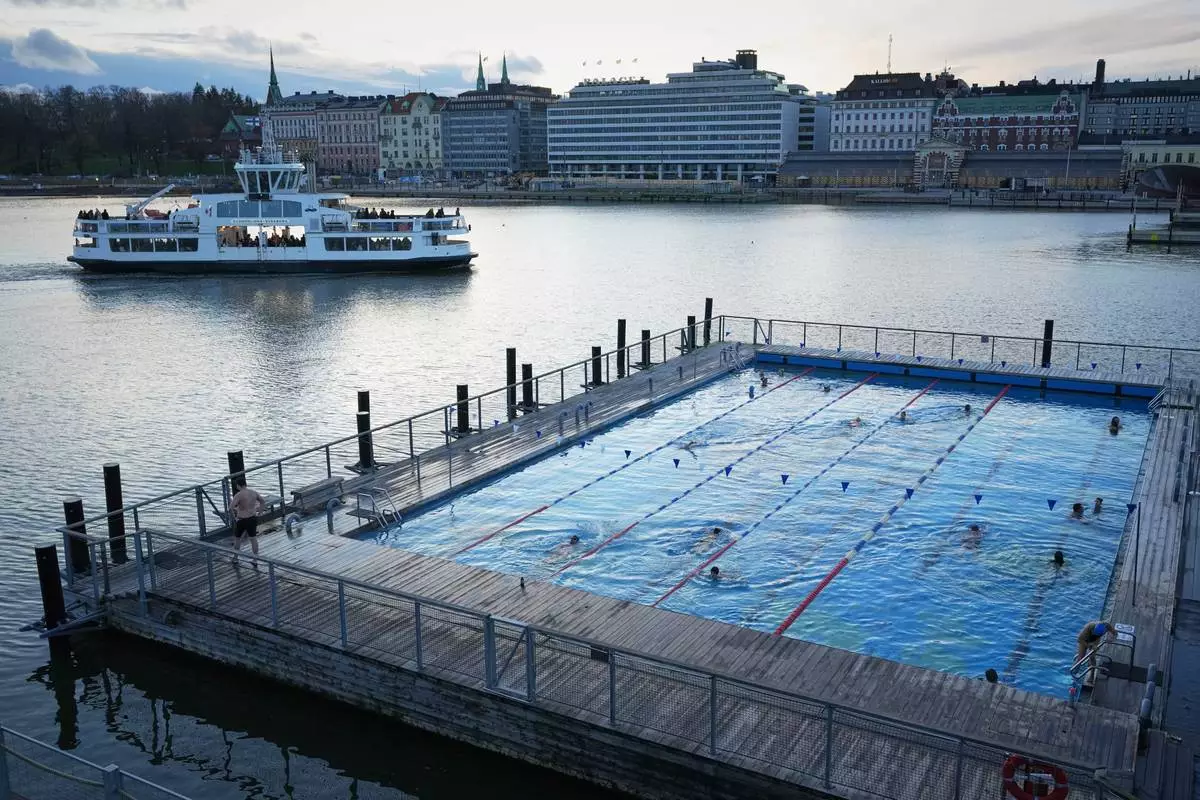
People enjoy in a public pool in Helsinki, Finland, Friday, Nov. 14, 2025. (AP Photo/Sergei Grits)

People enjoy the sunny weather with the Helsinki Cathedral of the background in Helsinki, Finland, Friday, Nov. 14, 2025. (AP Photo/Sergei Grits)
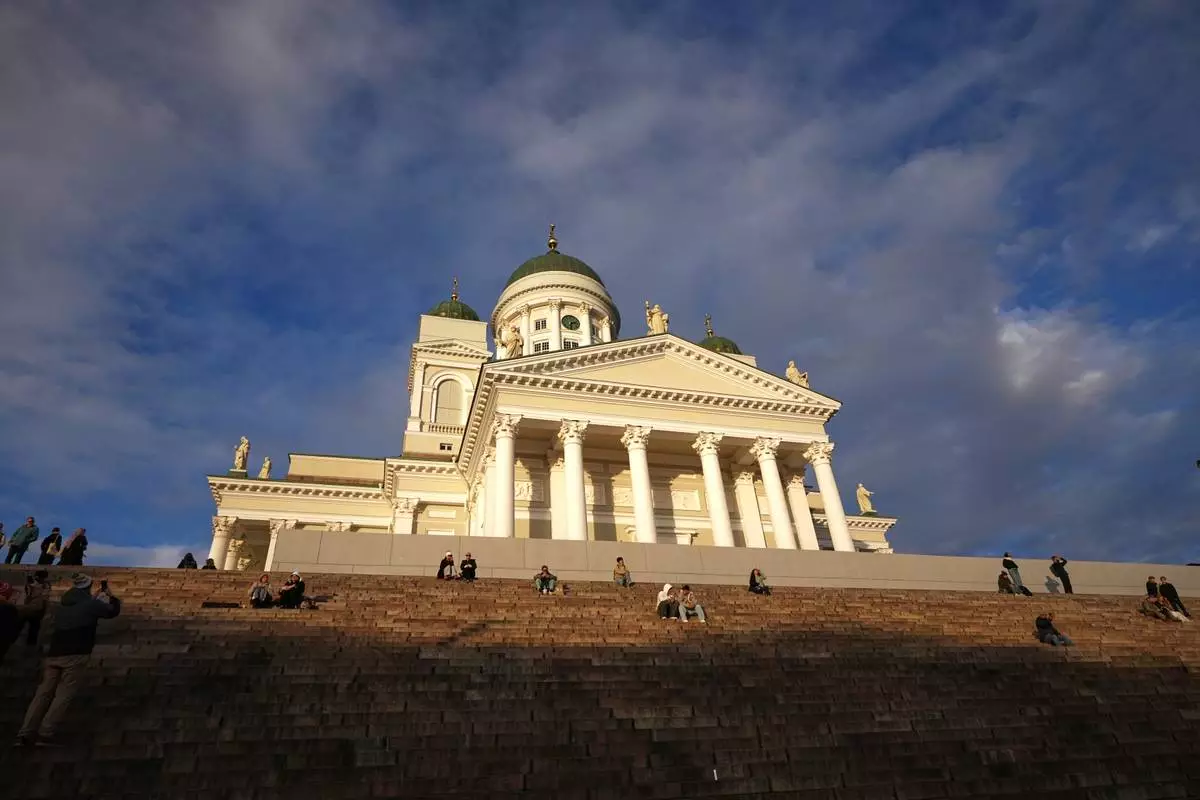
People enjoy the sunny weather with the Helsinki Cathedral of the background in Helsinki, Finland, Friday, Nov. 14, 2025. (AP Photo/Sergei Grits)