PALO ALTO, Calif.--(BUSINESS WIRE)--Nov 18, 2025--
Marking a new era of industrial innovation, SymphonyAI, a global leader in Vertical AI product platforms, announced a milestone integration of NVIDIA Omniverse™ libraries into its IRIS Foundry DataOps platform and IRIS Forge application builder, running on Microsoft Azure cloud and edge infrastructure. Unlike static digital-twin tools, this integration brings live industrial data into 3D digital twins developed using Omniverse libraries, enabling teams to simulate entire plants or production lines in minutes instead of weeks—reducing the time to insight and accelerating operational improvements. Unveiled at Microsoft Ignite, this integration brings together transformative 3D modeling, real-time simulation, and enterprise-grade AI to accelerate digital transformation for refineries, manufacturers, energy producers, and process industry leaders worldwide.
This press release features multimedia. View the full release here: https://www.businesswire.com/news/home/20251118461531/en/
As industrial organizations increasingly move from AI pilots to full-scale production, they face complex challenges: how to visualize and optimize diverse, distributed operations in real time; how to break down data silos across sites and assets; and how to empower teams with actionable insight for better, faster decisions. This solution—integrating NVIDIA Omniverse libraries into IRIS Foundry, running in Microsoft Azure—enables users to build dynamic applications within minutes using IRIS Forge. These applications support collaborative simulations, 3D visualizations, and interactive modelling, while enhancing operational intelligence and allowing one-click deployment to the Azure cloud.
Built on Microsoft Azure’s cloud and edge infrastructure, the integration uses Azure Kubernetes Service for orchestration, Azure Entra ID for secure access, Azure Edge Runtime for near-real-time processing, and Model Context Protocol (MCP) for native connectivity with Microsoft 365 Copilot and Teams.
Learn more about the integration and see real-world examples at symphonyai.com/industrial/iris-foundry/nvidia-omniverse.
Why Now?
The pressure to digitalize operations is accelerating, yet building dynamic applications using Agentic AI remains a massive, real-world challenge. With Vertical AI representing a $344 billion opportunity, enterprises face rising demand for flexible, secure, and scalable models. SymphonyAI is meeting this need by empowering users to leverage IRIS Forge to ideate faster and rapidly develop advanced simulations and visualizations through prompt-based coding.
What Makes This Integration Unique?
This isn’t simply another 3D rendering tool or digital twin software. It marks the rise of the frontier firm in industrial operations—where vertical-specific AI, interactive modeling, and advanced workflows unite in a single platform. Manufacturers, energy providers, and process companies can now optimize performance, safety, and productivity at every step of their value chains.
Key Innovations and Integration Highlights
Enabling Custom Industrial AI Applications with Omniverse Integration
The heart of this innovation is SymphonyAI’s integration of NVIDIA Omniverse libraries into the IRIS Forge application builder, which is powered by the robust data connections and governance of IRIS Foundry. IRIS Forge serves as the development and deployment engine, allowing engineers and operators to rapidly build, customize, and launch industrial AI applications that leverage advanced Omniverse 3D visualization and modeling libraries. This empowers teams to create tailored solutions for their unique manufacturing and process environments, unlocking new possibilities for real-time simulation, scenario modeling, and actionable insights.
Supported by IRIS Foundry’s unified data foundation, which securely connects assets, systems, and contextual data across the organization, every custom app built in Forge is enriched with operational intelligence and enterprise interoperability. The result: scalable, secure, and flexible industrial applications that deliver sophisticated digital experiences, accelerate decision-making, and drive business value in hours—not months.
Industry Leaders on the Future of Industrial AI
SymphonyAI:
“This integration brings engineering depth to the promise of Vertical AI. By integrating NVIDIA Omniverse libraries into our IRIS Foundry platform, we’re uniting industrial data, real-time simulation, and 3D visualization in one intelligent system. Engineers and operators can model, test, and optimize complex operations faster—on-prem, in the cloud, or at the edge—with greater clarity and confidence. That’s the power of Vertical AI in practice.”
— Prateek Kathpal, President of Industrial, SymphonyAI
NVIDIA:
“Enterprises across every industrial sector are seeking faster, more connected ways to transform operations through AI and digitalization. By leveraging NVIDIA’s Omniverse libraries and Microsoft’s cloud and edge infrastructure, SymphonyAI’s Forge and Foundry solutions enable teams to rapidly build dynamic web apps that merge live industrial data with 3D digital twins—accelerating insight and operational excellence.”
— Ganesh Sivaraman, Director, Omniverse Partnerships, NVIDIA
Microsoft:
“As more organizations adopt AI, they need flexible deployment—cloud, on-premises, and edge—and frictionless integration across data, visualization, and operations. Working with SymphonyAI and NVIDIA, we’re enabling the next frontier of industrial innovation—bringing Azure’s robust cloud and edge capabilities together with interactive 3D modeling and industry-focused AI. This is how a new generation of intelligent, connected manufacturing operations is being built.”
— Indranil Sircar, CTO, Manufacturing, Microsoft
See It in Action at Microsoft Ignite
Experience the next frontier of industrial AI in person at Microsoft Ignite, taking place November 18-21, 2025, at the Moscone Center, San Francisco, CA.
Visit SymphonyAI at booth 5127L for a demo and attend our NVIDIA booth theater presentation on November 19 at 2:40 pm for a closer look at the next generation of enterprise-scale industrial AI.
About SymphonyAI
SymphonyAI delivers Vertical AI product platforms that help enterprises solve their most complex, high-value challenges — from stopping financial crime to improving store performance and boosting manufacturing efficiency. Trusted by more than 2,000 enterprise customers worldwide, including 200 of the top financial institutions, the top 25 CPG companies, and many of the world’s largest grocers and industrial manufacturers, SymphonyAI provides domain-trained applications and pre-built agents that are ready to work on day one. Learn more at https://www.symphonyai.com/.
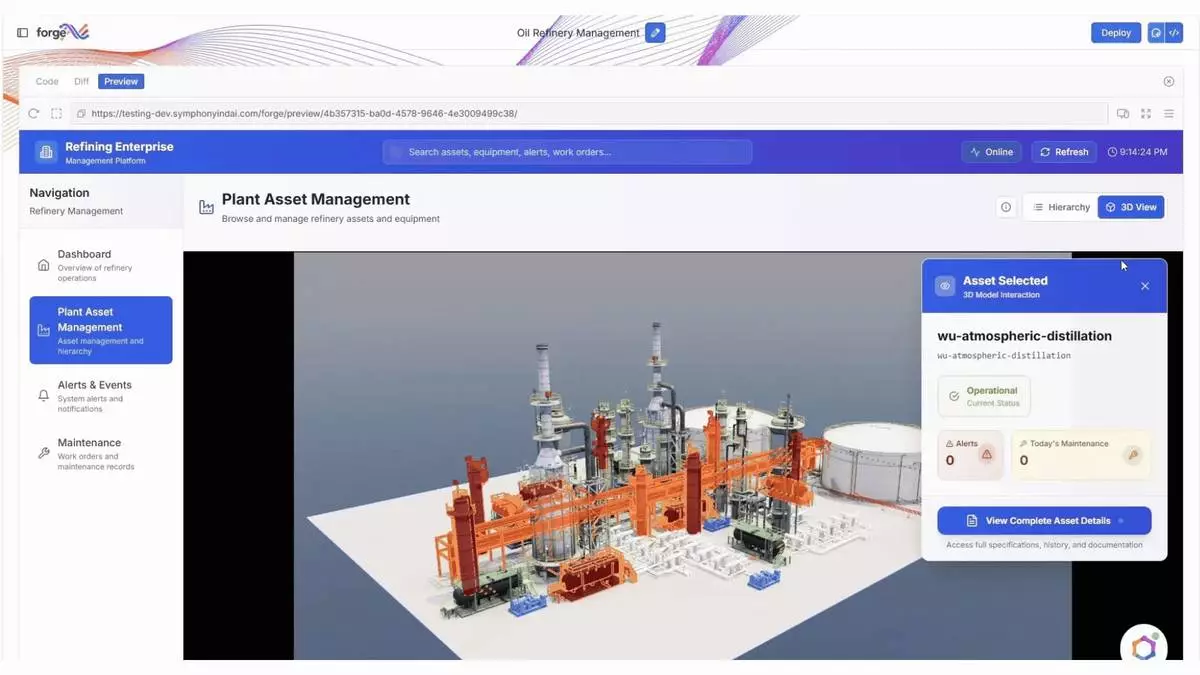
SymphonyAI’s IRIS Foundry on Microsoft Azure Integrates with NVIDIA Omniverse Libraries
TRIKORFO, Greece (AP) — Can a centuries-old ritual of spiritual renewal rekindle a New Year’s resolution to build healthy eating habits before it fades in the spring?
For six weeks every year, millions of Orthodox Christians around the world adopt a largely vegan diet, abstaining from meat, dairy products, eggs, and fish with backbones. Oil and wine also are prohibited on weekdays during the 40-day Lenten period before Orthodox Easter, which often falls later than its Catholic and Anglican counterpart.
The annual adherence to a plant-based, Mediterranean-style meal plan drives a communal rediscovery of vegetables and oil-free cooking methods in majority-Orthodox countries.
In Greece, even McDonald’s franchises get into the lean Lent spirit by adding seasonal menu items that meet most of the proscriptions of the Greek Orthodox Church. The menu includes shrimp wraps, shrimp salad, vegetable spring rolls and plant-based McVeggie burgers but is not oil-free.
Although following Eastern Orthodox dietary guidelines before Easter is often referred to as fasting, the focus is on going without certain foods, not refraining from eating altogether. The rules are not rigid but can be adapted to account for personal needs.
Here’s a look at the annual alimentary tradition, along with reasons to consider sticking with a similar diet and cautionary advice from nutritionists.
Christian traditions diverge between East and West ahead of Easter, and not just in their methods for determining the most important date on their calendars. Catholics are encouraged to give up one or more personal indulgences during Lent but get to decide whether to deny themselves dessert, alcohol, video games, swearing or something else. Members of the Orthodox Church forgo animal products except for shellfish.
Gone are Greeks' beloved dishes like mousaka and souvlakia — grilled meat wrapped with toppings. So are dairy products like milk and cheese. Vertebrate fish like anchovies, mullet and hake are no-nos too, although shrimp, oysters and calamari are permitted.
On a lush coastal hillside in central Greece, 40 monks closely follow these rules at the Monastery of St. Augustine and Seraphim. The monks, who wear black robes and full beards, grow and harvest most of their own produce in the monastery's gardens, including an abudance of zucchini and tomatoes.
Their meals during Lent are basic but not bland. The monks have mastered methods to replicate familiar tastes and textures. Oven-roasted potatoes are coated with tahini instead of oil to preserve the crunch factor. Vegetable stock prepared from scratch gives lentil dishes a hearty flavor.
The monks listen to prayers read aloud as they eat.
Father Nektarios Moulatsiotis, the monastery's affable abbot, says the practice of fasting and following a restricted diet is essential for deep reflection and focus required for the spiritual preparation for Easter. He compares it to endurance training.
“In the same way someone goes to the gym to shape their body," Nektarios said, "the church is a gym for the soul.”
Occasional hunger pangs aren't something to resist; they are part of the plan. The idea is simple: less indulgence, more clarity.
“You cannot really pray, study, chant or do any spiritual exercise with a full stomach,” he said with a chuckle.
Nektarios argues that a nutritious yet disciplined diet can produce benefits that apply outside of a religious setting as much as inside of one, such as a sense of greater self-control and enhanced awareness.
Orthodox monks observe several fasting periods that limit what, when and how much they eat for most of the year. Researchers have studied their health and food intake for decades to determine if their customs hold any clues to preventing heart disease, type 2 diabetes and strokes.
However, the advantages of eating a balanced diet that includes whole grains, vegetables, fruits and legumes are well-established. Reduce consumption of meat, saturated fats and processed foods long enough, and the body typically responds.
“Fasting certainly has benefits, provided it’s done correctly,” Eirini Babaroutsi, a sports nutritionist at the Hellenic Athletics Federation, said. For example, Orthodox Christians tend to eat more fiber during Lent, which helps the digestive system function better, she said.
“It also matters what we do eat, not simply what we avoid," Babaroutsi said. "With the right combinations, we can get all the nutrients we need.”
Meals that meet the guidelines aren’t confined to the ingredients found in Orthodox-majority countries in Southern and Eastern Europe. Babaroutsi suggests porridge with oat milk, vegetable wraps with olive paste, and high-quality peanut butter as helpful international additions.
There are a few considerations.
A six-week fasting cycle is not advisable for older adults and young children, Babaroutsi said. The Eastern Orthodox church also exempts people with serious health conditions, special dietary requirements, and pregnant or nursing women from strict obedience.
Engaging in a post-Lent binge as a reward also is best avoided because loading up after a period of abstinence can strain the body, Babaroutsi said.
For those wary of making a full commitment, know that you're not alone. Orthodox Lent started on Feb. 23, but many Greeks participate only during Holy Week, which starts on April 5, Palm Sunday, and goes until April 11, the day before Orthodox Christians celebrate Easter this year.
Supermarkets and bakeries in Greece make it easier to abide by stocking fast, family-friendly meals and an assortment of seasonal goods.
These include jars of pickles and olives, bags of chickpeas and other pulses, squid sliced into rings in freezer cases, the creamy pink fish roe known as taramosalata, and slabs of unleavened bread shaped like small surfboards.
In central Athens, at the slippery-floored central fish market, vendors call out over piles of Lent-compliant clams, octopus and mussels, shoveling seafood into paper cones.
Gerasimos Mantalvanos, the market’s general manager, said many customers tend to overindulge when Easter Sunday's traditional lamb dishes and sweets arrive. For most, a spirit of moderation eventually returns, he said.
“It is good for eating habits to change from time to time during the year,” Mantalvanos said. “So a period of fasting, a little fish and some abstinence from meat, I think these are good for the body. It is a kind of small detox, a little break.”
–––
AP photographer Thanassis Stavrakis and videojournalist Srdjan Nedeljkovic contributed.
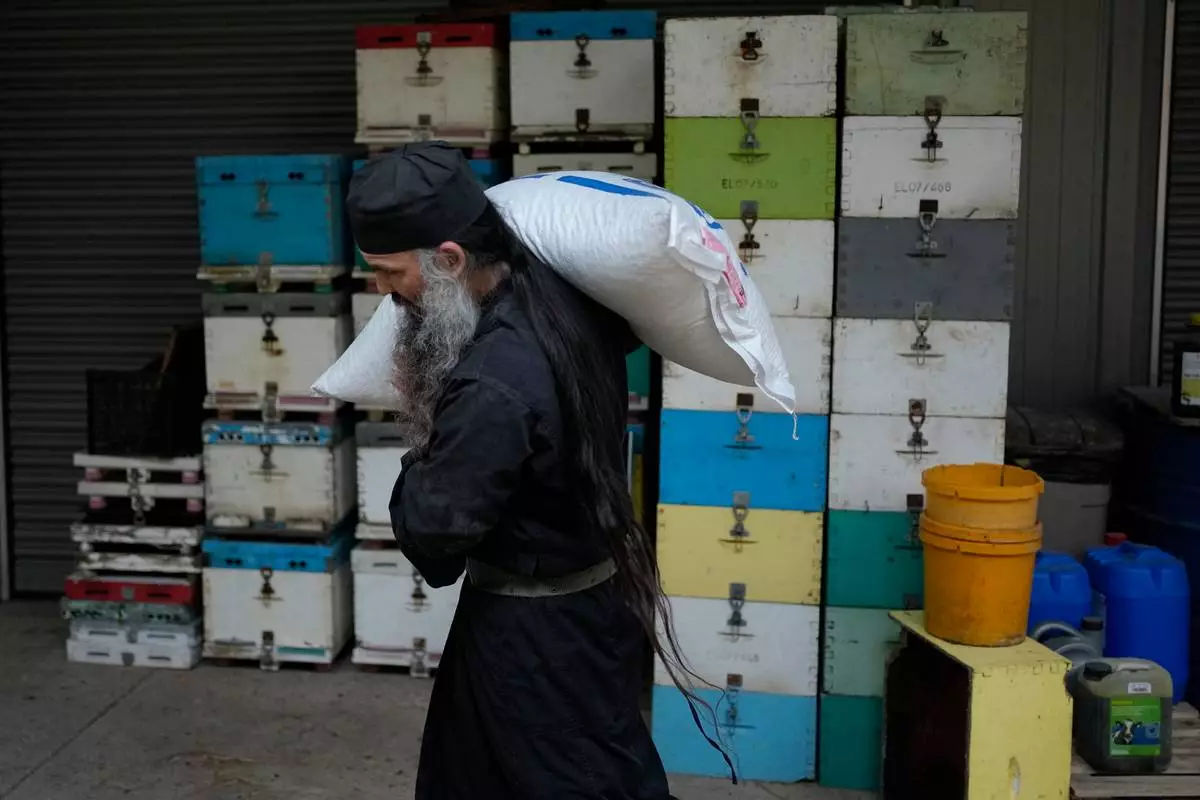
Father Seraphim carries a sack of feed for sheep at the Monastery of St. Augustine and Seraphim of Sarov in the village of Trikorfo, about 236 kilometers (147 miles) northwest of Athens, Friday, March 20, 2026. (AP Photo/Thanassis Stavrakis)
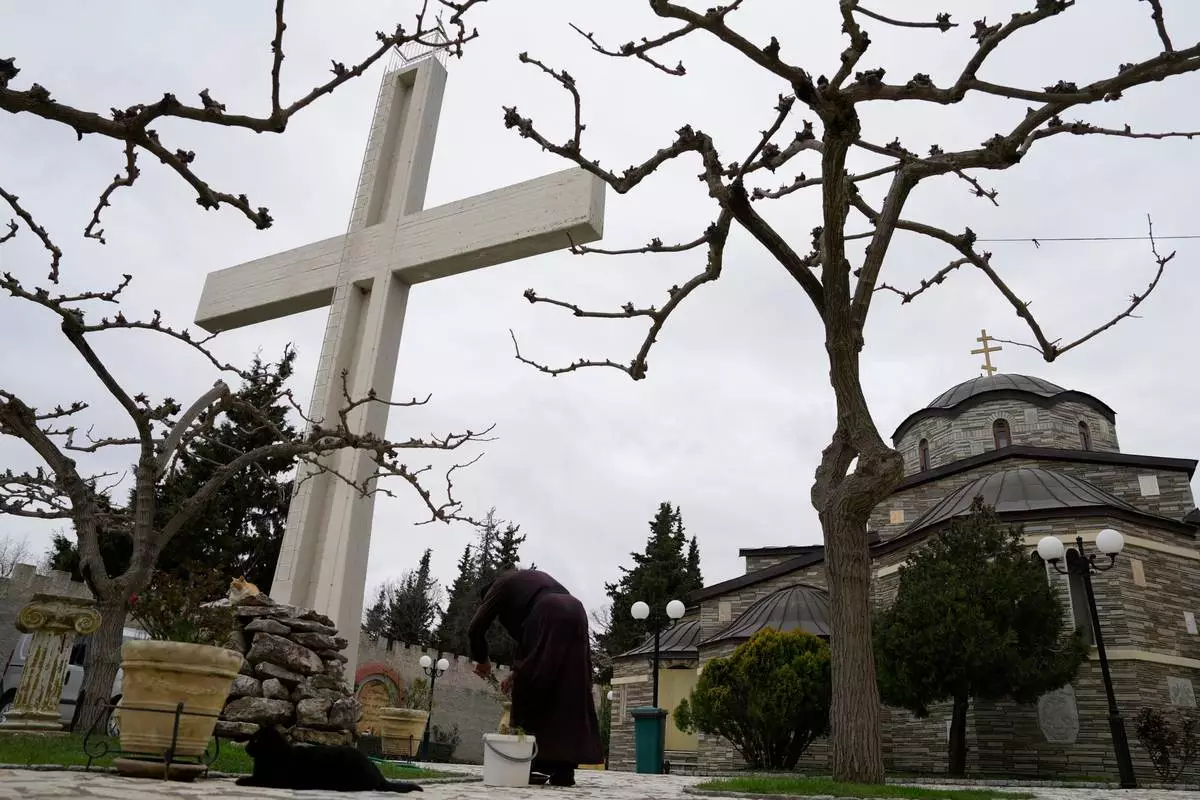
A monk tends to plants at the Monastery of St. Augustine and Seraphim of Sarov in the village of Trikorfo, about 236 kilometers (147 miles) northwest of Athens, Friday, March 20, 2026. (AP Photo/Thanassis Stavrakis)
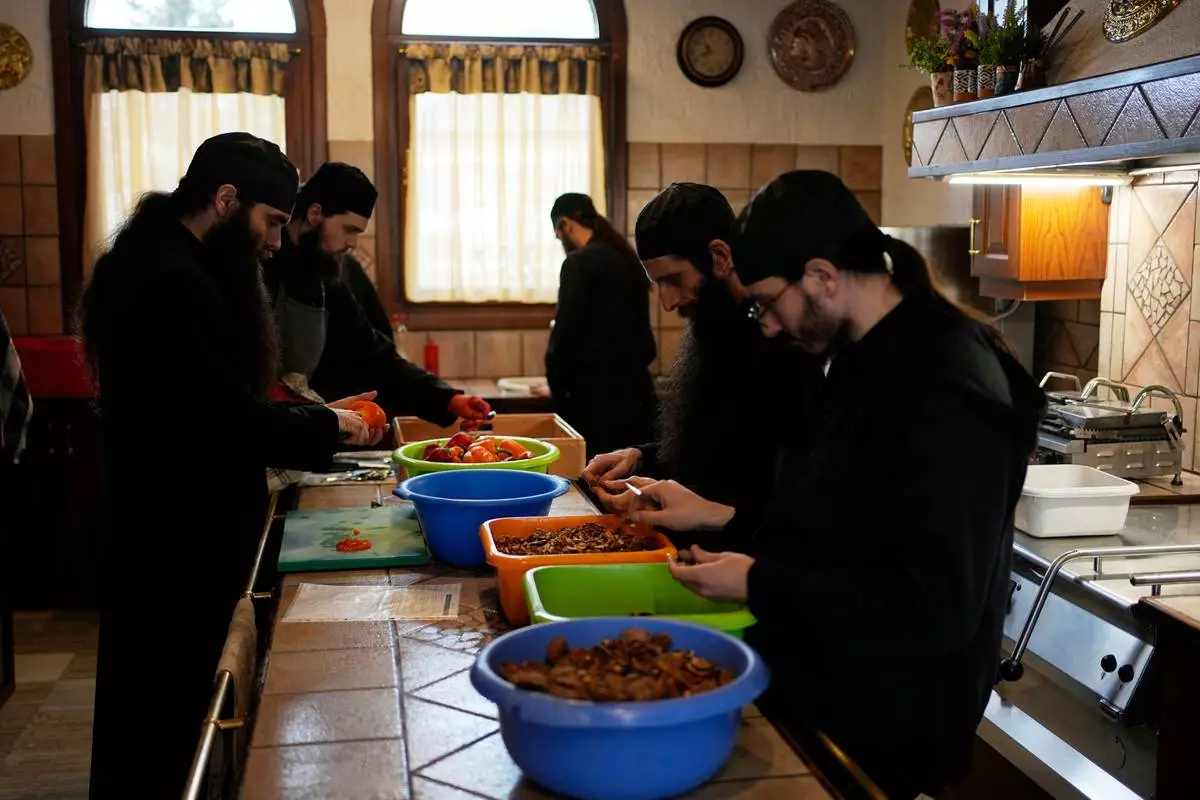
Monks prepare the meals at the Monastery of St. Augustine and Seraphim of Sarov in the village of Trikorfo, about 236 kilometers (147 miles) northwest of Athens, Friday, March 20, 2026. (AP Photo/Thanassis Stavrakis)
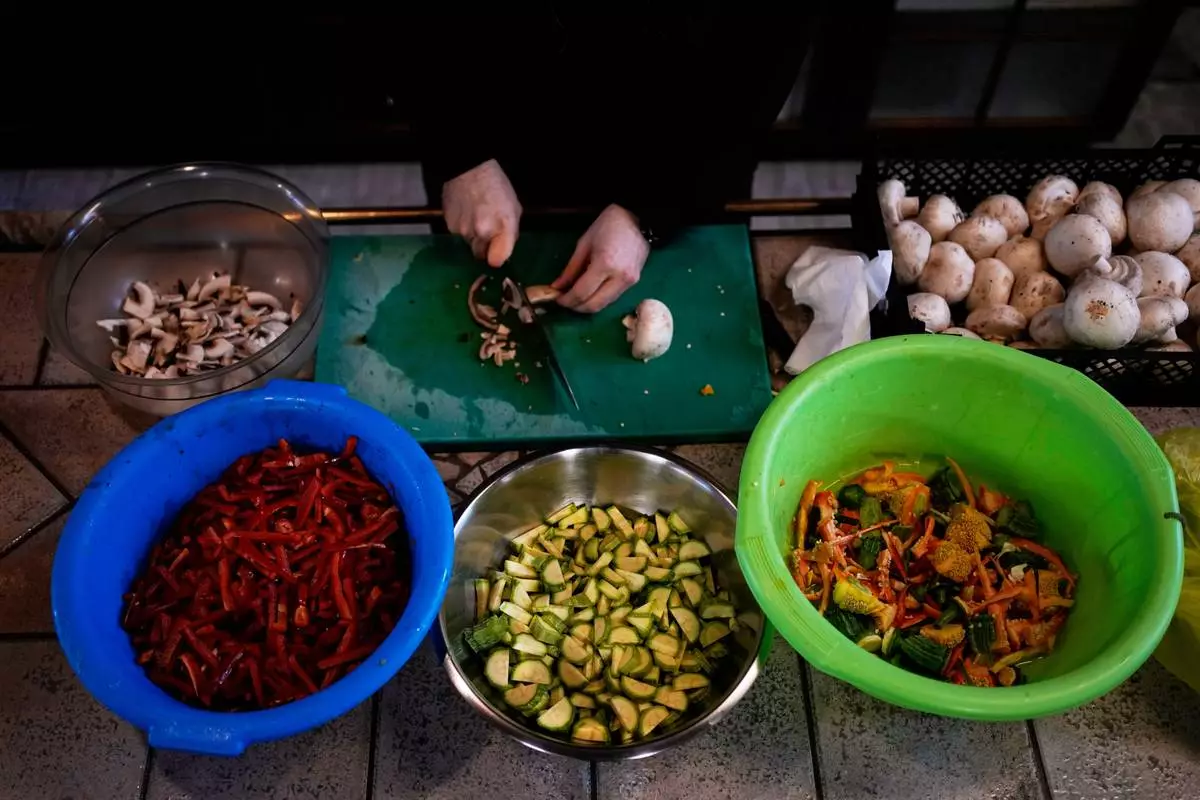
A monk prepares meals at the Monastery of St. Augustine and Seraphim of Sarov ahead of Easter as part of annual Lenten dietary restrictions in the village of Trikorfo, about 236 kilometers (147 miles) northwest of Athens, Friday, March 20, 2026. (AP Photo/Thanassis Stavrakis)
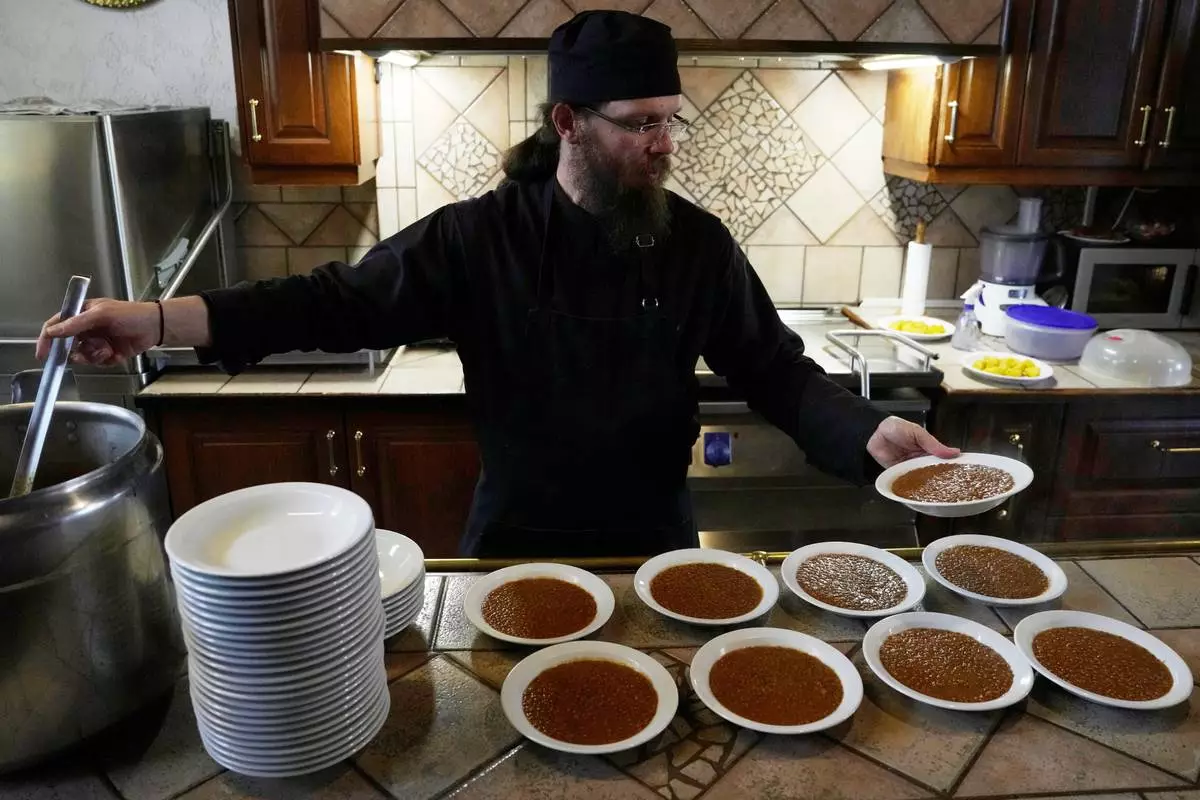
Father Isaac serves lentils for the midday meal at the Monastery of St. Augustine and Seraphim of Sarov in the village of Trikorfo, about 236 kilometers (147 miles) northwest of Athens, Friday, March 20, 2026. (AP Photo/Thanassis Stavrakis)