A federal court on Tuesday blocked Texas from using a redrawn U.S. House map that touched off a nationwide redistricting battle and is a major piece of President Donald Trump’s efforts to preserve a slim Republican majority ahead of the 2026 elections.
The ruling is a blow to Trump's rush to create a more favorable political landscape for Republicans in next year's midterms, at least for now. Texas filed an appeal Tuesday evening with the U.S. Supreme Court after Gov. Greg Abbott and other Republicans publicly defended the map, which was engineered to give Republicans five additional House seats.
In a 2-1 ruling, a panel of federal judges in El Paso sided with opponents who argued that Texas' unusual summer redrawing of congressional districts would harm Black and Hispanic residents. The decision was authored by U.S. District Judge Jeffrey V. Brown, a Trump nominee from the president's first term.
“To be sure, politics played a role in drawing the 2025 Map. But it was much more than just politics. Substantial evidence shows that Texas racially gerrymandered the 2025 Map,” the ruling states.
The decision comes amid an widening national battle over redistricting. Missouri and North Carolina followed Texas with new maps adding an additional Republican seat each.
To counter them, California voters approved a ballot initiative to give Democrats an additional five seats there. The Trump administration filed a federal lawsuit challenging that map, with Attorney General Pam Bondi calling it “a brazen power grab.”
In a post on X, California Democratic Gov. Gavin Newsom celebrated the Texas ruling: “Donald Trump and Greg Abbott played with fire, got burned — and democracy won.”
Texas Republicans insisted they drew the new map only for partisan advantage. The U.S. Supreme Court ruled in 2019 that partisan gerrymandering is a political question and not one for the federal courts to decide.
“Texas’s map was drawn the right way for the right reasons,” Bondi posted on X.
Civil rights groups representing Black and Hispanic voters argued the map reduced the influence of minority voters, making it a racial gerrymander that violates the federal Voting Rights Act and the U.S. Constitution. They sought an order blocking Texas from using the map while their case proceeded, which the judges granted.
If the ruling stands, Texas will be forced to use the map drawn by the GOP-controlled Legislature in 2021 for next year’s elections.
"Today’s decision is a critical victory for voting rights and a powerful rebuke of Texas’s brazen attempt to dilute the political power of Latino and Black voters,” said Abha Khanna, a partner in the Elias Law Group, a Democratic firm representing minority voters opposing the new Texas map.
The judges signaled that they think the map's critics have a substantial chance of winning their case at trial. An appointee of Democratic President Barack Obama joined Brown in the majority, while an appointee of Republican President Ronald Reagan dissented.
The majority said that absent their injunction blocking the map's use for now, minorities would be forced to have congressional representation based on “likely unconstitutional racial classifications for at least two years.”
The two appeals judges concluded that a major reason that Abbott and Republican lawmakers moved was a letter from the head of the U.S. Department of Justice's Civil Rights Division in July, directing Texas to redraw four districts that it said violated the Voting Rights Act.
Harmeet Dhillon, the assistant U.S. attorney general overseeing the division, cited a ruling last year by the conservative federal appeals court for Texas, Louisiana and Mississippi.
The 5th U.S. Circuit Court of Appeals declared that the landmark Voting Rights Act of 1965 does not allow separate minority groups to “aggregate their populations” to argue that a map illegally dilutes minority voters’ ability to elect the candidate of their choice. The court said each group’s situation must be analyzed separately.
Dhillon's letter to Texas officials dealt with four so-called “coalition” districts, one in the Dallas area and three in the Houston area, where no group has a majority but minority voters together outnumber non-Hispanic white voters. Dhillon argued that those districts must be dismantled as “vestiges of an unconstitutional racially based gerrymandering past.”
The judges said Dhillon's conclusion was “legally incorrect,” but, added, "The Legislature adopted those racial objectives.”
“The redistricting bill’s sponsors made numerous statements suggesting that they had intentionally manipulated the districts’ lines to create more majority-Hispanic and majority-Black districts," the ruling said.
Republicans hold 25 of Texas’ 38 congressional seats, with Democrats holding two of their 13 seats in districts Trump carried in 2024. Had the new map been in place last year, Trump would have carried 30 congressional districts by 10 percentage points or more, making it likely that the GOP would have won that many seats as well.
The new map decreased from 16 to 14 the number of congressional districts where minorities comprise a majority of voting-age citizens.
Texas eliminated five of the state's nine coalition districts. Five of the six Democratic lawmakers drawn into districts with other incumbents are Black or Hispanic.
“The state’s intent here is to reduce the members of Congress who represent Black communities, and that, in and of itself, is unconstitutional,” said Derrick Johnson, national president of the NAACP, which was among the parties suing Texas over redistricting.
Republicans argued that the map is better for minority voters. While five “coalition” districts are eliminated, there’s a new, eighth Hispanic-majority district, and two new Black-majority districts.
Critics consider each of those new districts a sham, arguing that the majority is so slim that white voters, who tend to turn out in larger numbers, will control election results.
But in a statement Tuesday, Abbott said it's “absurd” to claim that the map is discriminatory.
"The Legislature redrew our congressional maps to better reflect Texans’ conservative voting preferences – and for no other reason,” he said.
Associated Press journalists Jim Vertuno in Austin, Texas; Meg Kinnard in Columbia, South Carolina; Adriana Gomez in Pembroke Park, Florida, and Mark Sherman in Washington, contributed to this story.
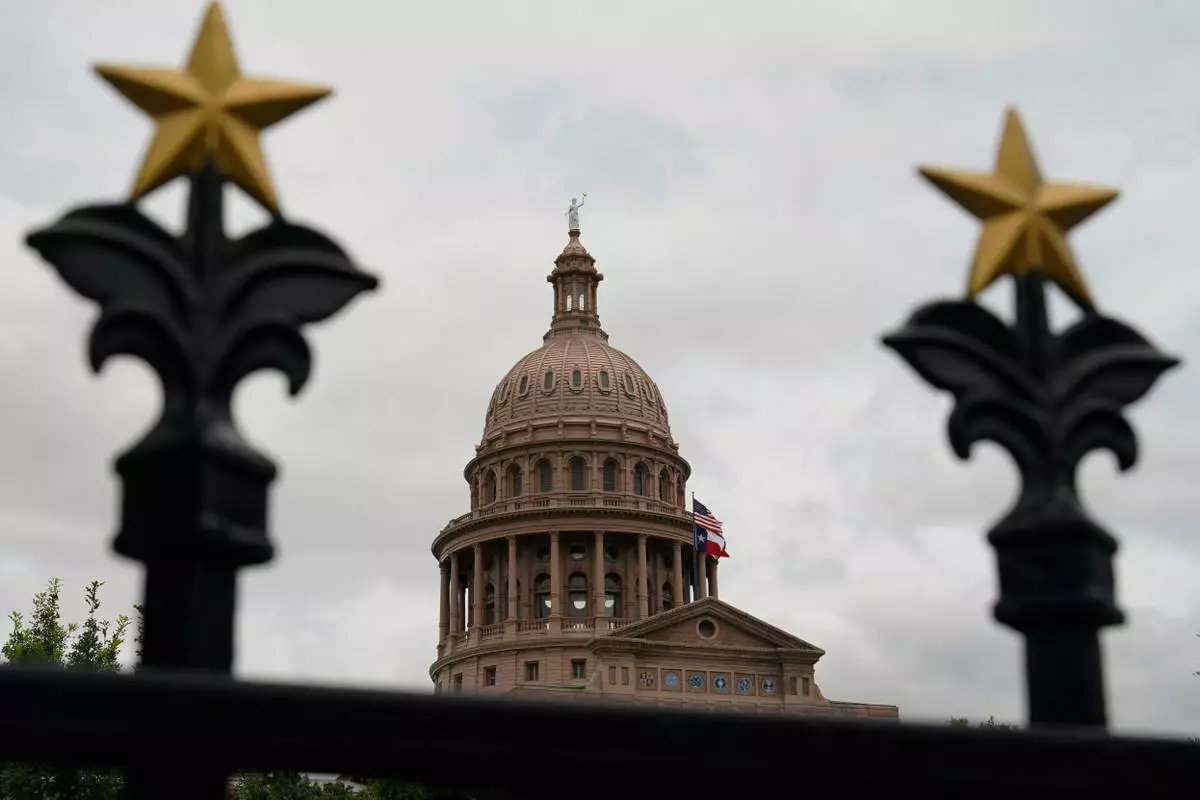
FILE - The State Capitol is seen in Austin, Texas, on June 1, 2021. (AP Photo/Eric Gay, File)