Skills gap widespread; gender gap narrowing; youth proficiency lowZURICH, Nov. 19, 2025 /PRNewswire/ -- EF (Education First), a global provider of culturally immersive education, released the 2025 edition of its EF English Proficiency Index (EF EPI), the world's most comprehensive annual ranking of adult English skills across 123 countries and regions."English remains the world's most widely shared language for international communication. In a time of growing global complexity, its role as a common bridge between cultures, economies, and ideas is more important than ever," said Kate Bell, EF EPI author.The EF EPI 2025 is based on data from 2.2 million EF Skills Evaluation Technology (EF SET) test takers worldwide. EF SET is the world's largest free English test for individuals and organizations – making robust language evaluation accessible to millions.This year, for the first time, speaking and writing skills are evaluated using proprietary AI technology developed by Efekta Education Group, a tech company within EF focused on improving learning outcomes at scale."Thanks to Efekta's advanced technology, we can now assess not only what people understand through listening and reading, but also how well they express themselves through speaking and writing – essential for building understanding across borders and cultures," added Bell. "This richer, more complete view of English proficiency reveals how skills vary across individuals and groups. AI-powered assessment enables us to do this with unprecedented scale, speed, and consistency worldwide."Key Findings:
- Top performers: The Netherlands remains #1, followed by Croatia and Austria – which improved their rankings. Germany climbed to #4 with one of the biggest gains in Europe.
- Speaking remains a global challenge: In over half of the countries measured, speaking is the weakest English skill.
- Skill gaps are widespread: Most countries show significant differences between English skills, especially those with higher overall proficiency. However, which skill ranks strongest, or weakest, varies by country – suggesting no skill is inherently more difficult than others.
- Gender gap narrows: The gender gap is narrowing in most parts of the world, although it widened slightly in the Middle East.
- Youth proficiency falls short: Contrary to expectations, adults under 25 are not rebounding post-pandemic. In many countries, they score lower than older age groups.
- Regional highlights: Europe plateaued; Asia showed the narrowest skill gap; Latin America posted the widest age disparity; Africa remained the most varied.
Beyond rankings, the EF EPI examines how English proficiency relates to innovation, economic opportunity, and global collaboration. As AI reshapes work and life, English remains essential for accessing and influencing the future, especially since leading AI tools are developed mainly in English.Full report: ef.com/epiFounded in 1965, EF is a global association of education companies dedicated to opening the world through language, academic, cultural exchange, and travel programs.Efekta is an innovative Tech company and the world's leading provider of AI-powered learning technology – focused on improving educational outcomes at scale in high schools, universities, and global companies.Contact:
mediainquiry@ef.com
** The press release content is from PR Newswire. Bastille Post is not involved in its creation. **

EF English Proficiency Index 2025 launched: AI-Powered Insights Reveal Global Language Shifts in a Fragmented World
|
The fund will invest in startups in SMU's flagship Urban SustaInnovator accelerator programme, which began incubating them from February 2026.
SINGAPORE, May 22, 2026 /PRNewswire/ -- Singapore Management University (SMU) today announced the launch of the Urban SustaInnovator (USI) Fund, a US$10 million (S$12.69 million) investment programme designed to support startups emerging from USI, SMU's flagship accelerator for urban solutions and sustainability (USS) ventures for expansion in Singapore and across Asia. The fund will invest in USI's globally sourced and competition-vetted pipeline of early stage deep-tech startups from the Lee Kuan Yew Global Business Plan Competition (LKYGBPC).
USI was launched at the 12th edition of LKYGBPC held in September 2025 at SMU by Minister for National Development, Mr Chee Hong Tat, and was designed to incubate high-potential startups in the USS sector. The accelerator began incubating its first batch of startups in February 2026.
The USI Fund, believed to be South-east Asia's first university-anchored co-investment fund dedicated to urban solutions and sustainability, is integrated with the purpose-built accelerator that supports early-stage ventures addressing critical urban challenges – including decarbonisation, energy transition, the built environment, mobility, and circularity – as they move from validation to real-world deployment across Asian cities.
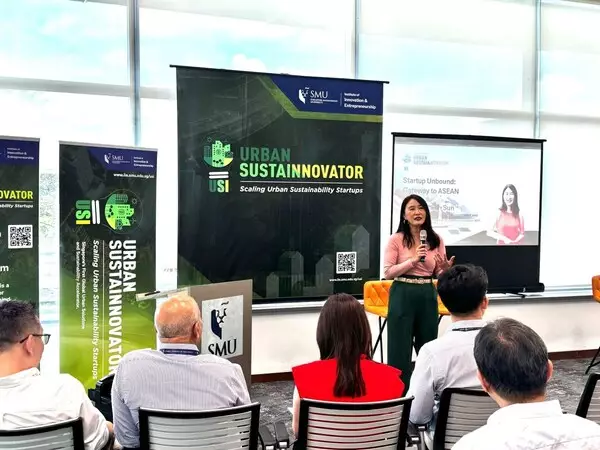
Professor Sun Sun Lim, SMU's Vice President (Partnerships & Engagement), said, "Urban sustainability innovation often fails not for lack of ideas, but for lack of capital that understands early–stage risk and long deployment cycles. The USI Fund addresses this pain point by co–investing with leading venture capital partners and backing deep-tech startups from SMU's robust global pipeline, providing targeted early–stage capital to help founders scale proven solutions into Asian urban markets."
Professor Lim, who is also the Chair of the USI Programme Management Committee, said that the Fund will co–invest alongside established venture capital partners under prevailing market terms, providing catalytic capital while benefiting from the commercial rigour and sector expertise of lead investors. The Fund is expected to make its first investments from the inaugural USI accelerator cohort, with deployments expected to commence by Q4 2026.
Built-in Pipeline from the Lee Kuan Yew Global Business Plan Competition
The competition attracted over 1,500 applications from more than 90 countries, creating a strong pipeline from which seven high-potential startups were selected for incubation under the USI accelerator programme. This gives the USI Fund privileged access to quality startups with demonstrated traction and strong alignment with priority urban sustainability themes.
The USI programme brings together public, private, and philanthropic partners to support these high–potential startups to anchor in Singapore and scale across Asia. The 12–month, hybrid, non–residential, zero–fee and equity–free programme provides founders with regional market access through SMU's growing network of overseas centres in the region, fundraising and pilot support, as well as mentorship and ecosystem connectivity.
The programme is supported by a 'Singapore Inc' Advisory Board comprising venture capitalists, scientists, corporates, and regulators, providing founders with multi-sectoral and multidisciplinary guidance from early validation through to regional expansion.
Inaugural Cohort Demonstrates Early Traction
The seven startups in the inaugural USI accelerator cohort are showing significant progress across capital raise, deployment and international validation.
Qarbotech, a Malaysia–based nanotechnology company developing photosynthesis–enhancing materials for agriculture, has gained global visibility after winning the Grand Prix at SusHi Tech 2026 and securing a pilot project with Tokyu Fudosan Group. MacroCycle, a US–based startup specialising in chemical upcycling of PET plastics, has attracted institutional backing from Volta Circle, the investment platform of the Lohia family which owns Indorama Corporation, while also being recognised as a finalist at Temasek Foundation's The Liveability Challenge 2026.
Commercial progress is also evident among ventures that have moved beyond proof–of–concept.
Inviscid AI, a Singapore company focused on real–time thermodynamic simulation using physics–informed neural networks, has reported eightfold revenue growth since joining the USI programme. Sesame Sustainability, an AI–driven industrial decarbonisation software platform founded by alumni of the Massachusetts Institute of Technology, has secured paid pilot engagements with Swedish multinational ABB and received strong interest from a strategic investor. Smart Tire Company, a US–based venture commercialising airless tyres derived from shape–memory alloy technology, is advancing pilot projects linked to NASA–affiliated programmes. Mimicrete, a UK based company working on self–healing concrete solutions, has commenced a pilot in Singapore with The GEAR by Kajima. Pronoe, a French company focused on carbon capture through modular ocean alkalinity systems, is working on a carbon removal pre–purchase agreement project with Frontier, backed by Meta and Google.
Both Qarbotech and Mimicrete are also in the process of establishing or expanding their presence in Singapore, underscoring the city's role as a regional launchpad for deep tech commercialisation and scale–up.
Advancing the 'Teaching Accelerator' Model
In line with SMU's emphasis on experiential and practice–oriented learning, another important benefit of the USI Fund is that it enables SMU students to learn directly from live ventures and real investment decisions through interactions with the founders and mentors on the USI programme, said Prof Lim.
She said, "Selected SMU students are embedded across stages of the USI platform – from startup evaluation and market analysis to diligence and portfolio support – allowing them to develop venture literacy, climate and sustainability insight, commercialisation know-how and applied decision–making skills beyond the classroom."
"By integrating capital deployment with deep experiential learning, the USI Fund reinforces SMU's mission as a global city university, where education, innovation, and real–world impact are closely intertwined," she added.
For more information, please visit https://iie.smu.edu.sg/usi
About SMU IIE
The Singapore Management University's Institute of Innovation and Entrepreneurship (IIE) empowers aspiring entrepreneurs and innovators to create positive change. It offers tailored training programmes, an equity-free incubator, and a vibrant community that connects innovators through events and networking opportunities, including the renowned Lee Kuan Yew Global Business Plan Competition (LKYGBPC). For more information: https://iie.smu.edu.sg
About SMU
Established in 2000, Singapore Management University (SMU) is recognised for its disciplinary and multi-disciplinary research that addresses issues of global relevance, impacting business, government, and society. Its distinctive education, incorporating innovative experiential learning, aims to nurture global citizens, entrepreneurs and change agents. With more than 13,000 students, SMU offers a wide range of bachelors, masters and PhD degree programmes in the disciplinary areas associated with six of its eight schools - Accountancy, Business, Computing, Economics, Law and Social Sciences. Its seventh school, the SMU College of Integrative Studies, offers degree programmes in deep, integrative interdisciplinary education. The College of Graduate Research Studies, SMU's eighth school, enhances integration and interdisciplinarity across the various SMU postgraduate research programmes that will enable students to gain a holistic learning experience and well-grounded approach to their research. SMU also offers a growing number of executive development and continuing education programmes. Through its city campus, SMU focuses on making meaningful impact on Singapore and beyond through its partnerships with industry, policymakers and academic institutions. https://www.smu.edu.sg/
The fund will invest in startups in SMU's flagship Urban SustaInnovator accelerator programme, which began incubating them from February 2026.
SINGAPORE, May 22, 2026 /PRNewswire/ -- Singapore Management University (SMU) today announced the launch of the Urban SustaInnovator (USI) Fund, a US$10 million (S$12.69 million) investment programme designed to support startups emerging from USI, SMU's flagship accelerator for urban solutions and sustainability (USS) ventures for expansion in Singapore and across Asia. The fund will invest in USI's globally sourced and competition-vetted pipeline of early stage deep-tech startups from the Lee Kuan Yew Global Business Plan Competition (LKYGBPC).
USI was launched at the 12th edition of LKYGBPC held in September 2025 at SMU by Minister for National Development, Mr Chee Hong Tat, and was designed to incubate high-potential startups in the USS sector. The accelerator began incubating its first batch of startups in February 2026.
The USI Fund, believed to be South-east Asia's first university-anchored co-investment fund dedicated to urban solutions and sustainability, is integrated with the purpose-built accelerator that supports early-stage ventures addressing critical urban challenges – including decarbonisation, energy transition, the built environment, mobility, and circularity – as they move from validation to real-world deployment across Asian cities.
Professor Sun Sun Lim, SMU's Vice President (Partnerships & Engagement), said, "Urban sustainability innovation often fails not for lack of ideas, but for lack of capital that understands early–stage risk and long deployment cycles. The USI Fund addresses this pain point by co–investing with leading venture capital partners and backing deep-tech startups from SMU's robust global pipeline, providing targeted early–stage capital to help founders scale proven solutions into Asian urban markets."
Professor Lim, who is also the Chair of the USI Programme Management Committee, said that the Fund will co–invest alongside established venture capital partners under prevailing market terms, providing catalytic capital while benefiting from the commercial rigour and sector expertise of lead investors. The Fund is expected to make its first investments from the inaugural USI accelerator cohort, with deployments expected to commence by Q4 2026.
Built-in Pipeline from the Lee Kuan Yew Global Business Plan Competition
The competition attracted over 1,500 applications from more than 90 countries, creating a strong pipeline from which seven high-potential startups were selected for incubation under the USI accelerator programme. This gives the USI Fund privileged access to quality startups with demonstrated traction and strong alignment with priority urban sustainability themes.
The USI programme brings together public, private, and philanthropic partners to support these high–potential startups to anchor in Singapore and scale across Asia. The 12–month, hybrid, non–residential, zero–fee and equity–free programme provides founders with regional market access through SMU's growing network of overseas centres in the region, fundraising and pilot support, as well as mentorship and ecosystem connectivity.
The programme is supported by a 'Singapore Inc' Advisory Board comprising venture capitalists, scientists, corporates, and regulators, providing founders with multi-sectoral and multidisciplinary guidance from early validation through to regional expansion.
Inaugural Cohort Demonstrates Early Traction
The seven startups in the inaugural USI accelerator cohort are showing significant progress across capital raise, deployment and international validation.
Qarbotech, a Malaysia–based nanotechnology company developing photosynthesis–enhancing materials for agriculture, has gained global visibility after winning the Grand Prix at SusHi Tech 2026 and securing a pilot project with Tokyu Fudosan Group. MacroCycle, a US–based startup specialising in chemical upcycling of PET plastics, has attracted institutional backing from Volta Circle, the investment platform of the Lohia family which owns Indorama Corporation, while also being recognised as a finalist at Temasek Foundation's The Liveability Challenge 2026.
Commercial progress is also evident among ventures that have moved beyond proof–of–concept.
Inviscid AI, a Singapore company focused on real–time thermodynamic simulation using physics–informed neural networks, has reported eightfold revenue growth since joining the USI programme. Sesame Sustainability, an AI–driven industrial decarbonisation software platform founded by alumni of the Massachusetts Institute of Technology, has secured paid pilot engagements with Swedish multinational ABB and received strong interest from a strategic investor. Smart Tire Company, a US–based venture commercialising airless tyres derived from shape–memory alloy technology, is advancing pilot projects linked to NASA–affiliated programmes. Mimicrete, a UK based company working on self–healing concrete solutions, has commenced a pilot in Singapore with The GEAR by Kajima. Pronoe, a French company focused on carbon capture through modular ocean alkalinity systems, is working on a carbon removal pre–purchase agreement project with Frontier, backed by Meta and Google.
Both Qarbotech and Mimicrete are also in the process of establishing or expanding their presence in Singapore, underscoring the city's role as a regional launchpad for deep tech commercialisation and scale–up.
Advancing the 'Teaching Accelerator' Model
In line with SMU's emphasis on experiential and practice–oriented learning, another important benefit of the USI Fund is that it enables SMU students to learn directly from live ventures and real investment decisions through interactions with the founders and mentors on the USI programme, said Prof Lim.
She said, "Selected SMU students are embedded across stages of the USI platform – from startup evaluation and market analysis to diligence and portfolio support – allowing them to develop venture literacy, climate and sustainability insight, commercialisation know-how and applied decision–making skills beyond the classroom."
"By integrating capital deployment with deep experiential learning, the USI Fund reinforces SMU's mission as a global city university, where education, innovation, and real–world impact are closely intertwined," she added.
For more information, please visit https://iie.smu.edu.sg/usi
About SMU IIE
The Singapore Management University's Institute of Innovation and Entrepreneurship (IIE) empowers aspiring entrepreneurs and innovators to create positive change. It offers tailored training programmes, an equity-free incubator, and a vibrant community that connects innovators through events and networking opportunities, including the renowned Lee Kuan Yew Global Business Plan Competition (LKYGBPC). For more information: https://iie.smu.edu.sg
About SMU
Established in 2000, Singapore Management University (SMU) is recognised for its disciplinary and multi-disciplinary research that addresses issues of global relevance, impacting business, government, and society. Its distinctive education, incorporating innovative experiential learning, aims to nurture global citizens, entrepreneurs and change agents. With more than 13,000 students, SMU offers a wide range of bachelors, masters and PhD degree programmes in the disciplinary areas associated with six of its eight schools - Accountancy, Business, Computing, Economics, Law and Social Sciences. Its seventh school, the SMU College of Integrative Studies, offers degree programmes in deep, integrative interdisciplinary education. The College of Graduate Research Studies, SMU's eighth school, enhances integration and interdisciplinarity across the various SMU postgraduate research programmes that will enable students to gain a holistic learning experience and well-grounded approach to their research. SMU also offers a growing number of executive development and continuing education programmes. Through its city campus, SMU focuses on making meaningful impact on Singapore and beyond through its partnerships with industry, policymakers and academic institutions. https://www.smu.edu.sg/
** This press release is distributed by PR Newswire through automated distribution system, for which the client assumes full responsibility. **
Singapore Management University Launches South-east Asia's First University-Anchored Fund Dedicated to Urban Solutions & Sustainability