
WARSAW, Poland (AP) — Polish authorities plan to charge two Ukrainians with sabotage of a terrorist nature on behalf of Russia over an explosion that damaged a train track used for deliveries to Ukraine, prosecutors said Wednesday.
Officials said the two suspects left Poland and crossed into Belarus as soon as they committed the weekend attack on a rail line linking Warsaw with the Ukrainian border. Polish authorities allege the two Ukrainians had been collaborating with the Russian secret services for a long time.
Several others have been detained in connection to the railway explosion, prosecutors said on Wednesday. They did not provide more details.
Poland’s Prime Minister Donald Tusk has described the explosion as an “unprecedented act of sabotage.” Foreign Minister Radek Sikorski said it was “an act of state terror.”
The blast damaged tracks near Mika, about 100 kilometers (60 miles) southeast of Warsaw. No one was hurt.
In a separate weekend incident, power lines on the same rail track were destroyed in the area of Pulawy, about 50 kilometers (30 miles) from Lublin in eastern Poland.
Ukrainian president Volodymyr Zelenskyy said on Wednesday that Ukrainian officials also believe the sabotage has a “Russian link.”
“No one except for Russians is interested in this,” Zelenskyy added, after speaking to Tusk.
He said Ukraine would provide Poland with all required information, and that a Polish-Ukrainian working group to prevent Russian sabotage would be created.
Western officials have accused Russia and its proxies of staging dozens of attacks and other incidents across Europe since the invasion of Ukraine more than three years ago, according to data collected by The Associated Press. Moscow’s goal, Western officials say, is to undermine support for Ukraine, spark fear and divide European societies.
The Polish government said on Wednesday it would deploy up to 10,000 soldiers to support the police in defending critical infrastructure across Poland.
Sikorski said Wednesday that he will order the closure of the last Russian consulate still operating in the country in response to the attack.
“In connection with this, though it will not be our full response, I have decided to withdraw consent for the operation of the last Russian consulate in Gdansk,” he said.
Two other consulates, in Krakow and Poznan, had been closed in recent years. The Russian embassy in Warsaw remains open.
In response, Moscow will “reduce Poland’s diplomatic and consular presence in Russia,” the state news agency RIA Novosti cited Russian Foreign Ministry spokeswoman Maria Zakharova as saying.
Asked about Sikorski’s comments, Kremlin spokesman Dmitry Peskov said that Russia’s “relations with Poland have deteriorated completely.”
“This is probably a manifestation of this degradation, of the desire of the Polish authorities to reduce to zero any possibility of consular or diplomatic ties. In this case, one can only express regret,” Peskov told reporters during his daily conference call.
Geir Moulson in Berlin, Dasha Litvinova in Tallinn, Estonia, and Illia Novikov in Kyiv contributed to this report.
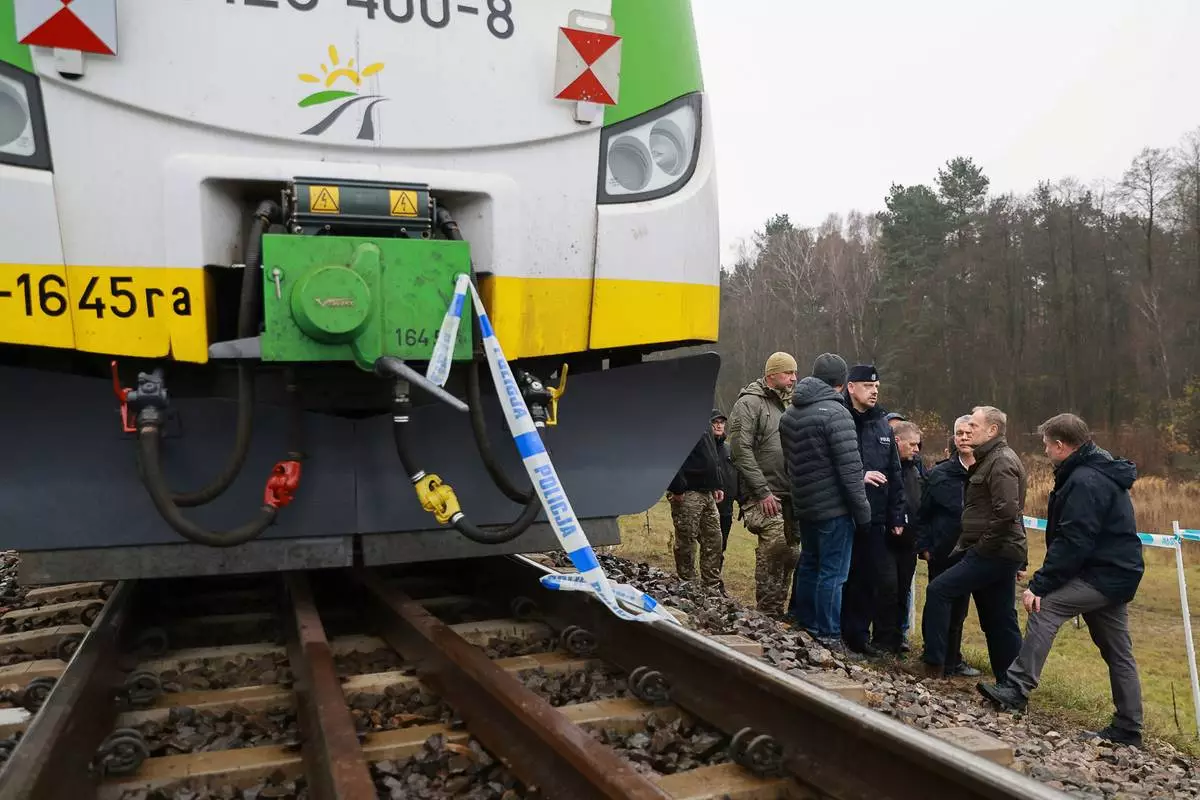
Prime Minister Donald Tusk, second right, visits site of the rail line Mika, that was damaged by sabotage, near Deblin, Poland, Monday, Nov. 17, 2025. (AP Photo/KPRM)


BEIJING (AP) — In China, the names of things are often either ornately poetic or jarringly direct. A new, wildly popular app among young Chinese people is definitively the latter.
It's called, simply, “Are You Dead?"
In a vast country whose young people are increasingly on the move, the new, one-button app — which has taken the country by digital storm this month — is essentially exactly what it says it is. People who live alone in far-off cities and may be at risk — or just perceived as such by friends or relatives — can push an outsized green circle on their phone screens and send proof of life over the network to a friend or loved one. The cost: 8 yuan (about $1.10).
It's simple and straightforward — essentially a 21st-century Chinese digital version of those American pendants with an alert button on them for senior citizens that gave birth to the famed TV commercial: “I've fallen, and I can't get up!”
Developed by three young people in their 20s, “Are You Dead?” became the most downloaded paid app on the Apple App Store in China last week, according to local media reports. It is also becoming a top download in places as diverse as Singapore and the Netherlands, Britain and India and the United States — in line with the developers' attitude that loneliness and safety aren't just Chinese issues.
“Every country has young people who move to big cities to chase their dreams,” Ian Lü, 29, one of the app's developers, said Thursday.
Lü, who worked and lived alone in the southern city of Shenzhen for five years, experienced such loneliness himself. He said the need for a frictionless check-in is especially strong among introverts. “It's unrealistic,” he said, “to message people every day just to tell them you're still alive.”
Against the backdrop of modern and increasingly frenetic Chinese life, the market for the app is understandable.
Traditionally, Chinese families have tended to live together or at least in close proximity across generations — something embedded deep in the nation's culture until recent years. That has changed in the last few decades with urbanization and rapid economic growth that have sent many Chinese to join what is effectively a diaspora within their own nation — and taken hundreds of millions far from parents, grandparents, aunts and uncles.
Today, the country has more than 100 million households with only one person, according to an annual report from the National Bureau of Statistics of China in 2024.
Consider Chen Xingyu, 32, who has lived on her own for years in Kunming, the capital of southern China’s Yunnan province. “It is new and funny. The name ’Are You Dead?' is very interesting,” Chen said.
Chen, a “lying flat” practitioner who has rejected the grueling, fast-paced career of many in her age group, would try the app but worries about data security. “Assuming many who want to try are women users, if information of such detail about users gets leaked, that’d be terrible,” she said.
Yuan Sangsang, a Shanghai designer, has been living on her own for a decade and describes herself as a “single cow and horse.” She's not hoping the app will save her life — only help her relatives in the event that she does, in fact, expire alone.
"I just don’t want to die with no dignity, like the body gets rotten and smelly before it is found," said Yuan, 38. “That would be unfair for the ones who have to deal with it.”
While such an app might at first seem best suited to elderly people — regardless of their smartphone literacy — all reports indicate that “Are You Dead?” is being snapped up by younger people as the wry equivalent of a social media check-in.
“Some netizens say that the 'Are you dead?' greeting feels like a carefree joke between close friends — both heartfelt and gives a sense of unguarded ease,” the business website Yicai, the Chinese Business Network, said in a commentary. ""It likely explains why so many young people unanimously like this app."
The commentary, by writer He Tao, went further in analyzing the cultural landscape. He wrote that the app's immediate success “serves as a darkly humorous social metaphor, reminding us to pay attention to the living conditions and inner world of contemporary young people. Those who downloaded it clearly need more than just a functional security measure; they crave a signal of being seen and understood.”
Death is a taboo subject in Chinese culture, and the word itself is shunned to the point where many buildings in China have no fourth floor because the word for “four” and the word for “death” sound the same — “si.” Lü acknowledged that the app's name sparked public pressure.
“Death is an issue every one of us has to face,” he said. “Only when you truly understand death do you start thinking about how long you can exist in this world, and how you want to realize the value of your life.”
A few days ago, though, the developers said on their official account on China’s Weibo social platform that they’d pivot to a new name. Their choice: the more cryptic “Demumu,” which they said they hoped could "serve more solo dwellers globally.”
Then, a twist: Late Wednesday, the app team posted on its Weibo account that workshopping the name Demumu didn’t turn out “as well as expected.” The app team is offering a reward for whoever offers a new name that will be picked this weekend. Lü said more than 10,000 people have weighed in.
The reward for the new moniker: $96 — or, in China, 666 yuan.
Fu Ting reported from Washington. AP researcher Shihuan Chen in Beijing contributed.
The app Are You Dead? is seen on a smartphone in Beijing, China, Thursday, Jan. 15, 2026. (AP Photo/Ng Han Guan)
A woman looks at her smartphone in a cafe in Beijing, China, Thursday, Jan. 15, 2026. (AP Photo/Ng Han Guan)
A woman looks at her smartphone outside a restaurant in Beijing, China, Thursday, Jan. 15, 2026. (AP Photo/Ng Han Guan)
A man looks down near his smartphone in Beijing, China, Thursday, Jan. 15, 2026. (AP Photo/Ng Han Guan)
A man reacts while holding his smartphone in Beijing, China, Thursday, Jan. 15, 2026. (AP Photo/Ng Han Guan)