WASHINGTON (AP) — The House voted overwhelmingly Wednesday to repeal part of a new law that gives senators the ability to sue the federal government for millions of dollars if their personal or office data is accessed without their knowledge.
The 427-0 vote was a bipartisan rebuke after Majority Leader John Thune added the provision to the funding bill that passed earlier this month to end the nation’s longest government shutdown. The Senate language blindsided House lawmakers on both sides of the political aisle and immediately prompted accusations of self-dealing at the taxpayers' expense.
Senators appeared unlikely to go along with the House repeal, with many vocally defending it. Thune added the provision after the recent disclosure that the FBI in 2023 analyzed phone records of as many as 10 senators as part of an investigation into President Donald Trump's efforts to overturn the 2020 presidential election. The records enabled investigators to see basic information about the date and time of the calls but not the content of the communications.
Senators were furious about the revelation, and Thune added the provision to the spending bill in the final hours before passage. Thune said Wednesday that the Justice Department's actions under former President Joe Biden were “a violation of the separation of powers under the Constitution,” and that it “is something that needed to be addressed.”
Trump has not said whether he would sign the repeal. A senior White House official, who was granted anonymity to describe the president’s thinking, said last week that the president has no objections to the language added by the senators and indicated privately that he does not think it's a bad provision. The White House had been fully looped in as senators drafted the bill, the person said.
But the addition of the lawsuit provision did not sit well with other lawmakers. House Republicans were threatening to derail the funding bill at the last minute until Speaker Mike Johnson promised a vote to undo it.
Ahead of the repeal vote Wednesday evening, Rep. Austin Scott, R-Ga., said the provision allowing the lawsuits was “probably the most self-centered, self-serving piece of language that I have ever seen."
House Democrats were just as angry.
“This kind of self-serving, self-dealing, one-sided get rich scheme at the expense of taxpayers is why Americans are so disgusted with this Congress,” said Rep. Joe Morelle, D-N.Y.
Democratic leader Hakeem Jeffries said that because Thune has not agreed to take up the bill, Wednesday’s vote is “for show.”
“It’s not serious. It’s not designed to get an end result,” Jeffries said.
Under the new law, the senators can now sue for up to $500,000 in damages for each instance of data retrieval without their knowledge. The senators involved have argued that the Biden administration, through the investigation by former special counsel Jack Smith, targeted political rivals.
House Republicans have criticized the investigation, known as Arctic Frost, but said elected officials should not benefit financially as a result.
The Senate is unlikely to take up the repeal and pass it without changes without Thune's support. In a Republican conference meeting Wednesday, senators discussed potentially working with the House to expand the provision so it applies to all lawmakers as well as any groups that are targeted by the government. But it's unclear exactly how that would work, or if it will happen.
South Carolina Sen. Lindsey Graham, one of the senators targeted and the most vocal supporter of the new law, has said he will use it to sue the Justice Department and Verizon, the phone company that handed over the records. He said after the conference meeting that he was open to expanding the provision to other individuals and groups, but that he is “not backing off."
“I’m going to make this hurt as much as it possibly can so nobody can do it again," Graham said.
Alabama Sen. Tommy Tuberville has also suggested he would sue after he was targeted, posting on X earlier this month that former special counsel Smith should be “DISBARRED and THROWN IN JAIL.”
“If they aren’t, I will sue the living hell out of every Biden official involved in this to make sure this NEVER happens to a conservative again,” Tuberville wrote.
Other Republican senators who were targeted have said they would not seek damages, including Tennessee Sen. Bill Hagerty and Florida Sen. Rick Scott.
“I have no idea how it got in” the spending bill, Scott said of the provision. “It’s not like I need to make any money off the government.”
Scott said he would support the House repeal if it came up for a vote in the Senate, as did Oklahoma Sen. Markwayne Mullin, who was not among those targeted. Mullin says he backs the idea of keeping the government accountable, but doesn’t believe the legislation should apply retroactively.
Mullin suggested that senators could work something out with the House as they consider the next package of spending bills.
“Keeping the government accountable, and keeping them from overreach, I have no problem with,” Mullin said.
Senate Democratic leader Chuck Schumer said he had agreed to the language before the Senate passed the spending package, even though he voted against the overall legislation to end the shutdown.
“The bottom line is that Thune wanted the provision,” Schumer said, but Democrats agreed to it so they would be protected against similar actions from the Trump administration.
“But I’d be for repealing all of it,” Schumer said. “And I hope that happens.”
Associated Press writer Seung Min Kim contributed to this report.

Speaker of the House Mike Johnson, R-La., speaks after the final vote to bring the longest government shutdown in history to an end, at the Capitol in Washington, Wednesday, Nov. 12, 2025. (AP Photo/J. Scott Applewhite)
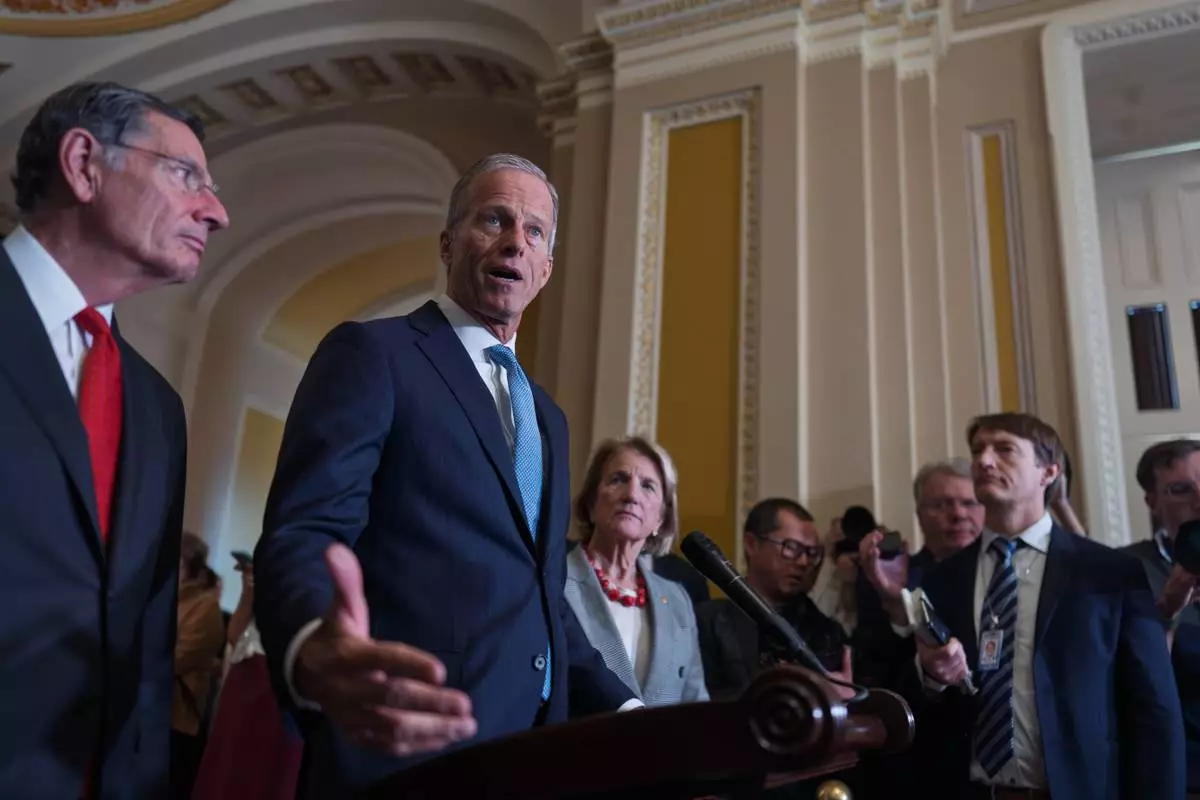
Senate Majority Leader John Thune, R-S.D., flanked by Sen. John Barrasso, R-Wyo., the GOP whip, left, and Sen. Shelly Moore Capito, R-W.Va., as he speaks with reporters after a closed-door GOP meeting at the Capitol in Washington, Wednesday, Nov. 19, 2025. (AP Photo/J. Scott Applewhite)