Government promulgates Conceptual Outline of Development Plan for Innovation and Technology Industry in San Tin Technopole
The Government promulgated the Conceptual Outline of the Development Plan for the Innovation and Technology Industry in the San Tin Technopole today (November 20). The Conceptual Outline provides a top-level design for the 210 hectares of new innovation and technology (I&T) land in the San Tin Technopole in terms of development vision, objectives and positioning, industrial spatial layout, and development model, thereby setting a clear development strategy for the San Tin Technopole.
The Secretary for Innovation, Technology and Industry, Professor Sun Dong, said that, "The San Tin Technopole spans across a large area. Its development takes time and needs to be conducted in an orderly manner. Based on the schedule of land supply, the Conceptual Outline proposes a phased development plan, industrial positioning and layout, co-ordinated development of various land zones, and strategy to channel market resources into development. It serves as a clear guideline for the San Tin Technopole to develop into a strategic base for I&T industries.
"The San Tin Technopole has three major advantages. It is adjacent to the Hong Kong Park in the Loop and closely connected to the I&T ecosystems of Futian and Huanggang, giving it a locational advantage. Its provision of 210 hectares of new I&T land can meet the spatial needs of different segments of the industry chain, enterprises of varying scales and different technology fields, giving it a scale advantage. It also enjoys an excellent transportation network, and is close to Shenzhen and the Sam Po Shue Wetland Conservation Park, providing a favourable ecological environment and strengths as a liveable place.
"As a natural extension of the Loop, the new I&T land in the San Tin area can integrate with the comprehensive industry supply chains in the Mainland cities of the Guangdong-Hong Kong-Macao Greater Bay Area. It can also take up the transformation and industrialisation of research outcomes derived from the Hong Kong Park. These would drive economic growth, create high-quality employment opportunities and lead to structural upgrades of industries. By focusing on the interaction between industries, talent, and space, it aims to create a virtuous cycle of enhancing the city's quality with industries, attracting talent with the city, and developing industries with talent."
The Innovation, Technology and Industry Bureau commissioned a consultant to conduct a study. With views gauged from industry-related personnel and stakeholders, including I&T enterprises, academic institutions, chambers of commerce, and I&T associations, etc, the positioning of the development of the San Tin Technopole will be anchored on three key strands: (1) providing space for prototyping, pilot production, and small-scale manufacturing, (2) developing high-quality local I&T industries, and (3) pooling global I&T resources and talent.
In terms of industry development, the San Tin Technopole can provide land of larger scale to support the development of strategic I&T industries such as life and health technology, AI and robotics, microelectronics and smart devices, new materials, new energy, and green technology, as set out in the Hong Kong I&T Development Blueprint. It will also focus on the building of Hong Kong's I&T industrial system with advanced manufacturing as its core.
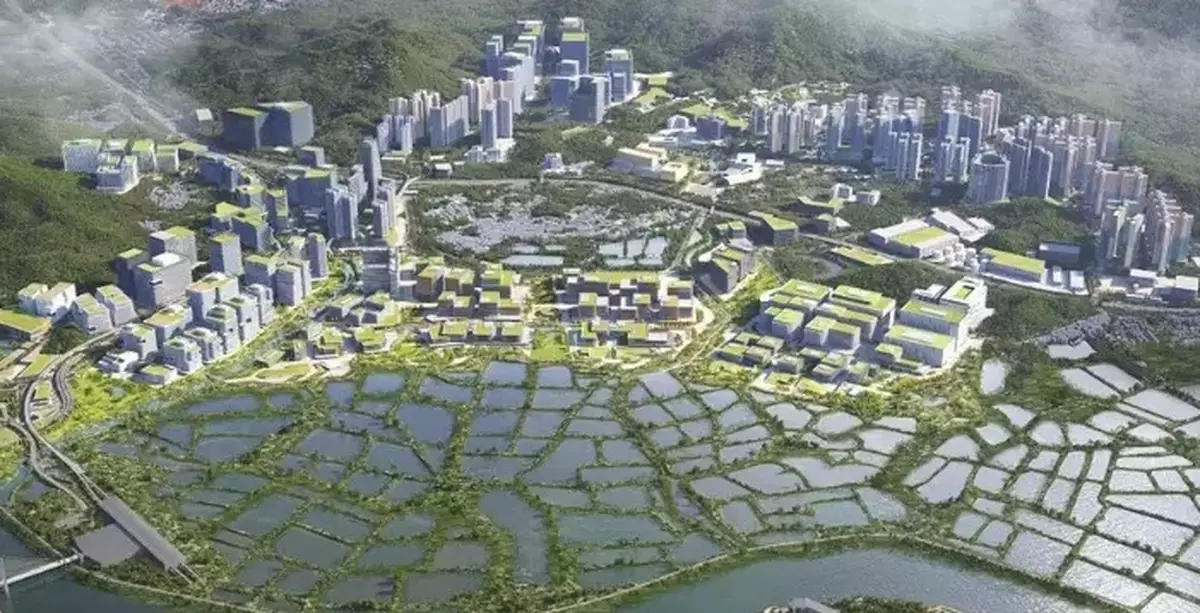
In terms of a layout plan of the land, the new I&T land in the San Tin Technopole will be divided and developed into three development hubs and three industry development corridors (the three hubs and three corridors). They are the Hetao Hub, Chau Tau Hub, and Ki Lun Hub from north to south, and the life and health technology corridor, AI and robotics corridor, and microelectronics and advanced industry corridor. This planning structure can cater for the pace of I&T industry development and the relevant timetable for land resumption and site formation works undertaken by works departments. The development will have five phases, from introduction, industry ecosystem expansion, city-industry hub to consolidation.
In taking forward each phase of development, the development hubs will be used for co-ordinating and leading the development of its core advanced industries, emphasising a city-industry integration. This includes attracting enterprises to set up headquarters, creating commercial complexes, and providing talent accommodation which will offer various urban living amenities for I&T talent. The planning also takes into account actual circumstances and allows certain flexibility in development by reserving strategic white space for supporting emerging technology industries at subsequent phases in the future.
In terms of a development model, following the principle of a capable government and an efficient market, consideration can be given to the establishment of a dedicated company to take forward the development of the San Tin Technopole in collaboration with the market, thereby leveraging market resources to accelerate development and optimise development costs.
According to the estimates of the consultant, the San Tin Technopole will contribute some $250 billion or more to Hong Kong's GDP (Gross Domestic Product) annually upon its full operation, and provide over 300000 full-time equivalent work positions.
The new I&T land around San Tin and the Hong Kong Park will together form a crucial node for the integrated development of upstream, midstream and downstream industries, offering full-chain support to I&T industries by providing space for offices, prototyping, test and pilot production, as well as manufacturing. Under the National 14th Five-Year Plan and the recommendations for the 15th Five-Year Plan for Hong Kong as an international I&T centre and Hong Kong's new industrial layout of a South-North dual engine (finance-I&T) in the future, the San Tin Technopole, as an indispensable key part of Hong Kong's I&T development, will become a stronghold for the future development of emerging technology industries in Hong Kong and an important base for developing new quality productive forces.
The Conceptual Outline has been uploaded to the Innovation, Technology and Industry Bureau's website (www.itib.gov.hk/en/index.html).
The conceptional image of San Tin Technopole, Photo source: reference image