Skip to Content Facebook Feature Image

Meta alerts young Australians to download their data before a social media ban

TECH

Meta alerts young Australians to download their data before a social media ban
TECH

TECH

Meta alerts young Australians to download their data before a social media ban

2025-11-20 14:02 Last Updated At:15:07

MELBOURNE, Australia (AP) — Technology giant Meta on Thursday began sending thousands of young Australians a two-week warning to downland their digital histories and delete their accounts from Facebook, Instagram and Threads before a world-first social media ban on accounts of children younger than 16 takes effect.

The Australian government announced two weeks ago that the three Meta platforms plus Snapchat, TikTok, X and YouTube must take reasonable steps to exclude Australian account holders younger than 16, beginning Dec. 10.

California-based Meta on Thursday became the first of the targeted tech companies to outline how it will comply with the law. Meta contacted thousands of young account holders via SMS and email to warn that suspected children will start to be denied access to the platforms from Dec. 4.

“We will start notifying impacted teens today to give them the opportunity to save their contacts and memories,” Meta said in a statement.

Meta said young users could also use the notice period to update their contact information “so we can get in touch and help them regain access once they turn 16.”

Meta has estimated there are 350,000 Australians aged 13-to-15 on Instagram and 150,000 in that age bracket on Facebook. Australia’s population is 28 million.

Account holders 16-years-old and older who were mistakenly given notice that they would be excluded can contact Yoti Age Verification and verify their age by providing government-issued identity documents or a “video selfie,” Meta said.

Terry Flew, co-director of Sydney University’s Center for AI, Trust and Governance, said such facial-recognition technology had a failure rate of at least 5%.

“In the absence of a government-mandated ID system, we’re always looking at second-best solutions around these things,” Flew told the Australian Broadcasting Corp.

The government has warned platforms that demanding that all account holders prove they are older than 15 would be an unreasonable response to the new age restrictions. The government maintains the platforms already had sufficient data about many account holders to ascertain they were not young children.

Failure to take reasonable steps to exclude young children could earn platforms fines of up to 50 million Australian dollars ($32 million).

Meta's vice president and global head of safety, Antigone Davis, said she would prefer that app stores including Apple App Store and Google Play collect the age information when a user signs up and verifies they are at least 16 year old for app operators such as Facebook and Instagram.

“We believe a better approach is required: a standard, more accurate, and privacy-preserving system, such as OS/app store-level age verification,” Davis said in a statement.

“This combined with our investments in ongoing efforts to assure age … offers a more comprehensive protection for young people online,” she added.

Dany Elachi, founder of the parents’ group Heaps Up Alliance that lobbied for the social media age restriction, said parents should start helping their children plan on how they will spend the hours currently absorbed by social media.

He was critical of the government's only announcing on the complete list of platforms that will become age-restricted on Nov. 5.

“There are aspects of the legislation that we’re not entirely supportive of, but the principle that children under the age of 16 are better off in the real world, that’s something we advocated for and are in favor of,” Elachi said.

“When everybody misses out, nobody misses out. That’s the theory. Certainly we expect that it would play out that way. We hope parents are going to be very positive about this and try to help their children see all the potential possibilities that are now open to them,” he added.
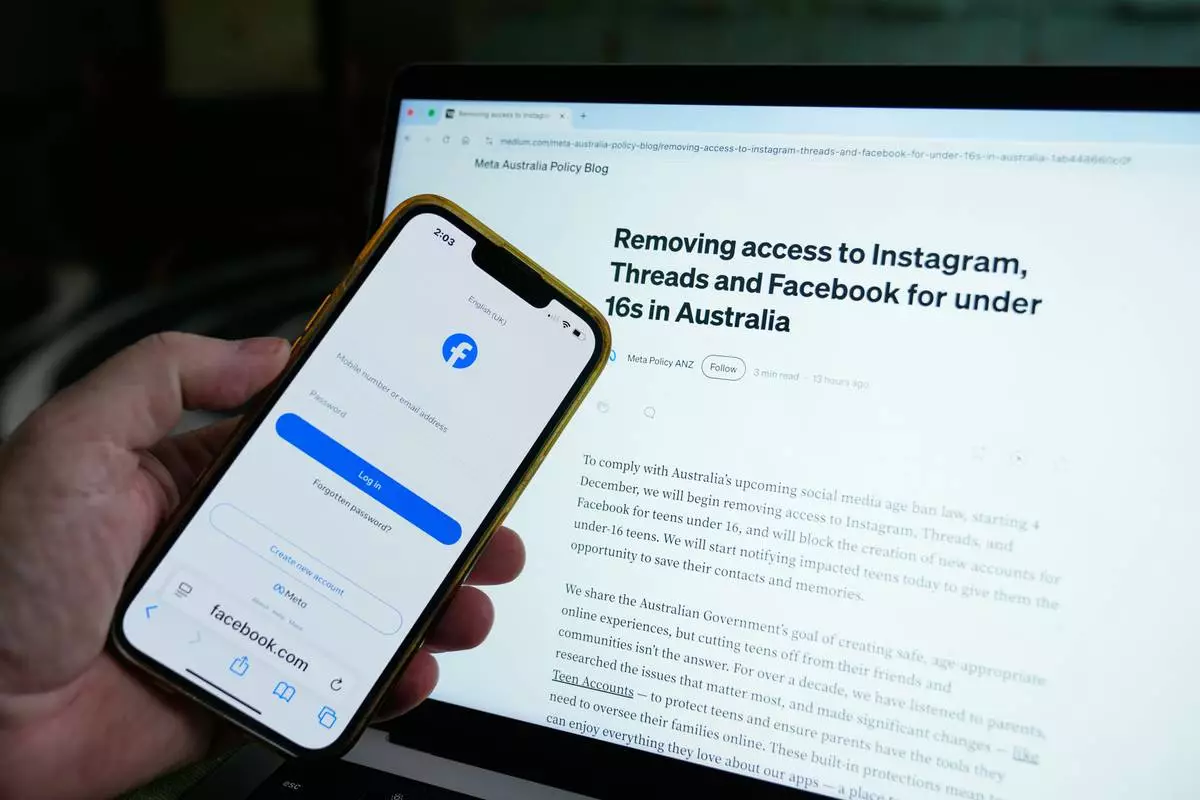
A logon screen for Facebook and the new Meta policy are photographed in Sydney, Australia, Thursday, Nov. 20, 2025. (AP Photo/Rick Rycroft)

A logon screen for Facebook and the new Meta policy are photographed in Sydney, Australia, Thursday, Nov. 20, 2025. (AP Photo/Rick Rycroft)
WASHINGTON (AP) — The Supreme Court is taking up one of the term’s most consequential cases, President Donald Trump’s executive order on birthright citizenship declaring that children born to parents who are in the United States illegally or temporarily are not American citizens, and he was in the courtroom on Wednesday for some of the arguments.

The justices are hearing Trump’s appeal of a lower-court ruling from New Hampshire that struck down the citizenship restrictions, one of several courts that have blocked them. They have not taken effect anywhere in the country.

Trump is the first sitting president to attend oral arguments at the nation’s highest court. He spent just over an hour inside the courtroom, hearing arguments by the government’s lawyer, Solicitor General D. John Sauer. He left shortly after Sauer wrapped up and the plaintiff was invited to present her case.

The case frames another test of Trump's assertions of executive power that defy long-standing precedent for a court that has largely ruled in the president's favor — but with some notable exceptions that Trump has responded to with starkly personal criticisms of the justices. A definitive ruling is expected by early summer.

The birthright citizenship order, which Trump signed the first day of his second term, is part of his Republican administration’s broad immigration crackdown.

Birthright citizenship is the first Trump immigration-related policy to reach the court for a final ruling. The justices previously struck down global tariffs Trump had imposed under an emergency powers law that had never been used that way.

Trump reacted furiously to the late February tariffs decision, saying he was ashamed of the justices who ruled against him and calling them unpatriotic.

He issued a preemptive broadside against the court on Sunday on his Truth Social platform. “Birthright Citizenship is not about rich people from China, and the rest of the World, who want their children, and hundreds of thousands more, FOR PAY, to ridiculously become citizens of the United States of America. It is about the BABIES OF SLAVES!,” the president wrote. “Dumb Judges and Justices will not a great Country make!”

Trump's order would upend the long-standing view that the Constitution’s 14th Amendment, ratified in 1868, and federal law since 1940 confer citizenship on everyone born on American soil, with narrow exceptions for the children of foreign diplomats and those born to a foreign occupying force.

The 14th Amendment was intended to ensure that Black people, including former slaves, had citizenship, though the Citizenship Clause is written more broadly. “All persons born or naturalized in the United States, and subject to the jurisdiction thereof, are citizens of the United States and of the State wherein they reside,” it reads.

In a series of decisions, lower courts have struck down the executive order as illegal, or likely so, under the Constitution and federal law. The decisions have invoked the high court's 1898 ruling in Wong Kim Ark, which held that the U.S.-born child of Chinese nationals was a citizen.

The Trump administration argues that the common view of citizenship is wrong, asserting that children of noncitizens are not “subject to the jurisdiction” of the United States and therefore are not entitled to citizenship.

The court should use the case to set straight “long-enduring misconceptions about the Constitution’s meaning,” wrote Sauer, the solicitor general.

No court has accepted that argument, and lawyers for pregnant women whose children would be affected by the order said the Supreme Court should not be the first to do so.

“We have the president of the United States trying to radically reinterpret the definition of American citizenship,” said Cecillia Wang, the American Civil Liberties Union legal director who is facing off against Sauer at the Supreme Court.

More than one-quarter of a million babies born in the U.S. each year would be affected by the executive order, according to research by the Migration Policy Institute and Pennsylvania State University’s Population Research Institute.

While Trump has largely focused on illegal immigration in his rhetoric and actions, the birthright restrictions also would apply to people who are legally in the United States, including students and applicants for green cards, or permanent resident status.

Associated Press writer Darlene Superville contributed to this report.

Follow the AP’s coverage of the U.S. Supreme Court at https://apnews.com/hub/us-supreme-court.

Pro and anti-Trump demonstrators rally outside the U.S. Supreme Court, before justices hear oral arguments on whether President Donald Trump can deny citizenship to children born to parents who are in the United States illegally or temporarily, on Capitol Hill, in Washington, Wednesday, April 1, 2026. (AP Photo/J. Scott Applewhite)

Pro and anti-Trump demonstrators rally outside the U.S. Supreme Court, before justices hear oral arguments on whether President Donald Trump can deny citizenship to children born to parents who are in the United States illegally or temporarily, on Capitol Hill, in Washington, Wednesday, April 1, 2026. (AP Photo/J. Scott Applewhite)

President Donald Trump leaves the U.S. Supreme Court, Wednesday, April 1, 2026, in Washington. (AP Photo/Mark Schiefelbein)

President Donald Trump leaves the U.S. Supreme Court, Wednesday, April 1, 2026, in Washington. (AP Photo/Mark Schiefelbein)

President Donald Trump's motorcade arrives at the U.S. Supreme Court, Wednesday, April 1, 2026, in Washington. (AP Photo/Tom Brenner)

President Donald Trump's motorcade arrives at the U.S. Supreme Court, Wednesday, April 1, 2026, in Washington. (AP Photo/Tom Brenner)

Pro and anti-Trump demonstrators rally outside the U.S. Supreme Court, before justices hear oral arguments on whether President Donald Trump can deny citizenship to children born to parents who are in the United States illegally or temporarily, on Capitol Hill, in Washington, Wednesday, April 1, 2026. (AP Photo/J. Scott Applewhite)

Pro and anti-Trump demonstrators rally outside the U.S. Supreme Court, before justices hear oral arguments on whether President Donald Trump can deny citizenship to children born to parents who are in the United States illegally or temporarily, on Capitol Hill, in Washington, Wednesday, April 1, 2026. (AP Photo/J. Scott Applewhite)

President Donald Trump's motorcade arrives at the U.S. Supreme Court, Wednesday, April 1, 2026, in Washington. (AP Photo/Tom Brenner)

President Donald Trump's motorcade arrives at the U.S. Supreme Court, Wednesday, April 1, 2026, in Washington. (AP Photo/Tom Brenner)

Demonstrators holding opposing views verbally engage ahead of President Donald Trump's arrival at the U.S. Supreme Court, Wednesday, April 1, 2026, in Washington. (AP Photo/Tom Brenner)

Demonstrators holding opposing views verbally engage ahead of President Donald Trump's arrival at the U.S. Supreme Court, Wednesday, April 1, 2026, in Washington. (AP Photo/Tom Brenner)

President Donald Trump's limo exits the White House en route to the Supreme Court, Wednesday, April 1, 2026, in Washington. (AP Photo/Mark Schiefelbein)

President Donald Trump's limo exits the White House en route to the Supreme Court, Wednesday, April 1, 2026, in Washington. (AP Photo/Mark Schiefelbein)

President Donald Trump's motorcade arrives at the U.S. Supreme Court, Wednesday, April 1, 2026, in Washington. (AP Photo/Tom Brenner)

President Donald Trump's motorcade arrives at the U.S. Supreme Court, Wednesday, April 1, 2026, in Washington. (AP Photo/Tom Brenner)

Pro and anti-Trump demonstrators rally outside the U.S. Supreme Court, before justices hear oral arguments on whether President Donald Trump can deny citizenship to children born to parents who are in the United States illegally or temporarily, on Capitol Hill, in Washington, Wednesday, April 1, 2026. (AP Photo/J. Scott Applewhite)

Pro and anti-Trump demonstrators rally outside the U.S. Supreme Court, before justices hear oral arguments on whether President Donald Trump can deny citizenship to children born to parents who are in the United States illegally or temporarily, on Capitol Hill, in Washington, Wednesday, April 1, 2026. (AP Photo/J. Scott Applewhite)

People arrive to walk inside the U.S. Supreme Court, on Capitol Hill in Washington, Wednesday, April 1, 2026. The Supreme Court justices will hear oral arguments today on whether President Donald Trump can deny citizenship to children born to parents who are in the United States illegally or temporarily. (AP Photo/J. Scott Applewhite)

People arrive to walk inside the U.S. Supreme Court, on Capitol Hill in Washington, Wednesday, April 1, 2026. The Supreme Court justices will hear oral arguments today on whether President Donald Trump can deny citizenship to children born to parents who are in the United States illegally or temporarily. (AP Photo/J. Scott Applewhite)

People arrive to walk inside the U.S. Supreme Court, on Capitol Hill in Washington, Wednesday, April 1, 2026. The Supreme Court justices will hear oral arguments today on whether President Donald Trump can deny citizenship to children born to parents who are in the United States illegally or temporarily. (AP Photo/J. Scott Applewhite)

People arrive to walk inside the U.S. Supreme Court, on Capitol Hill in Washington, Wednesday, April 1, 2026. The Supreme Court justices will hear oral arguments today on whether President Donald Trump can deny citizenship to children born to parents who are in the United States illegally or temporarily. (AP Photo/J. Scott Applewhite)

President Donald Trump answers questions from reporters after signing an executive order in the Oval Office of the White House Tuesday, March 31, 2026, in Washington, as Commerce Secretary Howard Lutnick listens. (AP Photo/Alex Brandon)

President Donald Trump answers questions from reporters after signing an executive order in the Oval Office of the White House Tuesday, March 31, 2026, in Washington, as Commerce Secretary Howard Lutnick listens. (AP Photo/Alex Brandon)

The U.S. Supreme Court is seen as the moon rises Tuesday, March 31, 2026, in Washington. (AP Photo/Jose Luis Magana)

The U.S. Supreme Court is seen as the moon rises Tuesday, March 31, 2026, in Washington. (AP Photo/Jose Luis Magana)

Recommended Articles