|
- New collaboration plans to unite strengths of both leaders to design a connected network of large-scale, fault-tolerant quantum computers, targeted by early 2030s
- Companies plan to deliver an initial demonstration of multiple networked quantum computers within five years
- Distributed quantum network could lay groundwork towards quantum computing internet defined by quantum computers, sensors, and communication in the late 2030s
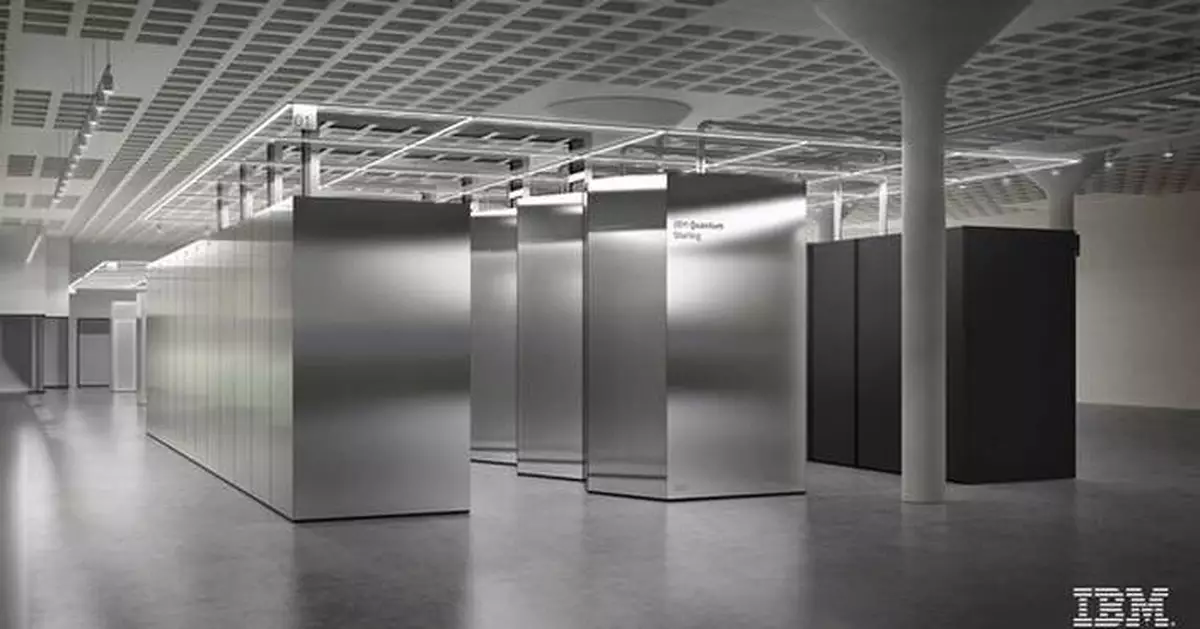
YORKTOWN HEIGHTS, N.Y. and SAN JOSE, Calif., Nov. 20, 2025 /PRNewswire/ -- Today, IBM (NYSE: IBM) and Cisco (NASDAQ: CSCO) announced an intention to collaborate on the groundwork for networked distributed quantum computing, to be realized as soon as the early 2030s. By combining IBM's leadership in building useful quantum computers with Cisco's quantum networking innovations, the companies plan to explore how to scale large-scale, fault-tolerant quantum computers beyond IBM's ambitious roadmap. Additionally, they will work to solve fundamental challenges towards a quantum computing internet.
Within five years, IBM and Cisco will aim to demonstrate the first proof-of-concept for a network that combines individual, large-scale, fault-tolerant quantum computers, enabling them to work together to run computations over tens to hundreds of thousands of qubits. This network would allow problems to be run with potentially trillions of quantum gates, the fundamental entangling operations required for transformative quantum applications such as massive optimization problems, or the design of complex materials and medicines.
"At IBM, our roadmap includes plans to deliver large-scale, fault-tolerant quantum computers before the end of the decade," said Jay Gambetta, Director of IBM Research and IBM Fellow. "By working with Cisco to explore how to link multiple quantum computers like these together into a distributed network, we will pursue how to further scale quantum's computational power. And as we build the future of compute, our vision will push the frontiers of what quantum computers can do within a larger high-performance computing architecture."
"Getting quantum computing to useful scale is not just about building bigger individual machines, it is also about connecting them together," said Vijoy Pandey, GM/SVP at Outshift by Cisco. "IBM is building quantum computers with aggressive roadmaps for scale-up, and we are bringing quantum networking that enables scale-out. Together, we are solving this as a complete system problem, including the hardware to connect quantum computers, the software to run computations across them, and the networking intelligence that makes them work."
Scaling a Distributed Quantum Computing Network
IBM and Cisco intend to explore the development of quantum hardware and software that could physically link many large-scale, fault-tolerant quantum computers together to form networked distributed quantum computing.
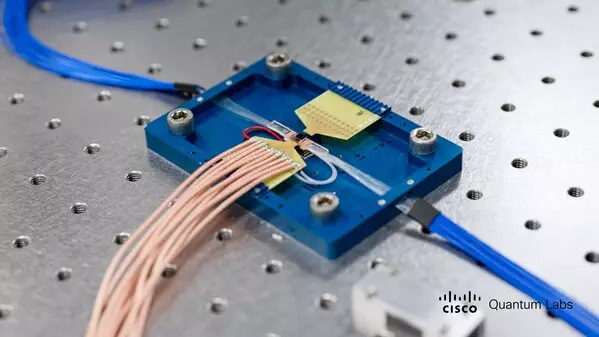
The companies are targeting an initial proof-of-concept demonstration by the end of 2030, for which they plan to entangle qubits from multiple separate quantum computers located in distinct cryogenic environments. Doing so will require the companies to invent new connections, including microwave-optical transducers and a supporting software stack.
The Cisco vision for a quantum data center introduces an architecture for quantum networking infrastructure that could make distributed quantum computing a reality in the near future. This vision includes a complete hardware and software stack that aims to preserve fragile quantum states, distribute entanglement resources, facilitate teleportation between quantum computers, and synchronize operations with sub-nanosecond precision.
To scale beyond linking two quantum computers that are separate but physically close, IBM and Cisco are planning to explore how to transmit qubits over longer distances, such as between buildings or data centers. To achieve this, the companies will explore optical-photon and microwave-optical transducer technologies, as well as investigate how they can be incorporated into a quantum network to transfer quantum information as needed.
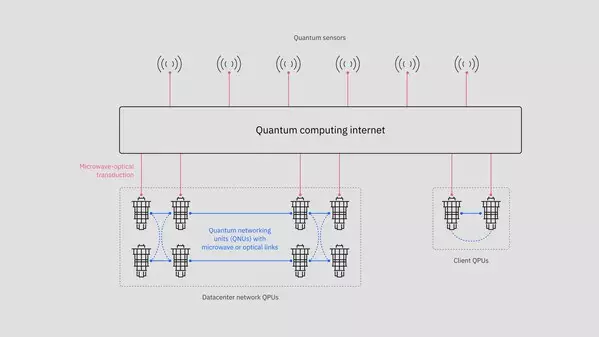
Linking together multiple quantum computers will require an appropriate interface. IBM plans to build a quantum networking unit (QNU) to serve as the interface to a quantum processing unit (QPU), with the explicit task of taking stationary quantum information in the QPU and converting it into "flying" quantum information through the QNU to then be further linked across potentially multiple quantum computers through a network.
Cisco's quantum network would aim to distribute the entanglements to arbitrary pairs of these QNUs on an on-demand basis to drive the quantum information transfer required for a given quantum algorithm or application. Towards this goal, Cisco is developing a high-speed software protocol framework that can continuously and dynamically reconfigure network paths so entanglements could be distributed to the QNUs when they are done with their partial computations.
Together, the companies plan to investigate how a network bridge, comprised of novel hardware and open-source software, could use Cisco quantum network nodes to link many IBM QPUs within a data center through its QNU interface. In the future, this approach could be extended to link QPUs across multiple data centers. This would scale a larger quantum network across even larger distances to form the groundwork for a future quantum computing internet.
IBM quantum computers linked by this architecture could facilitate massively computationally demanding workloads, including those that require high-performance computing resources as part of a quantum-centric supercomputing framework.
Towards this vision, IBM is also working with the Superconducting Quantum Materials and Systems Center (SQMS), led by Fermi National Accelerator Laboratory, in its role as a member of four of the U.S. Department of Energy National Quantum Information Science and Research Centers. Together, IBM and SQMS intend to investigate how many QNUs could be used within quantum data centers, and they are planning an initial demonstration of multiple connected QPUs within the next three years.
The Foundation of a Quantum Computing Internet
Building a distributed and scalable quantum computing network will create a pathway towards an exponentially large computational space and enable the expansion of diverse technologies, which could begin to form a future quantum computing internet by the late 2030s.
A quantum computing internet provides a future where many distributed quantum-based technologies, such as quantum computers, quantum sensors, and quantum communications are connected and share information across distances, such as a metro region and eventually, at a planetary scale. This bold vision could facilitate new possibilities such as ultra-secure communications, or precise monitoring of climate, weather, and seismic activity.
As another part of their current intention to collaborate, IBM and Cisco plan to co-fund academic research and collaborative projects to advance the broader quantum ecosystem, following a long history of fostering research in academic and national labs.
About IBM
IBM is a leading global hybrid cloud and AI, and business services provider, helping clients in more than 175 countries capitalize on insights from their data, streamline business processes, reduce costs and gain the competitive edge in their industries. Thousands of governments and corporate entities in critical infrastructure areas such as financial services, telecommunications and healthcare rely on IBM's hybrid cloud platform and Red Hat OpenShift to affect their digital transformations quickly, efficiently and securely. IBM's breakthrough innovations in AI, quantum computing, industry-specific cloud solutions and business services deliver open and flexible options to our clients. All of this is backed by IBM's legendary commitment to trust, transparency, responsibility, inclusivity and service.
For more information, visit https://research.ibm.com.
About Cisco
Cisco (NASDAQ: CSCO) is the worldwide technology leader that is revolutionizing the way organizations connect and protect in the AI era. For more than 40 years, Cisco has securely connected the world. With its industry leading AI-powered solutions and services, Cisco enables its customers, partners and communities to unlock innovation, enhance productivity and strengthen digital resilience. With purpose at its core, Cisco remains committed to creating a more connected and inclusive future for all. Discover more on The Newsroom and follow us on X at @Cisco.
Cisco and the Cisco logo are trademarks or registered trademarks of Cisco and/or its affiliates in the U.S. and other countries. A listing of Cisco's trademarks can be found at http://www.cisco.com/go/trademarks. Third-party trademarks mentioned are the property of their respective owners. The use of the word 'partner' does not imply a partnership relationship between Cisco and any other company.
Disclaimer: Many of the products and features mentioned are still in development and will be made available as they are finalized, subject to ongoing evolution in development and innovation. The timeline for their release is subject to change.
Media Contacts
IBM
Erin Angelini
IBM Communications
edlehr@us.bim.com
Cisco
Ramona Redlingshafer
Public Relations
rredling@cisco.com
- New collaboration plans to unite strengths of both leaders to design a connected network of large-scale, fault-tolerant quantum computers, targeted by early 2030s
- Companies plan to deliver an initial demonstration of multiple networked quantum computers within five years
- Distributed quantum network could lay groundwork towards quantum computing internet defined by quantum computers, sensors, and communication in the late 2030s
YORKTOWN HEIGHTS, N.Y. and SAN JOSE, Calif., Nov. 20, 2025 /PRNewswire/ -- Today, IBM (NYSE: IBM) and Cisco (NASDAQ: CSCO) announced an intention to collaborate on the groundwork for networked distributed quantum computing, to be realized as soon as the early 2030s. By combining IBM's leadership in building useful quantum computers with Cisco's quantum networking innovations, the companies plan to explore how to scale large-scale, fault-tolerant quantum computers beyond IBM's ambitious roadmap. Additionally, they will work to solve fundamental challenges towards a quantum computing internet.
Within five years, IBM and Cisco will aim to demonstrate the first proof-of-concept for a network that combines individual, large-scale, fault-tolerant quantum computers, enabling them to work together to run computations over tens to hundreds of thousands of qubits. This network would allow problems to be run with potentially trillions of quantum gates, the fundamental entangling operations required for transformative quantum applications such as massive optimization problems, or the design of complex materials and medicines.
"At IBM, our roadmap includes plans to deliver large-scale, fault-tolerant quantum computers before the end of the decade," said Jay Gambetta, Director of IBM Research and IBM Fellow. "By working with Cisco to explore how to link multiple quantum computers like these together into a distributed network, we will pursue how to further scale quantum's computational power. And as we build the future of compute, our vision will push the frontiers of what quantum computers can do within a larger high-performance computing architecture."
"Getting quantum computing to useful scale is not just about building bigger individual machines, it is also about connecting them together," said Vijoy Pandey, GM/SVP at Outshift by Cisco. "IBM is building quantum computers with aggressive roadmaps for scale-up, and we are bringing quantum networking that enables scale-out. Together, we are solving this as a complete system problem, including the hardware to connect quantum computers, the software to run computations across them, and the networking intelligence that makes them work."
Scaling a Distributed Quantum Computing Network
IBM and Cisco intend to explore the development of quantum hardware and software that could physically link many large-scale, fault-tolerant quantum computers together to form networked distributed quantum computing.
The companies are targeting an initial proof-of-concept demonstration by the end of 2030, for which they plan to entangle qubits from multiple separate quantum computers located in distinct cryogenic environments. Doing so will require the companies to invent new connections, including microwave-optical transducers and a supporting software stack.
The Cisco vision for a quantum data center introduces an architecture for quantum networking infrastructure that could make distributed quantum computing a reality in the near future. This vision includes a complete hardware and software stack that aims to preserve fragile quantum states, distribute entanglement resources, facilitate teleportation between quantum computers, and synchronize operations with sub-nanosecond precision.
To scale beyond linking two quantum computers that are separate but physically close, IBM and Cisco are planning to explore how to transmit qubits over longer distances, such as between buildings or data centers. To achieve this, the companies will explore optical-photon and microwave-optical transducer technologies, as well as investigate how they can be incorporated into a quantum network to transfer quantum information as needed.
Linking together multiple quantum computers will require an appropriate interface. IBM plans to build a quantum networking unit (QNU) to serve as the interface to a quantum processing unit (QPU), with the explicit task of taking stationary quantum information in the QPU and converting it into "flying" quantum information through the QNU to then be further linked across potentially multiple quantum computers through a network.
Cisco's quantum network would aim to distribute the entanglements to arbitrary pairs of these QNUs on an on-demand basis to drive the quantum information transfer required for a given quantum algorithm or application. Towards this goal, Cisco is developing a high-speed software protocol framework that can continuously and dynamically reconfigure network paths so entanglements could be distributed to the QNUs when they are done with their partial computations.
Together, the companies plan to investigate how a network bridge, comprised of novel hardware and open-source software, could use Cisco quantum network nodes to link many IBM QPUs within a data center through its QNU interface. In the future, this approach could be extended to link QPUs across multiple data centers. This would scale a larger quantum network across even larger distances to form the groundwork for a future quantum computing internet.
IBM quantum computers linked by this architecture could facilitate massively computationally demanding workloads, including those that require high-performance computing resources as part of a quantum-centric supercomputing framework.
Towards this vision, IBM is also working with the Superconducting Quantum Materials and Systems Center (SQMS), led by Fermi National Accelerator Laboratory, in its role as a member of four of the U.S. Department of Energy National Quantum Information Science and Research Centers. Together, IBM and SQMS intend to investigate how many QNUs could be used within quantum data centers, and they are planning an initial demonstration of multiple connected QPUs within the next three years.
The Foundation of a Quantum Computing Internet
Building a distributed and scalable quantum computing network will create a pathway towards an exponentially large computational space and enable the expansion of diverse technologies, which could begin to form a future quantum computing internet by the late 2030s.
A quantum computing internet provides a future where many distributed quantum-based technologies, such as quantum computers, quantum sensors, and quantum communications are connected and share information across distances, such as a metro region and eventually, at a planetary scale. This bold vision could facilitate new possibilities such as ultra-secure communications, or precise monitoring of climate, weather, and seismic activity.
As another part of their current intention to collaborate, IBM and Cisco plan to co-fund academic research and collaborative projects to advance the broader quantum ecosystem, following a long history of fostering research in academic and national labs.
About IBM
IBM is a leading global hybrid cloud and AI, and business services provider, helping clients in more than 175 countries capitalize on insights from their data, streamline business processes, reduce costs and gain the competitive edge in their industries. Thousands of governments and corporate entities in critical infrastructure areas such as financial services, telecommunications and healthcare rely on IBM's hybrid cloud platform and Red Hat OpenShift to affect their digital transformations quickly, efficiently and securely. IBM's breakthrough innovations in AI, quantum computing, industry-specific cloud solutions and business services deliver open and flexible options to our clients. All of this is backed by IBM's legendary commitment to trust, transparency, responsibility, inclusivity and service.
For more information, visit https://research.ibm.com.
About Cisco
Cisco (NASDAQ: CSCO) is the worldwide technology leader that is revolutionizing the way organizations connect and protect in the AI era. For more than 40 years, Cisco has securely connected the world. With its industry leading AI-powered solutions and services, Cisco enables its customers, partners and communities to unlock innovation, enhance productivity and strengthen digital resilience. With purpose at its core, Cisco remains committed to creating a more connected and inclusive future for all. Discover more on The Newsroom and follow us on X at @Cisco.
Cisco and the Cisco logo are trademarks or registered trademarks of Cisco and/or its affiliates in the U.S. and other countries. A listing of Cisco's trademarks can be found at http://www.cisco.com/go/trademarks. Third-party trademarks mentioned are the property of their respective owners. The use of the word 'partner' does not imply a partnership relationship between Cisco and any other company.
Disclaimer: Many of the products and features mentioned are still in development and will be made available as they are finalized, subject to ongoing evolution in development and innovation. The timeline for their release is subject to change.
Media Contacts
IBM
Erin Angelini
IBM Communications
edlehr@us.bim.com
Cisco
Ramona Redlingshafer
Public Relations
rredling@cisco.com
** The press release content is from PR Newswire. Bastille Post is not involved in its creation. **
IBM and Cisco Announce Plans to Build a Network of Large-Scale, Fault-Tolerant Quantum Computers
IBM and Cisco Announce Plans to Build a Network of Large-Scale, Fault-Tolerant Quantum Computers
IBM and Cisco Announce Plans to Build a Network of Large-Scale, Fault-Tolerant Quantum Computers
|
BEIJING, April 2, 2026 /PRNewswire/ -- LONGi has officially unveiled its LONGi ONE integrated solar-plus-storage strategy, marking a transition from traditional multi-vendor architectures to a unified system design.
A Shift from Fragmentation to Integration
As solar energy establishes itself as a core pillar of the global energy system, conventional "assembled" solutions are increasingly constrained by efficiency losses, complex commissioning, and unclear accountability. LONGi ONE addresses these challenges through full-stack, self-developed native integration, combining advanced BC solar technology with 5S storage technology to deliver a unified, high-performance "Solar Generator."
One System, One Platform, One Responsibility
LONGi ONE is built upon three core principles: One System, One Platform, and One Responsibility.
Its natively integrated architecture reduces system losses, enhances performance, and shortens deployment timelines. The AI-driven platform enables coordinated optimization across generation, storage, and consumption.
Equally important, the One Responsibility principle redefines accountability in solar-storage systems. Instead of managing multiple vendors, customers work with a single partner—LONGi—across the entire lifecycle. This eliminates fragmented interfaces, avoids responsibility gaps, and ensures faster issue resolution with clear ownership.
A Comprehensive Product Portfolio
LONGi ONE delivers tailored solutions for two key market segments: utility-scale and commercial & industrial (C&I) applications.
For utility-scale projects, OneBank 2.0 offers a fully integrated AC/DC storage solution featuring advanced safety design. Its proprietary iCCS technology enables millisecond-scale fault detection and isolation, reducing system-level failure rates by 60% and cutting pre-commissioning time by over 30%.
OneMatrix 2.0 provides a flexible, modular approach for plant-level deployment, supporting multiple duration scenarios (2h/4h/8h) while reducing deployment time by 20-30% and lowering lifecycle costs.
For C&I users, Hi-MO One—paired with the EnergyOne platform—delivers 24.8% module efficiency and up to 90.3% system efficiency. With response times under 20 ms and AI-driven energy management, it enables intelligent operation and optimized returns.
Global Service Network Expansion
LONGi has also launched its "2830 Plan," which aims to establish 30 localized service centers across key global markets by 2028.
Supported by 13 GWh of delivery experience across over 120 countries, this network will provide end-to-end lifecycle services, ensuring rapid, localized support worldwide.
Toward the Solar Generator Era
From monocrystalline to BC technology, and from PV to storage, LONGi remains committed to translating innovation into customer value. With LONGi ONE, the company aims to redefine solar energy as a stable and intelligent "Solar Generator"—supporting the next phase of the global energy transition.
BEIJING, April 2, 2026 /PRNewswire/ -- LONGi has officially unveiled its LONGi ONE integrated solar-plus-storage strategy, marking a transition from traditional multi-vendor architectures to a unified system design.
A Shift from Fragmentation to Integration
As solar energy establishes itself as a core pillar of the global energy system, conventional "assembled" solutions are increasingly constrained by efficiency losses, complex commissioning, and unclear accountability. LONGi ONE addresses these challenges through full-stack, self-developed native integration, combining advanced BC solar technology with 5S storage technology to deliver a unified, high-performance "Solar Generator."
One System, One Platform, One Responsibility
LONGi ONE is built upon three core principles: One System, One Platform, and One Responsibility.
Its natively integrated architecture reduces system losses, enhances performance, and shortens deployment timelines. The AI-driven platform enables coordinated optimization across generation, storage, and consumption.
Equally important, the One Responsibility principle redefines accountability in solar-storage systems. Instead of managing multiple vendors, customers work with a single partner—LONGi—across the entire lifecycle. This eliminates fragmented interfaces, avoids responsibility gaps, and ensures faster issue resolution with clear ownership.
A Comprehensive Product Portfolio
LONGi ONE delivers tailored solutions for two key market segments: utility-scale and commercial & industrial (C&I) applications.
For utility-scale projects, OneBank 2.0 offers a fully integrated AC/DC storage solution featuring advanced safety design. Its proprietary iCCS technology enables millisecond-scale fault detection and isolation, reducing system-level failure rates by 60% and cutting pre-commissioning time by over 30%.
OneMatrix 2.0 provides a flexible, modular approach for plant-level deployment, supporting multiple duration scenarios (2h/4h/8h) while reducing deployment time by 20-30% and lowering lifecycle costs.
For C&I users, Hi-MO One—paired with the EnergyOne platform—delivers 24.8% module efficiency and up to 90.3% system efficiency. With response times under 20 ms and AI-driven energy management, it enables intelligent operation and optimized returns.
Global Service Network Expansion
LONGi has also launched its "2830 Plan," which aims to establish 30 localized service centers across key global markets by 2028.
Supported by 13 GWh of delivery experience across over 120 countries, this network will provide end-to-end lifecycle services, ensuring rapid, localized support worldwide.
Toward the Solar Generator Era
From monocrystalline to BC technology, and from PV to storage, LONGi remains committed to translating innovation into customer value. With LONGi ONE, the company aims to redefine solar energy as a stable and intelligent "Solar Generator"—supporting the next phase of the global energy transition.
** This press release is distributed by PR Newswire through automated distribution system, for which the client assumes full responsibility. **
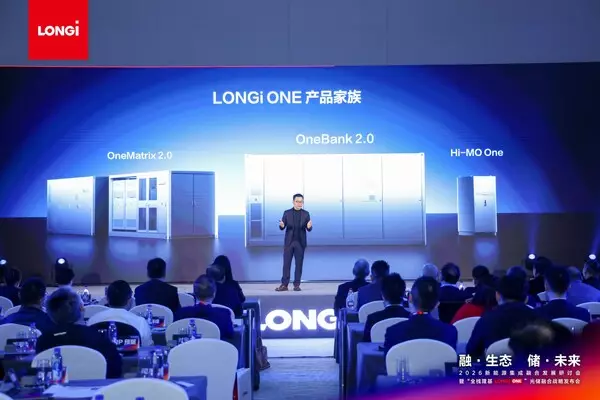
LONGi Unveils LONGi ONE, Ushering in a New Era of Integrated Solar-Plus-Storage Systems