China is accelerating the rollout of an upgraded "5G plus industrial internet," with plans to further integrate artificial intelligence (AI) into manufacturing, according to the Ministry of Industry and Information Technology (MIIT).
The initiative builds on the rapid progress made during the 14th Five-Year Plan period (2021-2025), in which industrial internet applications have expanded across all 41 major industrial sectors and targets for 5G-enabled smart factories have been fully achieved. It is also in line with the country's push to build a modernized industrial system with advanced manufacturing as the backbone.
MIIT said it will launch a new round of pilot cities for integrated 5G plus industrial internet applications and advance early-stage research on combining 6G with industrial use cases.
China has already established an independent and secure industrial internet identification system and built more than 300 platforms with national influence, connecting over 100 million industrial devices.
More than 20,000 "5G plus industrial internet" projects are now under construction nationwide, MIIT data showed, marking the transition from pilot-stage exploration to large-scale deployment. In Quanzhou, Fujian Province, a "lights-out" smart factory operated by a leading ceramics bathroom products manufacturer has adopted 5G-enabled machine-vision systems to replace manual inspection.
In this factory, which functions in the dark with minimal human intervention onsite, the 5G smart systems work collaboratively with glazing robots, completing uniform spraying in just 30 seconds. Quality checks are also automated using 5G connectivity and AI-powered data collection.
"Powered by the 5G network, all real-time inspection data on site is transmitted directly to our system, and digital quality checks now cover more than 90 percent of the process," said Yang Zhiyang, n an engineer at the factory.
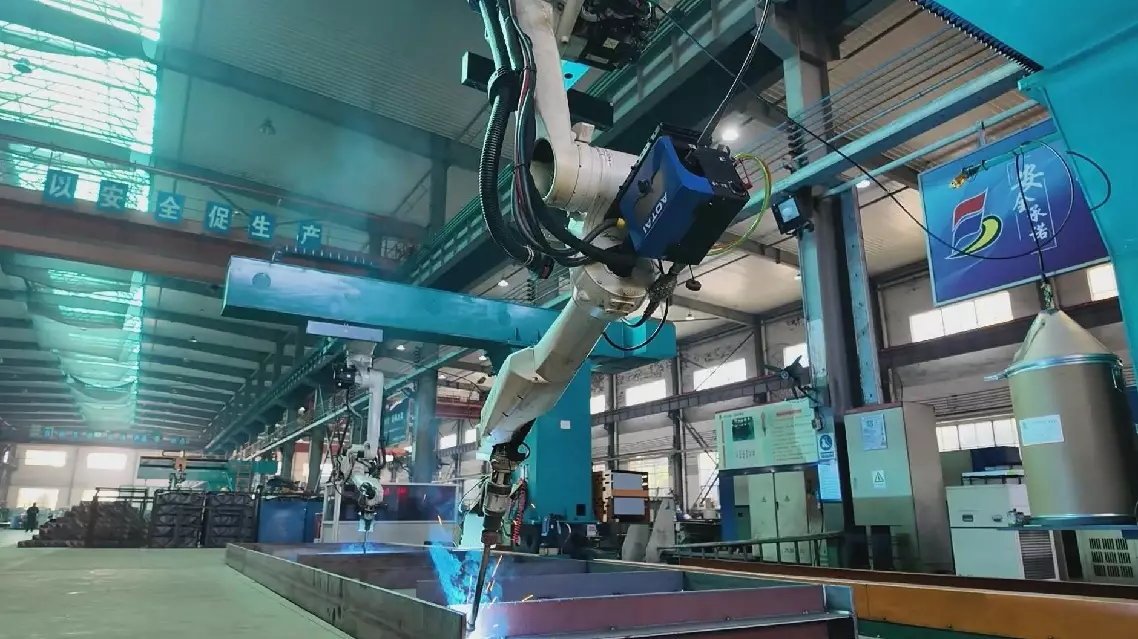
In Zhuji, Zhejiang Province, environmental equipment maker Zhejiang Feida Environmental Science and Technology Co., Ltd. has integrated smart sensing, data-driven decision-making and IoT-enabled coordination with 5G networks, allowing workers to complete the entire process from raw materials to packaging through digital command.
"By deeply integrating 5G-enabled industrial internet with technologies such as intelligent sensing, data-driven decision-making and IoT (Internet of Things)-based coordinated control, our products have become smarter. This reduces energy and material consumption in environmental treatment and significantly improves processing capacity and efficiency," said Yu Liyuan, an assistant to the general manager of the company.
In Lushui, Yunnan Province, a "5G plus AI" production line has transformed the processing of specialty coffee beans. The digital system covers sorting, roasting, packaging and storage, addressing longstanding issues of low efficiency and unstable quality.
"At the processing stage, we use a '5G plus AI' system that relies on machine vision and AI algorithms to identify the color, size and defects of coffee beans in real time. The sorting accuracy reaches 99.8 percent, and the rate of deep processing has jumped from 35 percent to 80 percent," said Ou Wenling, director for brand development and promotion at Lushui's market supervision and administration authority.
MIIT data shows that China's top 100 smart factories powered by 5G have, on average, increased production capacity by 25 percent, improved product quality by 21 percent and cut operating costs by 19 percent.
China accelerates digital transformation of industries by scaling up 5G, AI applications