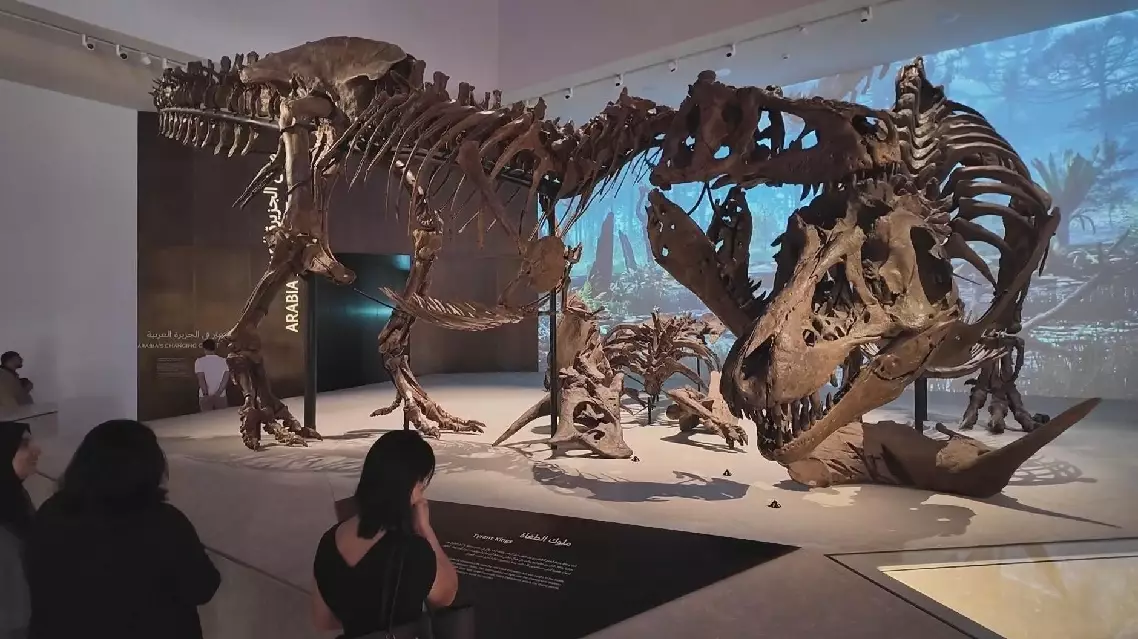
The Abu Dhabi Natural History Museum, the largest of its kind in the Middle East, opened to the public on Saturday.
Spanning 13.8 billion years of natural history, the museum invites visitors to trace the origins of the universe and explore the evolution of life on Earth.
A wide range of valuable exhibits is on display, complemented by interactive installations that deepen the visitor experience.
"Our story begins at the beginning of time itself, so 13.8 billion years ago, and that's the big bang. And as you leave that first gallery, then you enter the world of the dinosaurs. And this is not what the museum is just about, because from here you go into life after the dinosaurs in the Baynunah Formation in the western region of Abu Dhabi. Then through there, you enter the world today and celebrate the biodiversity on our planet. And the final gallery gives you an opportunity to see what nature can do for us, but what also we can do for nature," said Phil Manning, deputy director with the museum.
Among the visitors was Spanish paleontologist Alvaro Simarro, who participated in the museum's exhibition layout.
"We were really lucky to be part of specifically these two T-rexes. It's like a dream since when we were kids and specifically this Stan, the one on the right, is a really famous specimen," said Simarro.
One of the museum's most awe-inspiring exhibits is the Murchison meteorite, a space rock that fell in Australia in 1969 and carries the chemical seeds of life.
"It's hard to choose a favorite object in the museum because they're all part of that beautiful tapestry. One of the first objects you meet when you enter the first gallery is the Murchison meteorite. The grains from which it formed contained material solar grains, which are older than our solar system. It also contains amino acids and sugars, which are critical for life on earth. These are the building blocks of proteins. So for me, that one object sums up the whole museum," said Manning.
Abu Dhabi opens Middle East's largest natural history museum
An international academic symposium was held on Saturday at the Xizang Museum in Lhasa, capital of southwest China's Xizang Autonomous Region, to mark the 75th anniversary of the peaceful liberation of the region.
Perched on the Roof of the World, the Xizang Museum is the first modern museum on the plateau.
On the 75th anniversary of Xizang's peaceful liberation, it welcomed a group of international scholars to reflect on the region's transformation and future.
Greening efforts on the highest region on Earth have seen major strides.
Forest coverage has risen from less than 1 percent in 1951 to 12.5 percent today.
"Even here you see around the mountains of Lhasa here, the massive large-scale plantation. There is a big lesson to learn now to other parts of the world and other countries also to come. This is the conservation. We should move this way," said Krishna Prasad Oli, former Nepali ambassador to China. Nestled in the Himalayas is not just Xizang's natural beauty, but its unique culture.
Over the past few decades, the central government has invested billions of yuan in the region's heritage protection.
"In general there are so many rumors that are just not true. For example, there are rumors in our media that China suppresses the Tibetan language. A very simple thing is on the street that you see signs and two languages everywhere (in Mandarin and in Tibetan). Even in Austria and the minority areas, there are big discussions if we should write something in minority languages. But in China it is not a problem. So China's handling this is far better than Austria," said Georg, Vavra, an Austrian historian.
The most ambitious and costly undertaking on the plateau since its liberation has been building modern infrastructure.
Today, Xizang boasts a network of roads and railways that continues to expand.
"It just so happens that yesterday I traveled by train from Nyingchi to Lhasa. The UK is a country of 60 million people and has been struggling and failing for 17 years to build 150 kilometers of high speed rail. Now if you consider Xizang with a population of 4 or 5 million, they could never undertake a project of that scale, and that is what China is trying to do. China is the only country in the world that has a genuine interest in the prosperity and the development of Xizang," said David Ferguson, a Scottish commentator.
Beyond traditional industries, emerging sectors are also taking root in China's western frontier.
"In the 75 years since its peaceful liberation, Xizang has built its scientific and technological capabilities from the ground up. It has become a driving force behind the region's economic and social progress," said Nyima Tashi, a professor with the School of Information Science and Technology under Xizang University.
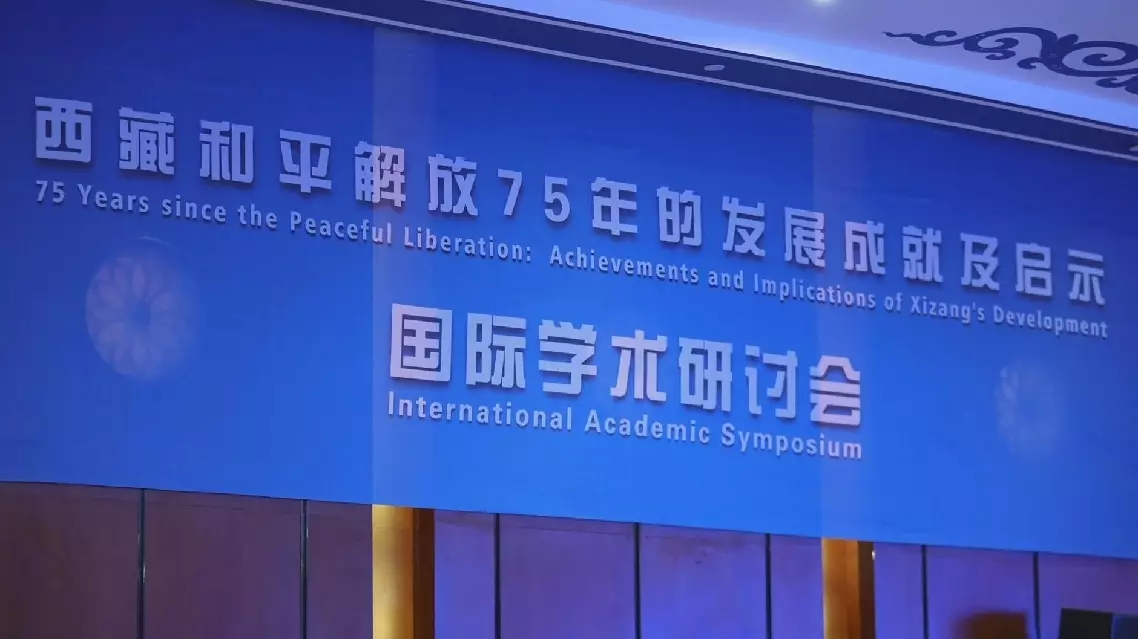
Int'l scholars gather in Xizang to review regional development over past 75 years