Cushman & Wakefield Report Highlights Five Key Market Impacts
HONG KONG SAR - Media OutReach Newswire - 24 November 2025 - Global real estate services firm Cushman & Wakefield has released its The 15th Five-Year Plan — Reshaping China's Real Estate Market Landscape for the Next Five Years report. It provides an expert interpretation of the communique from the Fourth Plenary Session of the 20th CPC Central Committee, and explores how the new Five-Year Plan (FYP) will influence China's real estate market from 2026 to 2030.
The 15th FYP marks a notable juncture in China's pursuit of its "Two Centenary Goals." It serves as the operational blueprint connecting to the 14th Five-Year Plan and laying the foundation for modernization by 2035, and will also reshape the future landscape of China's commercial real estate market.
During the 14th FYP period, China faced unprecedented challenges: the COVID-19 pandemic, rising anti-globalization sentiment, and geopolitical volatility. These factors slowed global economic momentum and created complex pressures on China's growth trajectory. Consequently, the nation faces mounting pressures on both domestic and international fronts, necessitating timely and coordinated policy solutions.
In response to these challenges, the government has adopted a strategic framework focused on "domestic circulation as the core, reinforced by international circulation."
The 15th FYP serves as the operational blueprint for executing this strategy. It outlines a comprehensive set of priorities aimed at driving sustainable and inclusive growth over the next five years, including the building of a modern industrial system, technological self-reliance, domestic market cultivation, and high-level opening up.
Cushman & Wakefield identifies five major impacts on real estate:
New Productive Forces Driving Office and Industrial Demand
The FYP prioritizes a modern industrial system to optimize traditional industries, expand emerging industries, and position for the future. Strategic sectors such as new energy vehicles and biomedicine have already achieved large-scale growth. New energy vehicle production reached 12.8 million units at the end of 2024, with a compound annual growth rate of 72% and a global market share of 76.4%. In the first five months of 2025, China's share of global large-scale pharmaceutical industry transactions surged to 42%. And in AI manufacturing technologies, China leads globally in industrial robot installations, with 276,300 units in 2023 — six times Japan's total. Over the next five years, policy and capital support for industrial and technology enterprises will likely spur demand for office space and industrial parks, enabling a recovery and new growth phase.
Growth trend of China's new energy vehicle industry
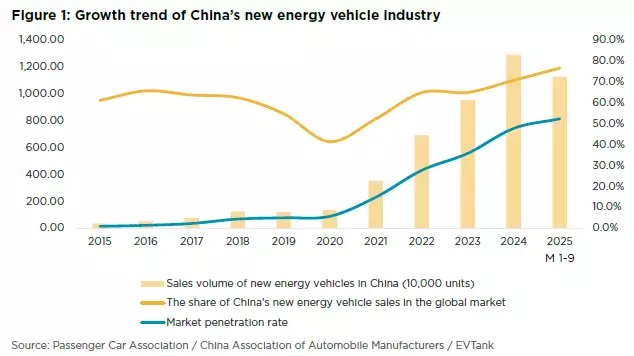
Growth trend of China’s new energy vehicle industry
Domestic Demand Expansion Boosting Retail Development
The 15th FYP highlights a model of "new demand leading new supply, and new supply creating new demand," marking a shift from reliance on material investment and supply-side reforms to leveraging both supply and demand. Over the past few decades, China has achieved success in "investing in physical assets" such as infrastructure, real estate, and manufacturing equipment, but investment in human capital and public welfare has lagged behind.
The FYP signals a policy shift toward addressing public concerns such as education, social security and employment, healthcare, and housing. Policies such as childcare subsidies and free preschool education aim to unlock consumption potential. Consumer infrastructure REITs have become a market hotspot, with all 11 listed products posting strong gains. As at October 15, 2025, two REITS — Cathay Shih Mei and E Fund Huawei Farmers' Market — recorded gains exceeding 70%. As the government continues to stimulate consumption and consumer-focused REITs expand, retail assets should attract growing investor interest, prompting brand repositioning and exploration of new demographics and demand sources.
High-Quality Opening-Up Attracting Global Capital
Despite global protectionism, China's two-way opening-up has yielded significant results. As a core asset class for global capital allocation to the RMB, Panda bonds have surpassed RMB1 trillion in issuances, benefiting from financing cost advantages. The FYP's policy certainty and defined targets, together with expectations for RMB appreciation, are also expected to attract global capital back into China's capital markets. Over the medium to long term, China asset classes such as retail properties, industrial logistics facilities, data centers, and office buildings are likely to garner growing interest from international investors.
Number and scale of Panda bond issuances
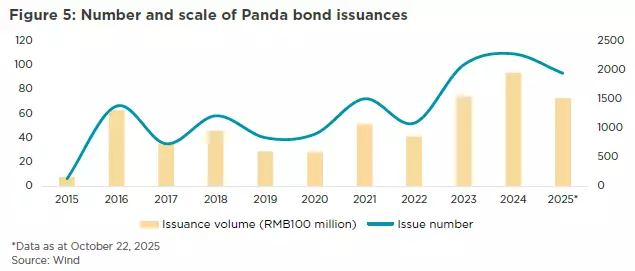
Number and scale of Panda bond issuances
Livelihood Improvements Supporting Real Estate Growth
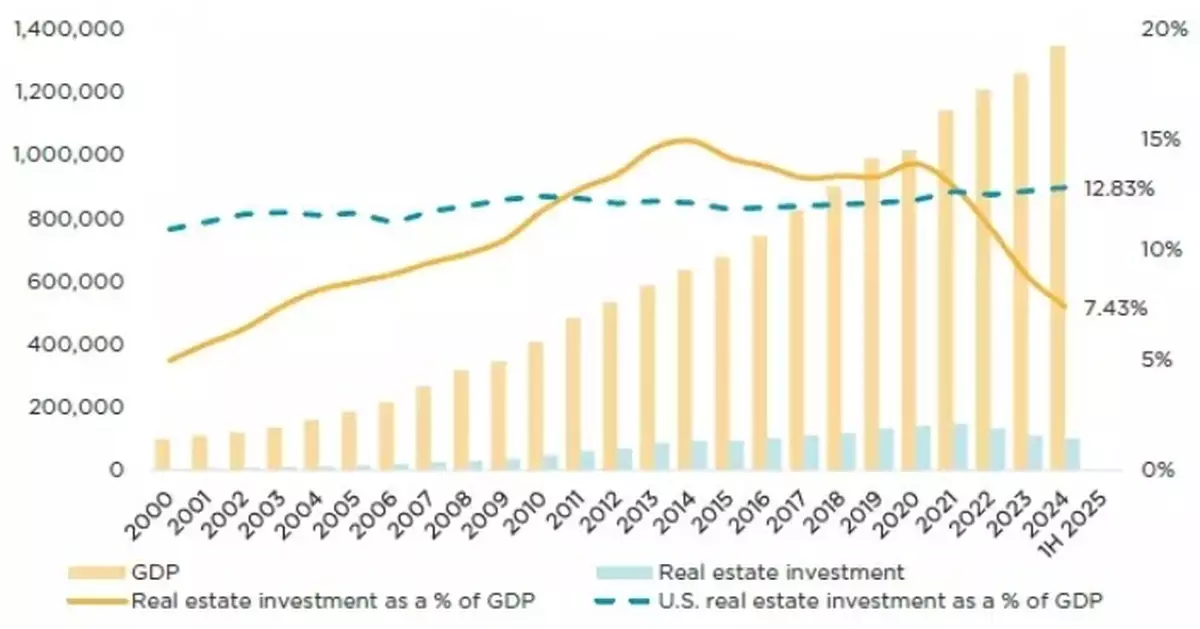
The FYP highlights real estate sector development within the context of improving people's livelihoods, reflecting a fundamental shift in the role of real estate in national economic development. Total real estate investment as a share of China's GDP dropped to 7.4% in 2024 from nearly 15% in 2014, while remaining under the United States' average of around 12%. Future market growth policies will focus on the construction of affordable housing, the development of the rental market, and urban renewal.
Trend of real estate development investment as a percentage of GDP
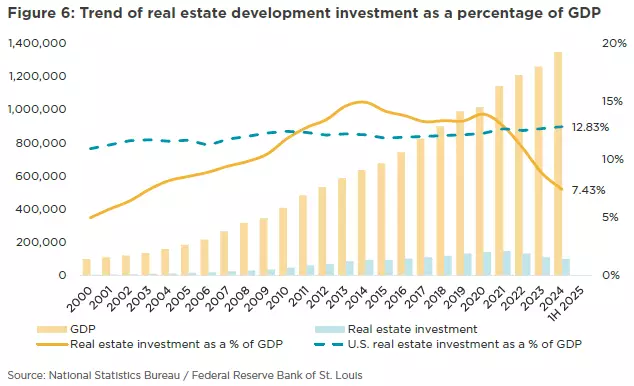
Trend of real estate development investment as a percentage of GDP
Accelerating Green Transformation
The FYP prioritizes sustainability in the real estate industry, with approximately 100 national-level zero-carbon industrial parks to be established by the end of the FYP period. A UN Environment Program report for 2024-2025 shows that the global construction industry accounts for 34% of carbon emissions, indicating a significant opportunity for emissions reduction in the real estate sector. ESG considerations are increasingly shaping the sector, with ESG principles becoming a key indicator for evaluating the value of commercial real estate projects.
Sabrina Wei, Chief Policy Analyst and Head of Research, North China, Cushman & Wakefield, said, "The 15th Five-Year Plan, as a blueprint for the 'accelerated period' of modernization, is driving China's economy to shift from investment and export dependence to a new model underpinned by domestic demand and coordinated supply and demand.
The positive impacts of key FYP themes will see the commercial real estate industry usher in an upgrade period across four subsectors: industrial real estate, retail properties, cross-border asset allocation, and green real estate. In the next five years, the combined effects of policy dividends, capital inflows, and consumption upgrades will open up greater development space for China's commercial real estate, helping the industry achieve high-quality transformation."
Please click here to access the full report.
Hashtag: #CushmanWakefield
The issuer is solely responsible for the content of this announcement.
** The press release content is from Media OutReach Newswire. Bastille Post is not involved in its creation. **
HONG KONG SAR – Media OutReach Newswire – 26 November 2026 – Cushman & Wakefield, a leading global real estate services firm, today released Life Sciences: From Lab to Landscape – How the Evolution of Life Sciences Is Transforming Real Estate Demand on the Chinese Mainland, a new report examining how the rapid growth of the life sciences industry is creating a distinct, specialist real estate sector across the country's leading innovation clusters.
The report finds that biotechnology, pharmaceutical, diagnostics and medical technology companies are moving beyond conventional offices and standard industrial premises into purpose-built laboratories, Good Manufacturing Practice (GMP) facilities and integrated research campuses. While these buildings demand higher specifications and greater capital investment, they also benefit from longer leases, stronger tenant retention and more resilient occupancy.
A Specialist Asset Class Takes Shape
Supported by national innovation policy, an ageing population, rising healthcare expenditure and expanding research and development (R&D), life sciences has become one of the Chinese mainland's most strategically important growth sectors. The 15th Five-Year Plan identifies biotechnology, biomedicine and biomanufacturing as strategic emerging industries.
The scale of this growth is clear. The value of the biotech industry on the Chinese mainland has risen from RMB 1.59 trillion in 2021 to an estimated RMB 2.31 trillion in 2026, an increase of more than 45%.
As companies progress from research to commercial production, their real estate needs follow a relatively predictable lifecycle, driving demand for:
- Shared laboratories and incubators for early-stage companies
- Modular, expandable laboratories for growth-stage businesses
- GMP-compliant manufacturing and clean-room facilities
- Integrated campuses combining research, manufacturing and corporate functions
Ecosystems Matter More Than Buildings
Life sciences is one of the most cluster-dependent industries in commercial real estate. Occupiers prioritize access to universities, hospitals, talent, venture capital and regulatory support over occupancy costs alone. As a result, demand remains concentrated in seven leading markets – Beijing, Shanghai, Shenzhen, Guangzhou, Chengdu, Suzhou and Wuhan – which together form an increasingly integrated national innovation network. Within the Greater Bay Area, Hong Kong is emerging as a complementary gateway connecting international capital, clinical research and regulatory capability with the research and manufacturing strengths of Shenzhen and Guangzhou.
Innovation Is Driving Demand for Specialist Space
Rising research and clinical activity is translating directly into demand for laboratories, pilot facilities and GMP production space. Annual drug clinical trial registrations on the Chinese mainland have more than doubled, from 2,386 in 2019 to 5,215 in 2025, as companies move more products from discovery towards commercialization.
In response, specialist life sciences space is now available at scale. Cushman & Wakefield tracks around 23.8 million sq m of life sciences space across 31 main clusters in the seven leading markets, giving occupiers a wider choice of quality research and production facilities. Pricing remains competitive, with nearly 80% of this space achieving rents of RMB 1.0–2.0 per sq m per day.
Retrofitting and ESG Unlock Value
Developers and investors are increasingly repositioning older offices, research parks and industrial buildings into laboratory and innovation space. Where floor loading, ceiling heights and utility capacity allow, retrofitting can shorten delivery times, lower development costs and reduce embodied carbon. At the same time, the energy intensity of laboratories is placing ESG performance at the center of investment decisions, with key priorities including:
- HVAC upgrades and improved energy management
- Lower water consumption and renewable energy where practical
- Operational resilience for uninterrupted research activity
- Access to green finance for lower-carbon, more efficient assets
Outlook
With a pipeline of new supply in several cities, rents are expected to remain flat or soften in most markets in the near term, giving occupiers access to purpose-built space on favorable terms. Of the 27 near-term cluster assessments in the report, 26 point to stable or lower rents.
Conclusion
Life Sciences: From Lab to Landscape concludes that life sciences real estate on the Chinese mainland is evolving from a specialist niche into an institutional asset class. Over the coming years, success will depend less on adding space and more on specialized operations, clear sector positioning and the ability to support occupiers as they progress from research to commercial production. Landlords and investors offering strong locations, ecosystem depth and specialist operating capability will be best placed to capture growing demand.
Andrew Chan, Managing Director, Head of Valuation & Advisory Services, Greater China, said, "Life sciences assets are increasingly being assessed as a distinct asset class rather than as a variation on office or industrial property. Specialist fit-outs, longer lease commitments and strong tenant retention support income resilience, but value will depend on technical specification, location within an established ecosystem and the quality of operational management. For investors, retrofit opportunities in the right clusters offer an attractive middle ground between stable core assets and higher-risk development."
Tony Su, Managing Director, National Head of Industrial & Logistics Property Services, China, said, "Demand for specialist life sciences space continues to grow, led by innovative drug developers, cell and gene therapy and medical device companies. With a significant pipeline coming through in several cities, landlords that offer flexible unit sizes, move-in-ready space and specialist operating capability will be best positioned to secure occupiers as they scale from the laboratory to commercial production."
Jonathan Wei, President, Project & Occupier Services, China, said, "For occupiers, life sciences facilities are among the most complex projects to deliver. Laboratories and GMP facilities require resilient power, sophisticated HVAC systems, contamination control and strict regulatory compliance, often within tight timeframes. Engaging early on-site selection, design and fit-out is critical, particularly as companies plan for future expansion and look to integrate research, manufacturing and corporate functions within a single campus."
Shaun Brodie, Head of Research Content, Greater China, said, "Life sciences is reshaping commercial real estate demand on the Chinese mainland. Our research shows that occupiers are choosing ecosystems, not just buildings – access to talent, hospitals, universities and capital matters as much as the space itself. While new supply means rents are generally stable or moderating, this creates a window of opportunity for occupiers, and rewards landlords and investors who focus on established clusters, specialist operations and sustainable, flexible design."
Please click here to download the full report.
Hashtag: #Cushman&Wakefield
The issuer is solely responsible for the content of this announcement.
About Cushman & Wakefield
Cushman & Wakefield (NYSE: CWK) is a leading global commercial real estate services firm for property owners and occupiers with approximately 53,000 employees in nearly 350 offices and 60 countries. In Greater China, a network of 23 offices serves local markets across the region. In 2025, the firm reported revenue of $10.3 billion across its core services of Valuation, Consulting, Project & Development Services, Capital Markets, Project & Occupier Services, Industrial & Logistics, Retail, and others. Built around the belief that Better never settles, the firm receives numerous industry and business accolades for its award-winning culture. For additional information, visit www.cushmanwakefield.com.hk or follow us on LinkedIn (https://www.linkedin.com/company/cushman-&-wakefield-greater-china).
** This press release is distributed by Media OutReach Newswire through automated distribution system, for which the client assumes full responsibility. **