WELLINGTON, New Zealand (AP) — Inoperable pistols gifted by FBI Director Kash Patel to senior New Zealand security officials, who had to relinquish them for destruction because they were illegal to possess, were revolvers inspired by toy Nerf guns and popular among 3D-printed weapons hobbyists, documents obtained by The Associated Press show.
The AP first reported that Patel gifted the plastic 3D-printed replica revolvers to New Zealand’s police and spy chiefs, along with two cabinet ministers, in July. Police documents released this week identified the model as the Maverick PG22, a working revolver modeled on the brightly colored toy gun of the same name.
Pistols are tightly restricted under New Zealand law, requiring a permit beyond a standard gun license. Law enforcement agencies didn’t say whether the officials who met with Patel held such permits. Without them, they couldn’t legally keep the gifts.
After the officials surrendered the revolvers, emails between police leaders and firearms specialists confirmed the gifts met the legal definition of firearms in New Zealand. 3D-printed weapons are treated the same as other guns.
Patel, the highest-ranking Trump administration official to visit New Zealand, was in Wellington to open the FBI’s first standalone office in the country.
“The gifted item was a 3D-printed replica of a firearm, and it was specially designed to be incapable of firing ammunition," a spokesperson for Patel said by email Tuesday. "The item was modified in various ways, to include but not limited to omitting chambers, barrels, and firing pin within the replica. These modifications ensured that it was inoperable.”
In New Zealand, inoperable weapons are treated as functional if they could be made operable with modifications. In August, days after Patel’s visit, police armory team leader Daniel Millar emailed his bosses to outline how simple it would be to make the guns operable.
“These processes are very straight forward processes and require minimal skills and common ‘handyperson’ tools,” Millar wrote. He added that these tools were “a battery drill and a drill bit for the holes and a small screw for the firing pin.”
New Zealand’s police union said in February that the Maverick PG22 was among the most common 3D-printed guns seized by officers. Millar wrote that his team requested to keep one of the revolvers for testing, but the police commissioner denied the request and the guns were destroyed on Sept. 25.
“The first risk is that it can be made viable and it gets into the hands of the wrong person and it’s used for a crime,” said professor Alexander Gillespie, a lecturer on firearms regulation at New Zealand’s University of Waikato. “The second risk is it just explodes because it’s not actually safe. There’s a reason these have been made in people’s backyards instead of coming from an armory.”
Online instructions for making the Maverick PG22 say it “does not feature proper modern safeties and should be used in a controlled environment.”
It’s unclear who manufactured Patel’s guns, which Millar wrote had been “manufactured to a high standard.”
Three top New Zealand law enforcement officials said they received the gifts on July 31. Chambers was one. The other two were Andrew Hampton, director-general of the country’s human intelligence agency NZSIS, and Andrew Clark, director-general of the technical intelligence agency GCSB.
Police Minister Mark Mitchell and Judith Collins, who oversees the military and spy agencies, also received revolvers in meetings with Patel. All five officials voluntarily surrendered the guns.
It’s uncommon to see police officers in New Zealand carrying weapons. Front-line officers aren’t usually armed on patrol and leave their weapons locked in their vehicles.
The New Zealand Police refused the AP’s public records request for photos of the guns, on the grounds that “releasing the requested images would be likely to prejudice New Zealand’s relations with the United States of America.”
Photos and instructions for making the Maverick PG22 are available online. The police didn’t explain why releasing images of a U.S. official's gifts to his New Zealand counterparts could harm the relationship.
New Zealand bolstered its gun restrictions following a 2019 white supremacist attack on two mosques in the city of Christchurch. An Australian man, who had amassed a cache of semiautomatic weapons legally, shot dead 51 Muslim worshipers during Friday prayers.
The guns Patel gifted to the law enforcement chiefs were not semiautomatic models now prohibited after the Christchurch massacre. But there are many other reasons New Zealanders aren’t legally allowed to possess certain weapons, including the specific pistol permits.
New Zealand doesn’t have a passionate culture of gun ownership and the weapons have been viewed more dimly since the mass shooting. Gun ownership is enshrined in New Zealand law as a privilege, not a right.
Guns are common in rural areas for pest control. But violent gun crime is rare and many urban residents might never have even seen a firearm in person.
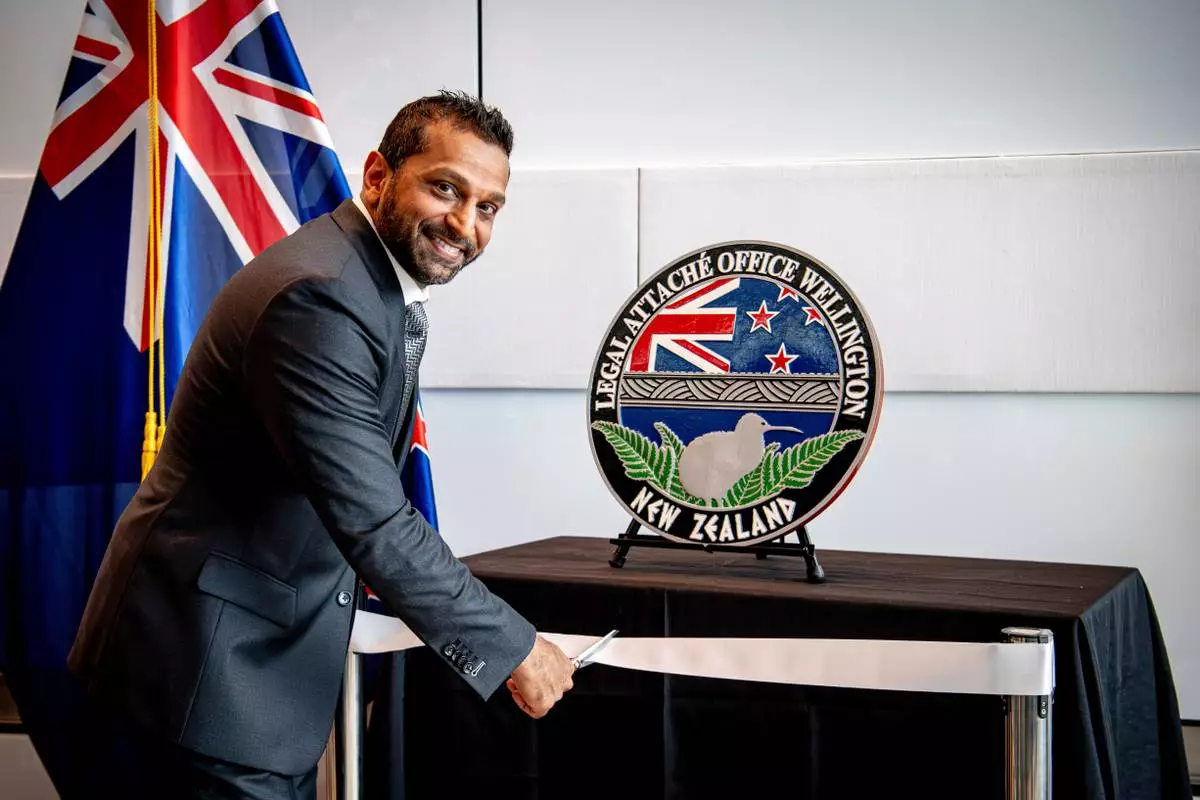
FILE - In this photo released by the U.S. Embassy in Wellington, New Zealand, FBI Director Kash Patel cuts the ribbon at the official opening of the FBI office in Wellington, New Zealand, July 31, 2025. (Ola Thorsen/U.S. Embassy via AP, File)