GREENACRE, Australia, Nov. 26, 2025 /PRNewswire/ -- In 2025, Australia's home battery storage sector has seen explosive growth. Since July, the federal Cheaper Home Batteries Program has driven the installation of around 100,000 household battery systems, delivering over 2 GWh of storage capacity in under four months.
This surge has been fueled by a government-backed discount of around 30% on upfront costs and strong consumer demand. Meanwhile, data from the Clean Energy Regulator shows that validated installations through August 2025 have already reached 43,517 units, amounting to approximately 825 MWh of capacity.
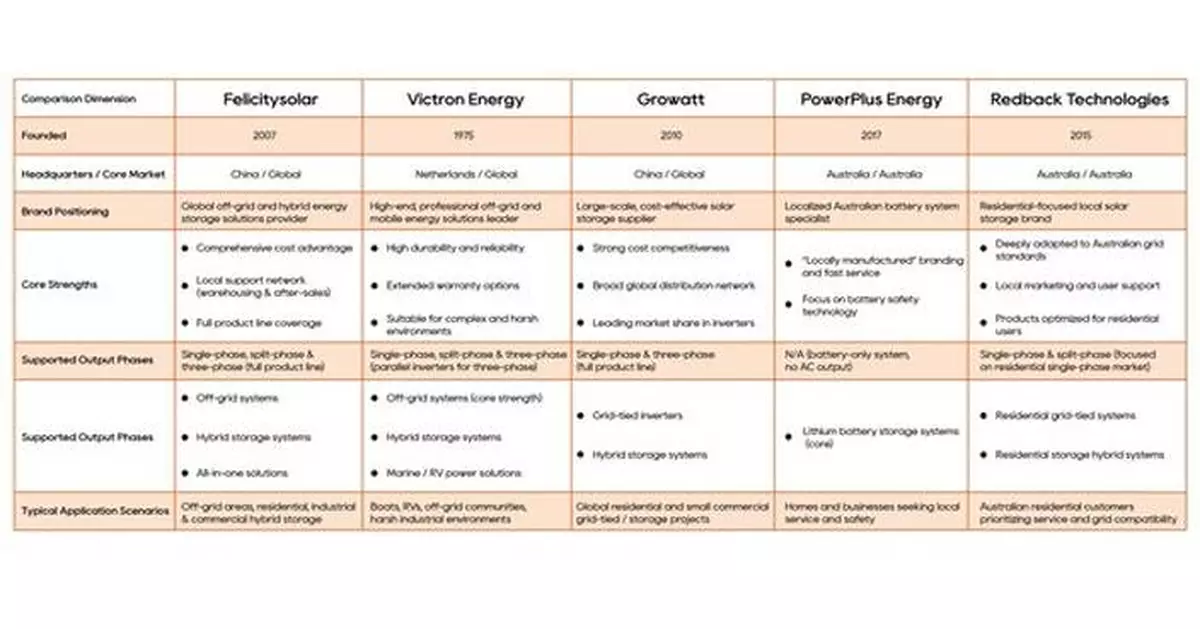
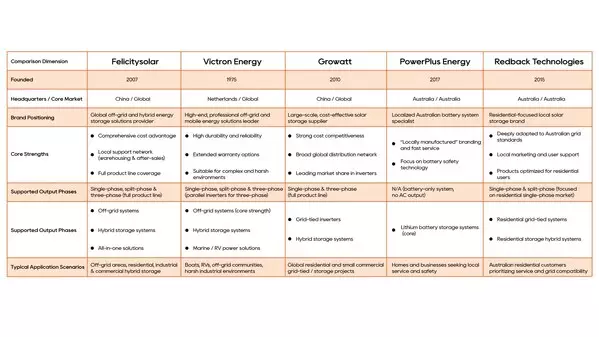
Brand Comparison Overview
When evaluating solar energy storage providers, several global and local brands offer diverse solutions. The following comparison highlights key aspects such as founding year, market focus, brand positioning, core strengths, supported output phases, main solutions, and typical application scenarios for five notable brands: Felicitysolar, Victron Energy, Growatt, PowerPlus Energy, and Redback Technologies.
Key Factors Installers and Distributors Consider
Installers and distributors are the link between products and the market. They typically focus on three critical factors when selecting solar energy storage solutions:
1. Product Reliability
Systems must deliver consistent performance with low failure rates, and be able to adapt to local conditions, such as harsh environment.
2. Profitability
Products should be reasonably priced, allowing distributors and installers sufficient margin to maintain healthy business operations.
3. After-Sales Support
Comprehensive technical training, installation assistance, and guaranteed after-sales service are crucial for long-term customer satisfaction and operational efficiency.
These factors guide distributors and installers in evaluating different brands, complementing considerations such as system type (off-grid, hybrid, all-in-one), output configuration, and application scenarios. Felicitysolar's solutions are designed to meet these requirements, offering reliable performance, competitive pricing, and strong local support networks.
Conclusion
Solar energy storage systems are becoming increasingly common in residential and commercial projects. Providers offer a range of solutions, including off-grid, hybrid, all-in-one, and battery-focused systems. Key factors such as product reliability, service and support networks, supported output configurations, and typical application scenarios differ between brands.
By carefully considering these aspects, installers and distributors can select the most suitable solutions for their customers, ensuring compatibility with local grid conditions, meeting performance expectations, and providing peace of mind through reliable after-sales support.
CONTACT: australian@felicitysolar.com
** The press release content is from PR Newswire. Bastille Post is not involved in its creation. **
A Look at Leading Solar Energy Storage Brands
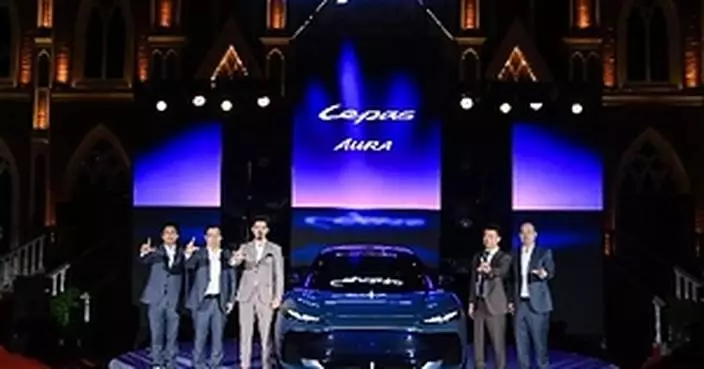
WUHU, China, Oct. 23, 2026 /PRNewswire/ -- On October 22, LEPAS unveiled AURA at Global Elegance Night during the inaugural LEPAS Global Elegant Lifestyle Week, marking the world premiere of the LEPAS Concept Car. Rooted in LEPAS's "Natural Energy" philosophy, the LEPAS All-New Concept Car brings Leopard Aesthetics to life through Future-Inspired Design, combining leopard-inspired proportions, flowing surfaces and lighting with a new family identity and personalization to explore the Future of Elegant Mobility.
Natural Energy, Expressed with Composure
"Elegance is not a matter of decoration, but of composure," said Ivan Dulanović, Chief Designer of LEPAS. AURA expresses elegance, confidence and mystery through its proportions, surfaces and details.
Inspired by the leopard's shifting weight and muscular tension, AURA features a long wheelbase, short overhangs and a wide stance. Pronounced shoulder lines suggest strength, while flowing surfaces and the gaze of the headlamps convey composure and mystery, capturing the understated power of Leopard Aesthetics.
AURA retains LEPAS's porcelain-inspired design, with sculpted volumes, flowing surfaces and a glossy finish balancing strength and refinement. Integrated air channels guide airflow while complementing the body's contours.
A New Design Identity, Made Personal
AURA's new front fascia unites the original rounded grille and side intake areas into a clean black surface. Its signature Leopard headlamps, inspired by the eyes of the leopard, reinforce LEPAS's visual identity. Both features will carry through to future LEPAS models, establishing a consistent family design language.
AURA explores personalization through front-screen graphics, lighting and animations, alongside an elliptical rear screen for customizable taillight displays. Its recognizable silhouette preserves brand identity while adaptable lighting allows individual expression, reflecting LEPAS's philosophy of quiet confidence and living at one's own pace.
Three Colors, Three Expressions of Elegance
Inspired by natural landscapes at different times of day, AURA's three colors capture the warmth of dawn, clarity of midday and mystery of twilight.
Dawn Pearl is inspired by sunrise in Tahiti, where the first light of day casts soft pink tones across the landscape. Inspired by the midday waters of Bacalar Lagoon, Bacalar Blue shifts between deep blue and clear turquoise, giving it a fresh, light feel. Provence Twilight captures the lavender fields at sunset, with deepening blue-violet tones lending the color a sense of mystery.
Together, the colors offer distinct expressions of elegance and more opportunities for personal style.
AURA's distinctive design identity and personalization possibilities will inspire future LEPAS models, bringing new expressions of "Drive Your Elegance" to everyday mobility.
-END-
About LEPAS
LEPAS is Chery Auto's Premium NEV brand, dedicated to creating elegant mobility experiences for users worldwide. Committed to becoming the Preferred Brand for Elegant Mobility Life, LEPAS brings together Leopard Aesthetics, Elegant Technology, and Exquisite Space - transforming elegance into a driving experience you can see, feel, and trust. Supported by a growing global dealer network of more than 500 sales and service outlets, LEPAS is expanding its international footprint through localized operations, delivering products and experiences tailored to users across global markets.
About Chery Auto
Founded in 1997, Chery Auto is a global automotive manufacturer specializing in vehicle development, intelligent technologies, and new energy solutions. The company operates in more than 130 countries and regions, supported by a strong international network of research, production, and strategic partnerships. Chery Auto has remained China's No. 1 passenger vehicle exporter among Chinese brands for 23 consecutive years. Guided by its global philosophy of "In somewhere, For somewhere, Be somewhere," Chery Auto is committed to advancing sustainable mobility through continuous innovation and global collaboration.
** This press release is distributed by PR Newswire through automated distribution system, for which the client assumes full responsibility. **
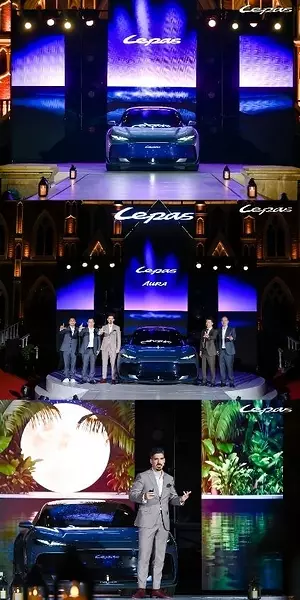
LEPAS AURA Global Premiere at Global Elegance Night: Driving Leopard Aesthetics Evolution with Natural Energy