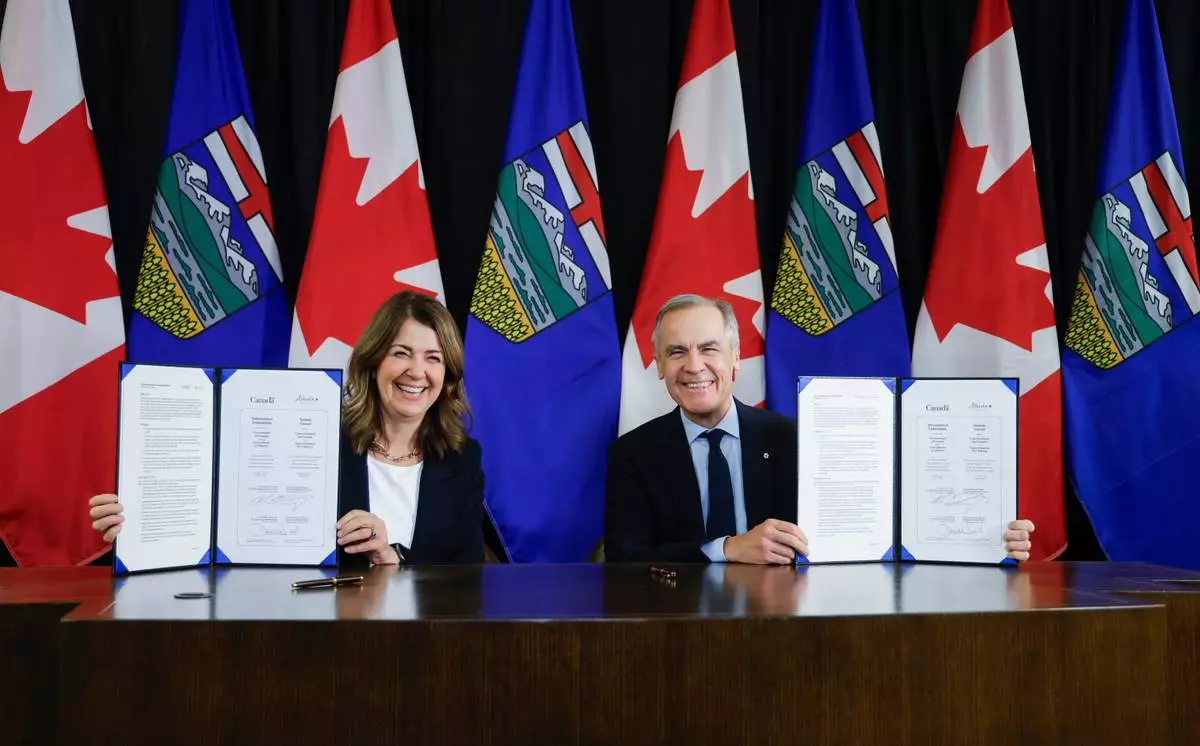
TORONTO (AP) — Canadian Prime Minister Mark Carney and the premier of Canada’s oil rich province of Alberta agreed Thursday to work toward building a pipeline to the Pacific Coast to diversify the country’s oil exports beyond the United States, in a move that has caused turmoil in Carney's inner circle.
The memorandum of understanding includes an adjustment of an oil tanker ban off parts of the British Columbia coast if a pipeline comes to fruition.
Carney’s support for it led to the resignation Thursday of one of his cabinet ministers, Steven Guilbeault, a former environment minister and career environmentalist who has been serving as the minister of culture.
Guilbeault said in a statement he strongly opposes the agreement with Alberta, noting the pipeline could cross the Great Bear Rainforest and that it would increase the risk of a tanker spill on the coast. But he said he understands why Canada needs to remain united and said he will stay on as a Liberal Member of Parliament.
Carney said he was glad Guilbeault is staying as a Liberal lawmaker.
Carney has set a goal for Canada to double its non-U.S. exports in the next decade, saying American tariffs are causing a chill in investment.
Alberta Premier Danielle Smith said the agreement will lead to more than 1 million barrels per day for mainly Asian markets so “our province and our country are no longer dependent on just one customer to buy our most valuable resource.”
Carney reiterated that as the U.S. transforms all of its trading relationships, many of Canada's strengths – based on those close ties to America – have become its vulnerabilities.
“Over 95% of all our energy exports went to the States. This tight interdependence – once a strength – is now a weakness,” Carney said.
Carney said a pipeline can reduce the price discount on current oil sales to U.S. markets.
He called the framework agreement the start of a process.
“We have created some of the necessary conditions for this to happen but there is a lot more work to do,” he said.
Carney said if there is not a private sector proponent there won’t be a pipeline.
The agreement calls on Ottawa and Alberta to engage with British Columbia, where there is fierce opposition to oil tankers off the coast, to advance that province's economic interests.
Former Prime Minister Justin Trudeau approved one controversial pipeline from the Alberta oil sands to the British Columbia coast in 2016 but the federal government had to build and finish construction of it as it faced opposition from environmental and aboriginal groups.
Trudeau at the same time rejected the Northern Gateway project to northwest British Columbia which would have passed through the Great Bear Rainforest. Northern Gateway would have transported 525,000 barrels of oil a day from Alberta’s oil sands to the Pacific to deliver oil to Asia, mainly energy-hungry China.
The northern Alberta region has one of the largest oil reserves in the world, with about 164 billion barrels of proven reserves.
Carney’s announcement comes after British Columbia Premier David Eby said lifting the tanker ban would threaten projects already in development in the region and consensus among coastal First Nations.
Eby said he knows the federal government could impose this pipeline if they wished.
“What this is about is the fact that this project has no company that's advancing it. It's got no money. It's got no coastal First Nations support," he said.
Eby said the agreement is a “distraction” to real projects.
“We have zero interest in co-ownership or economic benefits of a project that has the potential to destroy our way of life and everything we have built on the coast,” Coastal First Nations President Marilyn Slett said.
The agreement pairs the pipeline project a proposed carbon capture project and government officials say the two projects must be built in tandem.
The agreement says Ottawa and Alberta will with work with companies to identify by April 1 new emissions-reduction projects to be rolled out starting in 2027.
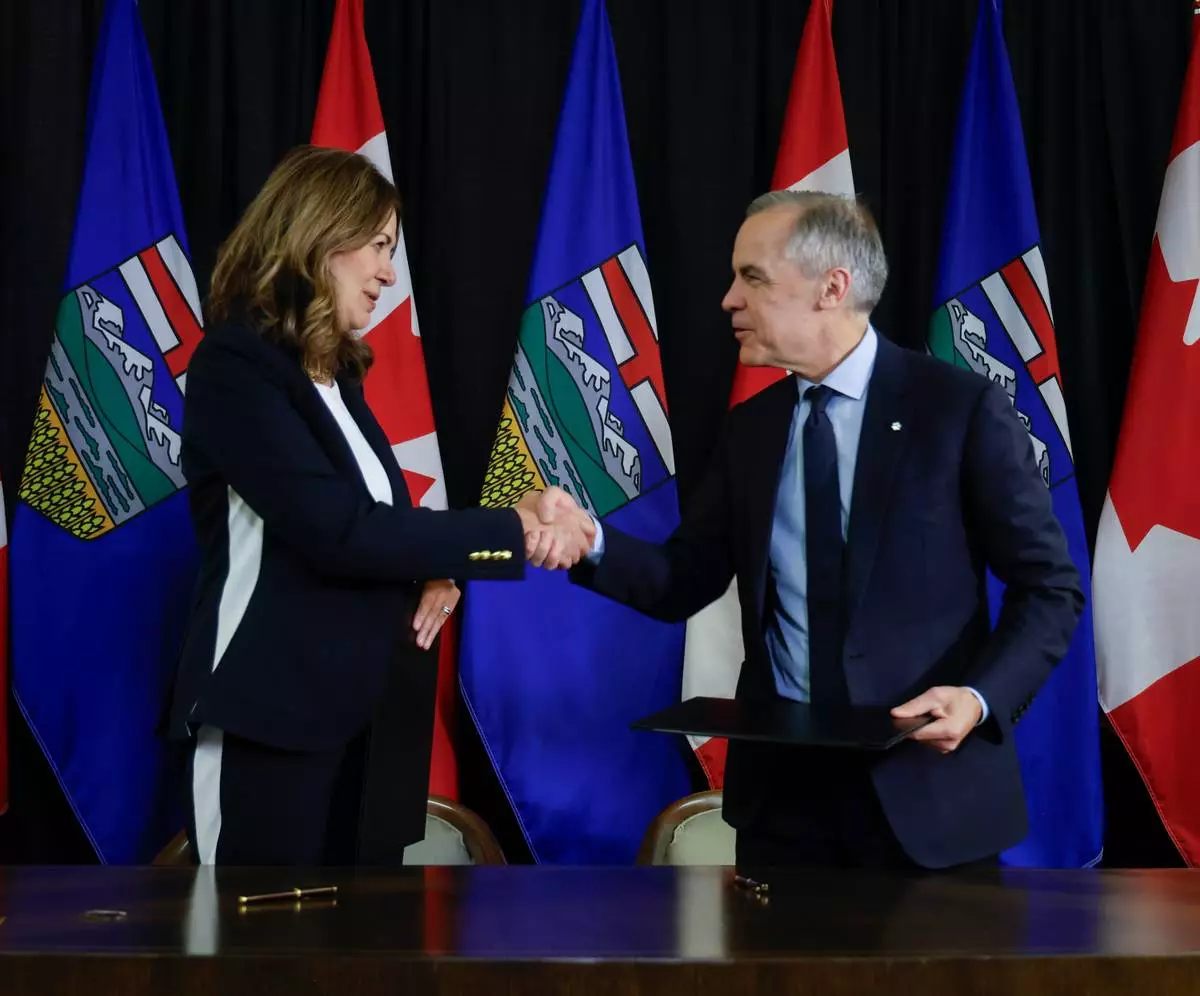
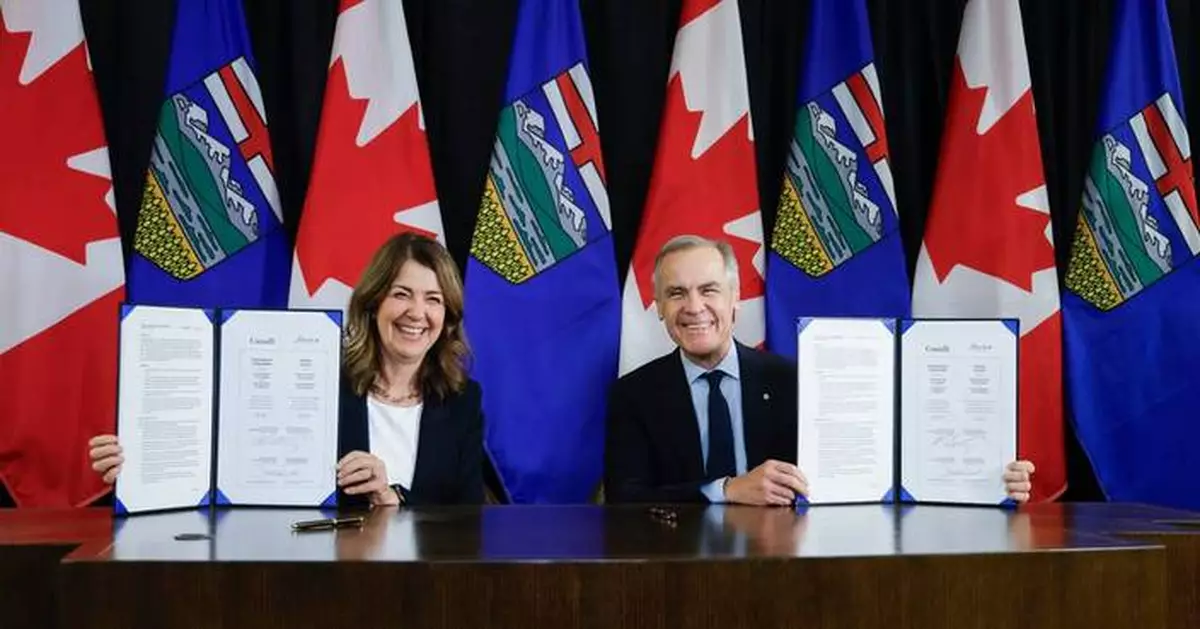
Prime Minister Mark Carney, right, signs an MOU with Alberta Premier Danielle Smith in Calgary, Alta., Thursday, Nov. 27, 2025. (Jeff McIntosh /The Canadian Press via AP)

President Donald Trump’s top Cabinet officials overseeing national security are back on Capitol Hill on Tuesday as questions mount over the swift escalation of U.S. military force and deadly boat strikes in international waters near Venezuela.
Secretary of State Marco Rubio, Defense Secretary Pete Hegseth and others briefed members of the House and the Senate amid congressional investigations into a military strike in September that killed two survivors of an initial attack on a boat allegedly carrying cocaine in the Caribbean. Lawmakers have been examining the Sept. 2 attack as they sift through the rationale for a broader U.S. military buildup in the region that increasingly appears pointed at Venezuela.
Here's the latest:
Prosecutors tried to paint a Milwaukee judge as rudely approaching federal officers, making it more dangerous for them to do their jobs when she helped an immigrant escape authorities trying to arrest him.
The second day of Milwaukee County Circuit Judge Hannah Dugan’s trial Tuesday has focused on her interactions with officers in the courthouse.
FBI agent Phillip Jackling testified he was concerned that his team was divided when Dugan directed agents to speak with the chief judge.
While they were in the judge’s chambers, Jackling and another member of the arrest team testified, the man they came to apprehend walked out of the courtroom. Officers had to chase him down through traffic outside when they could have safely arrested him in the building, they testified.
Dugan’s defense attorneys have suggested that agents could have arrested the suspect at any point.
Bovino, the face of the Trump administration’s immigration crackdown, was photographed Tuesday in the predominantly Mexican American neighborhood of Little Village by the Chicago Sun-Times as neighbors and activists blew whistles and shouted.
Bovino arrived in the Chicago area in September amid Operation Midway Blitz, which has yielded thousands of arrests and fueled fear among immigrant communities. The operation has become known for its aggressive tactics, including the use of chemical munitions and car chases. Bovino left Chicago in November to lead immigration operations in New Orleans and North Carolina.
Rep. Jason Crow of Colorado, a former Army Ranger and part of a group of six lawmakers in a video telling troops to defy unlawful orders, said he questions whether the use of the military is the right response to interdicting drug smugglers in the region.
“I have concerns about mission creep and how this can tumble out of control,” Crow said, “which is exactly why Congress needs to be consulted.”
“This is some exquisite intelligence that supports these actions,” the Republican speaker said.
Johnson gave brief remarks after Rubio and Hegseth spoke to House lawmakers in a classified briefing at the Capitol.
“It is certainly appropriate, it is necessary to protect the United States and our interests,” Johnson said. “That’s what was presented today.”
The speaker acknowledged that lawmakers do have questions about the deadly military campaign, and he said he hopes those are being answered.
Vance says he’s had some “disagreements” with Wiles but agrees with her on most issues.
“I’ve never seen her be disloyal to the president of the United States and that makes her the best White House chief of staff that the president could ask for,” the vice president said in Allentown, Pennsylvania.
“I’ve never seen Susie Wiles say something to the president and then counteract him or say something behind the scenes,” Vance said.
Vance added that he thought the takeaway from the Vanity Fair report was clear: “I hope that the lesson is we should be giving fewer interviews to mainstream media outlets.”
“There’s no doubt in my mind that we have the legal authority to blow up these boats,” said Sen. Lindsey Graham, R-S.C.
Graham, however, said he remains concerned that Maduro will be allowed to remain in power despite the U.S. military build up and show of force in the region.
“If he’s still standing when this is over, this is a fatal major mistake to our standing in the world,” Graham said.
He said he did not get a good answer from the Trump administration officials about “what happens next.”
“We’ll continue to engage with Congress on this,” the secretary of state said after briefing senators and making his way to the House.
Rubio did not mention the boat strikes directly during his public remarks about what he called the “counter-drug mission.”
He said it is “focused on dismantling the infrastructure of these terrorist organizations that are operating in our hemisphere, undermining the security of Americans.”
Rubio said, “This has been a highly successful mission that’s ongoing.”
Democratic Sen. Mark Kelly of Arizona said the Pentagon’s investigation of his remarks to troops about refusing unlawful orders is part of an effort to silence dissent within the ranks.
“This is just about sending a message to retired service members, active duty service members, government employees — do not speak out against this president or there will be consequences,” Kelly told reporters Tuesday.
Kelly went on to say the Defense Department did not notify him of an investigation “because ... what they really care about is the public message.”
The Pentagon confirmed late Monday that Hegseth’s office escalated a preliminary review of Kelly to an official command investigation “for serious allegations of misconduct.”
Command investigations are an incredibly common tool used by military officials to investigate allegations of wrongdoing that don’t rise to the level of criminal charges.
“We are sick of rewarding companies that ship jobs overseas. We’re going to reward companies that build jobs in America, and we’re going to give Americans good wages to do it,” the vice president told supporters at a Uline warehouse in Allentown, Pennsylvania. He was joined by Labor Secretary Lori Chavez-DeRemer and U.S. Rep. Ryan MacKenzie, R-Pa.
Vance touted an “economic comeback” for the U.S. after this week’s Bureau of Labor Statistics’ jobs report found that the U.S. gained 64,000 jobs in November but lost 105,000 in October. The unemployment rate stands at 4.7%, the highest since 2021.
He also denounced Democrats for attacking the administration on issues like inflation and blamed the previous administration for the country’s economic woes. He added that it was unrealistic for critics to assume the administration can “fix these problems in a single day.”
“It takes a little bit of time to fix something that was so fundamentally broken,” Vance told the crowd.
The Democratic senator from California said he’ll be making a request on the floor of the Senate to unanimously release the boat strike video to the full Congress, and the American people.
“The public should see this,” Schiff said after the closed-door briefing.
He said he found the administration’s “legal explanations and the strategy explanations incoherent.”
He says members of the House and Senate Armed Services Committee would have an opportunity this week to review the video, but did not say whether all members of Congress would be allowed to see it, even as a defense policy bill demands that it be released to Congress.
“Of course we’re not going to release a top secret, full, unedited video of that to the general public,” Hegseth told reporters as he exited a closed-door briefing with senators.
Defense Secretary Pete Hegseth says the Pentagon will release to select lawmakers the full, unedited video of a Sept. 2 second military strike on an alleged Venezuelan drug boat in the Caribbean that’s been criticized because of a second-hit on the boat that killed two survivors of the original attack.
After briefing senators with Secretary of State Marco Rubio on the latest developments in the Trump administration’s operations against narco-traffickers on Tuesday, Hegseth said the video would made available Wednesday to the Senate and House Armed Services Committees along with commentary from the Navy admiral who greenlit the strike. However, he said the video remains classified and would not be released to the general public or lawmakers without a role in Pentagon oversight.
“We’re proud of what we’re doing, able to lay it out very directly,” he said.
Rubio said similar operations — there have now been 22 since the first on Sept. 2 — had been “highly successful” and would continue.
The Senate Democratic leader said Hegseth rebuffed his demand to make the unedited video of the Sept. 2 boat strike available to all senators, with an appropriate version available to the broader public.
“If they can’t be transparent on this, how can you trust their transparency on all the other issues swirling about in the Caribbean?” Sen. Chuck Schumer asked. “The administration came to this briefing empty handed.”
Schumer said he’s seen the video of the follow-on boat strike that killed survivors.
“I saw it,” Schumer said. “It was deeply troubling.”
The designation imposes sanctions on the group and its members and opens the door to potential military or other action against it.
The State Department said Tuesday that the Colombia-based Clan del Golfo had been listed as both a foreign terrorist organization and a specially designated global terrorist group, calling it “a violent and powerful criminal organization with thousands of members.”
“The group’s primary source of income is cocaine trafficking, which it uses to fund its violent activities. Clan del Golfo is responsible for terrorist attacks against public officials, law enforcement and military personnel, and civilians in Colombia,” the department said.
Since taking office in January, the administration has made similar designations for at least 13 groups in Latin America, including the similarly named Cartel del Golfo, and launched military strikes against more than 20 alleged narcotics transporting vessels.
As of 10:45 a.m. in Washington, Trump had not weighed in on the explosive Vanity Fair piece featuring White House chief of staff Susie Wiles, even as West Wing figures defended her.
Wiles herself called the two-part magazine profile, which featured months of her candid interviews, a “hit piece.” She did not deny anything specific, including quotations attributed to her.
Press secretary Karoline Leavitt followed with a defense, as did Russell Vought, the chief White House budget office who’s shaping Trump’s remake of the federal government.
Vought on social media called Wiles “an exceptional chief of staff” and said Trump’s West Wing through two presidencies has “never worked this well or been more oriented towards accomplishing what he wants to.”
In Vanity Fair, Wiles described Vought as a “right-wing absolute zealot,” while praising him and several other hardline Trump lieutenants.
Susie Wiles sharply criticized Attorney General Pam Bondi’s handling of the Epstein case and the public’s expectations in the interview with Vanity Fair magazine that was released Tuesday.
Wiles specifically mentioned earlier in the year when Bondi distributed binders to a group of political commentators that included no new information about Epstein. Wiles also raised the issue of Bondi suggesting that a list of Epstein’s clients was on her desk and awaiting her review.
“I think she completely whiffed on appreciating that that was the very targeted group that cared about this,” Wiles said of Bondi. “First she gave them binders full of nothingness. And then she said that the witness list, or the client list, was on her desk. There is no client list, and it sure as hell wasn’t on her desk.”
After Vanity Fair published the interview, Wiles criticized it as a “disingenuously framed hit piece” on her, Trump, the White House staff and Cabinet. She did not deny any of the comments that were attributed to her.
Trump doesn’t drink. But Susie Wiles, according to Vanity Fair magazine, says the president has “an alcoholic’s personality.”
It’s among the many unvarnished thoughts attributed to Wiles in a series of interviews Vanity Fair featured Tuesday in a lengthy two-part profile of the White House chief of staff.
Wiles has called the profile a “hit piece” but has not denied any specifics.
In one interview, Wiles says she recognizes characteristics in Trump that she saw in her father, sports broadcaster Pat Summerall, who was an alcoholic.
“High-functioning alcoholics or alcoholics in general, their personalities are exaggerated when they drink. And so I’m a little bit of an expert in big personalities,” Wiles said, adding that Trump has “a view that there’s nothing he can’t do. Nothing, zero, nothing.”
White House press secretary Karoline Leavitt is defending chief of staff Susie Wiles after an explosive Vanity Fair piece that featured months of Wiles’ interviews with the magazine about Trump and his second presidency.
Neither Wiles nor Leavitt are denying any specific claims or quotations in the piece. But their pushback shows an effort to blunt potential criticism of Wiles, who to this point has maintained a low profile despite her considerable influence.
“President Trump has no greater or more loyal advisor than Susie,” Leavitt posted Tuesday on social media. “The entire Administration is grateful for her steady leadership.”
Wiles managed Trump’s 2024 campaign and then he tapped her as the first woman to serve as White House chief of staff.
Prosecutors are trying to convince jurors that Milwaukee County Circuit Judge Hannah Dugan knew what was at stake when she directed an immigrant to a private door in the courthouse to evade agents.
Jurors on Monday heard audio from the incident in which Judge Dugan told her court reporter, “I’ll get the heat,” as they discussed who would assist Eduardo Flores-Ruiz.
The prosecution continued its case Tuesday with cross examination of an FBI agent who was part of the arrest team.
White House Chief of Staff Susie Wiles is blasting a Vanity Fair piece that featured months of interviews about Donald Trump and his second presidency.
Wiles, in a social media post, called the two-part profile “a disingenuously framed hit piece on me and the finest President, White House staff, and Cabinet in history.” Wiles did not deny any specific quotations attributed to her, including criticism of Attorney General Pam Bondi, calling Health Secretary Robert F. Kennedy “quirky Bobby,” and saying Trump has “an alcoholic’s personality.” (The president does not drink.)
“Significant context was disregarded and much of what I, and others, said about the team and the President was left out,” Wiles asserted without details.
The first woman to serve as White House chief of staff, Wiles previously has kept a low profile despite her considerable influence.
The United States gained a decent 64,000 jobs in November but lost 105,000 in October as federal workers departed after cutbacks by the Trump administration, the government said Tuesday in delayed reports. And the unemployment rate rose to 4.6%, highest since 2021.
Hiring has clearly lost momentum, hobbled by uncertainty over Trump’s tariffs and the lingering effects of high interest rates the Federal Reserve engineered in 2022 and 2023 to rein in inflation.
American companies are mostly holding onto the employees they have. But they’re reluctant to hire new ones as they struggle to assess how to use artificial intelligence and how to adjust to Trump’s unpredictable policies, especially his double-digit taxes on imports from around the world.
▶ Read more about how the uncertainty leaves jobseekers struggling to even land interviews
The Ukrainian president says proposals being negotiated with U.S. officials for a deal to end the fighting in Russia’s nearly 4-year-old invasion of his country could be finalized within days, after which American envoys will present them to the Kremlin before possible further meetings in the U.S. next weekend.
A draft peace plan discussed with the U.S. during talks in Berlin on Monday is “not perfect” but is “very workable,” Volodymyr Zelenskyy told reporters, while cautioning that some key issues — notably what happens to Ukrainian territory occupied by Russian forces — remain unresolved.
But as the spotlight shifts to Moscow, Russian President Vladimir Putin may balk at some of the proposals thrashed out by officials from Washington, Kyiv and Western Europe, including postwar security guarantees for Ukraine.
The security proposal discussed in Berlin will be based on Western help in keeping the Ukrainian army strong, an official from a NATO nation said, speaking on condition of anonymity to discuss sensitive matters.
“Europeans will lead a multinational and multi-domain force to strengthen those troops and to secure Ukraine from the land, sea and air, and the U.S. will lead a ceasefire monitoring and verification mechanism, with international participation,” the official said.
Kremlin spokesman Dmitry Peskov repeated Tuesday that Russia wants a comprehensive peace deal, and that if Ukraine seeks “momentary, unsustainable solutions, we are unlikely to be ready to participate.”
“We want peace — we don’t want a truce that would give Ukraine a respite and prepare for the continuation of the war,” he told reporters. “We want to stop this war, achieve our goals, secure our interests, and guarantee peace in Europe for the future.”
“It seems like another example of the pay-to-play administration,” said Kedric Payne, who leads the ethics program at the nonpartisan Campaign Legal Center in Washington. “There is clearly a perception that in order to get favorable policies and acts from the administration, a company needs to provide a financial benefit to the president.”
Trump Media did not respond to specific questions about the arrangement. “Neither the President nor his family have ever engaged, or will ever engage, in conflicts of interest,” White House press secretary Karoline Leavitt said in a statement.
Crypto.com was under siege for more a year, told enforcement action was likely as part of an aggressive Biden administration push to regulate the cryptocurrency industry. Then Donald Trump won the 2024 election, and the company’s legal peril dissipated.
By August, Crypto.com announced it was plunging roughly $1 billion worth of assets into a venture with a new partner — Trump’s social media company, which had lost hundreds of millions of dollars since its 2021 launch.
Legal and ethics experts say Crypto.com’s journey from investigative target to Trump business partner provides a case study of conflicts of interest as Trump family businesses enter lucrative arrangements with federally regulated companies, some of which have benefited from action taken by his administration.
▶ Read more from the AP investigation into Trump’s relationship with Crypto.com
Hegseth, Rubio and others are set to brief members of the House and the Senate behind closed doors as the U.S. is building up its presence with warships, flying fighter jets near Venezuelan airspace and seizing an oil tanker as part of its campaign against Venezuelan President Nicolás Maduro, who has insisted the real purpose of the U.S. military operations is to force him from office.
Trump’s Republican administration has not sought any authorization from Congress for action against Venezuela. But lawmakers objecting to the military incursions are pushing war powers resolutions toward potential voting this week.
▶ Read more about the briefing
The Trump administration said in a court filing Monday that the president’s White House ballroom construction project must continue for unexplained national security reasons and because a preservationists’ organization that wants it stopped has no standing to sue.
The filing was in response to a lawsuit filed last Friday by the National Trust for Historic Preservation asking a federal judge to halt President Donald Trump’s project until it goes through multiple independent reviews and a public comment period and wins approval from Congress.
The administration’s 36-page filing included a declaration from Matthew C. Quinn, deputy director of the U.S. Secret Service, the agency responsible for the security of the president and other high-ranking officials, that said more work on the site of the former White House East Wing is still needed to meet the agency’s “safety and security requirements.” The filing did not explain the specific national security concerns; the administration has offered to share classified details with the judge in a private, in-person setting without the plaintiffs present.
▶ Read more about the court filing
Here’s a look at key moments in Trump fights with the media in his second term:
The 33-page lawsuit filed in Florida accuses the BBC of broadcasting a “false, defamatory, deceptive, disparaging, inflammatory, and malicious depiction of President Trump,” calling it “ a brazen attempt to interfere in and influence ” the 2024 U.S. presidential election.
It accuses the BBC of “splicing together two entirely separate parts of President Trump’s speech on January 6, 2021” in order to ”intentionally misrepresent the meaning of what President Trump said.” It seeks $5 billion in damages for defamation and $5 billion for unfair trade practices.
The broadcaster apologized last month to Trump over the edit of the speech he gave before his supporters stormed the U.S. Capitol. But the publicly funded BBC rejected claims it had defamed him, after Trump threatened legal action.
BBC chairman Samir Shah had called the edit an “error of judgment,” which triggered the resignations of the BBC’s top executive and its head of news.
▶ Read more about the lawsuit
Secretary of State Marco Rubio arrives to brief members of Congress on military strikes near Venezuela, Tuesday, Dec. 16, 2025, at the Capitol in Washington. (AP Photo/Julia Demaree Nikhinson)
Defense Secretary Pete Hegseth arrives to brief members of Congress on military strikes near Venezuela, Tuesday, Dec. 16, 2025, at the Capitol in Washington. (AP Photo/Julia Demaree Nikhinson)
President Donald Trump speaks during a Mexican Border Defense Medal presentation in the Oval Office of the White House, Monday, Dec. 15, 2025, in Washington, as Defense Secretary Pete Hegseth, looks on. (AP Photo/Alex Brandon)