Skip to Content Facebook Feature Image

Int’l experts at Shanghai forum urge stronger green, digital cooperation

China

China

China

Int’l experts at Shanghai forum urge stronger green, digital cooperation

2025-12-01 00:45 Last Updated At:03:17

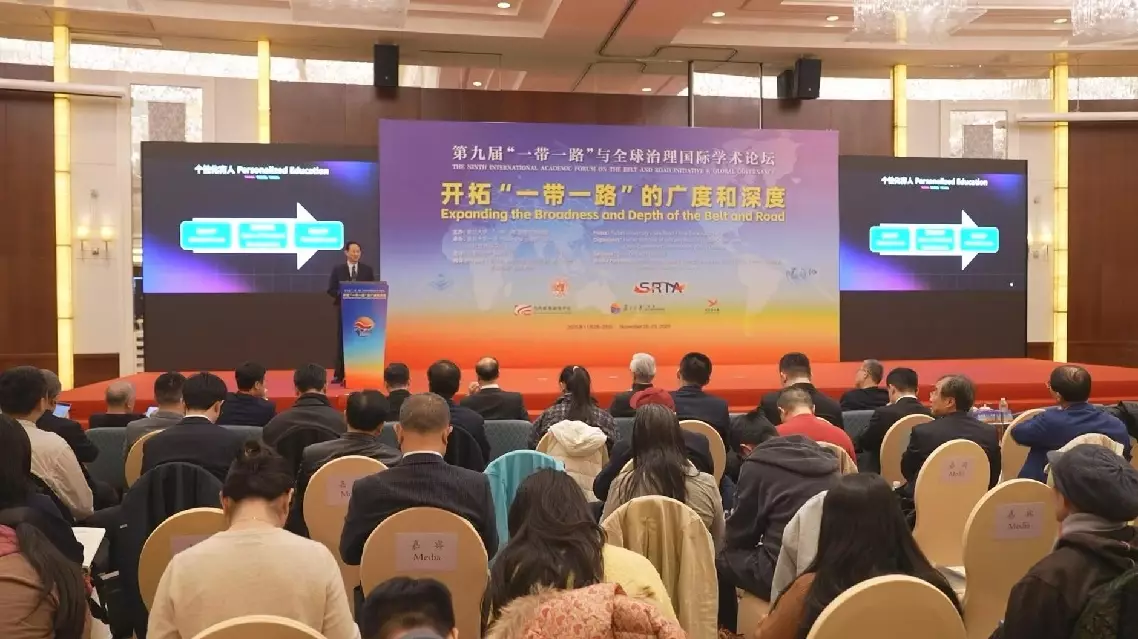
Top government officials, international experts and scholars gathered in Shanghai on Friday and Saturday for the ninth International Academic Forum on the Belt and Road Initiative and Global Governance, calling for stronger green and digital cooperation.

The two-day forum, co-hosted by Fudan University and the Silk Road Think Tank Association, focused on the challenges and progress of China's flagship development initiative.

Discussions covered a wide range of topics, including green development, the digital economy, artificial intelligence and global governance. The program also featured an entrepreneurs' session and roundtable discussions on Global South cooperation and international law.

Erik Solheim, former executive director of the U.N. Environment Programme and former U.N. undersecretary-general, called for greater efforts to support developing economies in both green and digital transitions.

"We need more green investment in railroads, and in solar and wind and hydropower. We need more of the same, and we also need a shift -- and that's the shift to the digital economy. Most developing nations are very poor in artificial intelligence. China can help them build their digital infrastructure, but also the software for this, the understanding, the competence of the digital economy. China is now totally dominant in green economics; 60 percent of everything green is happening in China. Then you also need to see their digital economy, and they want to see what President Xi calls 'small and beautiful' projects, like cultural heritage, health, education, sports -- all these," he said.

Liu Zhiqin, a senior fellow at the Chongyang Institute for Financial Studies at Renmin University of China, emphasized the need to maintain momentum and trust among Belt and Road partners.

"Over the next decade, it will be crucial to deepen mutual trust and keep the Belt and Road Initiative 'fresh' and appealing, as it is significant to keep the BRI appealing, dynamic, and full of expectations. Second, we must ensure that the BRI genuinely delivers tangible benefits to member countries and their people," he said.
Int’l experts at Shanghai forum urge stronger green, digital cooperation


Int’l experts at Shanghai forum urge stronger green, digital cooperation
Japan's reliance on U.S. economic policy is allowing foreign funds to acquire Japanese assets at bargain prices, according to Japanese economist Kazuhide Uekusa.

He warned that the government's economic and defense strategies prioritize foreign capital and political profits over public welfare, failing to bring true prosperity to ordinary citizens.

The Bank of Japan (BOJ) on Friday raised its policy interest rate by 0.25 percentage points to 1.25 percent, the highest in about 31 years, following a two-day board meeting.

According to Uekusa, the timing of the shift aligns perfectly with the interests of large American funds.

"The Takaichi Cabinet has been reluctant to raise interest rates, thus allowing the yen to continue to depreciate. I think this is actually equivalent to helping foreign capital purchase Japanese assets at a low price. However, U.S. Treasury Secretary Scott Bessent has recently made a clear adjustment to the policy direction of the U.S. dollar against the Japanese yen, promoting the appreciation of the Japanese yen. The reason is that some large funds in the United States have basically completed their investment layout in Japanese assets," said Uekusa.

Uekusa also said Japan cannot attempt to revitalize its economy by expanding military spending and supporting the defense industry, and such a military buildup strategy is unlikely to bring about true prosperity and stability.

"I think it is true that the Japanese economy has been stagnant for a long time. However, to expand military spending in an attempt to revitalize the economy is, in my opinion, an extremely foolish and even crazy move. To achieve peace and stability in Japan, the foundation should be to establish friendly relations with neighboring countries rather than military expansion. The reason why the Japanese government attaches so much importance to the military industry is that it can generate huge profits, and a part of these profits may flow back to political parties or political figures through various means. I don't think this is at all for the benefit of the people," he said.

Japanese economist criticizes gov't policies for enabling cheap asset sales to foreign funds

Japanese economist criticizes gov't policies for enabling cheap asset sales to foreign funds

Recommended Articles