Artificial intelligence (AI) is unlocking the potential of China's fast-growing silver economy, with innovations designed to turn the daily challenges of the elderly into enjoyable experiences.
China's Ministry of Industry and Information Technology and five other departments released an action plan on Wednesday, mapping out key measures to better align the supply and demand for consumer goods and further stimulate consumption.
By 2027, the supply structure of consumer goods is expected to be significantly optimized, with three trillion-yuan (about 141.25 billion U.S. dollars) consumption sectors and ten 100-billion-yuan consumption hotspots formed, according to the plan.
The market size of China's elderly products sector has already expanded from 2.6 trillion yuan in 2014 to 5.4 trillion yuan in 2024, posting an annual compound growth rate of 7.3 percent as seniors shift from basic needs to higher-quality lifestyles.
In Hangzhou Banshan National Forest Park, east China's Zhejiang Province, 70-year-old local resident surnamed Zhang is among the growing number of seniors embracing a cutting-edge wearable device, designed to assist with climbing.
He tried an exoskeleton robot available for rent at the park entrance. The lightweight device provides pulling force to the legs, reducing physical exertion by around 30 percent during hill climbs.
"It doesn't take much effort at all, and I don't feel tired. My legs feel very relaxed," said Zhang.
"Technological development must truly integrate with the real needs of the elderly and start from their pain points. Our products and services can be technologically advanced, but must be easily operated, so that seniors can easily use them," said Zhang Xiumei, deputy director of the Institute of Public Policy at Zhejiang Academy of Social Sciences.
At a lab in Hangzhou, engineers are putting the finishing touches on an upgraded smart wheelchair designed for people with limited mobility. Equipped with depth-sensing cameras, a robotic arm, and advanced AI algorithms, the wheelchair allows users to navigate simply by voicing their destination while seated.
"We have gone through 11 rounds of iterative upgrades in total. We have also added a screen to enable object grabbing through touch control," said Guo Hangsheng, staff member at a service robot company.
In the city of Ningbo, Zhejiang Province, local authorities are promoting an AI-enabled elderly care system for solitary elderly people that can remind them to take their medications on schedule and engage in natural, responsive conversations to help reduce loneliness.
A portable bathing machine has been introduced in Wenzhou City in the province, enabling bedridden elderly people to enjoy a comfortable bath without needing a professional caregiver.
Acceptance of smart devices among China's elderly is rising fast with 68.2 percent of those aged between 60 and 75 regularly using intelligent equipment.
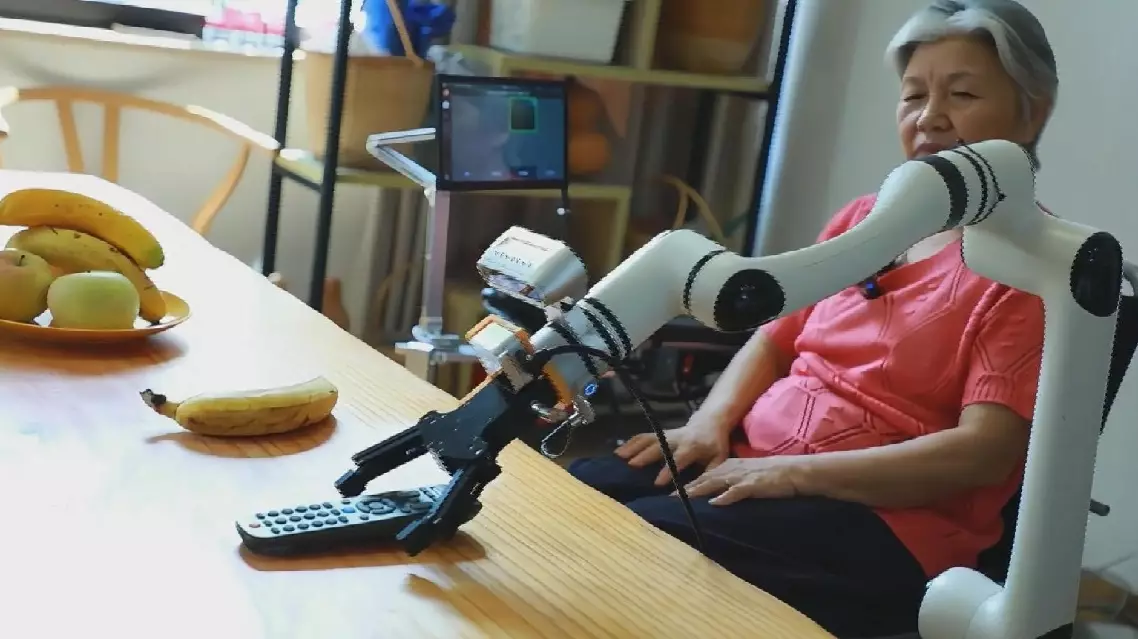
AI-powered innovations unlock new potential in China's silver economy