Speech by DSJ at 6th UNCITRAL Asia Pacific Judicial Summit 2025 - Judicial Conference (with photo/video)
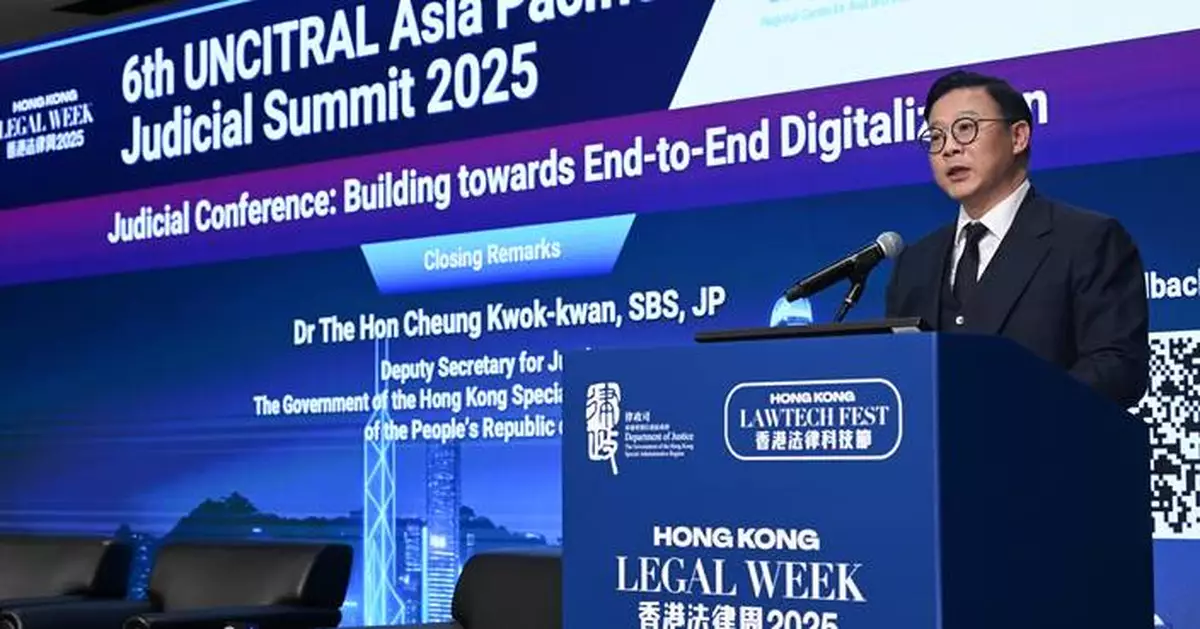
Following are the closing remarks by the Deputy Secretary for Justice, Dr Cheung Kwok-kwan, at the 6th UNCITRAL Asia Pacific Judicial Summit 2025 - Judicial Conference under Hong Kong Legal Week 2025 today (December 1):
Your excellencies, distinguished guests, ladies and gentlemen,
The conclusion of today's conference jointly organised by the UNCITRAL (United Nations Commission on International Trade Law) and the Hong Kong International Legal Talents Training Academy of the Department of Justice of the Hong Kong Special Administrative Region Government, marks a major milestone in advancing global legal co-operation and the exchange of expertise in the realm of digitalisation of trade. The insightful discussions throughout the day have offered meaningful perspectives, and set the stage for continuous engagement among members of the judiciary, government officials, legal specialists, practitioners, and stakeholders. These positive outcomes will foster continued professional interaction and constructive dialogues in the times ahead.
Centred on the theme "Building Towards End-to-End Digitalisation", today's sessions have demonstrated our collective dedication to facilitating and harmonising the seamless digitalisation of trade transactions.
Digitalisation of trade finance and digital assets
Our first panel today explored the intersection between virtual assets and existing commercial and financial legal frameworks, with a particular focus on how virtual assets intersect with existing legal systems. The discussion highlighted evolving legislative frameworks from different jurisdictions designed to address the unique characteristics and challenges posed by these assets. Several legal instruments including the UNCITRAL, UNIDROIT (International Institute for the Unification of Private Law) Model Law on Warehouse Receipts and key initiatives of the Hague Conference on Private International Law supporting digitalisation were explored, with the aim to ensure that digital assets are governed by predictable and interoperable conflict-of-laws rules worldwide.
The panel devoted particular attention to enforcement aspects, emphasising how courts and regulatory bodies are adapting to the complexities posed by digital asset transactions and related disputes. Financial implications also formed an important part of the dialogue, highlighting the increasing prominence of virtual assets in the broader financial ecosystem.
These legislative framework, enforcement, and financial initiatives signify a concerted move towards a harmonised, innovation-friendly legal environment that supports the seamless digitalisation of trade and finance, ensuring these emerging assets are effectively incorporated into the global legal and economic landscape.
Enabling paperless trade – The UNCITRAL Model Law on Electronic Transferable Records
Panel 2 provided a detailed overview of the UNCITRAL Model Law on Electronic Transferable Records (MLETR), highlighting its crucial role in enabling the transition to paperless trade. The MLETR has garnered attention across the region, where an increasing number of jurisdictions, including Hong Kong, are actively exploring legislative amendments to adopt the UNCITRAL Model Law.
This panel discussed how this legislative advancement supports the broader trade digitalisation agenda, particularly benefiting micro, small and medium-sized enterprises by simplifying cross-border transactions and reducing reliance on cumbersome physical documentation. The panel also examined key provisions of the MLETR and implementation challenges, noting its interaction with foundational UNCITRAL instruments such as the Model Law on Electronic Commerce to create a cohesive legal framework for electronic transactions.
Additionally, the emerging case law interpreting UNCITRAL texts was reviewed, illustrating how judicial approaches increasingly integrate both legal reasoning and technological understanding. This evolving jurisprudence reflects a judicial readiness to oversee complex digital transactions, balancing legal certainty with technological innovation.
As outlined in the Chief Executive's Policy Address this year, legislative proposal will be introduced in 2026 in Hong Kong to provide legal basis for the digitalisation of business-to-business trade documents with reference to the MLETR and experiences from other common law jurisdictions. Hong Kong, as an international trade centre and an international innovation and technology centre, is developing a more streamlined, paperless trading environment. This advancement will enhance the validity of digital trade flows, mitigate risks, and accelerate cross-border transactions. Hong Kong's dedication to embracing the MLETR highlights our determination to remain at the forefront of global trade innovation, and to support businesses in seizing new opportunities in the digital age.
Digital transformation in transport – the Draft United Nations Convention on Negotiable Cargo Documents
Panel 3 examined the recently approved draft United Nations Convention on Negotiable Cargo Documents, which has been recommended for adoption by the United Nations General Assembly. This groundbreaking convention fills a crucial legal gap in international trade by creating a harmonised legal framework for negotiable documents of title applicable across all modes of transport - air, road, rail, and sea - regardless of the multimodal journey involved.
This panel provided an overview of how this harmonised framework addresses inconsistencies and legal voids in various domestic laws, fostering greater certainty and uniformity in the recognition and transfer of negotiable cargo documents. This panel also discussed how the draft Convention interacts with the existing international treaties, ensuring it complements rather than conflicts with current legal regimes.
A significant portion of the dialogue focused on the practical opportunities and challenges this draft Convention presents for the domestic implementation. Panelists discussed pilot projects testing the draft Convention's provisions in real-world scenarios, highlighting potential legal issues such as transport operator liability, interoperability of electronic negotiable documents, and the need for clear regulations on electronic document issuance and transfer.
The draft Convention stands to transform and modernise international trade by unlocking trade finance, enhancing supply chain efficiency, and enabling seamless door-to-door logistics. It represents a landmark step towards fully digitised, integrated global trade supported by robust, harmonised legal foundations.
Current trends of dispute resolution in the digital economy
Our final panel today focused on the ongoing exploratory work under UNCITRAL's Dispute Resolution in the Digital Economy project, which addresses the impact of emerging technologies on dispute resolution mechanisms. This includes an in-depth examination of how artificial intelligence (AI) and lawtech are reshaping the landscape of dispute resolution.
This panel explored the latest capabilities of AI technology in supporting arbitration, mediation, and other dispute resolution processes, highlighting both its transformative potential and current technical limitations. The discussion emphasised how AI can augment, rather than replace, human judgment, enhancing case management, predicting outcomes, and improving access to justice, while recognising that responsible use requires robust safeguards.
A key focus was the development of procedural guidelines for remote hearings in arbitration and mediation, an area of growing importance given the increased reliance on digital platforms. Panelists evaluated platform-based dispute resolution mechanisms, which leverage technology to facilitate cost-effective and timely resolution of disputes, particularly in cross-border and e-commerce contexts.
The responsible deployment of AI technology for dispute resolution was extensively discussed, including how existing regulatory regimes are adapting to monitor and mitigate risks such as data security, and ethical concerns.
This panel serves as a vital starting point, opening the door for the insightful discussions of the Judicial Roundtable tomorrow, as well as Day 5 of the Hong Kong Legal Week under the theme "The AI Era: Shaping the Legal Landscape in the 21st Century". It sets the stage for a more in-depth exploration of how AI and related technologies will continue to transform the legal profession, dispute resolution processes, and the broader justice ecosystem in the years to come.
Hong Kong International Legal Talents Training Academy
Before closing, I would like to commend the Hong Kong International Legal Talents Training Academy for their collaboration with UNCITRAL. Since its launch last November during the Hong Kong Legal Week 2024, the Academy has organised numerous training programmes in Hong Kong, the Chinese Mainland and abroad, covering a diverse range of topics and targeting a wide spectrum of participants. Through collaboration with international organisations and governmental bodies, the Academy plays a vital role in fostering the exchanges of international legal talents through capacity building programmes, strengthening Hong Kong's strategic position as an international legal and dispute resolution services centre in the Asia-Pacific region, establishing Hong Kong as a capacity-building hub, and actively participating in the next decade of the Belt and Road Initiative, contributing to our country's efforts to promote the construction of the rule of law. I wish to express my gratitude to UNICITRAL for the support to the Academy so far, and the ongoing engagement and continue collaboration with the Academy in the years to come.
Ladies and gentlemen, as it comes to the conclusion of the Judicial Conference of the 6th UNCITRAL Asia Pacific Judicial Summit 2025. We must thank colleagues of UNICITRAL, our colleagues at the Department of Justice, and all the distinguished judges, speakers, moderators, and participants who have joined us from across the globe. While the Judicial Conference wrapped up and so the first day of the Hong Kong Legal Week 2025, there is a diverse range of events that we have arranged for the remainder of this week. To our esteemed judges, we will see you at the Judicial Roundtable tomorrow morning for continued dialogues and meaningful exchanges. For all other participants, we also anticipate your presence at the Third Legal Forum on Interconnectivity and Development tomorrow afternoon, as well as many other enriching sessions that await us throughout this week.
Thank you once again for your participation and contribution today. Thank you.
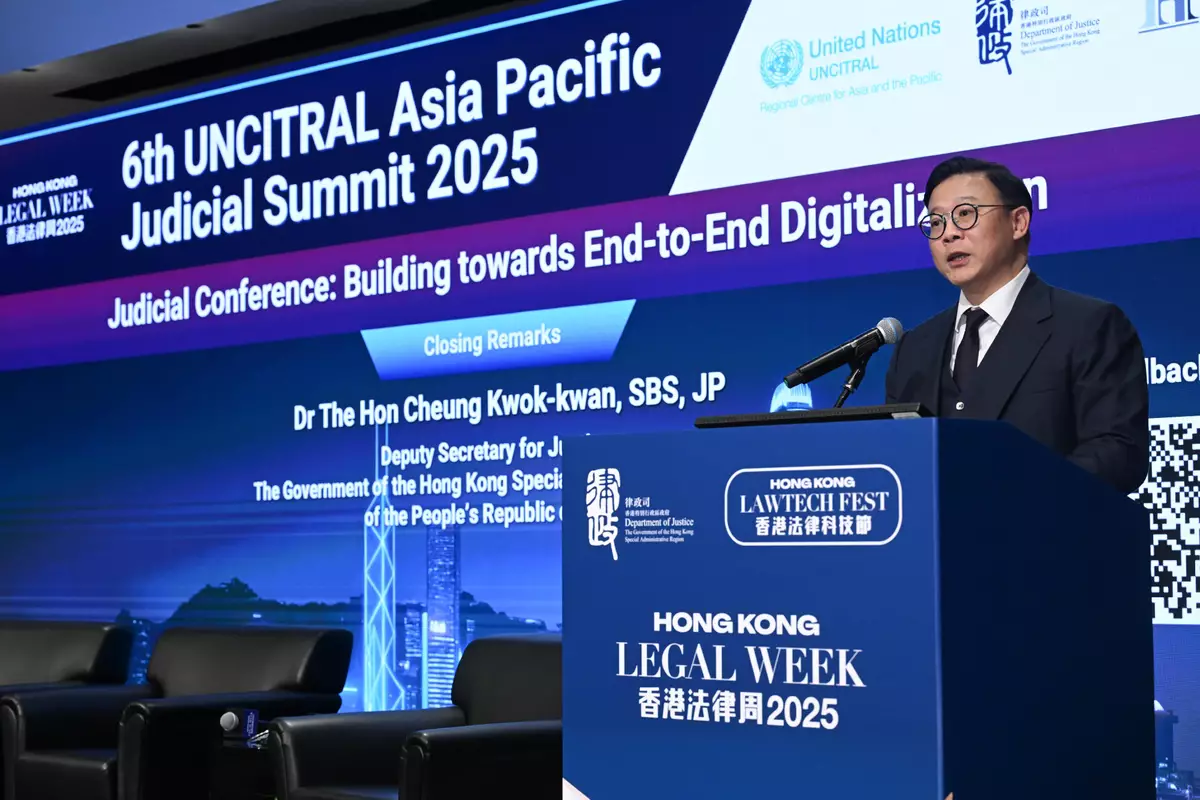
Speech by DSJ at 6th UNCITRAL Asia Pacific Judicial Summit 2025 - Judicial Conference Source: HKSAR Government Press Releases