SAINT-MARC, Haiti (AP) — Heavily armed gangs attacked Haiti’s central region over the weekend, killing men, women and children as they set fire to homes and forced survivors to flee into the darkness.
Police made emergency calls for backup, asserting that 50% of the Artibonite region had fallen under gang control after the large-scale attacks targeting towns including Bercy and Pont-Sondé.
“The population cannot live, cannot work, cannot move,” one of Haiti’s police unions, SPNH-17, said Sunday on X. “Losing the country’s 2 largest departments – West and Artibonite – is the greatest security failure in modern Haitian history.”
The bulk of Haiti’s police force and the Kenyan officers leading a U.N.-backed mission to help repel gangs are in the capital, Port-au-Prince, which itself is largely held by gangs.
Guerby Simeus, a Pont-Sondé official, told The Associated Press by phone on Monday that he had confirmed nearly a dozen deaths, including a mother and her child and a local government employee.
“The gangs are still in Pont-Sondé,” he said, noting that no additional police had arrived.
Many survivors fled to the coastal town of Saint-Marc, where hundreds of angry people on Monday demanded that the government take action against gangs who have repeatedly attacked Haiti's central region.
“Give me the guns! I'm going to fight the gangs!” said Réné Charles, who survived the attack. “We've got to stand up and fight!”
The crowd tried to break into the mayor's office with one unidentified man telling the AP that they weren't going to rely on the government any longer: “We’re going to take justice into our own hands!”
Charlesma Jean Marcos, a political activist, said the gang announced last week that they were going to invade the area, and that they alerted authorities to no avail.
“For now, the only people really fighting (the gang) is the self-defense group,” he said. “A country cannot run like this.”
Marcos urged all the survivors sleeping on the street and in public parks to instead sleep inside police stations and government offices until the government can take back Artibonite.
“A lot of people are going to be hungry,” he warned. “We can support you today, we can support you tomorrow, but we won’t be able to support you forever.”
More than half of Haiti's population is already experiencing crisis levels of hunger or worse, with gangs blocking main roads and the ongoing violence displacing a record 1.4 million people.
The attacks in central Haiti began late Friday and late Saturday, with gang members broadcasting them live on social media.
The attacks were blamed on the Gran Grif gang, which operates in the area and was responsible for an attack on Pont-Sondé in October 2024 that killed at least 100 people, one of the biggest massacres in Haiti’s recent history.
“I heard heavy shooting, so much shooting,” one unidentified man recalled to The Associated Press and criticized the lack of police, saying he was stuck inside his house all weekend until Monday morning. “Why don’t they send any drones to Artibonite? They just use the drones in Port-au-Prince. I feel this gang is special. They don’t want to destroy this gang.”
A spokesperson for Haiti’s National Police did not immediately return a message seeking comment.
Gran Grif is considered one of Haiti’s cruelest gangs. Its leader, Luckson Elan, recently was sanctioned by the U.N. Security Council and the U.S. government. Also sanctioned was Prophane Victor, a former legislator that the U.N. accused of arming young men in the Artibonite region.
The U.N. has said killings have risen dramatically in Haiti’s Artibonite and Centre departments this year, with 1,303 victims reported from January to August, compared with 419 during the same period in 2024.
“These assaults underscore the capacity of gangs to consolidate control across a corridor from the Centre to the Artibonite amid limited law enforcement presence and logistical constraints,” a recent U.N. report stated.
Fritz Alphonse Jean, a member of Haiti’s transitional presidential council who was sanctioned by the U.S. last month and is seeking to oust the current prime minister, condemned the latest attacks.
“Blood continues to flow, lives and property continues to be lost in front of a government incapable of addressing the population’s problems for more than a year,” he wrote on X, adding: “Stability???!”
Coto reported from San Juan, Puerto Rico and Sanon from Port-au-Prince, Haiti.
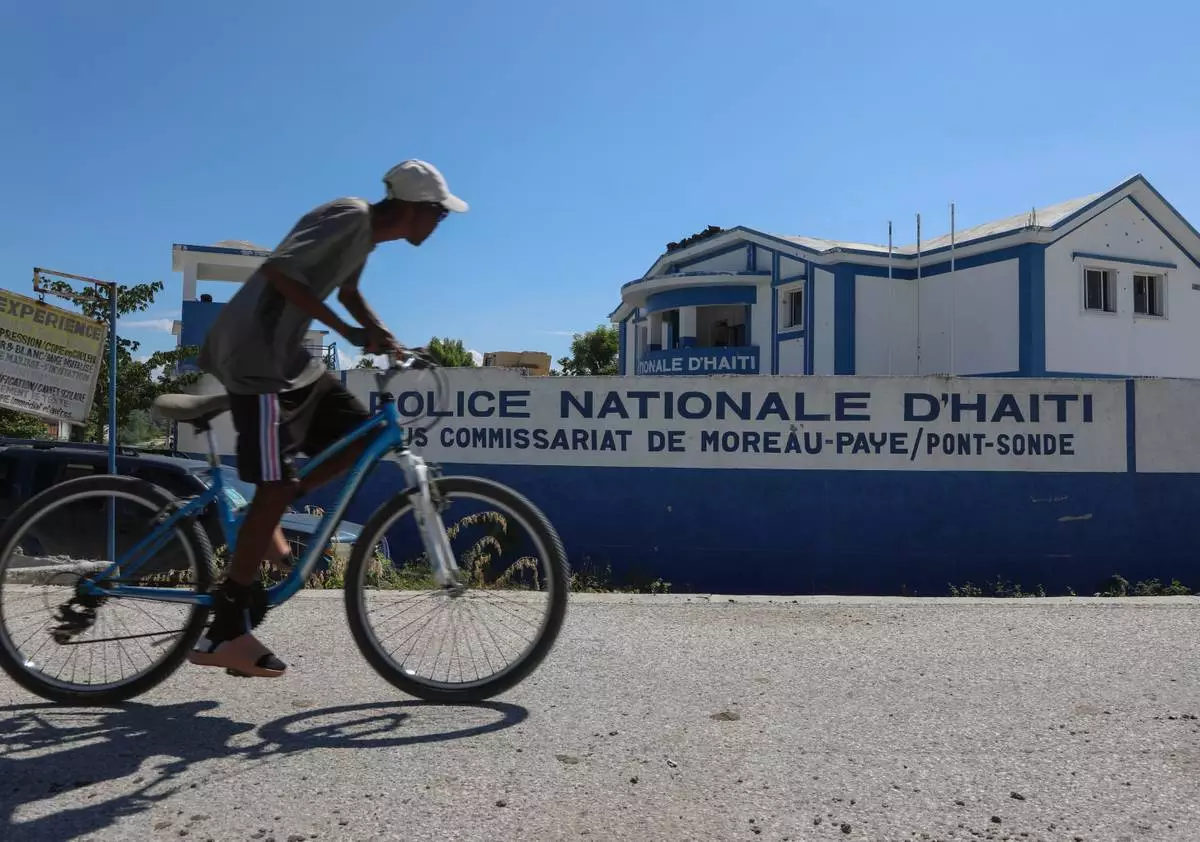
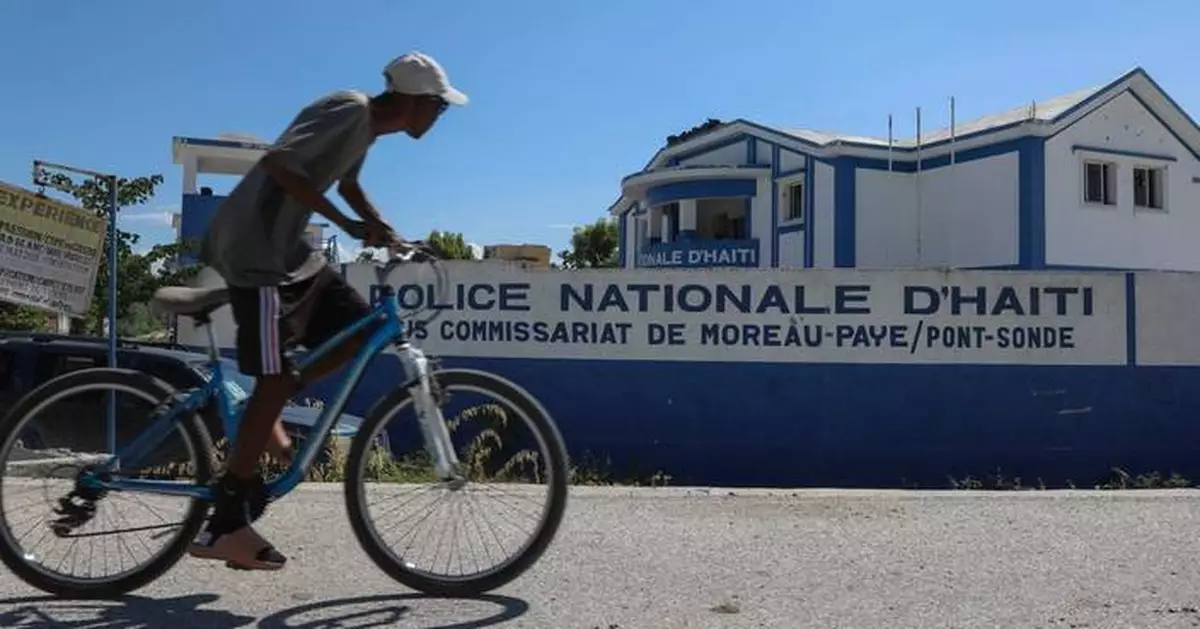
FILE - A man rides his bicycle past police station in Pont-Sonde, Haiti, Oct. 7, 2024. (AP Photo/Odelyn Joseph, File)
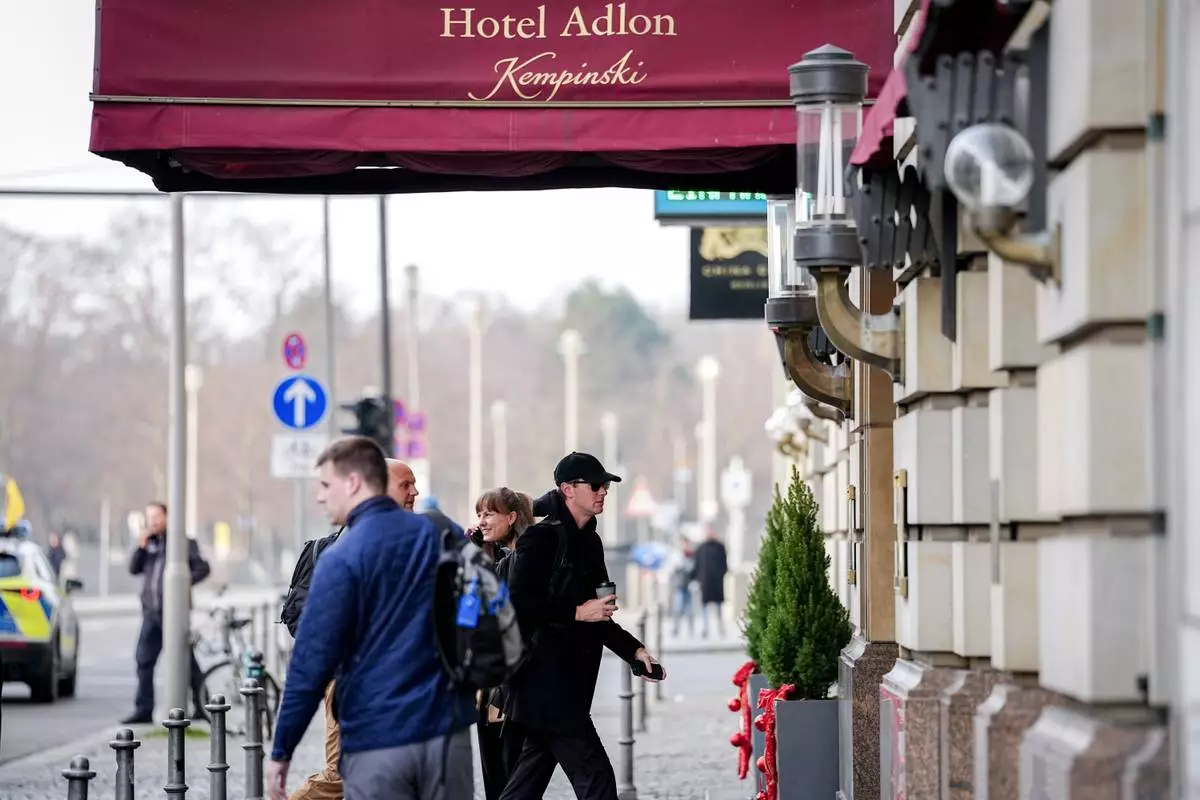
BERLIN (AP) — Ukrainian President Volodymyr Zelenskyy on Sunday voiced readiness to drop his country’s bid to join NATO in exchange for Western security guarantees, but rejected the U.S. push for ceding territory to Russia as he held talks with U.S. envoys on ending the war.
Zelenskyy sat down with U.S. President Donald Trump’s special envoy Steve Witkoff and Trump’s son-in-law Jared Kushner. The Ukrainian leader posted pictures of the negotiating table with German Chancellor Friedrich Merz sitting next to him facing the U.S. delegation.
Responding to journalists’ questions in audio clips on a WhatsApp group chat before the talks, Zelenskyy said that since the U.S. and some European nations had rejected Ukraine’s push to join NATO, Kyiv expects the West to offer a set of guarantees similar to those offered to the alliance members.
“These security guarantees are an opportunity to prevent another wave of Russian aggression,” he said. “And this is already a compromise on our part.”
Russian President Vladimir Putin has cast Ukraine's bid to join NATO as a major threat to Moscow's security and a reason for launching the full-scale invasion in February 2022. The Kremlin has demanded tha Ukraine renounce the bid for the alliance membership as part of any prospective peace settlement.
Zelenskyy emphasized that any security assurances would need to be legally binding and supported by the U.S. Congress, adding that he expected an update from his team following a meeting between Ukrainian and U.S. military officials in Stuttgart, Germany.
The U.S. government said in a social media post on Witkoff’s account after the five-hour meeting that “a lot of progress was made.”
Washington has tried for months to navigate the demands of each side as Trump presses for a swift end to Russia’s war and grows increasingly exasperated by delays. The search for possible compromises has run into major obstacles, including control of Ukraine’s eastern Donetsk region, which is mostly occupied by Russian forces.
Putin wants Ukraine to withdraw its forces from the part of the Donetsk region still under its control among the key conditions for peace, a demand rejected by Kyiv.
Zelenskyy said that the U.S. had floated an idea for Ukraine to withdraw from the Donetsk and create a demilitarized free economic zone there, a proposal he rejected as unworkable.
“I do not consider this fair, because who will manage this economic zone?” he said. “If we are talking about some buffer zone along the line of contact, if we are talking about some economic zone and we believe that only a police mission should be there and troops should withdraw, then the question is very simple. If Ukrainian troops withdraw 5–10 kilometers, for example, then why do Russian troops not withdraw deeper into the occupied territories by the same distance?”
Zelenskyy described the issue as “very sensitive” and insisted on a freeze along the line of contact, saying that “today a fair possible option is we stand where we stand.”
Putin's foreign affairs adviser Yuri Ushakov told the business daily Kommersant that Russian police and national guard would stay in parts of the Donetsk region even if they become a demilitarized zone under a prospective peace plan.
Ushakov warned that a search for compromise could take a long time, noting that the U.S. proposals that took into account Russian demands had been “worsened” by alterations proposed by Ukraine and its European allies.
Speaking to Russian state TV in remarks broadcast Sunday, Ushakov said that “the contribution of Ukrainians and Europeans to these documents is unlikely to be constructive," warning that Moscow will “have very strong objections.”
Ushakov added that the territorial issue was actively discussed in Moscow when Witkoff and Kushner met with Putin earlier this month. “The Americans know and understand our position," he said.
Zelenskyy said he spoke with French President Emmanuel Macron on Sunday just before the talks with Trump’s envoys, thanking him on X for his support and adding that “we are coordinating closely and working together for the sake of our shared security.”
Macron vowed on X that “France is, and will remain, at Ukraine’s side to build a robust and lasting peace — one that can guarantee Ukraine’s security and sovereignty, and that of Europe, over the long term.”
Merz, who has spearheaded European efforts to support Ukraine alongside Macron and U.K. Prime Minister Keir Starmer, said Saturday that “the decades of the ‘Pax Americana’ are largely over for us in Europe and for us in Germany as well.”
He warned that Putin's aim is “a fundamental change to the borders in Europe, the restoration of the old Soviet Union within its borders.”
“If Ukraine falls, he won’t stop,” Merz warned on Saturday during a party conference in Munich.
Putin has denied plans to restore the Soviet Union or attack any European allies.
Ukraine’s air force said that Russia overnight launched ballistic missiles and 138 attack drones at Ukraine. The air force said 110 had been intercepted or downed, but missile and drone hits were recorded at six locations.
Zelenskyy said Sunday that hundreds of thousands of families were still without power in the south, east and northeast regions and work was continuing to restore electricity, heat and water to multiple regions following a large-scale attack the previous night.
The Ukrainian president said that in the past week, Russia had launched over 1,500 strike drones, nearly 900 guided aerial bombs and 46 missiles of various types at Ukraine.
Russia’s Defense Ministry said that air defenses downed 235 Ukrainian drones late Saturday and early Sunday.
In the Belgorod region, a drone injured a man and set his house ablaze in the village of Yasnye Zori, regional Gov. Vyacheslav Gladkov said.
Ukrainian drones struck an oil depot in Uryupinsk in the Volgograd region, triggering a fire, according to regional Gov. Andrei Bocharov.
In the Krasnodar region, the Ukrainian drones attacked the town of Afipsky, where an oil refinery is located. Authorities said that explosions shattered windows in residential buildings, but didn’t report any damage to the refinery.
__
Ciobanu reported from Warsaw, Poland.
Follow AP’s coverage of the war in Ukraine at https://apnews.com/hub/russia-ukraine
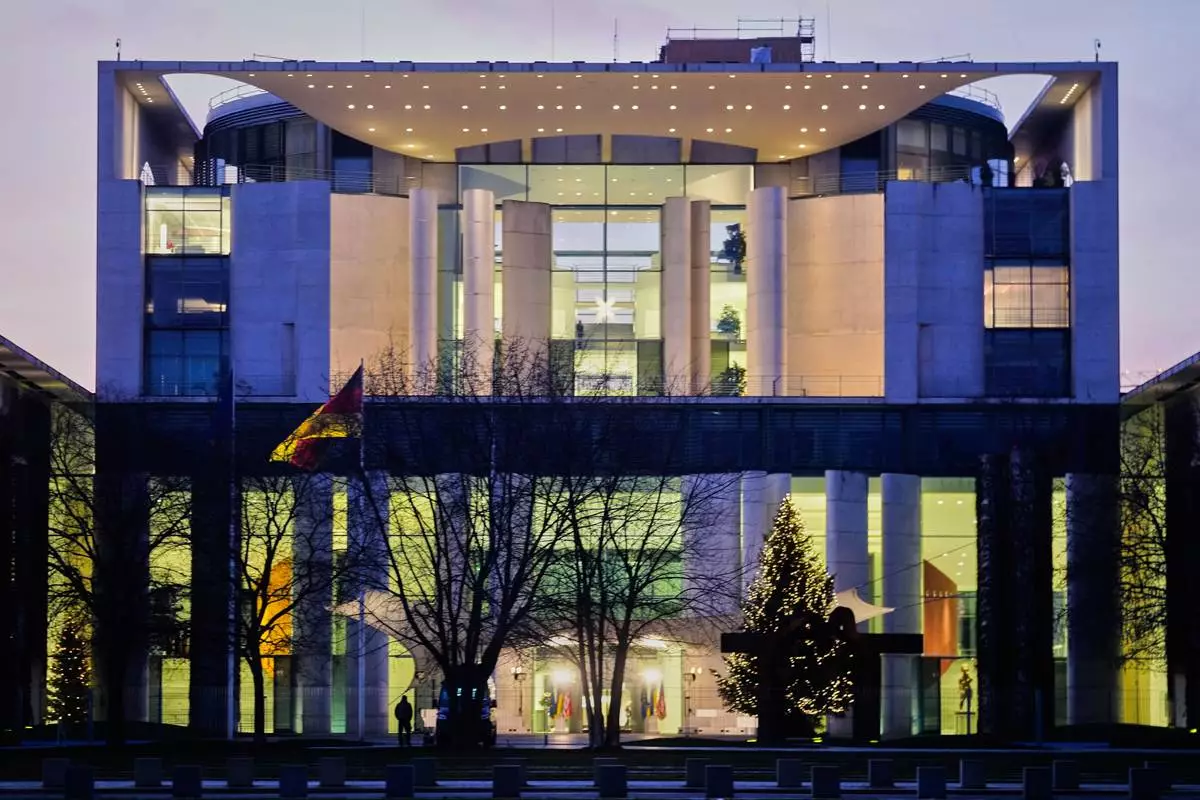
The chancellory is pictured during talks between representatives of the U.S. and Ukraine in Berlin, Germany, Sunday, Dec. 14, 2025. (AP Photo/Markus Schreiber)
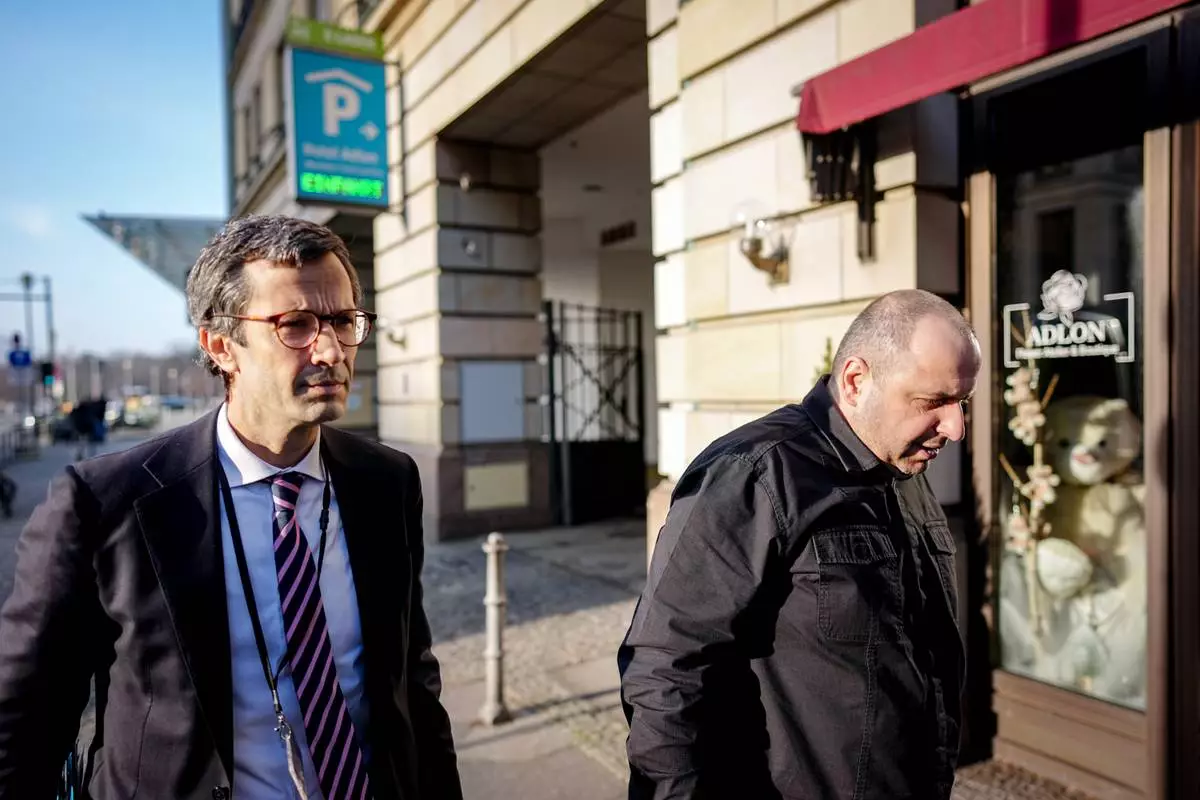
Günter Sautter, left, foreign and security policy advisor to the Federal Chancellor, and former Ukrainian Defense Minister Rustem Umjerow arrive for talks between representatives of the U.S. and Ukraine, at the Hotel Adlon, in Berlin, Sunday, Dec. 14, 2025. (Kay Nietfeld/dpa via AP)
Jared Kushner, entrepreneur and former chief advisor to President Donald Trump, arrives for talks between representatives of the U.S. and Ukraine at the Hotel Adlon, in Berlin, Sunday, Dec. 14, 2025. (Kay Nietfeld/dpa via AP)
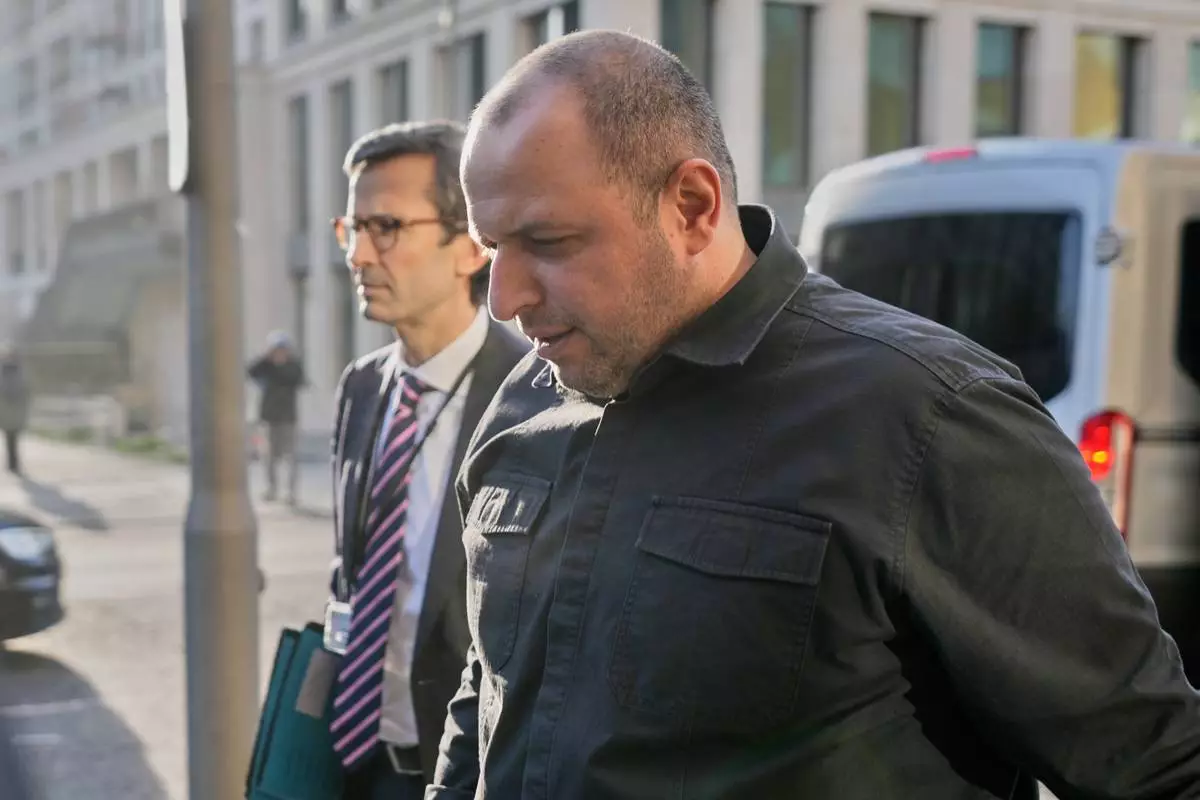
Ukraine's Secretary of National Security Rustem Umerov, right, and Günter Sautter, Foreign and Security Policy Advisor to Chancellor Merz meet in Berlin, Germany, Sunday, Dec. 14, 2025. (AP Photo/Markus Schreiber)
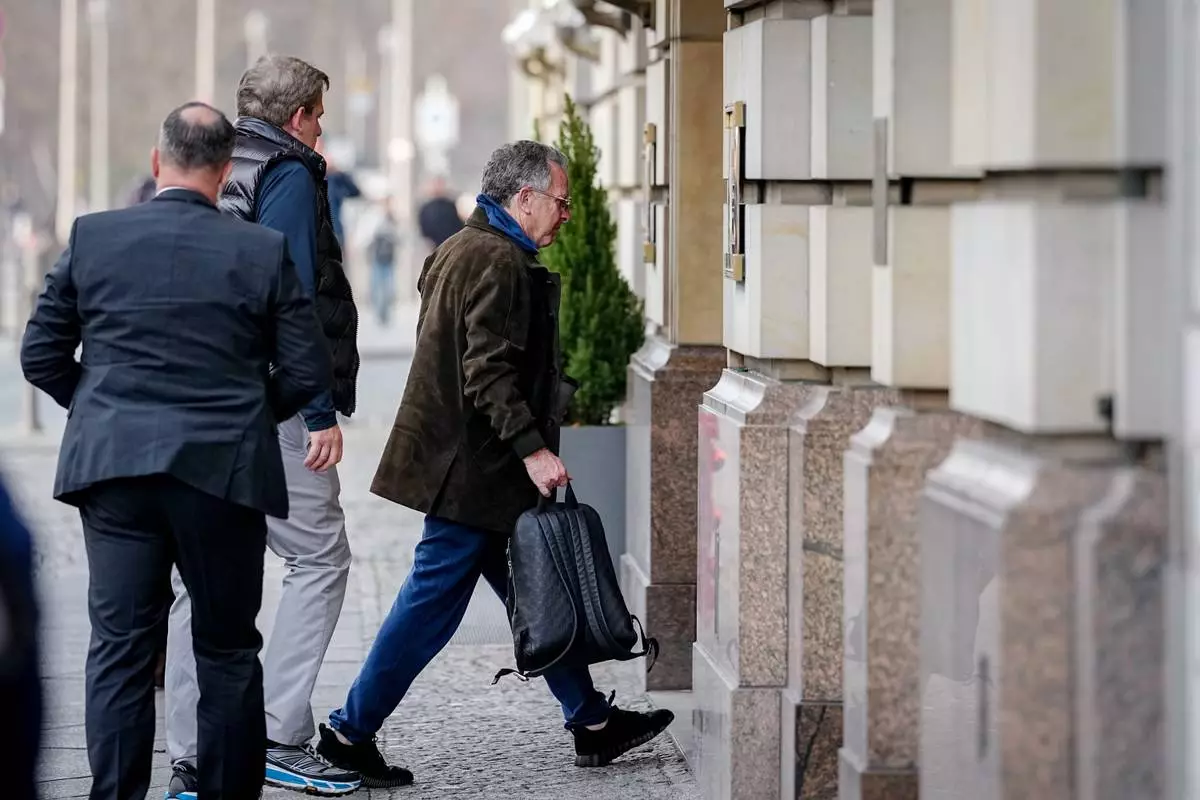
Steve Witkoff, special envoy of the United States, arrives for talks between representatives of the U.S. and Ukraine, at the Hotel Adlon, in Berlin, Sunday, Dec. 14, 2025. (Kay Nietfeld/dpa via AP)
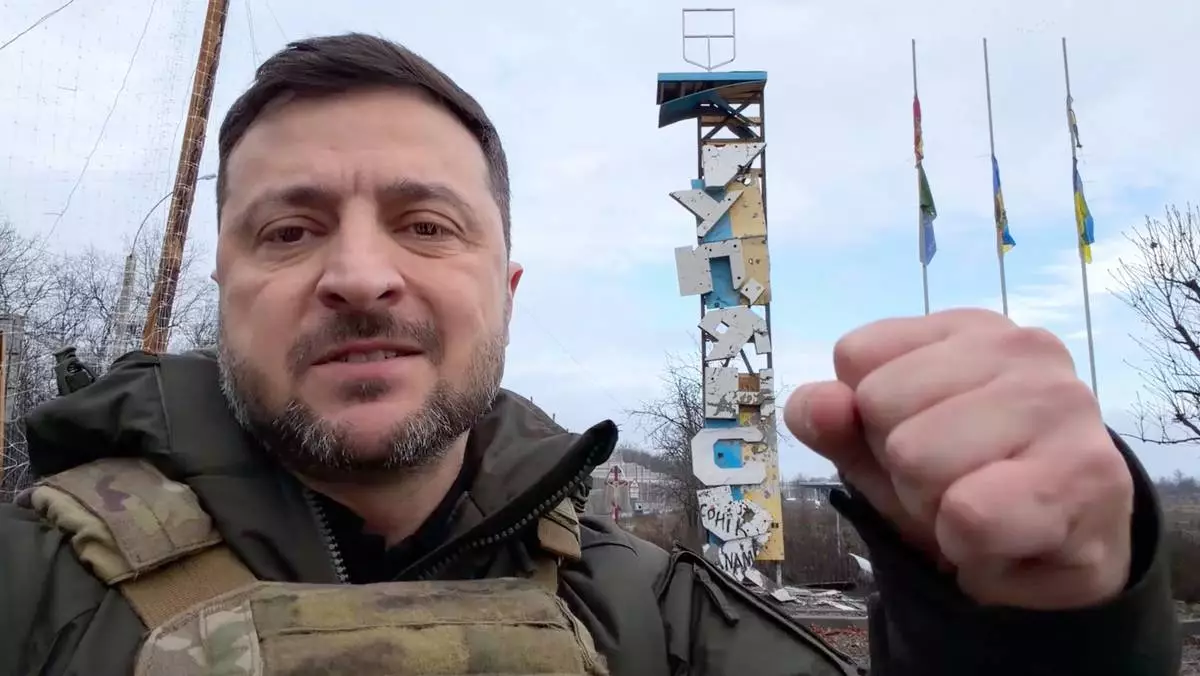
In this grab from a video provided by the Press Service Of The President Of Ukraine on Friday, Dec 12, 2025, Ukraine's President Volodymyr Zelenskyy records a video at the road entering of Kupiansk, Ukraine. (Press Service Of The President Of Ukraine via AP)