CAIRO (AP) — An international rights group on Wednesday accused the paramilitary group fighting against Sudan's military of committing war crimes during its attack earlier this year on the country’s largest displacement camp in the Darfur region.
The Rapid Support Forces, which is at war with the Sudanese military, rampaged through the Zamzam camp in April as part of its siege of the city of el-Fasher, the provincial capital of North Darfur province. The RSF seized the city, the military’s last stronghold in Darfur, in an October attack that was marked by the executions of civilians, rapes and sexual assaults, and other atrocities.
Amnesty International said in a report that the RSF's multi-day attack on Zamzam involved killings of civilians, hostage taking and the destruction of mosques, schools and health clinics, and that they must be investigated as war crimes.
“The RSF’s horrific and deliberate assault on desperate, hungry civilians in Zamzam camp laid bare once again its alarming disregard for human life,” said Agnès Callamard, Amnesty International’s secretary-general.
Amnesty’s report was the latest by an international rights group to accuse RSF of atrocities in Sudan’s 30-month war. These have included mass killings and rapes in attacks on towns and cities, particularly in Darfur. The Sudan military also has been accused of atrocities in the war.
A power struggle between the military and the RSF erupted into war in April 2023. The conflict has killed 40,000 people — though some rights groups say the death toll is significantly higher — and has created the world’s worst humanitarian crisis with over 14 million displaced. Many areas have experienced famine, including at the Zamzam camp.
“This was not an isolated attack, but part of a sustained campaign against villages and camps for internally displaced persons,” Callamard said of the Zamzam assault.
The RSF didn’t immediately respond to a request for comment. But following the attack, the group claimed that the camp was used as a base by the military and its allied militias, and said that its fighters didn’t target civilians. Amnesty also said the RSF didn't respond to its request for comment.
Residents and aid workers who survived the attacks told The Associated Press in May that RSF fighters gunned down men and women in the streets of the camp, beat and tortured others and raped and sexually assaulted women and girls. The paramilitaries burned down large swaths of houses, markets and other buildings. The April 11 attack virtually emptied the 20-year-old camp, which was once home to some 500,000 residents.
Amnesty said in its report that 47 people who were killed in the assault were fleeing the violence and hiding in homes, at a clinic and seeking refuge in a mosque.
“Civilians were ruthlessly attacked, killed, robbed of items critical to their survival and livelihood, and left without recourse to justice, while grieving the loss of their loved ones,” Callamard said.
Citing survivors, the rights group also reported that many people were killed in shelling of densely populated areas between April 11-12, including a shell that landed near a mosque during a wedding ceremony.
One survivor recalled that RSF fighters stormed a compound, shooting and killing his 80-year-old brother and 30-year-old nephew. “No-one is concerned with our situation,” he was quoted as saying.
Another woman, who volunteered for NGOs, said that RSF fighters drove through her neighborhood near the camp's main market on April 12 and fired indiscriminately. “One (RSF fighter) will stand up through a small roof and just shoot around and shoot anyone in the street,” she was quoted as saying.
Amnesty criticized the United Arab Emirates, as it has done in the past, over what it says is the Gulf nation’s support for the RSF.
Callamard, the group’s chief, told the AP that Amnesty documented that the UAE kept supporting the RSF while knowing the Sudanese paramilitary group “is committing war crimes.”
She called for ceasing all arms transfer to the UAE, saying: “The arms embargo and focusing and denouncing the role of the UAE at the moment is absolutely key to bringing some kind of small respite to the population.”
The UAE has long denied the accusation of suppling arms to the RSF.
The RSF grew out of the Janjaweed militias, who became notorious for atrocities in the early 2000s in a ruthless campaign against people identifying as East or Central African in Darfur. That campaign killed some 300,000 people and drove 2.7 million from their homes.
Sudan’s former President Omar al-Bashir was indicted by the International Criminal Court for war crimes and genocide in Darfur in 2009.
Zamzam camp was established in 2004 to house people driven from their homes by Janjaweed attacks. Located just south of el-Fasher, it swelled over the years to cover an area 8 kilometers (5 miles) long by about 3 kilometers (2 miles) wide.
U.N. Secretary-General António Guterres has called the crimes committed in el-Fasher “horrendous,” and called for accountability.
The U.S. government has accused the RSF of genocide in Darfur. and the International Criminal Court has said it is investigating suspected war crimes in the Sudan war, especially in Darfur.
Associated Press correspondent Sarah El Deeb contributed from Beirut.
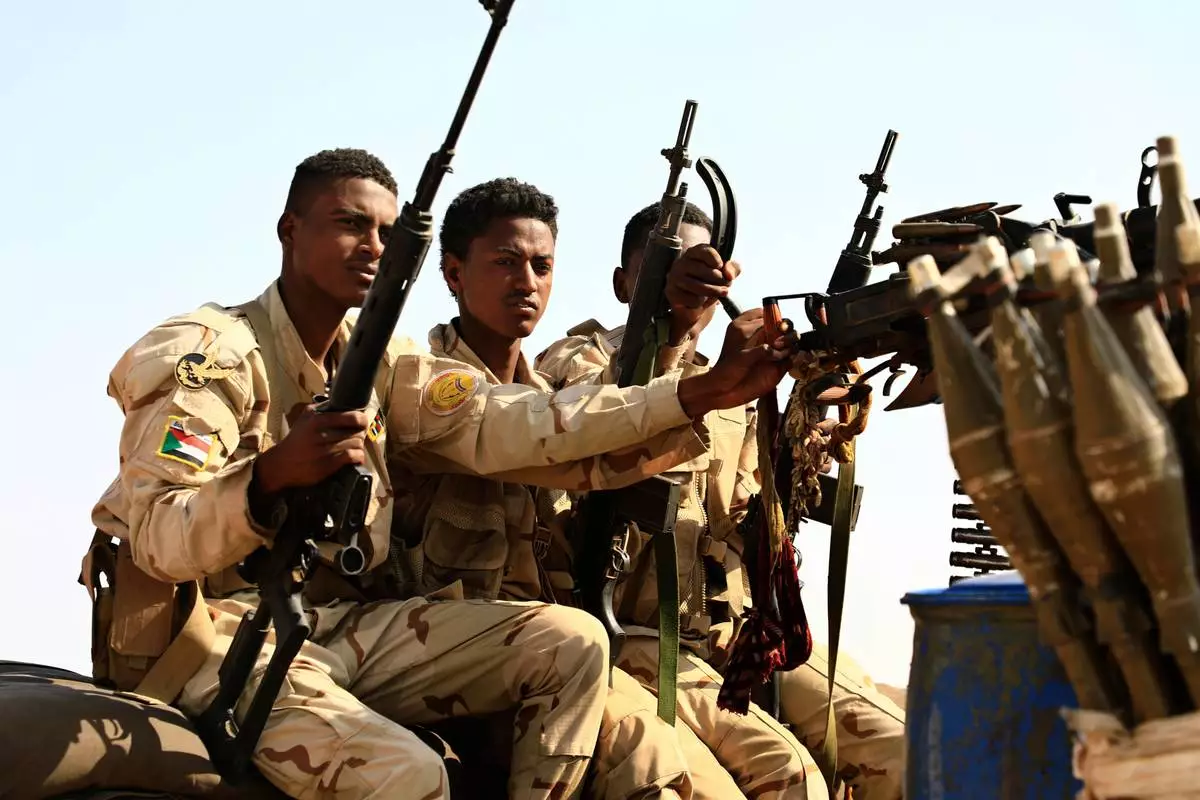
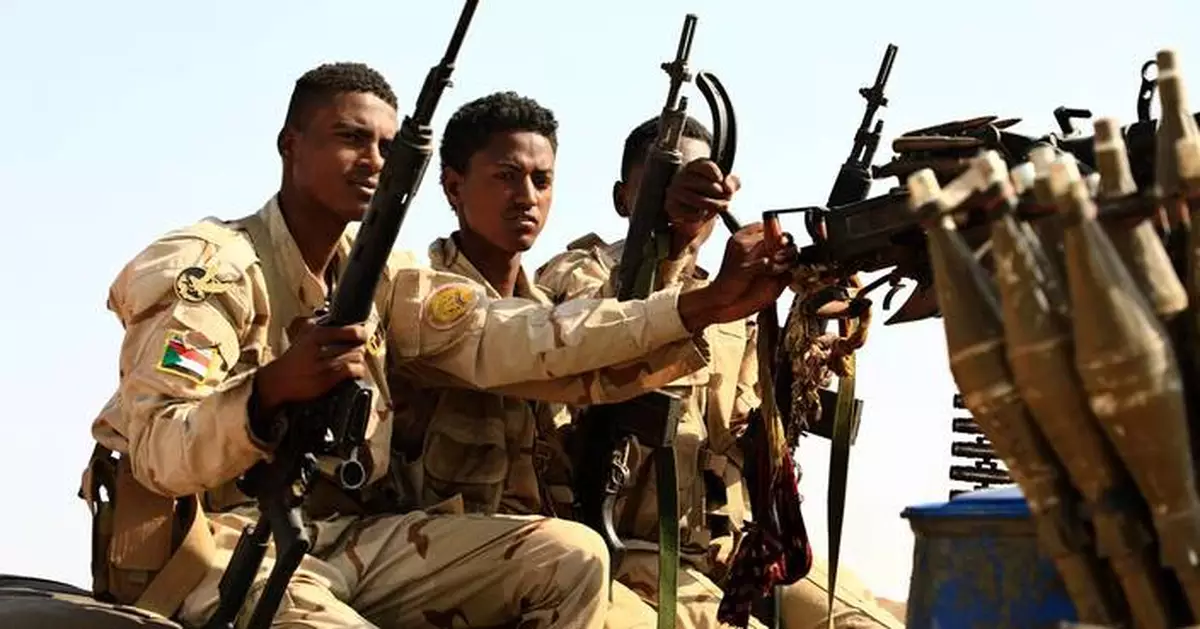
FILE - Sudanese soldiers from the Rapid Support Forces unit patrol during a rally for Dagalo, in Garawee town, north of Sudan, Saturday, June 15, 2019. (AP Photo)
A federal immigration officer shot a Dominican man in the neck as he drove in a car with a 5-year-old boy Thursday afternoon, officials said.
An irate New York Mayor Zohran Mamdani called the shooting an outrage, and spent two hours Thursday night pressing President Donald Trump and Homeland Security Secretary Markwayne Mullin to release the wounded man, and urging them to stop immigration enforcement operations in the city.
Meanwhile, Trump said Thursday that he will not order a resumption of military strikes on Iran before the Nov. 3 midterm elections in the United States. Trump, while stumping for Republicans this week, has hinted that he was confident an endgame to the war could come in the days before or after the election, while also hinting that he remained open to resuming full-scale military operations against Iran.
Here's the latest:
Mullin said ICE agents weren’t aware the child was in the car at the time. But he said Belgal “was aware” and chose to evade officers.
He didn’t answer a question about how officers wouldn’t know that, saying only that it’s an investigation.
Mullin also revealed that the officers involved in the incident were wearing body cameras “and they were on.”
Mullin spent much of the news conference criticizing New York Mayor Zohran Mamdani for resisting and denouncing ICE. An irate Mamdani on Thursday night called ICE “rotten to its core” and said he saw no justification for the shooting.
“Well, mayor, if you abolish ICE, who’s going to take criminals off the streets of your own town?” Mullin said Friday. “The mayor speaks with political tone. His words are dangerous and incite hostility. It doesn’t help.”
Marcos Charles, who heads Immigration and Customs Enforcement’s enforcement removal and operations division, said ICE officials attempted to arrest the Dominican man, whom officials have identified as Oscar Belgal, and attempted to use their vehicles to block him in.
Speaking to reporters, Charles said Belgal “refused to exit his vehicle” and accelerated, smashing into two government vehicles and moving toward officers, which prompted officers to fire weapons.
Facing backlash after a federal immigration officer shot a Dominican man in the neck as he drove in a car with a 5-year-old boy in New York on Thursday, Homeland Security Secretary Markwayne Mullin doubled down on the Trump administration’s criticism of so-called sanctuary cities.
There’s no clear definition of sanctuary jurisdictions, but the term is generally applied to state and local governments that limit cooperation with federal immigration authorities.
Sanctuary politicians and cities “create an environment for criminal activity to thrive, not for the American citizens to be safe,” Mullin said in a news conference Friday.
For about nine decades, executions in the U.S. have been private affairs, often shrouded in secrecy. The stunning Pentagon announcement Thursday that the first military execution in more than 65 years will be livestreamed could change that.
Allowing the world to watch Fort Hood shooter Nidal Malik Hasan face the firing squad in December would make it the first public execution since two hangings in the 1930s in Kentucky and Missouri drew crowds.
In 1936, a man who reportedly confessed to the rape and murder of a woman was hanged in front of thousands in Owensboro, Kentucky, while the following year, hundreds watched a man in Missouri be hanged.
▶ Read more
Trump said Thursday that he will not order a resumption of military strikes on Iran before the Nov. 3 midterm elections in the United States.
Trump, while stumping for Republicans this week, has hinted that he was confident that an endgame to the war could come in the days before or after the election, while also hinting that he remained open to resuming full-scale military operations against Iran.
For weeks, Trump has been threatening that a post-midterm election escalation in the seven-month-old war remains a viable option, despite his initial promises to Americans of a military campaign that would last a matter of weeks.
But Trump in a social media post on Thursday said the U.S. “will not be attacking Iran at any time prior to the Midterm Elections to be held in the United States on November 3rd.”
Trump added that his team has been “having productive discussions with the Islamic Republic of Iran.”
▶ Read more
A federal immigration officer shot a Dominican man in the neck as he drove in a car with a 5-year-old boy Thursday afternoon, officials said. The Department of Homeland Security said it was seeking to arrest the man in a “targeted enforcement operation,” but protesters and local officials decried it as an example of the dangers of the Trump administration’s immigration crackdown.
DHS said in a statement that it was seeking to arrest a “criminal illegal alien” with a grand larceny conviction and a history of other arrests. But an irate New York Mayor Zohran Mamdani called the shooting an outrage.
The mayor said he had spent two hours Thursday night pressing President Donald Trump and Homeland Security Secretary Markwayne Mullin to release the wounded man, to no avail, and urging them to stop immigration enforcement operations in the city. He said that late Thursday night, federal authorities removed the man from the hospital and took him away.
New York Gov. Kathy Hochul, also a Democrat, said in a statement that she had delivered a similar message to Trump and Mullin by phone.
▶ Read more
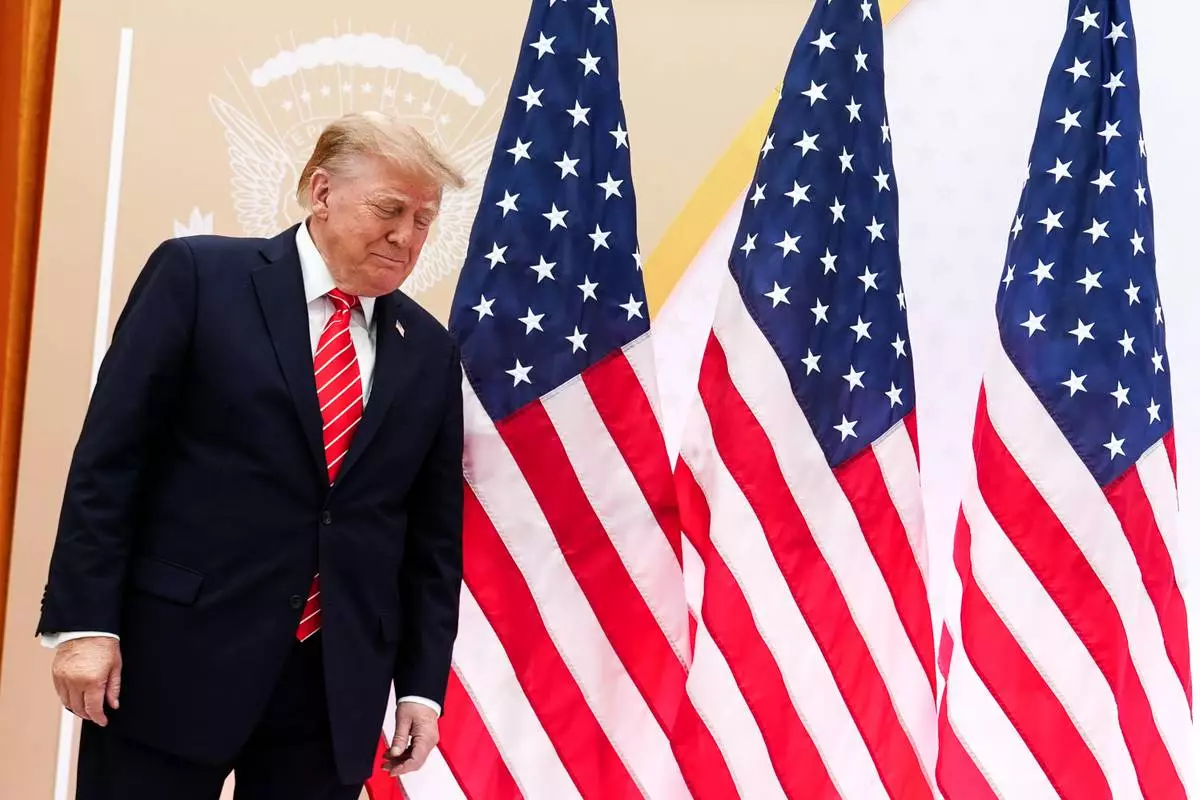
President Donald Trump arrives to speak at the U.S. Institute of Peace, Thursday, Oct. 8, 2026, in Washington. (AP Photo/Julia Demaree Nikhinson)
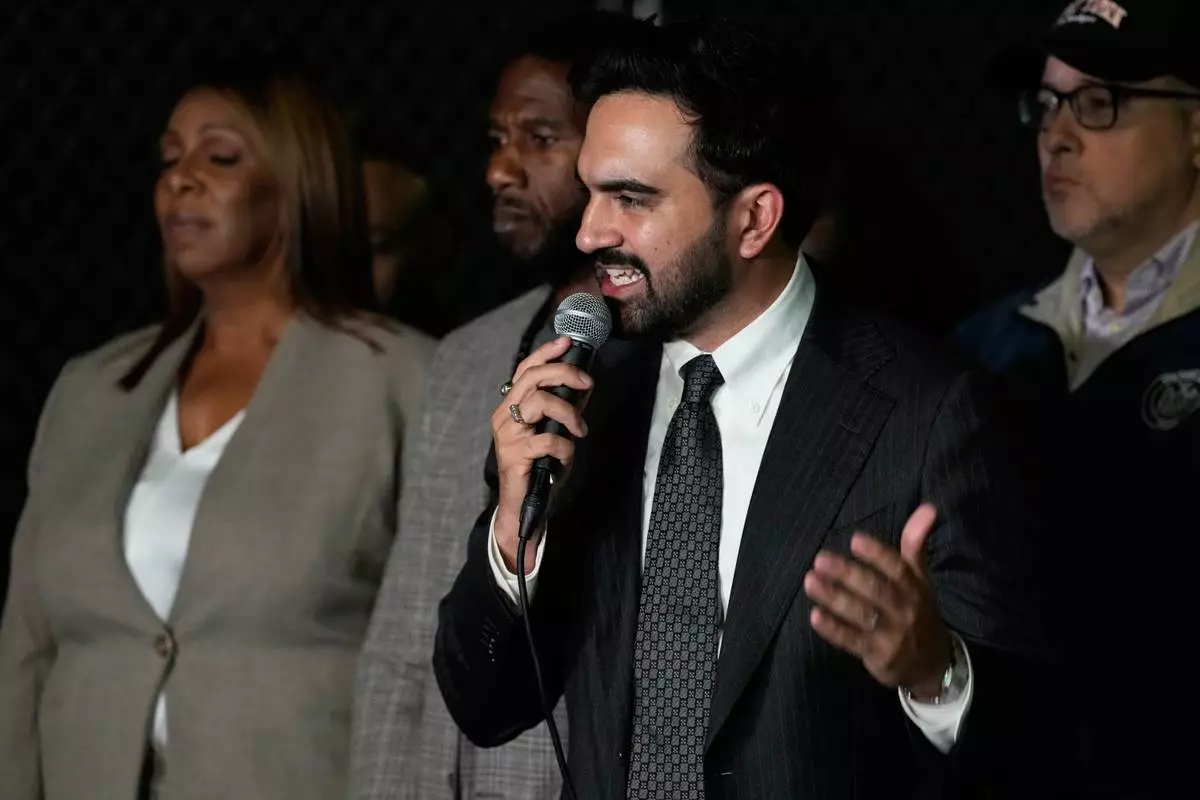
New York City Mayor Zohran Mamdani talks during a news conference near the scene of a shooting on Thursday, Oct. 8, 2026, in New York. (AP Photo/Seth Wenig)