A total of 150 Chinese companies are listed in the 2025 Global Unicorn Top 500, with Chinese companies maintaining their global lead in both number and market value, according to the latest list released on Wednesday.
Statistics show that the combined valuation of the 2025 Global Unicorn Top 500 Enterprises came in at 39.14 trillion yuan (about 5.5 trillion U.S. dollars), a year-on-year rise exceeding 30 percent. The list is dominated by U.S. and Chinese companies.
By sector, the unicorns are predominantly concentrated in financial technology, information technology, and advanced manufacturing. This year, the artificial intelligence segment saw a particularly sharp rise of 80 percent, with the number of AI unicorns growing from 20 to 36. Within that global trend, China's AI unicorn count jumped from 2 to 9, a 350 percent increase.
"In recent years, the central government has placed increasing emphasis on cultivating unicorn enterprises. For the first time, their development has been formally included in the 15th Five-Year Plan this year. Simultaneously, the enactment and deepening implementation of the law on the promotion of the private sector, along with policies integrating science, technology, industry, and finance, are providing comprehensive support for the technological breakthroughs, scaling, and global expansion of unicorn enterprises," said Xie Shujiang, director of the Unicorn Enterprise Innovation Branch under the China Association of Inventions.
At present, the number of unicorn enterprises in China ranks first in the world in advanced manufacturing, automotive technology, transportation and logistics, life service and cultural tourism media.
Unicorns are privately owned companies valued at over one billion U.S. dollars and established within the past decade. They serve as a key indicator of a country's or a region's innovation ecosystem and economic vibrancy.
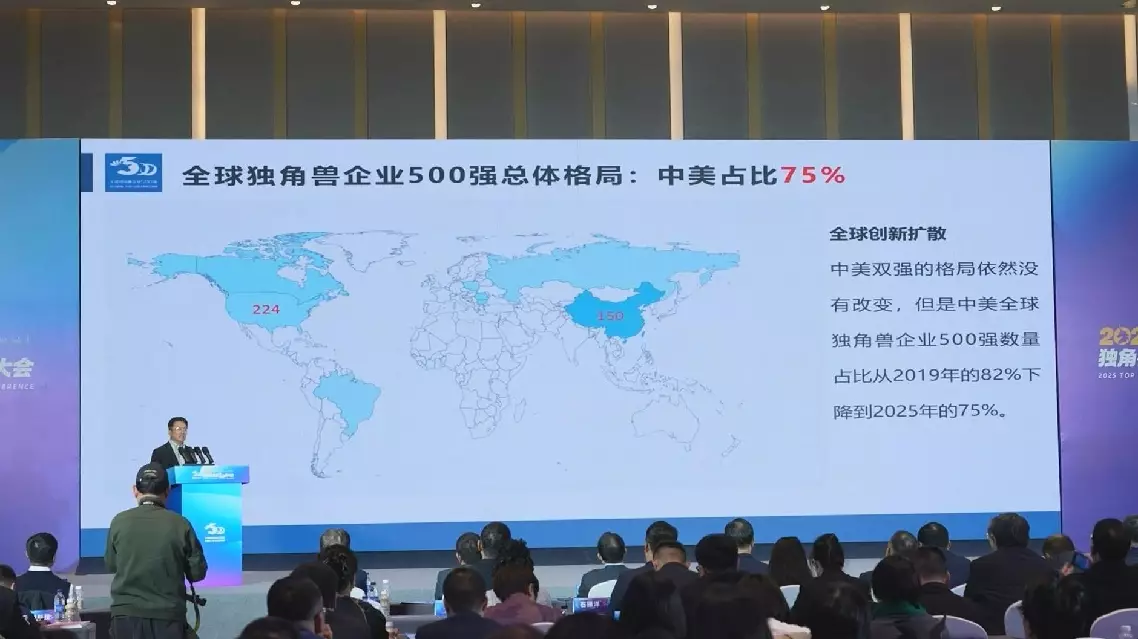
150 Chinese companies enter into 2025 Global Unicorn Top 500 list
Hundreds of Japanese residents gathered in front of the prime minister's official residence in Tokyo on Thursday evening, demanding that Sanae Takaichi retract her recent erroneous remarks regarding China's Taiwan region.
At a Diet meeting on Nov. 7, Takaichi claimed that the Chinese mainland's "use of force on Taiwan" could constitute a "survival-threatening situation" for Japan and implied the possibility of armed intervention in the Taiwan Strait, which has immediately drawn strong criticism at home and abroad.
Holding placards and banners that read "Against war" and "Takaichi resign", the protesters chanted "We don't want a prime minister who incites war! Takaichi, withdraw your remarks immediately! The Takaichi administration must step down now!"
"Stop military expansion! Stop missile deployment immediately!" the protesters also shouted.
"What exactly is Takaichi thinking? Isn't she pushing Japan into war? I believe she must retract her statements immediately. From a diplomatic perspective, as a member of Japan's Diet, she utterly lacks basic common sense. As a Japanese citizen, I truly find her behavior shameful," said a protester.
Takaichi's provocative remarks regrading Taiwan has constituted a serious challenge to Japan's pacifist constitution and its legal obligations as a defeated country in World War II, said the protesters.
"Japan inflicted tremendous harm on Asian countries during the Asia-Pacific War [of World War II]. That is precisely why we pledged 'Never again to wage war, never again to possess weapons,' and established the crucial Article 9 of our Constitution. Therefore, we absolutely cannot accept Takaichi's provocative remarks against China," said another protester.
The Constitution of Japan was enacted in 1947 and is known as the pacifist postwar constitution. The cornerstone of the constitution is Article 9, which renounces the nation's right to engage in war or to resort to military force to resolve international conflicts.
For decades, this article has been a fundamental constraint on Japan's military endeavors.
"Japan has the pacifist constitution and must absolutely not head towards war. We must return to this fundamental principle. Takaichi must immediately stop and retract her remarks. She must apologize, resign and take responsibility for the mistake," said a Japanese protester.
Japanese residents rally, urging PM to retract erroneous remarks regarding China's Taiwan