Skip to Content Facebook Feature Image

China Eastern Airlines launches world’s longest one-way flight connecting Shanghai, Buenos Aires

China

China

China

China Eastern Airlines launches world’s longest one-way flight connecting Shanghai, Buenos Aires

2025-12-04 13:29 Last Updated At:16:17

China Eastern Airlines' flight MU745 took off from Shanghai Pudong International Airport on Thursday, formally launching the world's longest one-way flight which connects Shanghai with Argentina's capital Buenos Aires and shortens the flight time from China to South America by over four hours to about 25 hours.

The 20,000-kilometer route between China's economic hub and Buenos Aires, with a stopover in Auckland, New Zealand, connects the eastern and western hemispheres making it one of the most ambitious flight offerings in commercial aviation.

Travelers between China and Argentina have long relied on routes passing through Europe or North America, often taking more than 30 hours including long stopovers.

According to the Shanghai-based carrier, the new air service is planned to run twice a week on the round-trip basis. It not only expands connectivity between Asia and South America, but also marks a bold move in ultra-long-haul aviation, potentially reshaping global travel patterns for business and tourism between the two continents.

"Compared to the traditional northbound route that transits through Europe, the Middle East, or North America, we chose this southbound route that makes a stopover in New Zealand before flying to Argentina, shortening the original nearly 30-hour journey to a 25- hour journey. This not only offers a shorter journey and consumes less time, but also provides more convenience thanks to visa-free transit policies and smaller time differences," said Liu Yanan, assistant general manager of the online revenue department of China Eastern Airlines' marketing division.

The new air service includes a two-hour stopover in Auckland, New Zealand, where passengers are allowed to disembark, stretch, and refresh. Despite the layover, the service is classified as a "direct flight" since it uses the same aircraft and flight number for the entire journey.

"Travelers are more willing to choose this route because it's shortened by at least five or six hours compared to the previous thirty-odd hours. Secondly, it's much more convenient as travelers don't have to change planes or transfer to other airlines although it has a stopover in Auckland," said a traveler.

"When I came to China from Argentina, I had to go to Germany at a ten-hour stopover and it was like a 36-hour trip, and this one is 25 to 26 hours. So it's much faster, so yeah, it's better," said another traveler.
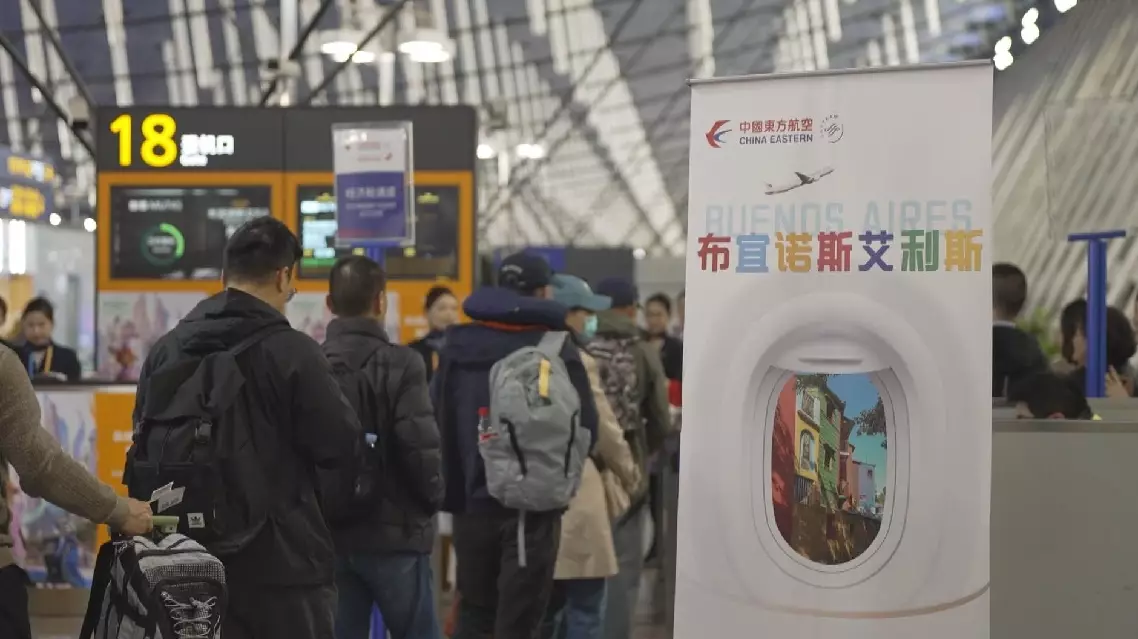
China Eastern Airlines launches world’s longest one-way flight connecting Shanghai, Buenos Aires
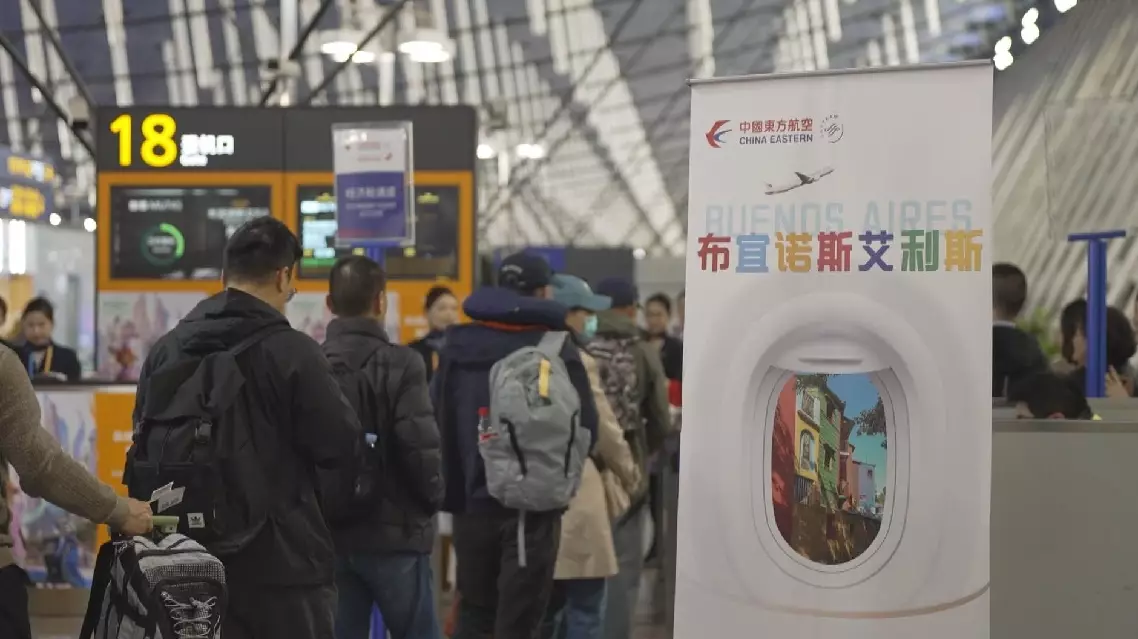
China Eastern Airlines launches world’s longest one-way flight connecting Shanghai, Buenos Aires
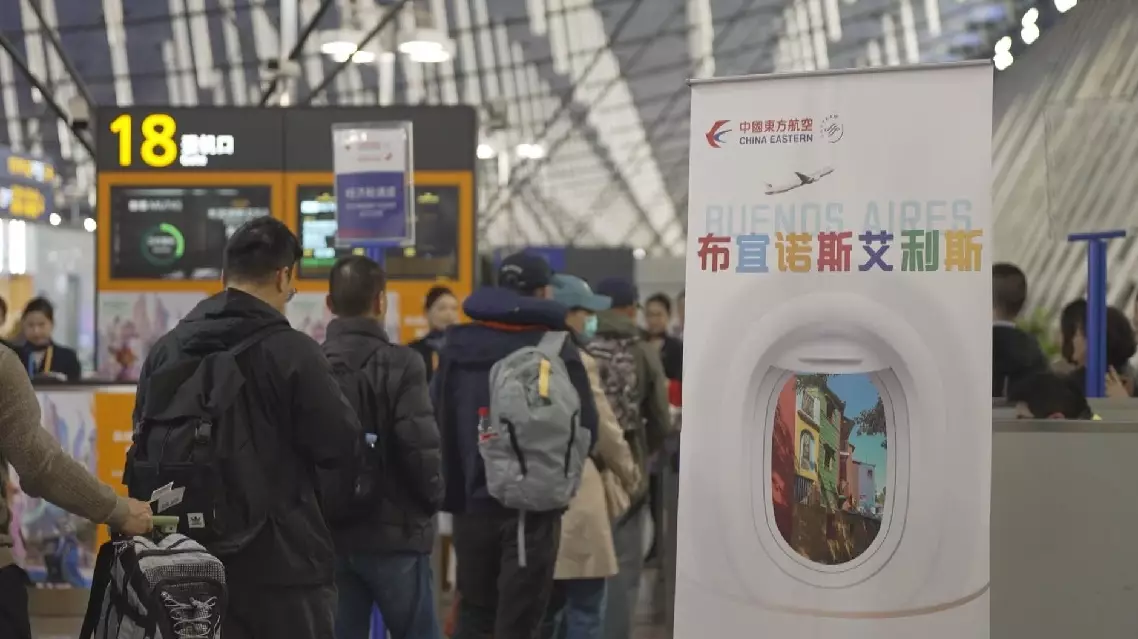
China Eastern Airlines launches world’s longest one-way flight connecting Shanghai, Buenos Aires


China Eastern Airlines launches world’s longest one-way flight connecting Shanghai, Buenos Aires
China Eastern Airlines launches world’s longest one-way flight connecting Shanghai, Buenos Aires
China Eastern Airlines launches world’s longest one-way flight connecting Shanghai, Buenos Aires

Highlighting the "Future Energy" as a key direction for China's strategic emerging industries, the country's nuclear energy development, guided by its three-step strategy, has seen major strides in the past year, said a member of the 14th National Committee of the Chinese People's Political Consultative Conference (CPPCC).

In a recent press briefing, Xin Feng, also deputy general manager of China National Nuclear Corporation (CNNC), updated the media on the progresses China has achieved under the strategy.

"China's three-step strategy for nuclear energy development -- from the thermal reactor to the fast reactor and the fusion reactor -- was formulated in 1983 as a medium- and long-term plan. For the thermal reactor, over the past year, our 2.0 version of the Hualong One technology has been approved. This is a unified and fully self-owned intellectual property based third-generation nuclear power technology solution. And the Linglong One small modular reactor also successfully completed its cold-state functional test last year and is expected to be put into commercial operation this year," he said.

For the second and third steps, Chinese researchers and engineers have achieved milestones in the past year with the government support, Xin noted.

"Then for the fast reactor, last year, a closed-cycle system for an integral fast reactor successfully achieved preliminary standard design. We will continue to solve its engineering technology challenges. As for the fusion reactor, in 2025, with national support, we established the China Fusion Energy Company in Shanghai. And our Huanliu-3, a platform for conducting research and development of fusion technology, made a big stride, with an iron temperature in it achieving 117 million Celsius and an electron temperature reaching 160 million Celsius. We will continue to adhere to the development strategy and focus on technological research and engineering technology development," Xin said.

The fourth session of the 14th NPC and the fourth session of the 14th National Committee of the CPPCC kicked off in Beijing on March 5 and March 4, respectively.

The "two sessions" -- which refer to the annual meetings of China's supreme organ of state power, the National People's Congress (NPC), and its top political advisory body, the National Committee of the CPPCC -- are a key event on the country's political calendar and offer a window into the country's development direction.

China's nuclear energy development makes great strides with three-step strategy: CPPCC member

China's nuclear energy development makes great strides with three-step strategy: CPPCC member

Recommended Articles