Chinese President Xi Jinping and visiting French President Emmanuel Macron held friendly exchanges on Friday in Dujiangyan in Chengdu, the capital city of southwest China's Sichuan Province.
Macron arrived in Chengdu on the previous evening for the second stop of his three-day state visit to China at the invitation of President Xi.
Click to Gallery
Xi, Macron visit site of ancient irrigation system in Chengdu
Xi, Macron visit site of ancient irrigation system in Chengdu
Xi, Macron visit site of ancient irrigation system in Chengdu
Xi, Macron visit site of ancient irrigation system in Chengdu
Upon their arrival in Chengdu, Macron and his wife, Brigitte Macron, were warmly received by Xi and his wife, Peng Liyuan. Welcoming them to Sichuan, which is known in China as the "Land of Abundance", Xi recalled his visit last year to France's Hautes-Pyrenees Department at Macron's invitation. Xi said he believed that Macron's latest visit will help further deepen his understanding of China.
The two presidents together visited the more than two-millennia-old Dujiangyan irrigation system, a major water conservancy project located along the Minjiang River which was built during China's Warring States period (475-221 BC) and has been recognized as a UNESCO World Heritage Site.
Xi noted that the Dujiangyan irrigation system is the world's only ancient irrigation project still in operation today, and also one of the earliest successful practices of harmonious coexistence between humanity and nature, adding that its construction process fully reflects the Chinese nation's spirit of constant self-improvement, fearlessness in the face of hardships, and courage to forge ahead.
Macron is set to conclude his state visit to China later on Friday, after having held talks with senior Chinese leaders in Beijing before traveling to Chengdu late on Thursday.
The French president is currently embarking on his fourth state visit to the country, with this being a reciprocal visit following President Xi's historic trip to France last year which came as the two sides marked the 60th anniversary of the establishment of bilateral diplomatic relations.
The city of Chengdu also has a long-standing relationship with France. In 1981, Chengdu and France's Montpellier became the first pair of sister cities between the two countries.
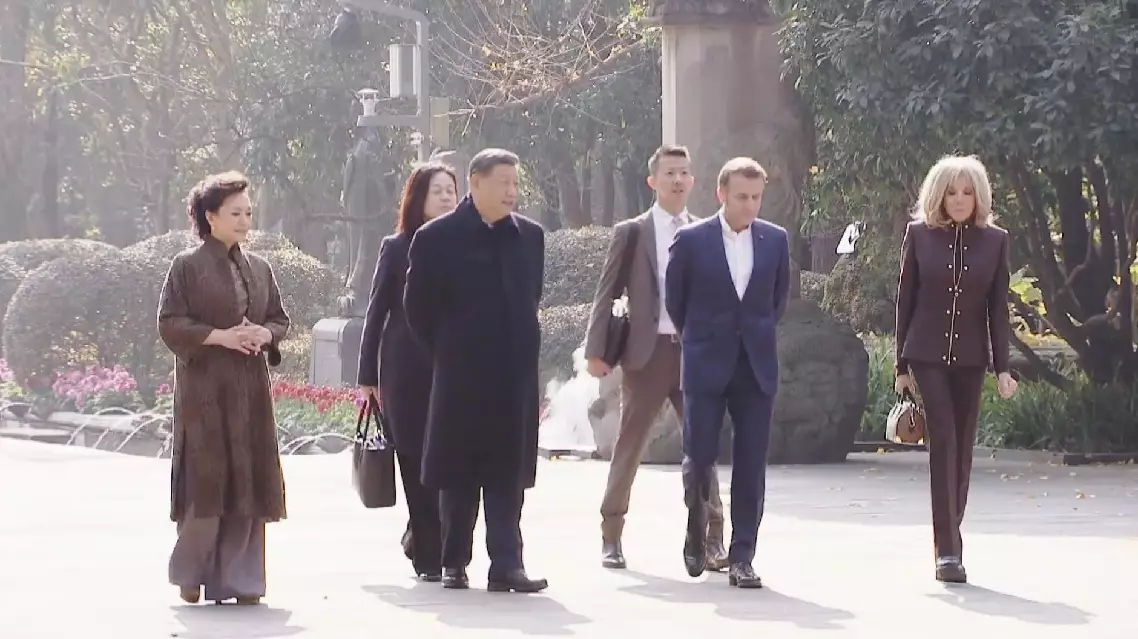
Xi, Macron visit site of ancient irrigation system in Chengdu

Xi, Macron visit site of ancient irrigation system in Chengdu

Xi, Macron visit site of ancient irrigation system in Chengdu
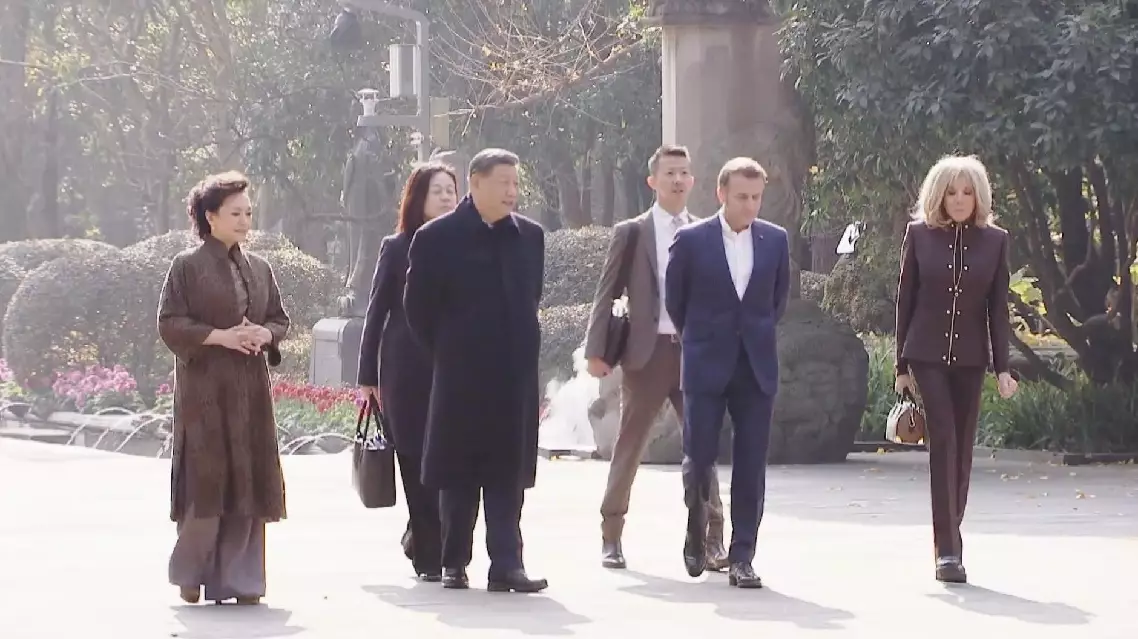
Xi, Macron visit site of ancient irrigation system in Chengdu
Japanese people gathered in Tokyo on Friday to protest against the government's recent decision to revise the "three principles on transfer of defense equipment and technology" which now allows the export of lethal weapons.
On Tuesday, the Japanese government, led by Prime Minister Sanae Takaichi, officially revised the "three principles on transfer of defense equipment and technology" and their implementation guidelines.
The revisions scrap the restrictions that had limited arms exports to five non-combat categories, allow, in principle, the export of lethal weapons, permit transfers to nations engaged in active conflict under specified circumstances, and sideline parliament from the decision-making process -- crossing a line that previous governments had at least nominally upheld.
Protesters assembled in Shinjuku district on Friday evening, voicing strong opposition to the dangerous shift away from Japan's postwar pacifist principles and expressing deep concerns over Japan's failure to fully reflect on its wartime past.
"It's unforgivable. Revising the 'three principles on transfer of defense equipment and technology' through a simple Cabinet decision is absolutely unacceptable," said a protester.
"We should have properly reflected on the war that happened over 80 years ago, but we haven't. Is it acceptable if people are killed by the weapons, missiles, or bombs we export? Absolutely not. Such a thing must never be allowed to happen. That is why I strongly oppose this policy," said another protester.
Also on Friday, over a thousand protesters gathered in front of the Liberal Democratic Party (LDP) headquarters, holding placards and chanting slogans demanding the resignation of Takaichi.
They expressed growing frustration with the current administration and condemned the export of lethal weapons.
"This has gone too far. Japan is becoming an outrageous country. From exporting weapons to revising the Constitution, everything is shifting. The LDP has long had this tendency, and under the Takaichi administration, the situation has become even worse. If we don't stop this now, Japan will turn into a truly frightening nation," said a protester.
"Manufacturing and selling weapons that may be used to kill people is something the Japanese public cannot tolerate. The government made this decision arbitrarily, and it is completely unacceptable," said another protester.
"I really hope the government stops exporting lethal weapons. My child even asked me, 'Is Japan going to sell weapons and start a war?' We must do everything we can to prevent this from happening," said a mother participating in the rally, expressing her worry for future generations.

Protesters gather in Tokyo, protest against Japan's move to allow lethal weapon exports