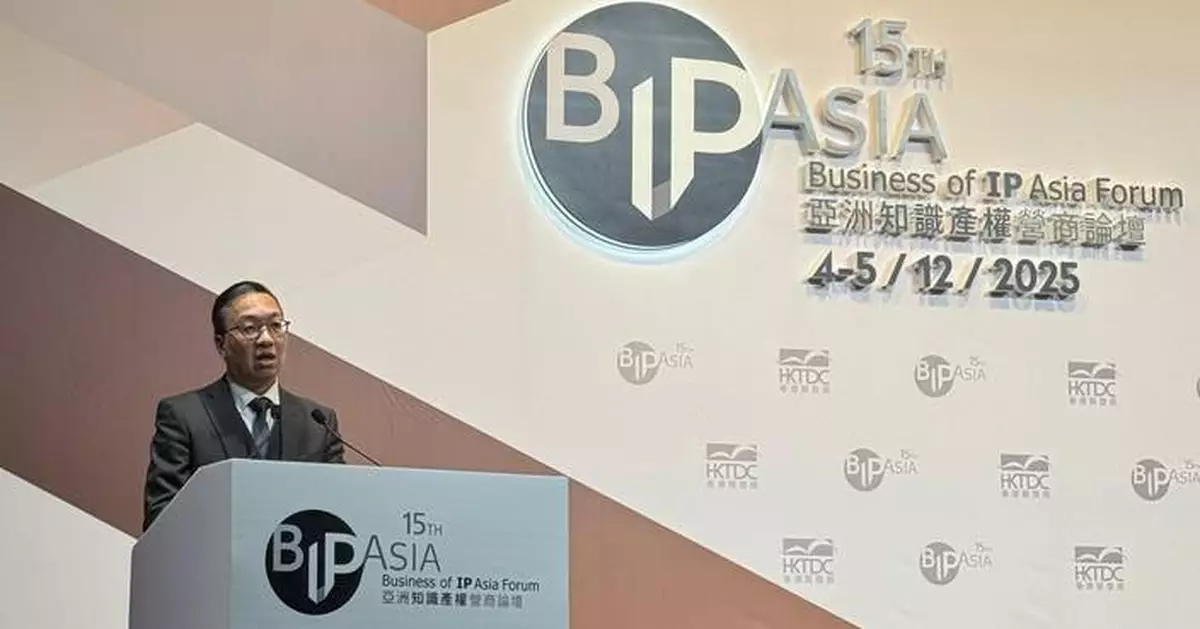
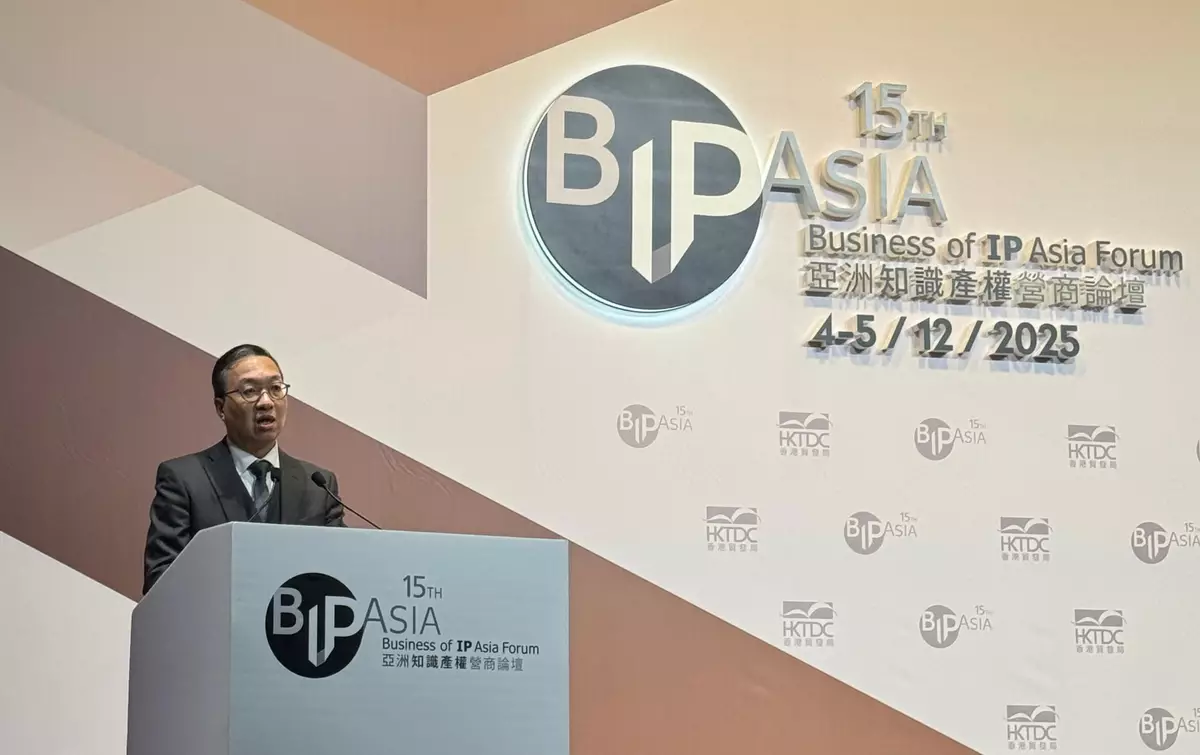
Speech by SJ at 15th Business of IP Asia Forum Concurrent Breakout Session
Following are the welcome remarks by the Secretary for Justice, Mr Paul Lam, SC, at the 15th Business of IP Asia Forum Concurrent Breakout Session "From Trends to Triumph: Conquering the Legal Hurdles in IP Commercialization" today (December 5):
Distinguished guests, ladies and gentlemen,
Good afternoon. I welcome you all to this thematic breakout session co-organised by the Department of Justice and the Hong Kong Trade Development Council.
In recent years, the popular art toy industry and the "goods economy" have expanded rapidly worldwide. Notably, the iconic art toy character Labubu, created by a renowned Hong Kong designer, has received the most attention. Its diverse range of IP (intellectual property) merchandise, from "blind boxes" and plush toys to apparels and accessories, have generated considerable profits in the markets of Hong Kong and beyond.
But the art toy phenomenon is more than a momentary trend, it presents valuable opportunities for Hong Kong. At the same time, numerous challenges in the realm of intellectual property have emerged alongside its growing fame. Later this afternoon, our distinguished speakers will take us through strategies for protecting the intellectual property rights of IP merchandise, the potential infringement risks and legal challenges related to IP commercialisation, and address how IP disputes can be tackled and resolved.
Robust IP protection regime
As Hong Kong is capitalising on IP as a new growth area, a robust and effective IP protection regime lays the foundation for fostering innovation, technological development and creativity. Indeed, such a regime builds up confidence and serves as a prerequisite for promoting IP trading in the highly competitive international landscape.
To fully leverage the advantage of support from the Central People's Government for Hong Kong to develop into a regional IP trading centre, the Government attaches great importance to the legal protection of IP rights, and has made every effort to ensure our IP legal framework remains up to date, aligns with current international standards, and meets the demands of Hong Kong's future economic development, especially those from creators and investors all over the world.
Recognising that industrial design, which seeks to protect the design of the appearance of an article, is one of the IP rights that is protected and registrable under the Paris Convention for the Protection of Industrial Property administered by the World Intellectual Property Organization (WIPO), the Government is currently conducting a comprehensive review of Hong Kong's registered designs regime under Registered Designs Ordinance (Cap. 522).
International and Mainland co-operation
Whilst the IP laws in Hong Kong are domestic and only offer territorial protection, Hong Kong continues to work closely with the international community in this respect. As of today, 10 main international IP conventions have been applied to Hong Kong, providing international and cross-border IP protection to IP creators. As a member of the World Trade Organization (WTO), our IP protection regime fully aligns with and strictly adheres to the international standards on the protection of IP rights set forth in the WTO's Agreement on Trade-Related Aspects of IP Rights.
Hong Kong has also established extensive co-operations with the Chinese Mainland in multiple areas of IP protection. For instance, the Commerce and Economic Development Bureau and the Qianhai Authority in Shenzhen jointly promulgated 16 Co-operation Measures for the Development of the Qianhai Shenzhen-Hong Kong Intellectual Property and Innovation Hub (Co-operation Measures) in 2023, which encompass a wide range of areas, including multidimensional co-operations in IP protection and IP trading.
These Co-operation Measures do not only serve to foster cross-boundary innovation and promote IP development on both sides, but also addresses in a timely manner the surging demand for IP trading in the areas of assignment and licensing of IP rights.
In this connection, the innovative capacity of the Guangdong-Hong Kong-Macao Greater Bay Area is well recognised by the international community. In the latest WIPO Global Innovation Index 2025, the Shenzhen-Hong Kong-Guangzhou cluster ranks first globally in the top 100 innovation clusters.
Dispute resolution
Moving onto dispute resolution, Hong Kong, as the international legal and dispute resolution services centre, is well-positioned to provide top-notch services in resolving IP disputes.
In respect of litigation, with the Mainland Judgments in Civil and Commercial Matters (Reciprocal Enforcement) Ordinance (Cap. 645) coming into effect last year, Hong Kong judgments on IP disputes are now generally recognised and enforceable in the Chinese Mainland. This represents a significant development as it goes beyond the international norms set out in the Hague Convention, which explicitly excludes all IP matters.
Turning to arbitration, arbitration is a prevalent option for resolving international IP disputes. Our dispute resolution professionals have substantial experience in resolving IP disputes. In this regard, our home-grown arbitral institution, the Hong Kong International Arbitration Centre, has maintained a Panel of Arbitrators for IP disputes. The Panel comprises members who have strong expertise and extensive experience in resolving IP disputes. As of November 2025, there are a total of 55 arbitrators for IP disputes on the panel.
The presence of these experienced IP arbitrators contributes to the attractiveness of Hong Kong as a seat for arbitration. According to the 2025 International Arbitration Survey conducted by Queen Mary University of London, Hong Kong ranks as the second most preferred seat for arbitration globally and the first in the Asia-Pacific region.
Hong Kong's arbitration regime is well suited to resolve IP disputes. In 2017, the Arbitration Ordinance (Cap. 609) was amended to clarify that disputes over IP rights can be resolved by arbitration and arbitral awards involving IP rights can be enforced in Hong Kong. Since the rapid development of innovation and technology around the world would inevitably give rise to IP disputes, these timely amendments have given Hong Kong a competitive edge over other jurisdictions in the region in resolving IP disputes. To ensure that the legislative framework for arbitration in Hong Kong stays at the forefront of international development, a Working Group on Arbitration Law Reform was recently established in late October 2025 to review and study further the needs to amend the Arbitration Ordinance.
In addition, the Interim Measures Arrangement (Arrangement Concerning Mutual Assistance in Court-ordered Interim Measures in Aid of Arbitral Proceedings by the Courts of the Mainland and of the HKSAR), which came into force in October 2019, has proven to be particularly useful in the context of cross-border IP disputes where urgent interim measures in the form of property and evidence preservation are usually called for. The arrangement allows parties to arbitral proceedings administered by designated arbitral institutions in Hong Kong to apply to court in the Chinese Mainland for interim measures. Hong Kong is currently the only common law jurisdiction with such an advantage, which again enhances Hong Kong's overall attractiveness as an arbitral seat.
Our panel speakers will discuss the benefits of resolving IP disputes through arbitration in further detail during the panel discussion session, and I am sure you will find the practical examples shared by the speakers insightful.
All in all, with the strong legal infrastructure and comprehensive policy initiatives in place to support IP trading and resolution of IP disputes, Hong Kong has the potential to strengthen its position as a premier hub for IP trading in the Asia-Pacific region and beyond in the years ahead.
On this note, I wish you all a very constructive session this afternoon. Thank you.
Speech by SJ at 15th Business of IP Asia Forum Concurrent Breakout Session Source: HKSAR Government Press Releases