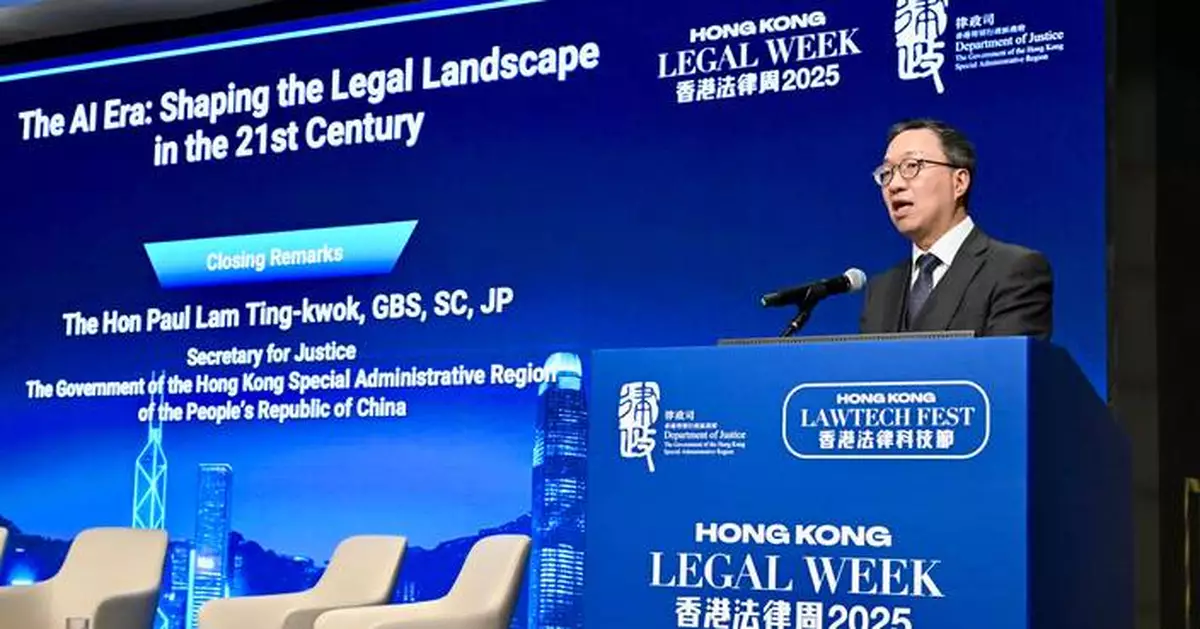
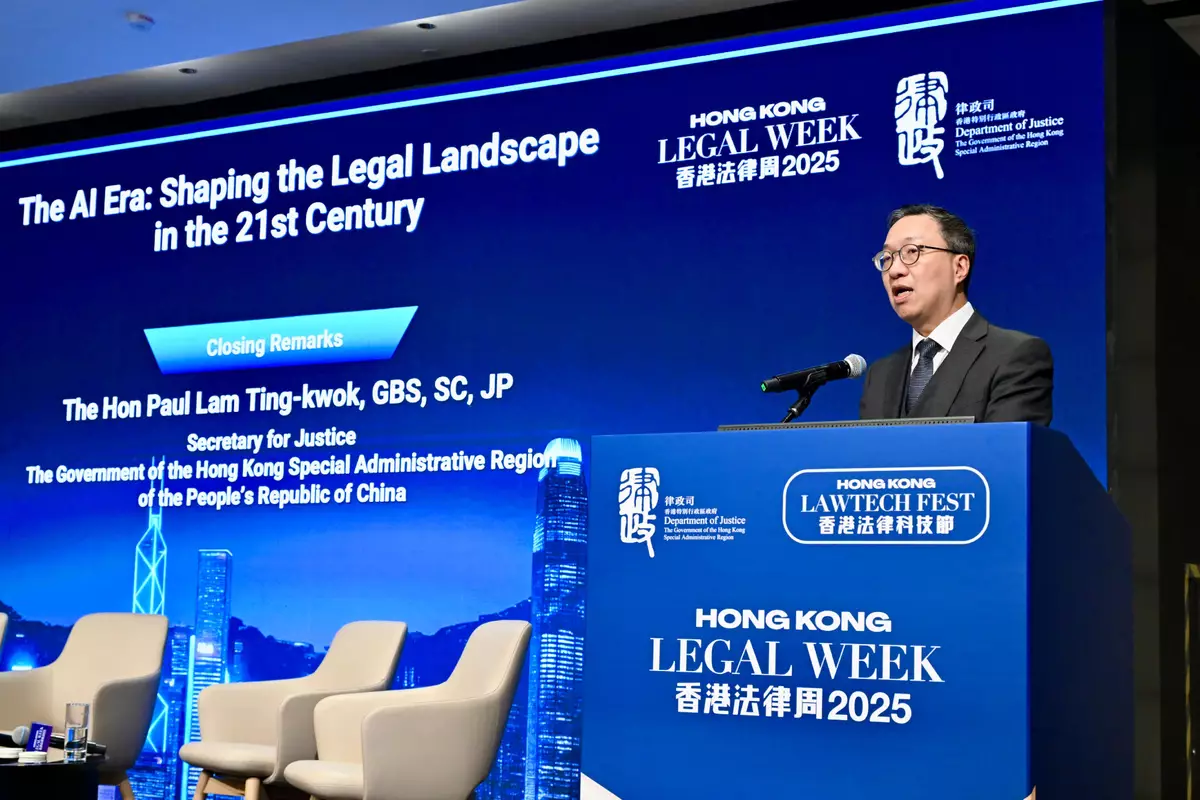
Speech by SJ at LawTech Conference "The AI Era: Shaping the Legal Landscape in the 21st Century" under Hong Kong Legal Week 2025 (with photo/video)
Following are the closing remarks by the Secretary for Justice, Mr Paul Lam, SC, at the LawTech Conference "The AI Era: Shaping the Legal Landscape in the 21st Century" under Hong Kong Legal Week 2025 today (December 5):
Distinguished guests, ladies and gentlemen,
As we approach the end of Hong Kong Legal Week 2025, I wish to extend my heartfelt gratitude to each of you for your active participation in the past few days despite the difficult circumstances in our community. We extend our deepest sympathies to all those affected by the tragic fire which took place last week and remain mindful of the gravity of the situation as we bring Hong Kong Legal Week 2025 to a close. This week has offered us a valuable platform to engage in meaningful dialogues on various international, regional and local hot topics. This afternoon, we have explored the burgeoning possibilities presented by lawtech and artificial intelligence (AI).
Importance of lawtech and AI in the 21st century
This is a meaningful year for the DoJ's (Department of Justice) annual flagship Hong Kong Legal Week, as we organised the inaugural Hong Kong LawTech Fest. Lawtech and AI are not only trends to observe but pivotal forces which are transforming the whole legal profession. During the Hong Kong LawTech Fest, we have explored how technological advancements are transforming the legal industry, enhancing not only efficiency but also accessibility and quality.
The significance oflawtech and AI cannot be overstated. The traditional methods we have relied on for long are now being complemented and, in some cases, supplanted by innovative technologies which help streamline workflow and enhance efficiency. AI-powered legal tools facilitate a wide variety of tasks including legal research, document review and drafting, contract lifecycle management and e-discovery, and are significantly changing the way legal practitioners engage with their work. These tools elevate legal services' quality by minimising human errors, speeding up administrative tasks, and ensuring more accurate and timely responses to clients.
Furthermore, the introduction of these technologies opens the door to a more inclusive legal landscape. The use of AI tools could facilitate access to justice through reducing the overall costs of legal services and making legal resources more easily accessible to individuals, regardless of their financial background. At the institutional level, they enable law firms, courts, and organisations to scale services, optimise resource allocation, and bridge gaps in access to justice.
Nevertheless, there are two sides to every coin. As we embrace these technological innovations, we must not neglect the associated risks and ethical considerations. Throughout the discussions and the LexGoTech Roundtables Report released today, we have acknowledged the dual nature of technology: whilst it holds the promise of efficiency and accuracy, it carries the risks of bias, challenges to data privacy, accountability and transparency, etc. In light of these risks, maintaining human-in-the-loop is critical. We should not forget that while AI can process vast amounts of data with remarkable speed, advocacy, ethical judgment, commercial acumen, critical decision-making, emotional intelligence and relationship building and management cannot be fully automated. It is therefore pertinent for us to adopt a "Human+AI" approach when embracing the use of AI so that we can harness the benefits of technology while safeguarding against its potential risks.
DoJ's work in the promotion of AI in the legal industry
It is imperative that we approach the implementation of lawtech and AI in legal practice in a cautious and step-by-step manner. In this connection, the DoJ has embraced the recommendation of the Consultation Group on LawTech Development to promote the use of technology in the legal industry progressively in three stages. In Phase 1, we aim to change certain ingrained mindsets and practices within the legal profession by raising awareness. To this end, the DoJ launched the LexGoTech Roundtable Series to raise the profession's understanding of lawtech and to facilitate the exchange and sharing of information between the profession and lawtech experts to enable them to plan for the viable adoption of lawtech. Moving to Phase 2, we aim to promote the profession's engagement with lawtech products. We hope that through the Hong Kong LawTech Fest, the legal sector could have a better understanding of and access to thelawtech products which are available in the market, and to empower them to make informed choices on the adoption approach that best suits their individual needs. In Phase 3, we would accelerate the widespread adoption of lawtech in the legal profession by encouraging local and overseas lawtech enterprises to establish and grow in the local market, thereby fostering Hong Kong's lawtech ecosystem.
Policy Address 2025 and the National "AI+" Initiative
The Chief Executive's 2025 Policy Address emphasises the Government's strong commitment to step up the promotion of AI as a core industry for Hong Kong's development. In this connection, apart from actively promoting the integration of lawtech and AI in the legal sector, the DoJ has taken on a pivotal role in shaping the broader legal regime for AI governance. In particular, we will establish an interdepartmental working group by the end of this year to co-ordinate the responsible bureaux in reviewing the relevant legislation, so as to support and complement the development of and need for wider application of AI in Hong Kong.
The emphasis of AI in Policy Address 2025 resonates with the national "AI+" Initiative. The 10-year blueprint for integrating AI into China's economy and society aims to maximise the technology's benefits for domestic development and international competitiveness. By aligning ourselves with this national strategy, and with Hong Kong being the springboard for Mainland enterprises going global, we would strengthen Hong Kong's competitiveness as a global hub for AI development as well as contribute to national development by powering up our legal services.
As legal practitioners, it is our responsibility to harness the potential of lawtech and AI, not merely to enhance our practices but also to contribute to the overall development of our society. Embracing AI complements our vision of a forward-looking, dynamic legal system which is well prepared to tackle the challenges of the digital age. As we consider the implications of these goals for the legal profession, we must commit ourselves to continuous learning, adaptation, and collaboration. We should work together to ensure that the legal sector evolves alongside technological advancements while adhering to key principles such as accuracy and reliability, compliance with laws and regulations, security and transparency, etc.
The AI revolution offers us an unprecedented opportunity to redefine the legal profession and sharpen our skills. By embracing these changes with an open and cautious mindset, we can create a legal system which is not only swifter and smarter, but also fairer and more accessible for all. Let us ride the wave of this AI revolution together and seize the opportunities to enhance our practices and serve our community with greater impact. Together, we can keep Hong Kong at the vanguard of legal innovation in the 21st century.
Last but not least, I would like to take this opportunity to invite all those who are eligible to exercise your right to vote in the Legislative Council General Election on Sunday. Your active participation is more than a constitutional duty - it is a pivotal choice which will shape the future of our legal system, uphold the rule of law, and secure the well-being of our society.
Before I conclude, I would like to take this opportunity to express my sincere gratitude to the supporting organisations, exhibitors of the Hong Kong LawTech Fest, moderators, speakers, my colleagues and all participants. None of the events of Hong Kong Legal Week 2025 would have been possible without your support, dedication, and hard work. On behalf of the Department, I extend our deepest thanks. Thank you.
Speech by SJ at LawTech Conference "The AI Era: Shaping the Legal Landscape in the 21st Century" under Hong Kong Legal Week 2025 (with photo/video) Source: HKSAR Government Press Releases

HKSAR Government actively aligns with National 15th Five-Year Plan and presses ahead with high-quality development
The fourth session of the 14th National People's Congress today (March 12) approved the "Outline of the 15th Five-Year Plan for National Economic and Social Development of the People's Republic of China" (the 15th Five-Year Plan). A spokesman for the Hong Kong Special Administrative Region (HKSAR) Government expressed sincere gratitude to the Central Authorities for their support in consolidating and enhancing Hong Kong's competitive edge across various key areas, facilitating Hong Kong's better integration into and service of the overall national development.
The Chief Executive, Mr John Lee, said, "The 15th Five-Year Plan is the blueprint and action agenda for the social and economic development of the country in the next five years. The major objectives for this period include significant achievements in high-quality development, substantial improvements in scientific and technological self-reliance and strength, fresh breakthroughs in further deepening reform comprehensively, notable cultural and ethical progress across society, further improvements in quality of life, major new strides in advancing the Beautiful China Initiative and further advances in strengthening the national security shield. The HKSAR is greatly encouraged by this and will proactively align with the 15th Five-Year Plan Outline, contributing Hong Kong's strength to further deepening reform comprehensively and advancing Chinese modernisation.
"I extend my sincere gratitude for the country's steadfast support and care for Hong Kong as demonstrated by the inclusion of multiple provisions in the 15th Five-Year Plan to promote Hong Kong's long-term prosperity and stability, and to deepen the development of the Guangdong-Hong Kong-Macao Greater Bay Area. I will lead the HKSAR Government to earnestly fulfil its role in bearing the primary responsibility for the governance of Hong Kong, unite various sectors of the community to actively support and proactively align with the National 15th Five-Year Plan. Through formulating a systematic policy framework, we will map out strategic initiatives of greater comprehensiveness, higher precision and in finer detail for key development areas, and draw up a macroscopic, strategic and forward-looking five-year plan for the first time for Hong Kong. The preparatory groups set up earlier by various bureaux under my instruction have been converted into the formulation teams for the alignment with the 15th Five-Year Plan, which will work full speed to complete the Hong Kong five-year plan within this year.
"The first Hong Kong's Five-year Plan, aligned with the National 15th Five-Year Plan, will have far-reaching implications. Serving as the collective action framework for the HKSAR, it will outline Hong Kong's development vision, core objectives, key areas and major initiatives over the next five years. This plan will provide clear guidance for Hong Kong's socio-economic and livelihood development, driving Hong Kong's deeper integration into and contribution to the overall national development. The most direct benefit of the Hong Kong's Five-Year Plan stems from the robust backing of national development. As the world's second-largest economy, the country's comprehensive capabilities provide Hong Kong with immense market momentum and development opportunities. As the country has surged to global leadership in various fields including innovation and technology, artificial intelligence, big data, and infrastructural development, Hong Kong can leverage the country's industrial ecosystem and progress to achieve leapfrog development in our own emerging industries. For instance, in the financial sector, Hong Kong can build upon the country's strategy to promote the internationalisation of the Renminbi to strengthen our function as a global offshore Renminbi business hub, and to enhance the mutual market access regime and consolidate our status as an international financial centre. In the area of innovation and technology, Hong Kong can accelerate collaboration and transformation among the industry, academic and research sectors through the development of the Northern Metropolis. As regards industrial upgrading, Hong Kong can also integrate into national strategies, such as the 'Artificial Intelligence Plus (AI+) Initiative', to empower its traditional competitive industries, thereby strengthening its new productive forces amid the new round of scientific and technological revolution as well as industry transformation.
"To ensure the smooth progress of the formulation work, I will take the lead in this endeavour, with the Constitutional and Mainland Affairs Bureau assuming primary responsibility. All Secretaries of Bureaux shall fully commit to driving forward and jointly participating in this initiative. I am confident that with our concerted efforts and collective wisdom, the first Hong Kong's Five-year Plan will serve as a guiding framework for pioneering new horizons and achieving a new leap forward for Hong Kong. It will lay a more concrete foundation for our long-term prosperity and stability, enabling Hong Kong to demonstrate renewed commitment and achievements in the journey of integrating into and serving the overall national development."
The 15th Five-Year Plan explicitly points out that the principles of "one country, two systems", "Hong Kong people administering Hong Kong" and a high degree of autonomy should be implemented with unwavering commitment; the principle of "patriots administering Hong Kong" should be put into practice; and the efficacy of governance in accordance with the law should be ensured to promote Hong Kong's economic and social development, and give full play to Hong Kong's unique advantages and important role of maintaining close connections with both the Mainland and the world. The 15th Five-Year Plan supports Hong Kong in consolidating and enhancing its status as an international financial, shipping and trade centre and an international aviation hub. It aims to strengthen Hong Kong's functions as a global offshore Renminbi business hub, an international asset management centre, and an international risk management centre. The plan also supports Hong Kong in developing into an international innovation and technology hub, while deepening its development as an international legal and dispute resolution services centre, a regional intellectual property trading centre, and the East-meets-West centre for international cultural exchange. The 15th Five-Year Plan also further incorporates, for the first time, support for Hong Kong in establishing a commodity trading ecosystem and a high value-added supply chain service centre. It also explicitly backs Hong Kong in accelerating the development of the Northern Metropolis and building an international hub for high-calibre talents. A spokesman for the HKSAR Government said that the Government is deeply encouraged by the Central Government's staunch support. Hong Kong will definitely seize the opportunity to proactively align with the requirements of national strategies, effectively translating the new positioning, functions and tasks entrusted by the Central Government into tangible outcomes that will drive high-quality economic development and improve people's livelihoods. The Government is accelerating the advancement of the Northern Metropolis, a crucial strategic development zone for Hong Kong, through innovative collaborative models, including large-scale land disposal and preferential policies. Multiple measures will be implemented with a view to attracting more leading enterprises to establish their operations there, thereby transforming this piece of land which is connected to the Mainland by mountains and sea into a new engine for Hong Kong's economic growth.
The 15th Five-Year Plan stated that co-operation between Hong Kong and the Mainland in the areas of economic, trade, technology and culture should be strengthened; policies and measures facilitating Hong Kong residents' development and life on the Mainland should be improved; and the mutual market access regime between Hong Kong and Mainland financial markets should be advanced in an orderly manner. The 15th Five-Year Plan also clearly proposed for the first time to deepen innovation collaboration between industry, academic and research sectors with the Mainland; to drive breakthroughs continuously in priority areas of co-operation; to promote the co-ordinated development of ports, airports and rail transit; to advance the preparatory work for the Hong Kong-Shenzhen Western Rail Link; and to develop major co-operation platforms including the Loop to high standards. It also called for improving mechanisms for Hong Kong to assume a greater role in the country's opening up to the world, supporting Hong Kong's deep involvement in the high-quality co-operation under the Belt and Road Initiative, leveraging its strengths in professional service to assist enterprises in going global, and harnessing Hong Kong's role as an important window for exchange and mutual learning between the Chinese and Western cultures.
The Government spokesman said that Hong Kong enjoys the advantage of connecting the Mainland and the world under the "one country, two systems" principle. It will fully leverage its international and market-oriented characteristics to promote connectivity with the Mainland. The HKSAR Government has established the Task Force on Supporting Mainland Enterprises in Going Global to connect the robust productivity of the Mainland, Hong Kong's world-renowned professional services and the keen demand of global buyers. Hong Kong will facilitate the efforts of quality enterprises in going global and bringing in international capital, steadfastly advancing high-quality development of the economy. Regarding the development of the Guangdong-Hong Kong-Macao Greater Bay Area, the HKSAR Government will proactively engage with relevant platform initiatives, continuously deepen the harmonisation of rules and mechanisms with Greater Bay Area cities, and facilitate the convenient cross-boundary flow of innovation elements.
The fourth session of the 14th National People's Congress also adopted the National Development Planning Law, marking for the first time that a dedicated piece of legislation concerning national development planning has been enacted at the top level. This provides a robust legal foundation for formulating development plans. The Government spokesman said that the National Development Planning Law established principles for national support in Hong Kong's proactive alignment with national development planning. It clearly affirmed the country's upholding of the "one country, two systems" principle, supporting the HKSAR's proactive integration into and service of the overall national development. This fully reflected the staunch support of the Central Authorities for Hong Kong's alignment with national development planning, providing robust legal safeguards for Hong Kong to better integrate into and serve the overall national development. It will enable Hong Kong to better leverage its unique advantages under the principle of "one country, two systems" and achieve deep alignment with the overall development strategy of the country, thereby giving full play to Hong Kong's strengths to serve the country's needs and facilitating Hong Kong's enhanced integration into and service of the overall national development.
The Government spokesman concluded, "This year marks the beginning of the country's 15th Five-Year Plan and represents a critical year for Hong Kong as it advances from stability towards prosperity. With the robust support of the National 15th Five-Year Plan, we shall continue to consolidate and enhance our international competitiveness, deepen international exchanges and co-operation, strengthen our bridging role between the Mainland and the world, and pioneer a new phase of high-quality development for Hong Kong. This will enable us to better integrate into and serve the overall national development, thereby making Hong Kong's contributions to the nation's endeavours in building a great country and achieving national rejuvenation."
Source: AI-found images