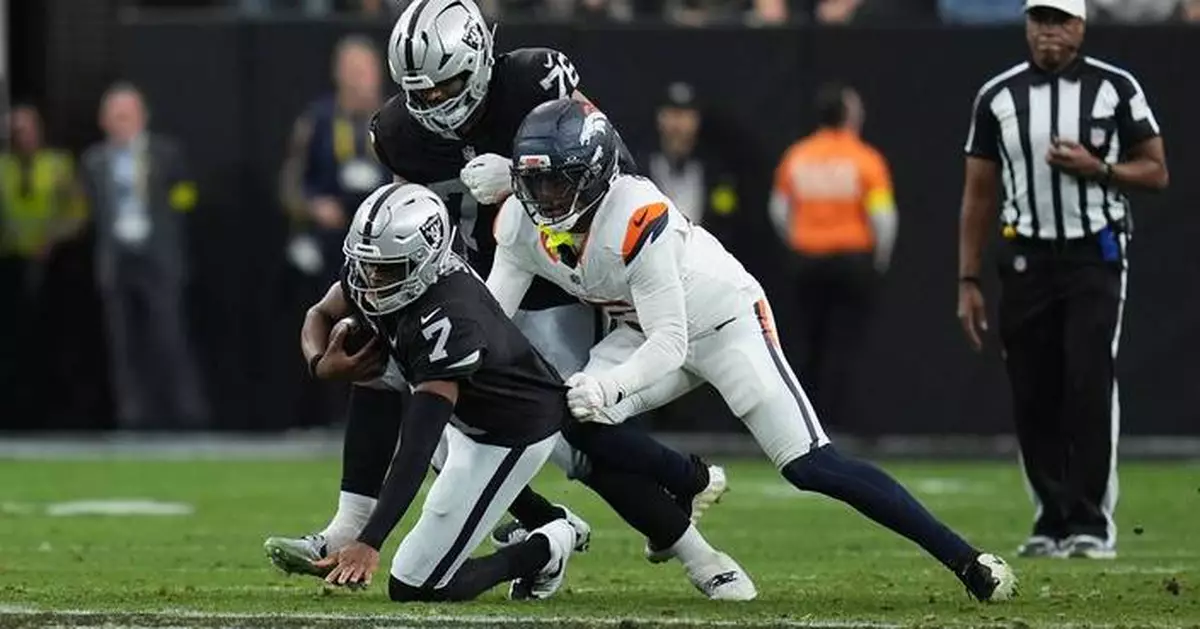
LAS VEGAS (AP) — Las Vegas Raiders quarterback Geno Smith suffered a right shoulder injury against the Denver Broncos on Sunday and was replaced by Kenny Pickett at the start of the fourth quarter.
Smith did not return, and the Raiders lost 24-17.
“From what I understand, I didn’t see the play happen, but he got banged on his shoulder,” Raiders coach Pete Carroll said. “It’s just kind of jammed up right now. The early indications that they were able to get didn’t show any damage. His shoulder's really locked up, so we’ll see what that means.”
Smith finished 13 of 21 for 116 yards and a touchdown. Trainers were also seen working on Smith’s right hand before his final series.
“What I heard, he got his hand cut,” Carroll added. “And so they just had to stop the bleeding.”
Pickett, who previously appeared in two games this season — at Kansas City and at Denver — finished 8 of 11 for 97 yards and a touchdown.
“It felt good just to get into a rhythm and play a little bit,” Pickett said. “It’s definitely a challenge coming in off the bench and in the game, just trying to find a rhythm. Glad we got to get some points.”
Carroll said it was too early to speculate on Smith’s status for next weekend’s game at Philadelphia. Pickett won a Super Bowl ring as a backup with the Eagles last season.
“I’m going to do what I think is the right thing to do, and if Geno can play, that’s my thought,” Carroll said. “But I know Kenny can play, and so our players understood it too that Kenny did a good job, and they recognized that in the locker room after the game.
“I’m rooting for Geno to get back out there and see how he does. But we’re not gonna play him if he’s not right. So Kenny will be ready to go, and (third-string QB) Aidan (O’Connell) will be ready to go as well. And that’s how we’ll deal with it.”
The Raiders also lost defensive back Kyu Blu Kelly, who was carted off the field with a knee injury in the first half, and tight end Ian Thomas early in the fourth quarter with a calf injury.
AP NFL: https://apnews.com/hub/nfl

Las Vegas Raiders quarterback Geno Smith (7) passes against the Denver Broncos during the first half of an NFL football game in Las Vegas, Sunday, Dec. 7, 2025. (AP Photo/Candice Ward)
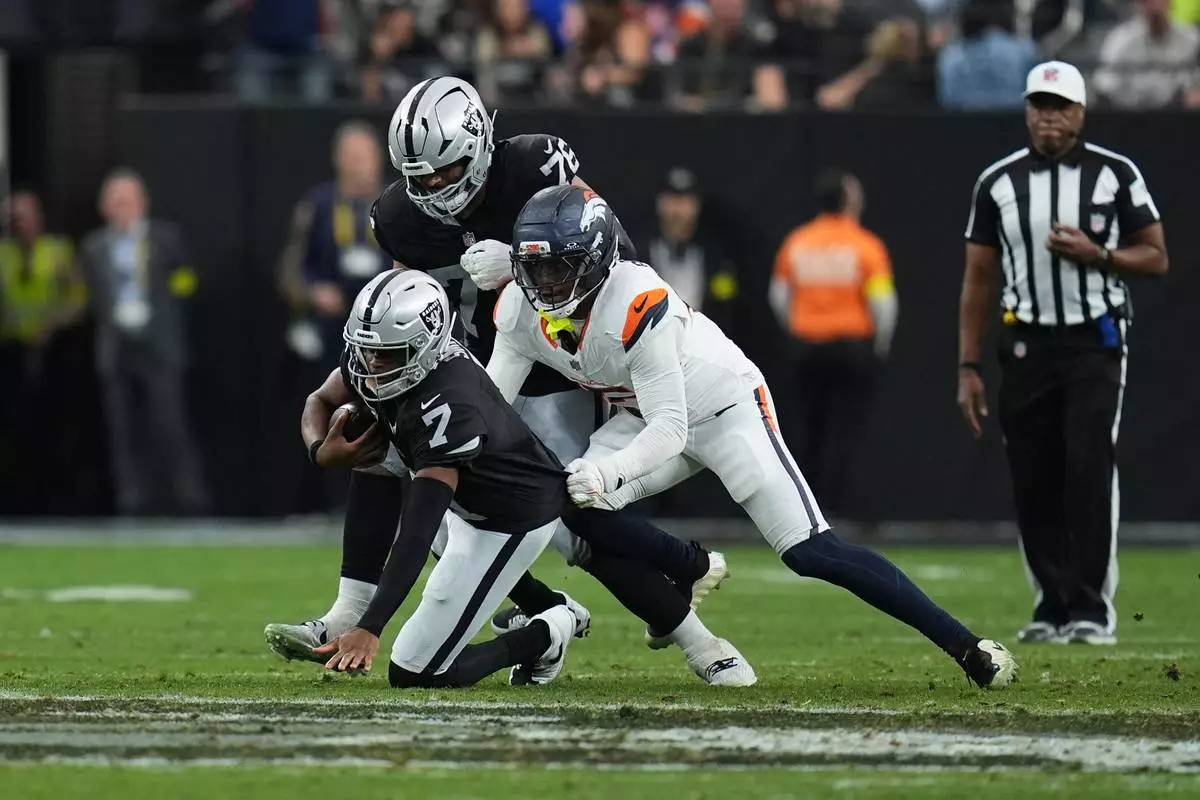
Las Vegas Raiders quarterback Geno Smith (7) is sacked by Denver Broncos linebacker Nik Bonitto, middle, during the first half of an NFL football game in Las Vegas, Sunday, Dec. 7, 2025. (AP Photo/Gregory Bull)
BANGKOK (AP) — The price of a barrel of Brent crude oil briefly topped $100 a barrel early Thursday, just days after it spiked near $120 in the latest jolts to financial markets and the global economy as a whole.
Oil prices initially shot more than 9% higher as supply concerns worsened with Iranian attacks on commercial shipping around the Strait of Hormuz. The U.S. campaign of airstrikes in Iran is now in its 13th day.
U.S. benchmark crude oil jumped 4.5% to about $91 a barrel. Brent, the international standard, was trading 5.3% higher at about $97 per barrel.
Iran has escalated its attacks aimed at generating enough global economic pain to pressure the United States and Israel to end the war. But there was no sign the conflict was subsiding.
Iran has targeted oil fields and refineries in Gulf Arab nations and effectively stopped cargo traffic through the narrow Strait of Hormuz, through which a fifth of all traded oil passes.
In response, the International Energy Agency agreed Wednesday to release 400 million barrels of oil, the largest volume of emergency oil reserves in its history, in a bid to counter the war’s effects on energy markets. The U.S. planned to release 172 million barrels of oil next week from its Strategic Petroleum Reserve to combat steep prices.
The IEA’s announcement came a day after energy ministers from the Group of Seven — the leading industrialized nations of Canada, the United States, France, Italy, Japan, Germany and Britain — met in Paris to look at ways to bring down prices.
But the continued strife and uncertainty have fueled speculation prices could push still higher, and that pulled shares lower.
The future for the S&P 500 lost 0.4% while that for the Dow Jones Industrial Average was 0.5% lower.
Germany's DAX lost 0.4% to 23,533.60, while the CAC 40 in Paris lost 0.7% to 7,982.64. Britain's FTSE 100 sank 0.7% to 10,285.91.
During Asian trading, Tokyo's Nikkei 225 fell 1% to 54,452.96. In South Korea, the Kospi lost 0.5% to 5,583.25, while Hong Kong's Hang Seng gave up 0.7% to 25,716.76.
The Shanghai Composite index shed 0.1% to 4,129.10 and in Australia, the S&P/ASX 200 dropped 1.3% to 8,629.00.
On Wednesday, U.S. stocks were little changed as the S&P 500 edged 0.1% lower for a second day of modest moves following a wild stretch caused by the war with Iran. The Dow Jones Industrial Average dropped 0.6%, to its lowest level this year, and the Nasdaq composite rose 0.1%.
Since the start of the war, sharp moves for oil prices have triggered swings up and down for financial markets worldwide, sometimes by the hour. Oil prices briefly spiked to their highest levels since 2022 this week because of the possibility that production in the Middle East could be blocked for a long time, which in turn raised worries about a surge of debilitating inflation for the global economy.
In a report, Oxford Economics said “the swings in Brent crude oil prices over the past several days are eye-catching and odds are volatility will remain because of the absence of a timeline for when the conflict will de-escalate and when the Strait of Hormuz, which is effectively closed, will see traffic begin to recover.”
The level of volatility suggests that depending on news developments, oil prices could spike as high as $140 per barrel, it said.
A report released Wednesday showed U.S. consumers paid prices for groceries, gasoline and other costs of living that were 2.4% higher in February than a year earlier.
That's the same level as the month before and better than the 2.5% that economists expected, but it remains above the Federal Reserve's 2% target and doesn’t include the spike in gasoline prices this month due to the war.
High inflation combined with a stagnating economy would create a worst-case scenario called “stagflation” that the Federal Reserve has no good tools to fix. Stagflation fears are rising not just because of higher oil prices but also because of weakness in hiring by U.S. employers.
In other dealings early Thursday, the dollar fell to 158.84 Japanese yen from 158.95 yen. The euro fell to $1.1553 from $1.1566.
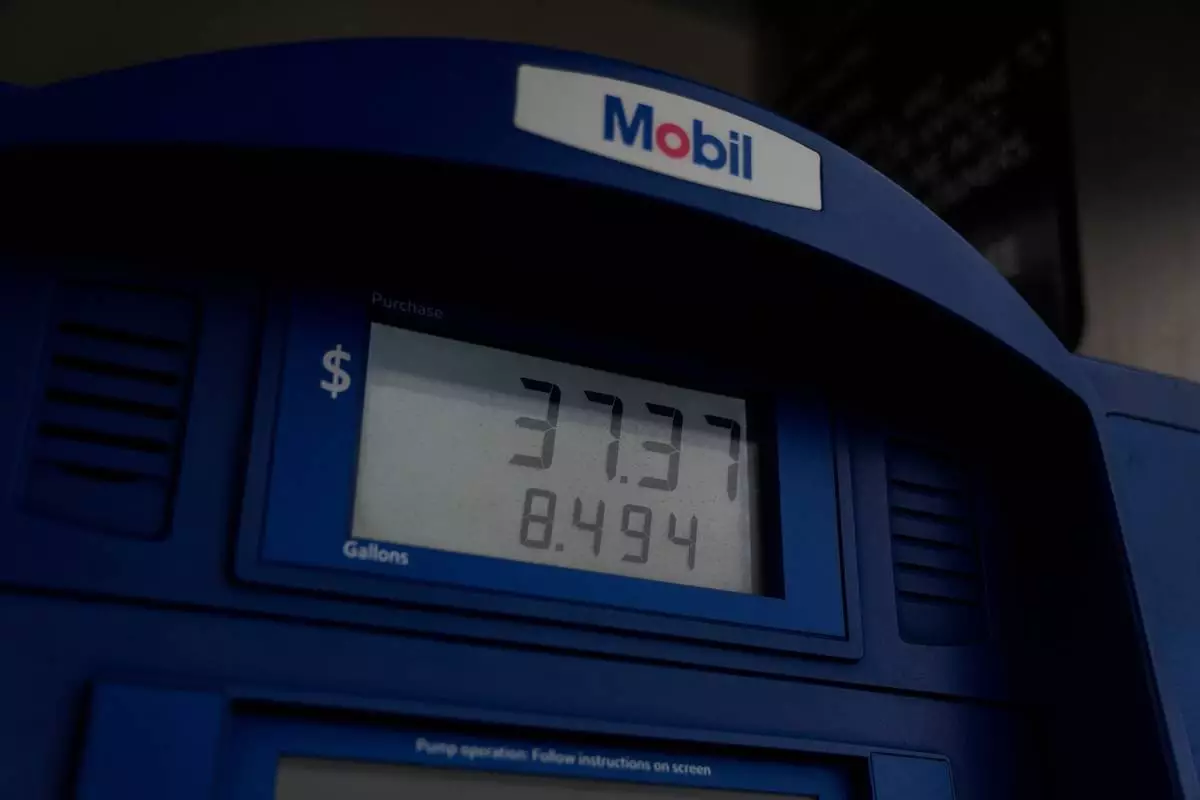
Gas prices are displayed at a station Wednesday, March 11, 2026, in Evanston Ill. (AP Photo/Erin Hooley)
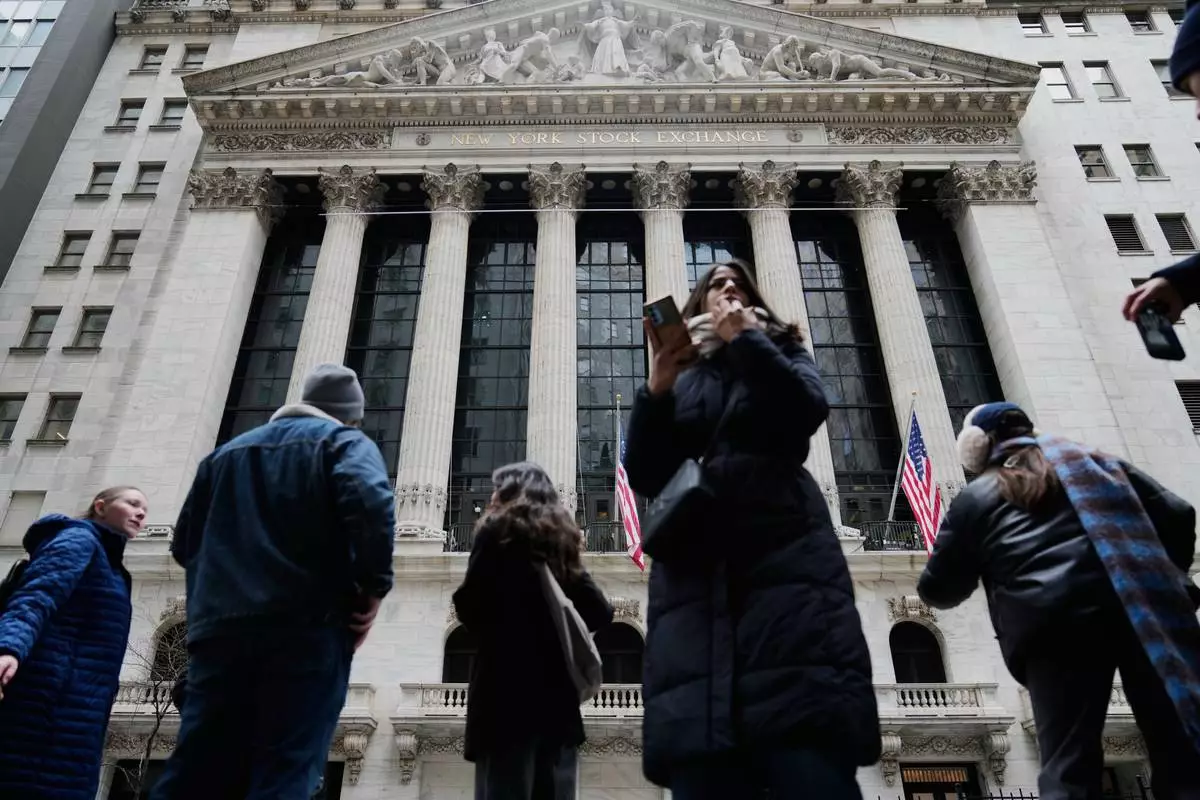
Pedestrians mill about outside the New York Stock Exchange in New York, Friday, March 6, 2026. (AP Photo/Seth Wenig)

The New York Stock Exchange is seen in New York, Friday, March 6, 2026. (AP Photo/Seth Wenig)

Traders work on the floor at the New York Stock Exchange in New York, Tuesday, March 10, 2026. (AP Photo/Seth Wenig)