Japan's attack on U.S. Pearl Harbor 84 years ago in Hawaii set off a chain of major events, dragging America into World War II and changing the course of global politics in the process.
The infamous base is located on Hawaii's O'ahu island, 3,500 kilometers from the closest continental landmass. There, on Dec 7, 1941, Japan launched a pre-emptive strike on the U.S. Pacific fleet, ahead of the seemingly inevitable start of hostilities, sinking six of its eight battleships and killing more than 2,100 Americans.
Kathi Hayashi's family lived less than two kilometers from the naval base.
"It was a lot of trauma. You'd got anti-aircraft bullets coming in from the battleships, and the zeros coming over. My grandfather, he was sitting on his bed. All of a sudden, this bullet came through the roof and right through his hand," said Hayashi, the president of 100th Infantry Battalion Veterans, an education center dedicated to the battalion's legacy.
Japan had feared a U.S. armed response to its plan to seize control of South East Asia for its natural resources, and its attack on the U.S. fleet stationed in Hawaii sought to cripple the U.S. Navy with a single blow.
The memory of the attack on Pearl Harbor is still visible in Hawaii today in the rusted remains of the multiple sunken American battleships that still poke out from beneath the waves, more than 80 years on. Today, the memorial site receives over 1.5 million visitors every year.
"It's hard to imagine what that day was. It's hard to put into words," said David Thiffault, a visitor to the memorial site.
"I'm a Navy veteran myself, so it has a special meaning for me to be here and see it for the first time," said Steven Tiefel, a U.S. Navy Veteran.
Having previously wavered over direct involvement given its politics of isolationism, the attack forced the United States to declare war on the Axis powers, bringing the country into World War II. The attack also had immediate impacts on the home front.
More than a third of Hawaii's population in 1941 were ethnically Japanese, the territory's largest ethnic group, resulting from decades of labor migration to its sugar plantations. Suspected by American authorities, many were taken to internment camps.
"Because the Japanese played such a major role in the sugar economy, they couldn't incarcerate the entire population, so they went after leadership. They targeted business owners, community leaders, religious leaders. It was very, very dismal for a lot of the prisoners," said Nate Gyotoku, president of the Japanese Cultural Center of Hawaii.
As the U.S. entered the war, American troops went to fight on two fronts, in the Pacific and in Europe, where 1,300 Japanese-Americans from Hawaii fought both Mussolini and American prejudice.
"They landed in Salerno, Italy, and within four months, they were down to only 500 or so able to fight. So, that's when the media started saying, this is the 'Purple Heart Battalion.' These Americans of Japanese ancestry are loyal Americans," said Hayashi.
While victory in Europe over Nazi Germany came on May 8, 1945, the conflict in the Pacific waged on for a further four months. It was aboard the USS Missouri in Tokyo Harbor, four years after the attack on Pearl Harbor, that the war officially came to an end with the signing of Japan's unconditional surrender.
However, the events of that period continue to echo today. The 1941 attack on Pearl Harbor set off a chain of events that led ultimately to the advent of nuclear warfare. Four years later, Japan's refusal to surrender saw U.S. planes drop atomic warheads on Hiroshima and Nagasaki.
At the memorial site in O'ahu, visitors are encouraged to reflect on the profound destruction these events wrought on the world.
"Conservatively, we estimate that about 69 million people died during World War II in all theaters of combat. Of that 69 million, about 50 million were civilians and non-combatants," said a tour guide.
"The submarine I was on carried nuclear weapons. I would like to think that we can step back from that, because if we resort to that level of weapon, I don't know what the outcome would be worldwide," Tiefel said.
A notorious event in world history, the lessons of Pearl Harbor have echoed around the world and down the generations.
"I was senior vice president of Verizon in New York City, the top Asian in a Fortune 50 company. And I wouldn't have had these opportunities, if these men didn't take a stand over 80 years ago to prove that Americans come in all colors," said Hayashi.
In a modern world wrought by conflict, Pearl Harbor stands as a stark reminder to those who come here.
"This is something to remember, we should try and work to prevent these events from happening," said Tiefel.
"We're still seeing some of these things happen in the modern-day world. Heightened tensions, suspicion without due process. And I think we can look at what happened to Japanese-Americans and other populations as a way to learn, hopefully, from history," Gyotoku said.
"It's still very relevant. There's still conflict all over the world. That launched the World War II, and it seems as if we're on the precipice of almost another world war, so it seems very somber to be here right now. You would think that after something like this it would end, but it never seems to end," said Thiffault.
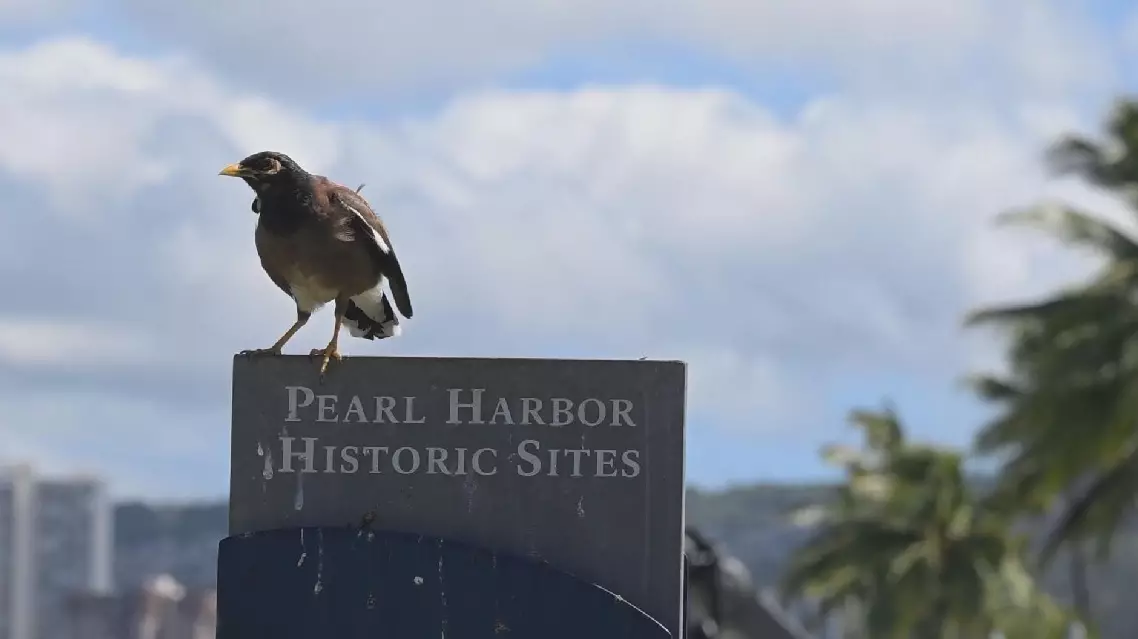
Pearl Harbor's legacy resonates 84 years on