A new high-yield hybrid wheat variety jointly bred by Chinese and Kazakh scientists is helping Kazakhstan, one of the main exporters of high-quality wheat products in the world, achieve more bumper harvests.
In Kazakhstan, farmers plant approximately 13 million hectares of wheat crops annually. However, the average yields per hectare have long stayed at around 1,200 kilograms.
In 2016, Northwest Agriculture and Forestry University in northwest China's Yangling launched a project to introduce high-yield Chinese wheat varieties to Central Asian countries including Kazakhstan, as part of China's plan to share agricultural technology with countries participating in the Belt and Road Initiative.
"This year, we have planted more than 200 Chinese wheat breeding materials in Kazakhstan, and two of those lines perform very well," said Chen Liang, professor at the College of Agronomy of Northwest Agriculture and Forestry University.
Initially, the Yangling wheat, known for yields as high as 7,500 kilograms per hectare in China, encountered significant adaptation challenges in Kazakhstan due to different geographical and climatic conditions between the two countries.
To breed a new wheat variety that combines the high output and stress resistance of Yangling wheat with the superior quality traits of Kazakh wheat -- particularly its high protein and wet gluten content -- the research team initiated a decade-long Sino-Kazakh wheat cross-breeding project.
"It's time for us to reap what we sowed ten years ago. Today, we've finalized several mature new wheat breeding lines. More importantly, we've inspired and trained a group of young local scientists, teaching them how to use modern biotechnology in breeding," said Li Xuejun, chairman of the Silk Road Wheat Innovation Alliance, and professor at the College of Agronomy at Northwest Agriculture and Forestry University.
According to the latest statistics this year, the new Yangling wheat variety has achieved more than a 20-percent growth in yield per unit area compared to local varieties.
"These varieties perform just as well as, or even better than our local crops. More importantly, their quality traits are attractive and outstanding, making them perfectly suited for our region's agricultural production system," said Altyn Shayakhmetova, dean of the Faculty of Agrotechnology at Manash Kozybayev North Kazakhstan University. The Chinese-Kazakh hybrid wheat is expected to bring additional income for local farmers in Kazakhstan.
"If we can increase yields on Kazakhstan's vast lands and help to transform the region into a 'global granary,' we can boost exports and raise local farmers' incomes. This represents a truly win-win cooperation," said Zhang Zhengmao, honorary chairman of the Silk Road Wheat Innovation Alliance and professor of Northwest Agriculture and Forestry University.
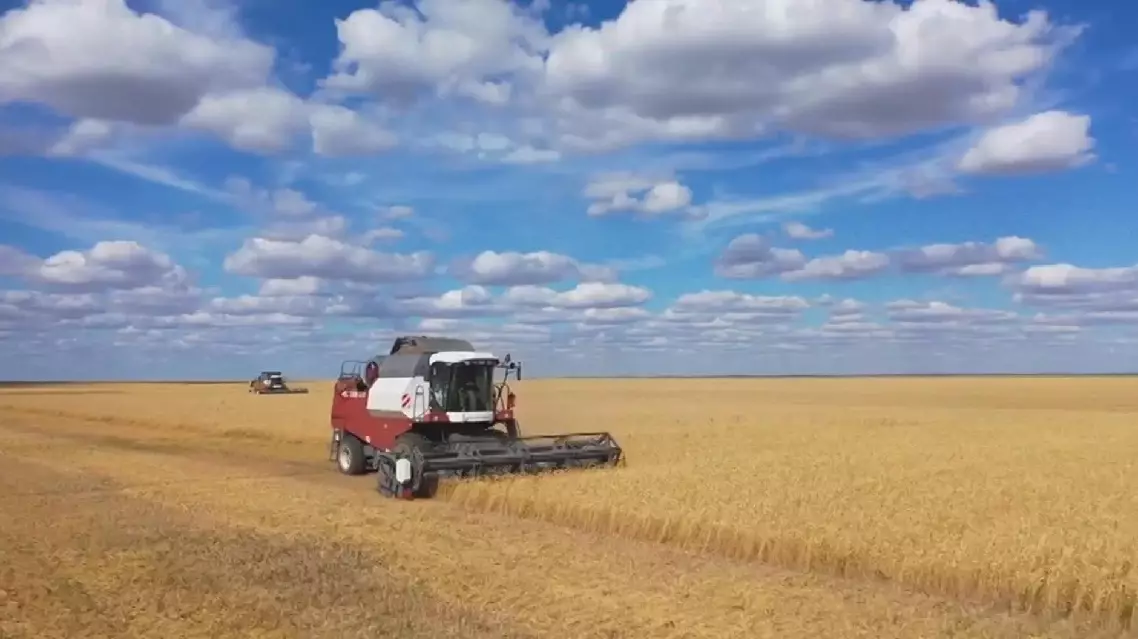
Chinese-Kazakh hybrid wheat variety helps Kazakhstan achieve bumper harvests