ORLANDO, Fla. (AP) — With Barry Bonds and Roger Clemens facing only one more chance under the current rules to get into baseball's Hall of Fame, the Hall chairman thinks they were turned down because contemporary era committee members evaluate the Steroids Era in the same manner as baseball writers.
Bonds and Clemens each received fewer than five votes Sunday from the committee that elected Jeff Kent.
“I'm not surprised because I think there’s overlap and obviously discussions among the writers and we have writers represented on that committee,” Hall chairman Jane Forbes Clark said Monday following a news conference with Kent at the winter meetings.
Under a change announced by the Hall last March, candidates who received fewer than five votes from the 16-person panel are not eligible for that committee’s ballot during the next three-year cycle. A candidate who is dropped, later reappears on a ballot and again receives fewer than five votes would be barred from future ballot appearances.
That means if Bonds and Clemens reappear on the contemporary era ballot in 2031 and fail to get five votes, they would be barred from future appearances unless the rules are changed.
“What’s lovely about it is it’s going to open up spots on the ballot so that more people can be reviewed,” Clark said. “They certainly can come back in six years, in ‘31, but between now and then some other people will have a chance because I think that’s really important.”
Under the Hall's committee format, contemporary era players from 1980 on alternates over three years with the classic era and contemporary era managers, executives and umpires.
A seven-time NL MVP and 14-time All-Star outfielder, Bonds set the career home run record with 762 and the season record with 73 in 2001. A seven-time Cy Young Award winner, Clemens went 354-184 with a 3.12 ERA and 4,672 strikeouts, third behind Nolan Ryan (5,714) and Randy Johnson (4,875).
Bonds has denied knowingly using performance-enhancing drugs and Clemens maintains he never used PEDs.
Bonds and Clemens fell short in 2022 in their 10th and final appearances on the BBWAA ballot, when Bonds received 260 of 394 votes (66%) and Clemens 257 (65.2%).
In their first appearance on the contemporary era committee ballot, Bonds and Clemens each received fewer than four votes in December 2022 as Fred McGriff was elected.
AP MLB: https://apnews.com/MLB

FILE - Houston Astros player Roger Clemens throws out the ceremonial pitch ahead of Game 1 of baseball's American League Championship Series between the Houston Astros and the New York Yankees, Oct. 19, 2022, in Houston. (AP Photo/Kevin M. Cox, File)

FILE - Former Pittsburgh Pirates outfielder Barry Bonds acknowledges the crowd during a ceremony for players that are part of the team's 2024 Hall of Fame class before a baseball game against the Cincinnati Reds in Pittsburgh, Aug. 24, 2024. (AP Photo/Barry Reeger, File)
The most comprehensive global environment assessment ever undertaken calls for a new approach to jointly tackle the most pressing environmental issues including climate change and biodiversity loss that threaten over 1 million plant and animal species with extinction.
The U.N. Environment Assembly — which the U.S. government didn't attend — produced the new report this week by almost 300 scientists from 83 countries.
The issues, which also include land degradation and pollution, are inextricably linked and require solutions that include increased spending and financial incentives to transition away from fossil fuels, encourage sustainable agricultural practices, curb pollution and limit waste, the authors of the U.N. Environment Programme's Global Environment Outlook said.
“You can’t think of climate change without thinking of biodiversity, land degradation and pollution,” said Bob Watson, one of the lead authors and a former top NASA and British climate scientist. "You can’t think of biodiversity loss without thinking about the implications of climate change and pollution."
They’re “all undermining our economy," worsening health and poverty and threatening food and water security and even national security, Watson said.
Experts have warned that the world is nearing a tipping point on climate change, species and land loss and other harms. But efforts to address those problems largely have been pursued through individual agreements that haven't made nearly enough progress, they said.
Instead, they advocate an approach that involves every area of government, the financial sector, industry and citizens and a circular economy that recognizes that natural resources are limited.
“What we’re saying is we can become much more sustainable, but it will take unprecedented change to transform these systems,” Watson said. “It has to be done rapidly now because we’re running out of time.”
The report lays out a dire future if the world continues on its current path.
Emissions of heat-trapping greenhouse gases — primarily from burning fossil fuels such as coal, gas and oil — reached a new high in 2024, despite decades of negotiations between countries to curb emissions.
Ten years ago, almost 200 nations signed the Paris Agreement with the goal of limiting future warming to no more than 1.5 degrees Celsius (2.7 degrees Fahrenheit) since preindustrial times to avoid or lessen the most catastrophic effects of climate change. But on the current trajectory, the climate could warm by 2.4 degrees Celsius (4 degrees Fahrenheit) by 2100, Watson said.
Scientists say climate change is contributing to wilder weather extremes, including more intense storms, drought, heat and wildfires.
What's more, climate change is a threat multiplier, meaning that it makes things like land degradation, deforestation and biodiversity loss worse, said Katharine Hayhoe, a climate scientist at Texas Tech University and chief scientist at the Nature Conservancy, who wasn't involved in the report.
“If we don’t fix climate change, we’re not going to be able to fix these other issues too,” Hayhoe said.
Among other challenges: Up to 40% of land area globally is degraded, and pollution contributes to an estimated 9 million deaths a year.
Adopting a comprehensive approach would be expensive, scientists acknowledge, but cost far less than the harms that otherwise could result.
The report says that to achieve a goal of net-zero emissions by 2050 and restore biodiversity, about $8 trillion in global investment is needed every year. But starting in 2050, economic benefits will surpass spending, growing to $20 trillion a year by 2070 and $100 trillion a year thereafter.
Nations also must look beyond gross domestic product as a barometer for economic health, because it doesn't measure whether growth is sustainable or recognize its potential harms, Watson said.
Environmental issues aren't the only things interlinked, Watson said. He also said governments, nonprofits, industry and the financial sector also must ensure that there are incentives and funding for renewable energy and sustainable agricultural practices, for example.
University of Pennsylvania climate scientist Michael Mann, who wasn't involved in the report, welcomed its emphasis on tackling issues across governments and society.
“We must do what is right, rather than what seems politically expedient,” Mann said. “The stakes are simply too great."
Despite the report's urgent call for action, international cooperation is anything but guaranteed, scientists say — especially as U.S. President Donald Trump has refused to participate in many of the discussions.
Trump, who withdrew the United States from the Paris Agreement, has called climate change a hoax. He's promoted fossil fuel use, canceled permits for renewable energy and is abandoning automobile fuel-efficiency standards.
“International action and agreements are becoming harder and harder,” Watson said, noting that this year's U.N. climate conference in Brazil failed to “move in the direction we needed it to move” with stronger commitments to reduce greenhouse gas emissions and other issues.
Talks this summer on a treaty to address plastic pollution in Geneva ended without an agreement, though a U.N. conference earlier in the year garnered commitments for funding to protect global biodiversity.
Watson said that the U.S. didn't attend the intergovernmental meeting in Nairobi, but joined discussions on the last day and "said they didn’t agree with anything in the report.”
“Some countries might say if the U.S. is not willing to act, why should we act?” Watson said.
Still, he believes that some countries will move forward, while others, including the U.S., could fall behind.
Hayhoe, the Texas Tech scientist, said that she's confident changes will happen, because the stakes are becoming too great.
“It is not about saving the planet. The planet will be orbiting the sun long after we’re gone,” Hayhoe said. “The question is, will there be a healthy, thriving human society on that planet? And the answer to that question is very much up for grabs at this point.”
The Associated Press’ climate and environmental coverage receives financial support from multiple private foundations. AP is solely responsible for all content. Find AP’s standards for working with philanthropies, a list of supporters and funded coverage areas at AP.org.
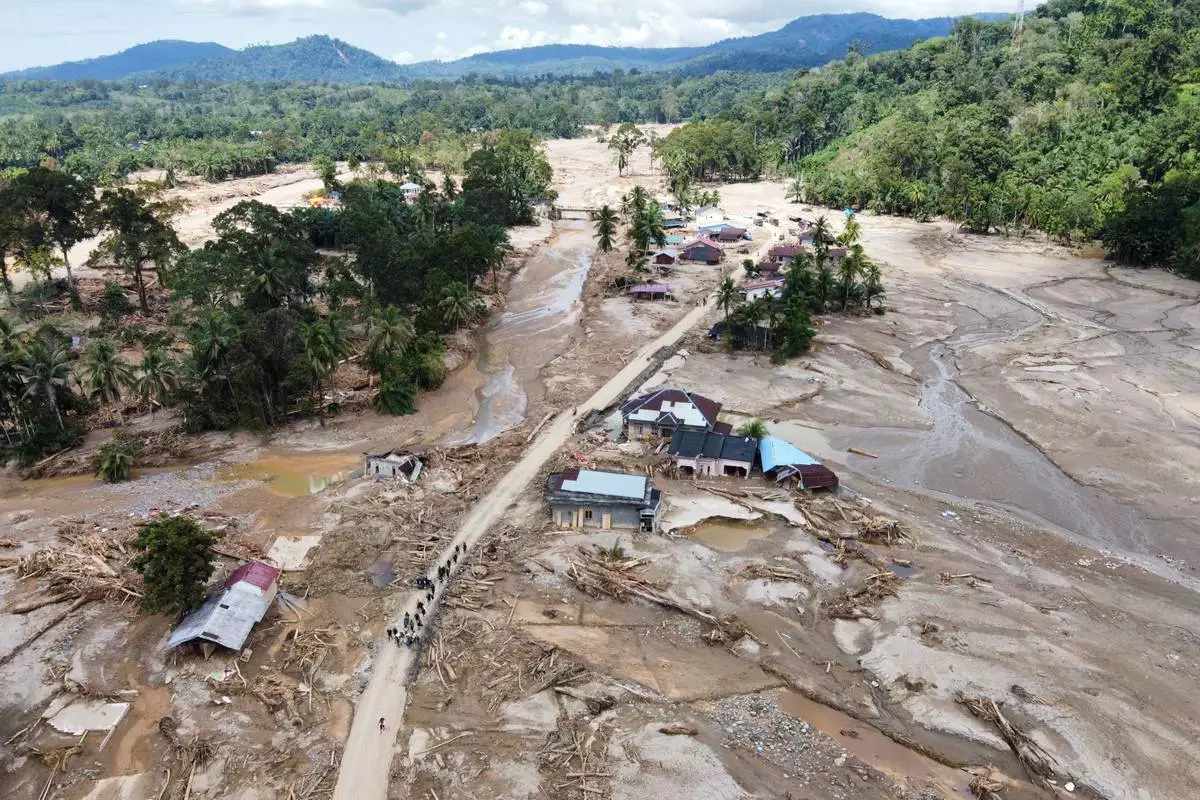
FILE - People walk along a road in a village affected by a flash flood in Batang Toru, North Sumatra, Indonesia, Dec. 1, 2025. (AP Photo/Binsar Bakkara, File)
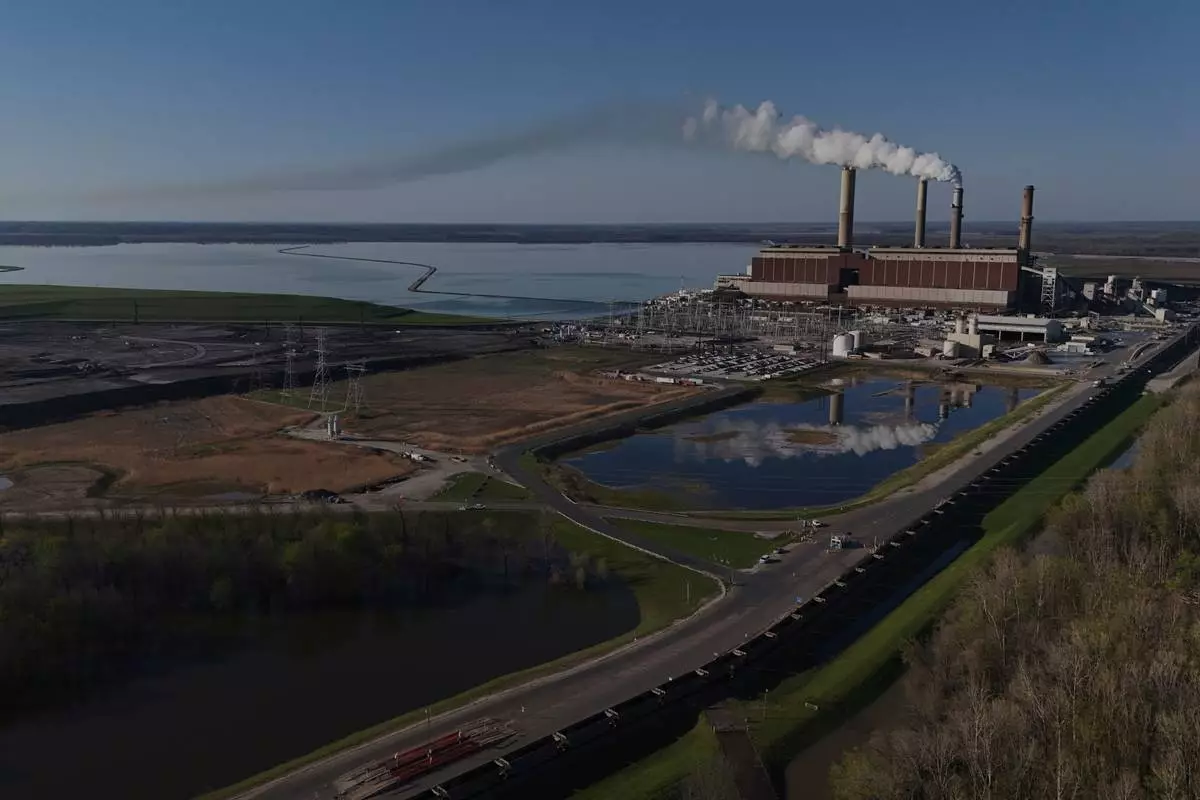
FILE - The Gibson Power Plant operates April 10, 2025, in Princeton, Ind. (AP Photo/Joshua A. Bickel, File)
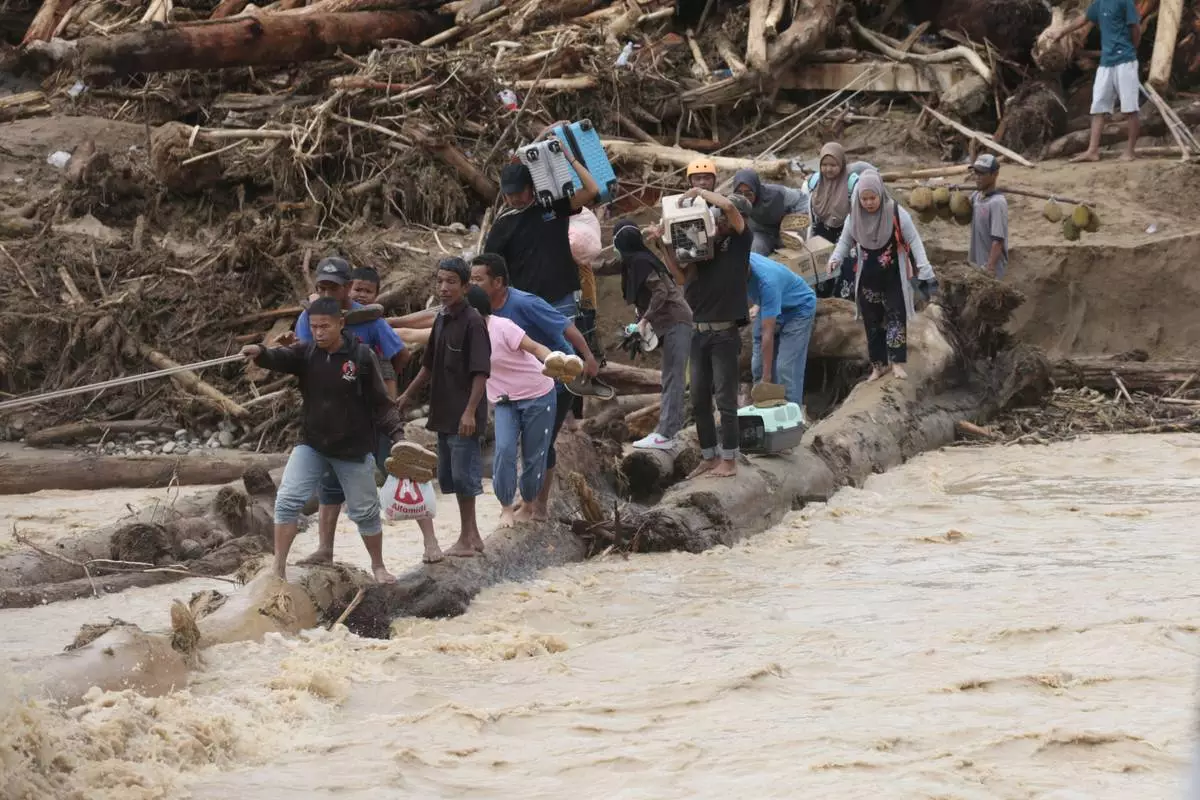
FILE - Flood survivors use logs to cross a river in Batang Toru, North Sumatra, Indonesia, Dec. 2, 2025. (AP Photo/Binsar Bakkara, File)
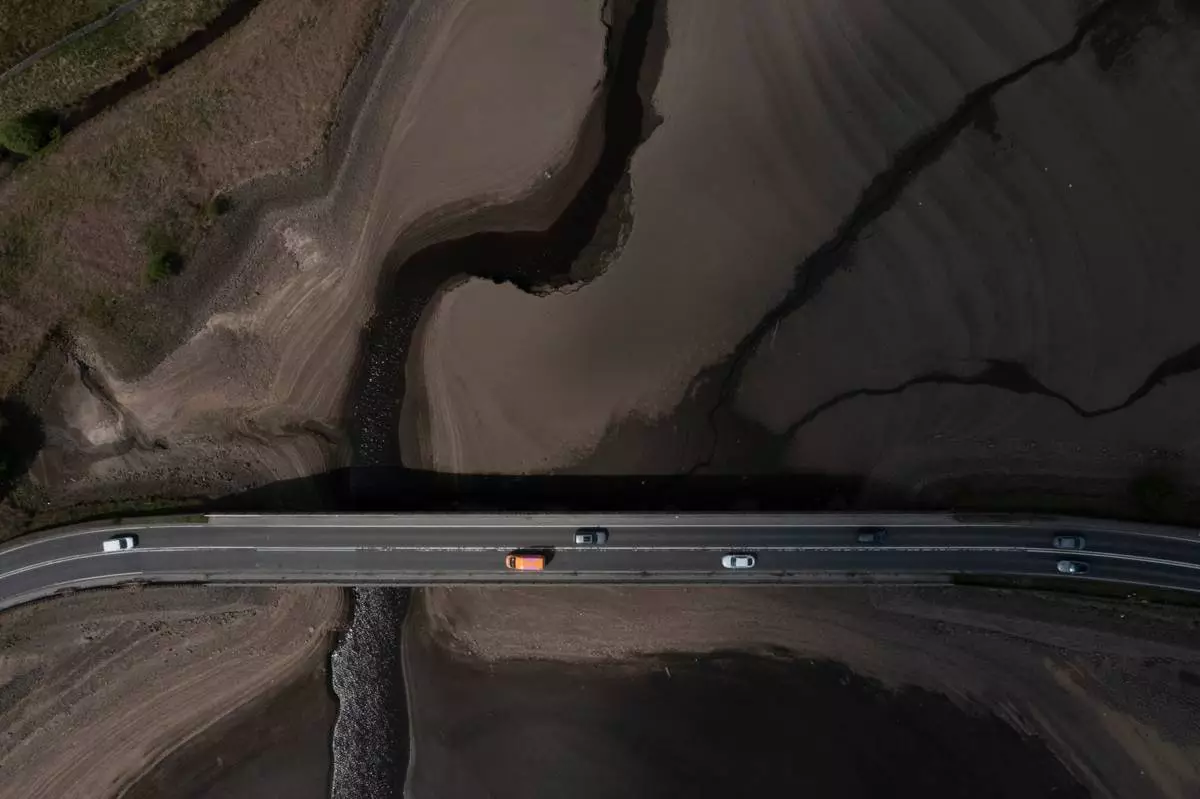
FILE - Traffic crosses a bridge at Woodhead Reservoir in Derbyshire as England experiences a drought in Woodhead, England, May 19, 2025. (AP Photo/Jon Super, File)
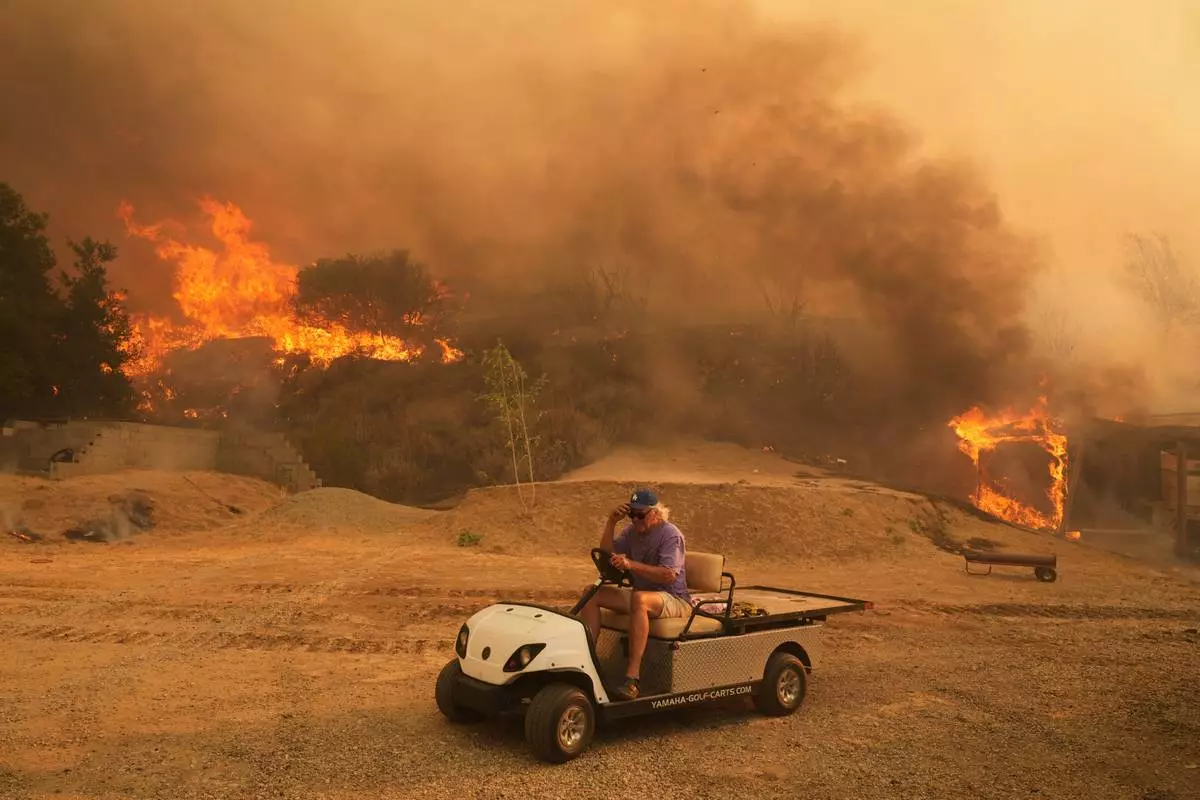
FILE - A resident rides a golf cart as he exits his property while the Canyon Fire burns on Aug. 7, 2025, in Hasley Canyon, Calif. (AP Photo/Marcio Jose Sanchez, File)