|
DUBAI, UAE, Dec. 9, 2025 /PRNewswire/ -- At the BIG Series Institutional Gala, Bybit Institutional introduced two major upgrades set to redefine the standards of institutional digital asset trading in 2025: an expanded INS Credit Suite and a fully redesigned Market Maker Gateway (MMGW) low-latency execution environment.
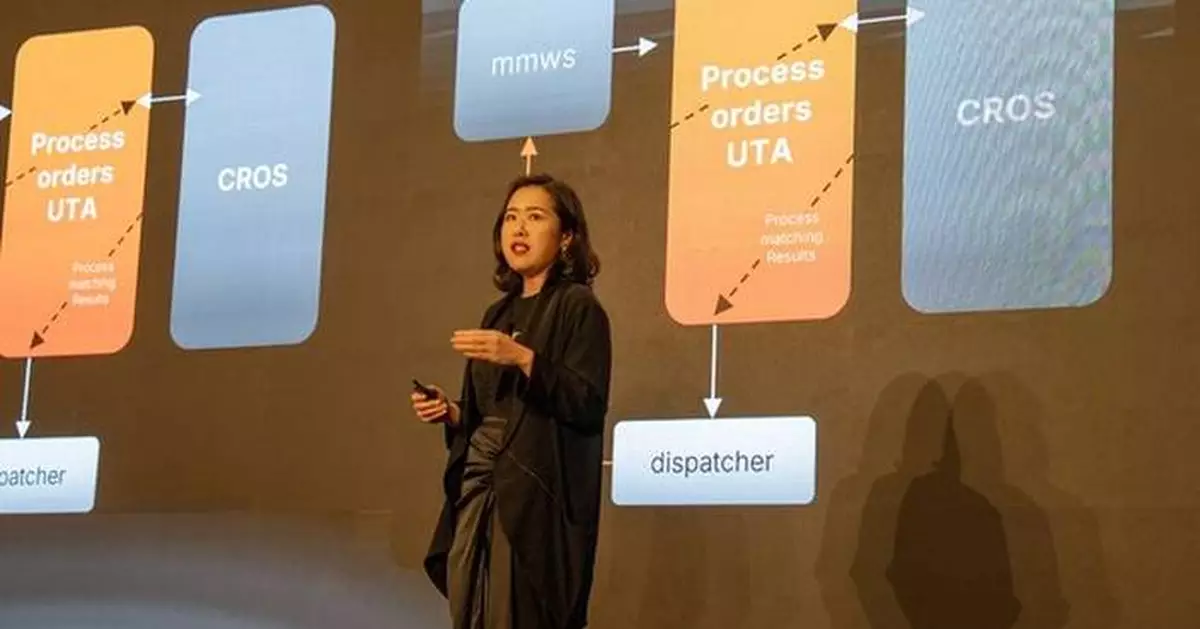
The announcements were led by Yoyee Wang, Head of Business to Business of Bybit, who outlined Bybit's integrated institutional blueprint — combining custody, credit, execution, governance, and operational resiliency into one cohesive platform.
Reinventing Institutional Credit
Yoyee highlighted that Bybit's upgraded INS Credit Suite now delivers one of the most advanced and transparent credit environments available to institutional clients.
"Across the industry, one theme is clear: institutions want capital efficiency without compromising control. With up to 5× leverage, TradFi-aligned LTV parameters, and support for 1,000 sub-accounts, we're delivering a true institutional-grade credit architecture," added Yoyee.
The demand reinforces that shift. Bybit's INS loan notional reached USD 1.1 billion this quarter, marking a 26% QoQ increase, driven by active adoption from professional trading firms.
Custody + RWA + Credit: A New Operating Model for Institutions
A headline announcement of Yoyee's presentation was the integration of custody-based RWA tokens into Bybit's off-exchange credit infrastructure — a first-of-its-kind development for digital asset markets.
"For the first time, institutions can keep assets in custody, earn returns through tokenized money-market RWAs, and still unlock institutional credit. It combines control, transparency, and efficiency in a way the market has not seen before," said Yoyee.
This model connects regulated custody, yield, and capital deployment into a single operational workflow — eliminating fragmentation and unlocking new efficiencies for asset managers and trading firms.
A Leap in Execution: Round-Trip Latency Cut from 30ms to 2.5ms
The second major upgrade unveiled was Bybit's next-generation Market Maker Gateway (MMGW) execution architecture, engineered specifically for institutional consistency and predictability.
Yoyee announced that Bybit has brought round-trip latency for INS clients down to 5 milliseconds through its new MMGW architecture, with a next-generation 2.5-millisecond execution channel planned for release in 2026.
"Speed alone isn't the breakthrough — certainty is," she said. "We engineered an execution lane designed for institutional performance: consistent, stable, and resistant to noise."
A Unified Institutional Vision for 2026
Yoyee closed by underscoring Bybit's dedication to shaping the industry's most complete and future-ready institutional ecosystem.
'At Bybit, our philosophy is simple: listen, care, improve. Today's innovations reflect our focus on delivering smarter credit and faster execution — and we are just getting started.'
#Bybit / #CryptoArk
About Bybit
Bybit is the world's second-largest cryptocurrency exchange by trading volume, serving a global community of over 70 million users. Founded in 2018, Bybit is redefining openness in the decentralized world by creating a simpler, open and equal ecosystem for everyone. With a strong focus on Web3, Bybit partners strategically with leading blockchain protocols to provide robust infrastructure and drive on-chain innovation. Renowned for its secure custody, diverse marketplaces, intuitive user experience, and advanced blockchain tools, Bybit bridges the gap between TradFi and DeFi, empowering builders, creators, and enthusiasts to unlock the full potential of Web3. Discover the future of decentralized finance at Bybit.com.
For more details about Bybit, please visit Bybit Press
For media inquiries, please contact: media@bybit.com
For updates, please follow: Bybit's Communities and Social Media
Discord | Facebook | Instagram | LinkedIn | Reddit | Telegram | TikTok | X | Youtube
DUBAI, UAE, Dec. 9, 2025 /PRNewswire/ -- At the BIG Series Institutional Gala, Bybit Institutional introduced two major upgrades set to redefine the standards of institutional digital asset trading in 2025: an expanded INS Credit Suite and a fully redesigned Market Maker Gateway (MMGW) low-latency execution environment.
The announcements were led by Yoyee Wang, Head of Business to Business of Bybit, who outlined Bybit's integrated institutional blueprint — combining custody, credit, execution, governance, and operational resiliency into one cohesive platform.
Reinventing Institutional Credit
Yoyee highlighted that Bybit's upgraded INS Credit Suite now delivers one of the most advanced and transparent credit environments available to institutional clients.
"Across the industry, one theme is clear: institutions want capital efficiency without compromising control. With up to 5× leverage, TradFi-aligned LTV parameters, and support for 1,000 sub-accounts, we're delivering a true institutional-grade credit architecture," added Yoyee.
The demand reinforces that shift. Bybit's INS loan notional reached USD 1.1 billion this quarter, marking a 26% QoQ increase, driven by active adoption from professional trading firms.
Custody + RWA + Credit: A New Operating Model for Institutions
A headline announcement of Yoyee's presentation was the integration of custody-based RWA tokens into Bybit's off-exchange credit infrastructure — a first-of-its-kind development for digital asset markets.
"For the first time, institutions can keep assets in custody, earn returns through tokenized money-market RWAs, and still unlock institutional credit. It combines control, transparency, and efficiency in a way the market has not seen before," said Yoyee.
This model connects regulated custody, yield, and capital deployment into a single operational workflow — eliminating fragmentation and unlocking new efficiencies for asset managers and trading firms.
A Leap in Execution: Round-Trip Latency Cut from 30ms to 2.5ms
The second major upgrade unveiled was Bybit's next-generation Market Maker Gateway (MMGW) execution architecture, engineered specifically for institutional consistency and predictability.
Yoyee announced that Bybit has brought round-trip latency for INS clients down to 5 milliseconds through its new MMGW architecture, with a next-generation 2.5-millisecond execution channel planned for release in 2026.
"Speed alone isn't the breakthrough — certainty is," she said. "We engineered an execution lane designed for institutional performance: consistent, stable, and resistant to noise."
A Unified Institutional Vision for 2026
Yoyee closed by underscoring Bybit's dedication to shaping the industry's most complete and future-ready institutional ecosystem.
'At Bybit, our philosophy is simple: listen, care, improve. Today's innovations reflect our focus on delivering smarter credit and faster execution — and we are just getting started.'
#Bybit / #CryptoArk
About Bybit
Bybit is the world's second-largest cryptocurrency exchange by trading volume, serving a global community of over 70 million users. Founded in 2018, Bybit is redefining openness in the decentralized world by creating a simpler, open and equal ecosystem for everyone. With a strong focus on Web3, Bybit partners strategically with leading blockchain protocols to provide robust infrastructure and drive on-chain innovation. Renowned for its secure custody, diverse marketplaces, intuitive user experience, and advanced blockchain tools, Bybit bridges the gap between TradFi and DeFi, empowering builders, creators, and enthusiasts to unlock the full potential of Web3. Discover the future of decentralized finance at Bybit.com.
For more details about Bybit, please visit Bybit Press
For media inquiries, please contact: media@bybit.com
For updates, please follow: Bybit's Communities and Social Media
Discord | Facebook | Instagram | LinkedIn | Reddit | Telegram | TikTok | X | Youtube
** The press release content is from PR Newswire. Bastille Post is not involved in its creation. **
Bybit Institutional Head Unveils New Institutional Credit Architecture and Ultra-Low-Latency Execution Layer
SHANGHAI, March 3, 2026 /PRNewswire/ -- AGIBOT, a global leader in embodied intelligence and robotics, today officially announced the launch of the AGIBOT World Challenge at ICRA 2026, opening registration for its two flagship tracks: the Reasoning to Action Track and the World Model Track. Following the success of its inaugural edition, this year's competition returns to the IEEE International Conference on Robotics and Automation (ICRA) with a broader vision and a record-breaking $530,000 USD prize pool.
Cutting-Edge Tracks, Ultimate Challenges
1. Reasoning to Action Track
This track is designed to evaluate a model's reasoning and action execution capabilities, encompassing both online simulation and offline real-robot stages. Participants will train models capable of solving a series of complex tasks based on the AGIBOT WORLD open-source dataset. The track focuses on bridging the Sim2Real Gap, achieving robust generalization from open-vocabulary understanding to real-world physical interaction. Tasks are designed in conjunction with real deployment scenarios and the Genie Sim 3.0 simulation platform, spanning common environments such as logistics, industrial, supermarket, food service, and home settings — with multiple challenges of varying difficulty levels.
Featured Task Scenarios:
- Continuous Sorting & Barcode Scanning
- Logistics Sorting
- Workpiece Inversion
- Shelf Stocking & Straightening Tilted Items
- Popcorn Scooping
- Door Opening
- Desk Clearing
- Dual-Arm Pot Handling
Dataset
We have carefully curated competition tasks and collected a dedicated set of high-quality data, with each task containing hundreds of complete manipulation trajectories. The dataset is fully open-sourced on Hugging Face and ModelScope for easy download:
https://huggingface.co/datasets/agibot-world/AgiBotWorldChallenge-2026
https://modelscope.cn/datasets/AgiBotWorld/AgiBotWorldChallenge-2026
Baseline Model
The competition will provide ACoT-VLA as the baseline model to help you quickly get up to speed with the training, testing, and submission workflow. You can compare the performance of different baseline models and select the most suitable one for development. We look forward to seeing your innovations built upon these models!
https://github.com/AgibotTech/ACoT-VLA
Evaluation Tool
For model evaluation, we provide Genie Sim 3.0 — the industry's first open-source simulation platform driven by large language models. This comprehensive evaluation platform integrates 3D reconstruction and visual generation to create a photorealistic, digital-twin-grade environment. Scenes, assets, and tasks within Genie Sim 3.0 are consistent with the test server, enabling participants to perform closed-loop evaluation locally. Genie Sim 3.0 utilizes AGIBOT's proprietary embodied brain Genie Reasoner to achieve fully automated VLM-based evaluation. Before submitting to the competition server, you can first validate your model and environment dependencies in the local simulation environment.
https://agibot-world.com/genie-sim
Competition Server
Starting now, participants can log in to the competition homepage to access event resources and submit their trained models — compete directly with the world's top developers and keep climbing up the ranking list!competing head-to-head with top developers worldwide and climbing the leaderboard!
https://agibot-world.com/challenge2026/reasoning2action/quick-start
2. World Model Track
The World Model Track focuses on the core capability of embodied world models — accurately modeling physical environment dynamics based on robot actions. Participants are required to train video generation models on the AGIBOT WORLD dataset, generating interaction videos of robots operating across 10 real-world task scenarios, based on provided real robot observations and action signals. Tasks span multiple real-world environments including furniture, retail, and industrial settings, providing a comprehensive evaluation of model generation quality. This track features an online-only competition stage.
Dataset
We have constructed a World Model training set of 10 diverse tasks based on the AGIBOT WORLD public dataset, covering over 30,000 real trajectories. The data encompasses a wide variety of robot-environment interaction types, such as grasping, placing, pushing, and pulling. The test set includes both expert trajectories and imperfect action trajectories (e.g., missed grasps, collisions), designed to comprehensively evaluate the generalization capability of generative models.
https://huggingface.co/datasets/agibot-world/AgiBotWorldChallenge-2026/tree/main/WorldMode
Baseline Model
The competition adopts EVAC — AGIBOT's proprietary open-source model — as the baseline. EVAC is the first embodied world model driven by robot actions, pre-trained on the full AGIBOT WORLD dataset. Participants may develop on top of EVAC or use other models to compete. We encourage participants to innovate boldly and showcase their technical capabilities!
https://github.com/AgibotTech/AgiBotWorldChallengeICRA2026-WorldModelBaseline
Evaluation Tool
The competition evaluates generated results using EWMBench, an embodied world model evaluation benchmark, assessing across multiple dimensions including image quality, scene consistency, and trajectory adherence — accurately reflecting generative model performance and providing reliable feedback.
https://github.com/AgibotTech/EWMBench
Evaluation Server
Starting now, participants can log in to the evaluation server hosted on HuggingFace, submit results according to the competition guidelines, and compete with developers worldwide — with the leaderboard updated in real time!
https://huggingface.co/spaces/agibot-world/ICRA26WM
Key Milestones — Mark Your Calendar
The AGIBOT World Challenge @ ICRA 2026 follows a rigorous selection process, culminating in the live finals this summer:
- February 12, 2026: Global Registration officially opens
- February 28, 2026: Competition servers for both tracks go live
- April 20, 2026: Competition server closes for final submissions
- April 30, 2026: Announcement of online stage results and finalists
- June 1, 2026: Offline real-robot finals begin at ICRA 2026
The stage is set for the world's most elite teams to demonstrate their prowess. As the AGIBOT World Challenge at ICRA 2026 unfolds, it will serve as a definitive arena where technical ingenuity meets physical capability, and where the strongest innovators will rise to define the next era of robotics.
Join the Community
AGIBOT invites developers and researchers worldwide to join the official Lark (Feishu) community. Connect with global peers, access real-time technical support, and stay updated on the latest challenge milestones through the following link: https://applink.feishu.cn/client/chat/chatter/add_by_link?link_token=b03mea0a-1212-428a-8b78-f77cf6f591e3
For more information, please visit AGIBOT at AGIBOT.com and follow AGIBOT on:
https://www.facebook.com/AGIBOT.zhiyuan
https://x.com/AGIBOT_zhiyuan
https://www.instagram.com/AGIBOT
https://www.youtube.com/@AGIBOT-robot
About AGIBOT
AGIBOT is dedicated to driving innovation through the integration of AI and robotics, creating world-leading general-purpose embodied robot products and an application ecosystem. Built on the foundation of the robotic body and powered by the fusion of interaction, manipulation, and locomotion intelligence — "1 Robotic Body + 3 Intelligence" — AGIBOT is a leading robotics company in the industry to deliver a complete product portfolio and deploy across all major application scenarios.
** This press release is distributed by PR Newswire through automated distribution system, for which the client assumes full responsibility. **

AGIBOT World Challenge at ICRA 2026 Now Opens "Reasoning to Action" and "World Model" Tracks