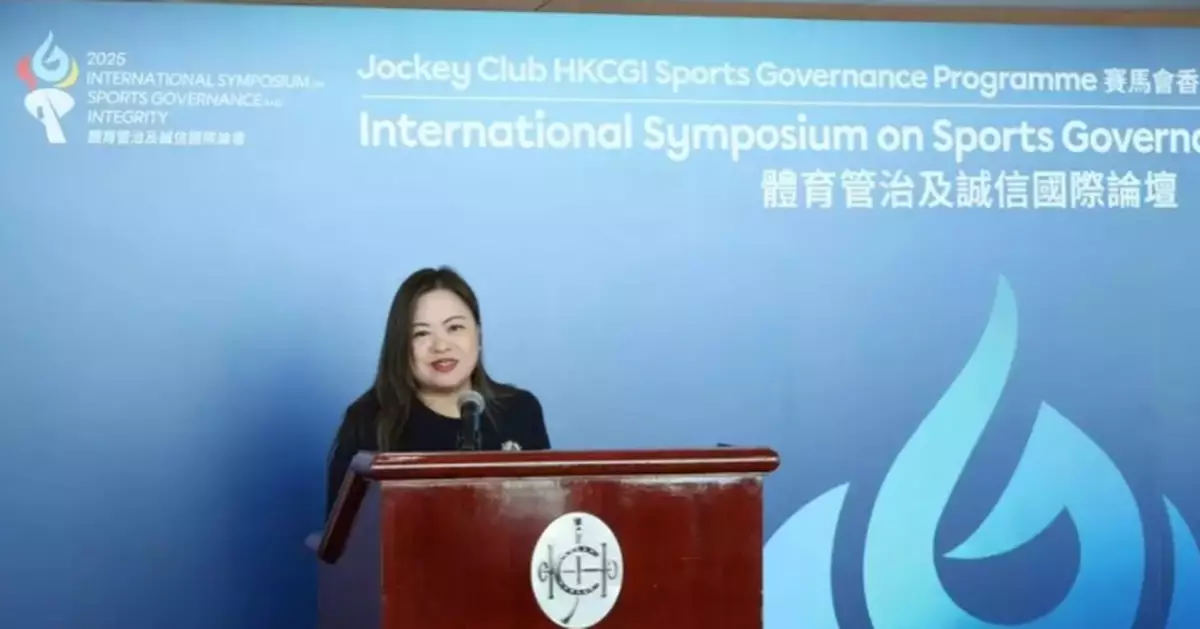
Speech by SCST at Jockey Club HKCGI Sports Governance Programme: International Symposium on Sports Governance and Integrity
Following is the speech by the Secretary for Culture, Sports and Tourism, Miss Rosanna Law, at the Jockey Club HKCGI (Hong Kong Chartered Governance Institute) Sports Governance Programme: International Symposium on Sports Governance and Integrity today (December 9):
Winfried (Chief Executive Officer of the Hong Kong Jockey Club, Mr Winfried Engelbrecht-Bresges), Moray (Executive Director of Security, Integrity and Information Security of the Hong Kong Jockey Club, Mr Moray Taylor-Smith), David (President of the Hong Kong Chartered Governance Institute, Mr David Simmonds), Irene (Assistant Director of Corruption Prevention of the Independent Commission Against Corruption (ICAC), Ms Irene Wang), Edgar (Honorary Secretary General of the Sports Federation & Olympic Committee of Hong Kong, China (SF&OC), Mr Edgar Yang), friends from the sports sector, ladies and gentlemen,
Good afternoon and good to see you all here today.
It has been a difficult two weeks for Hong Kong, as we collectively and gradually come out of the haze of the Tai Po fire. In times like these, it is vital for our entire community to join the Government in providing every possible support to those affected. So I must start by acknowledging the Hong Kong Jockey Club for its generous donation through the Jockey Club Emergency Relief Fund and for pledging the gross income of its November 30 race meeting to the Hong Kong Government's support fund. I also hope that the sports sector can contribute positive energy to help Hong Kong through this period.
As our Chief Executive, Mr John Lee, has stated, the Government is committed to investigating the causes of this incident and addressing the issues that it has raised across multiple fronts. Systemic reform is essential - not only in response to this tragedy, but as a principle that we must uphold in all areas of public service.
Supporting systemic reform in any organisation begins with what we term a "good design of top-level governance structure", for those who know Cantonese, 頂層設計的體制建設. Within such a structure, principles like "governance" and "integrity" are not just important - they are indispensable. They are key to delivering results, ensuring accountability, and achieving long-term success. It is precisely for these reasons that governance within the sports sector has been a priority of mine since I assumed the role of the Secretary for Culture, Sports and Tourism a year ago - in fact, it is this very topic that I addressed in one of my first speeches in this position.
In my remarks today, I will first outline why governance is so important from a policy perspective, then share what we have been doing to strengthen it, and finally touch on the path ahead.
First, good governance ensures integrity and accountability. A sound governance framework guides how organisations make critical decisions and establishes appropriate checks and balances. It helps build a healthy ecosystem for the sports sector, enabling national sports associations, NSAs in short, to modernise their management and operations, and to grow sustainably. As the Hong Kong Chartered Governance Institute aptly states in its purpose: "Better governance leading to better decisions for a better world". This succinctly captures the objective of upholding strong governance.
Second, good governance fosters professionalism and impartiality. Put simply, it ensures NSAs always act in the best interests of their organisations and athletes. Senior executives must place the organisation's mission above any personal interests. This is especially important in areas such as athlete selection for representing the Hong Kong, China team - a process that, when conducted fairly, helps elevate overall athletic performance.
Third, good governance ensures public funds are used effectively and responsibly. To provide context, in the 2025-26 financial year, the budget for sports development exceeds HK$9 billion - more than double the amount from a decade ago. Of this, over HK$1 billion is dedicated to elite sports development. We have a duty to ensure that public money is spent wisely and productively. As we consider how to increase investment in sports development, a robust governance framework is an essential prerequisite. We could not possibly allocate precious additional resources to NSAs unless we are confident that there is satisfactory governance. To put it bluntly, pouring good money after bad is never an option.
Fourth, we should aspire to be a global standard-setter in sports governance. This is no small ambition. But as a modern society that takes pride in its rule of law and professional services - including the governance experts here today - I believe we should aim high.
Now let me turn to what the Government has done to promote governance in the sports sectors.
In recent years, the sports sector in Hong Kong has embarked on an important journey to enhance transparency, accountability, integrity and operational efficiency. In November 2024, under the steer of the Government, the Sports Federation & Olympic Committee of Hong Kong, China completed a comprehensive review of NSA operations and corporate governance standards. I would like to thank the "three wise men" - Dr York Chow, Mr KS Tang (Mr Tang King-shing) and Mr CN Ma (Mr Ma Ching-nam), who I believe are with us today - for their invaluable guidance throughout this process.
The SF&OC has since promulgated a code of practice covering board governance, integrity management, athlete selection, coach and umpire management, membership administration, and general administration.
Over the past year, the SF&OC has worked diligently with NSAs and key stakeholders, including the Hong Kong Jockey Club, the Hong Kong Chartered Governance Institute and the ICAC, to implement this code in full.
Some NSAs are further along in achieving full compliance than others, and I expect these NSAs to set an example for others to follow. The SF&OC has also enlisted pro bono legal support from the Law Society of Hong Kong to assist NSAs with code-related legal matters. I am also very pleased to note that the Hong Kong Jockey Club and the HKCGI will soon launch a Sports Governance Programme to equip NSA officers and executives with essential governance skills.
Ladies and gentlemen, what we are witnessing is a true team effort - one that demonstrates our shared determination to modernise Hong Kong's sports sector through updated governance practices. This will not only benefit our athletes and support the professional, sustainable development of sports, but also strengthen Hong Kong's influence in the global sports arena.
Before I conclude, I would like to thank the Hong Kong Jockey Club and the HKCGI for echoing the Government's call to enhance the corporate governance in sports. I am most encouraged by today's symposium, such a big turnout, and its excellent lineup of local and international speakers.
The SF&OC and our NSAs are entrusted with significant and exciting responsibilities in advancing sports development in Hong Kong. Their professionalism, competence and capability have never been more important. This symposium is only the beginning of a series of programmes, and I look forward to your continued support.
I wish you all a fruitful day filled with inspiration and meaningful exchange.
Thank you.
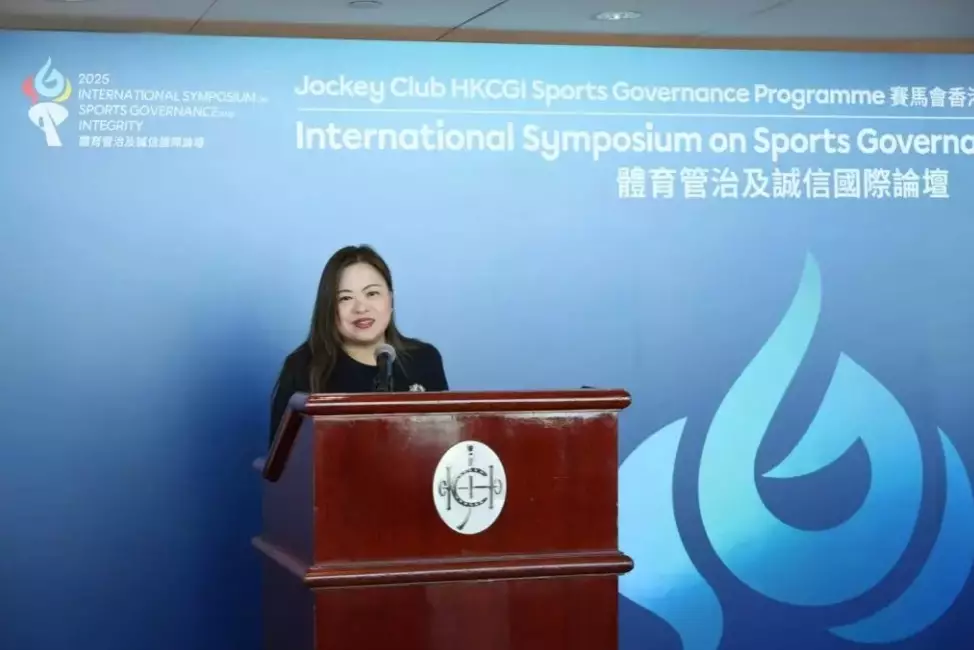
Miss Rosanna Law